Palm trees symbolism is closely associated with tropical beauty, relaxation, freedom, and the promise of a fresh start. In the United States, palm trees appear on beach vacation advertisements, resort logos, coastal home decor, and images of California and Florida. Their tall trunks and spreading fronds can turn an ordinary landscape into a picture of escape and possibility.
Yet palm trees have meanings that extend far beyond vacations. Across different historical periods and cultures, people have associated them with victory, peace, fertility, prosperity, spiritual life, and endurance. Their ability to grow in hot climates and produce useful materials has also made them important in everyday life.
Understanding these associations requires looking at where palm trees grow, how people have used them, and the religious and cultural traditions that shaped their symbolism. A palm tree on a greeting card may suggest a carefree holiday, while a palm branch in a religious ceremony can carry a much older meaning.
Quick Answer
Palm trees commonly symbolize relaxation, freedom, tropical beauty, and escape in modern American culture, especially in beach imagery, travel advertising, and coastal design. Historically, palm branches have also represented victory, peace, renewal, and spiritual significance in ancient Mediterranean cultures and several religious traditions.
TL;DR
- Palm trees represent tropical relaxation, freedom, and escape in modern American culture.
- Ancient Mediterranean societies associated palm branches with victory and honor.
- Christianity connects palm branches with Jesus’ entry into Jerusalem.
- Palm trees symbolize prosperity and resilience in some cultural and spiritual contexts.
- Florida, California, and Hawaii use palm imagery to express regional identity.
- Modern tattoos, home decor, and fashion often emphasize travel and personal freedom.
What Palm Trees Look Like and Why They Became Symbols
Palm trees are recognizable by their tall trunks, crowns of fan-shaped or feather-like leaves, and, in many species, clusters of fruit. Although people often picture a single type of tropical palm, the palm family includes a wide variety of plants that grow in different climates and environments.
Some palms produce coconuts, dates, or other useful fruits. Others provide leaves for weaving, fibers for practical materials, or shade in hot regions. Their value has therefore been practical as well as visual.
The familiar image of a palm beside blue water carries a different association from a palm branch held during a religious procession. The first often communicates leisure, while the second may convey honor, celebration, or faith.
This flexibility helps explain why palms have become such versatile symbols. Their physical appearance suggests warmth and abundance in some settings, while their historical use gives their branches meanings that cannot be reduced to tropical scenery alone.
Palm Trees as Symbols of Relaxation and Freedom
In the United States, one of the most familiar meanings of a palm tree is the freedom to step away from everyday responsibilities. A palm-lined beach suggests warm weather, open space, and time without a demanding schedule.
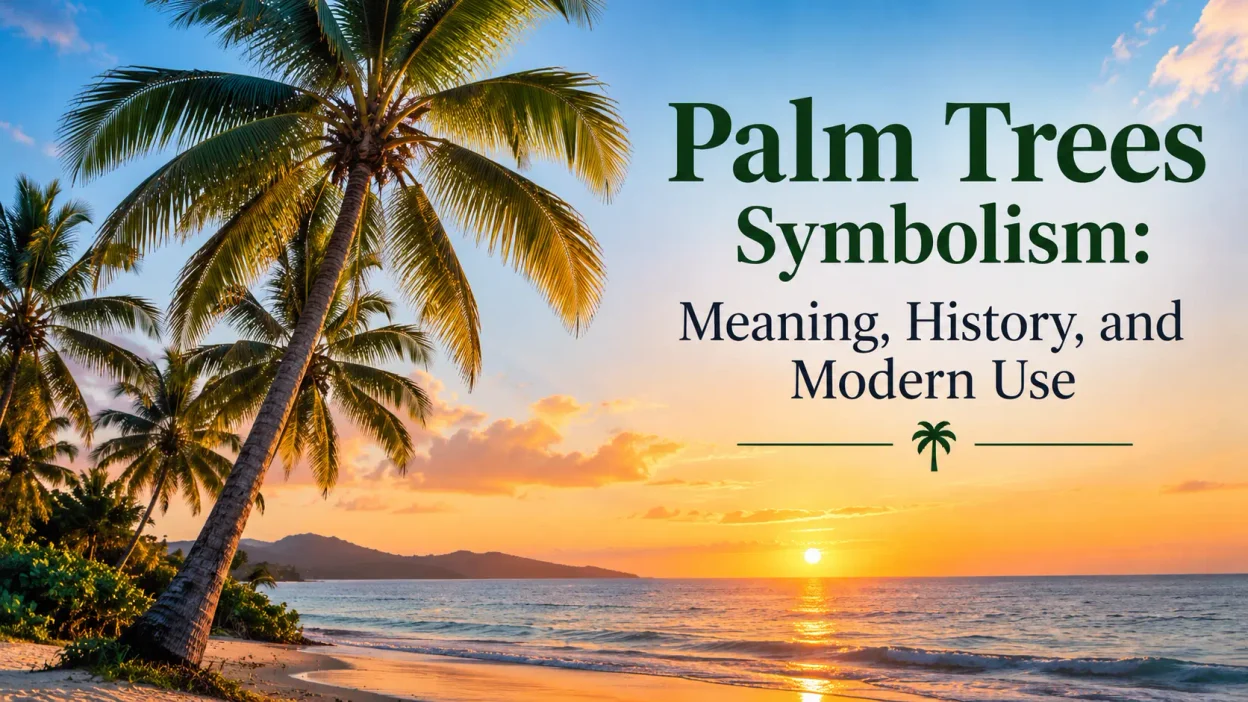
Travel companies use this imagery because it quickly communicates a recognizable experience. A palm tree against a sunset may imply a vacation, a resort stay, or the chance to recharge. The viewer does not need to know the plant’s history to understand the message.
Freedom is another common association. Palm trees often appear in images of road trips, beach towns, coastal living, and retirement destinations. They can suggest a lifestyle built around outdoor activities, flexible schedules, and a slower pace.
These meanings are cultural associations rather than fixed properties of the plant. A palm tree can represent work, agriculture, or urban development to someone who lives near one every day. For someone who sees palms mainly during vacations, the same tree may represent an escape from routine.
The surrounding setting usually determines which meaning becomes most prominent.
Victory and Honor in Ancient Mediterranean Cultures
Long before palm trees became familiar images in modern travel advertising, palm branches carried associations with victory and public honor in parts of the ancient Mediterranean world.
In ancient Greek culture, palm branches were associated with athletic achievement and celebration. Palm imagery also appeared in Roman contexts connected with triumph and recognition. A branch could serve as a visible sign of success, distinguishing an honored person or occasion from ordinary life.
The palm’s appearance may have contributed to its appeal as a symbol. Its upright growth and spreading crown create an image that can suggest elevation and distinction. Its practical value and familiarity also made it recognizable to communities living in regions where palms grew.
These historical associations later influenced the way palm branches appeared in art and ceremonial settings. However, not every ancient society assigned the same meaning to palms, and the symbolism varied according to location and historical period.
Today, victory is less likely to be the first association an American has with a palm tree than relaxation or travel. The older meaning remains relevant in historical artwork, religious imagery, and designs that intentionally draw on classical traditions.
Palm Trees and Peace in Religious Traditions
Palm branches have acquired religious meanings in several traditions, although the details differ.
In Christianity, palm branches are closely connected with Palm Sunday, the observance commemorating Jesus’ entry into Jerusalem before his crucifixion. The Gospel accounts describe people welcoming him with branches, and Christian communities later developed ceremonies that use palm leaves to mark the occasion.
In this setting, the palm can communicate welcome, reverence, hope, and the recognition of Jesus as a significant religious figure. The celebration also carries the tension between public acclaim and the events of Holy Week that follow.
In other contexts, palm branches may suggest peace or celebration, but these meanings should not be treated as universal religious rules. A branch used in a church service has a different purpose from one printed on a resort brochure.
The distinction matters because religious symbols often carry specific narratives. Understanding the event or practice behind the palm branch provides a more accurate interpretation than assuming it simply represents calmness.
Palm Trees in the Bible and Palm Sunday Palm Trees Symbolism
Palm imagery appears in biblical literature in more than one context. Palm trees and branches can be associated with flourishing, righteousness, celebration, and the landscape of the ancient Near East.
Psalm 92, for example, compares the righteous to a flourishing palm tree. This image connects the plant with vitality and sustained growth, making it a useful metaphor for a life that remains fruitful.
Palm branches are especially recognizable in the New Testament accounts of Jesus entering Jerusalem. Christians commemorate this event on Palm Sunday, when many congregations distribute palm leaves or use them in worship.
The branches can represent welcome and recognition, while the broader Christian observance points toward the events of Jesus’ final days. Some churches preserve or repurpose palm leaves from the service for later religious use, depending on local tradition.
For American Christians, a palm branch may therefore carry a specific memory of worship, family participation, and the church calendar. Its meaning is not necessarily related to beaches or tropical climates, even when the same plant appears in both settings.
Prosperity, Fertility, and Abundance
Palm trees have long provided food, shade, and useful materials in many parts of the world. Date palms, coconut palms, and other species support communities through their fruit and other resources. These practical benefits help explain why palms can symbolize prosperity and abundance.
In regions where date cultivation has been important, the date palm has held particular economic and cultural value. Its fruit can provide nourishment, and the tree can thrive in environments where successful agriculture requires careful management of water and land.
The palm’s ability to produce fruit while offering shade also makes it a natural image for sustenance. In art and decorative traditions, a flourishing palm may suggest a household or community supported by the land.
Fertility is a related interpretation, but it is not universal. Some people use palm imagery to suggest growth, family well-being, or a productive future, while others associate it primarily with comfort and leisure.
When a palm appears in a prosperity-themed design, context matters. It may refer to material success, agricultural abundance, spiritual flourishing, or simply the attractive look of a tropical landscape.
Palm Trees in Islamic and Middle Eastern Traditions
Palm trees hold particular importance in many Middle Eastern communities, where date palms have provided food, shade, and materials for daily life. Their significance reflects both practical dependence on the tree and its place in religious and cultural traditions.
In Islam, the date palm appears in religious literature and is often associated with nourishment, blessing, and the generosity of creation. Dates also have a familiar place in Ramadan, when many Muslims traditionally break their daily fast with dates and water. This practice gives the fruit a connection with hospitality, religious observance, and shared meals.
The palm also has cultural significance in parts of the Arabian Peninsula and North Africa. In communities shaped by date cultivation, the tree can represent continuity, livelihood, and the relationship between people and their environment.
These associations are not identical across all Muslim communities or Middle Eastern cultures. A date palm may carry particular meaning for someone whose family grows dates, while another person may know it mainly through religious imagery or regional art.
This tradition also shows why palm symbolism cannot be explained only through modern beach culture. In some places, the palm is not an image of escape from daily life; it is an essential part of daily life itself.
Palm Trees as Symbols of Endurance and Resilience
Palm trees often grow in hot environments, and some species tolerate conditions that challenge other plants. Their ability to survive in particular climates has encouraged modern interpretations involving endurance, adaptability, and persistence.
A palm standing in a dry landscape can represent life continuing under difficult conditions. A tree bent by coastal winds may suggest flexibility rather than fragility, although actual resilience varies considerably by species and growing conditions.
This association is especially useful in personal symbolism. Someone recovering from a difficult period may choose a palm tree to represent the ability to keep going without losing a sense of identity. In a home or workplace, palm imagery may communicate optimism and a preference for a calm, balanced outlook.
Still, resilience is an interpretation rather than a meaning shared by every historical tradition. Ancient associations with victory, religious devotion, and abundance arose in particular contexts, even when modern readers find connections between those ideas and endurance.
The palm works well as a resilience symbol because its recognizable form can communicate steadiness and growth without requiring a specific religious or cultural commitment.
Palm Trees in American Regional Identity
Palm trees have a strong visual connection with several parts of the United States, particularly Florida, Southern California, and Hawaii. Their presence in regional landscapes has helped make them symbols of place, lifestyle, and local identity.
Florida
In Florida, palms are associated with warm weather, beaches, tourism, and outdoor living. They appear in resort imagery, neighborhood landscaping, postcards, and business branding. For residents, however, palms can also be ordinary landscape plants rather than symbols of vacation.
Southern California
In Southern California, palm trees have become recognizable elements of urban and coastal imagery. They appear in photographs of Los Angeles, film and television settings, commercial designs, and depictions of the California lifestyle. Their meaning may include glamour, entertainment, ambition, or the appeal of outdoor living.
Hawaii
In Hawaii, palm trees are part of the tropical landscape and are frequently used in tourism imagery. However, the islands’ cultural identity is much broader than palm trees and beaches. Hawaiian history, Native Hawaiian traditions, language, land relationships, and living communities should not be reduced to a single tropical image.
The same distinction applies across the United States. A palm tree can express regional pride, but it can also become a simplified commercial image that overlooks the people and histories of the place it represents.
Palm Trees in Tattoos, Jewelry, and Personal Style
Palm trees are popular choices for tattoos because their shape remains recognizable even in a small or minimalist design. A simple silhouette can evoke a beach, a favorite destination, or a period of life associated with freedom and change.
The surrounding details often determine the intended meaning.
- A palm at sunset: May represent a cherished memory, relaxation, or a desire for balance.
- A palm beside ocean waves: Often suggests travel, adventure, or a personal connection to the coast.
- A palm with mountains: Can express a love of outdoor environments and exploration.
- A single palm in outline: May serve as a subtle reminder of a particular place or life experience.
- A palm with dates or fruit: Can emphasize abundance, family heritage, or cultural connections, depending on the design.
Palm imagery also appears on necklaces, earrings, clothing, bags, and accessories. In fashion, the motif frequently communicates a casual, summery style rather than a precise historical belief.
A personal symbol does not need to carry an ancient meaning to matter. Someone who gets a palm tattoo to remember a family vacation may attach more significance to that memory than to any traditional interpretation of the plant.
When the design includes religious or culturally specific elements, it is worth understanding their origins rather than assuming every palm-related motif has the same meaning.
Palm Trees in Home Decor, Weddings, and Celebrations
In American interior design, palm leaves and palm-tree motifs often create a relaxed, bright atmosphere. They appear on wallpaper, framed prints, textiles, ceramics, and furniture inspired by tropical or coastal environments.
The motif can suit several styles. A photograph of a solitary palm may create a minimalist coastal look, while large botanical prints can give a room a lush, resort-inspired appearance. Natural palm leaves used in arrangements can add texture without requiring the tree itself to be the focus.
Palm imagery also appears in weddings and other celebrations, especially those with beach, destination, or tropical themes. It may suggest a fresh beginning, shared adventure, or a relaxed setting for a major life event.
These meanings depend on the occasion. A palm decoration at a beach wedding usually serves an aesthetic purpose, whereas a palm branch carried during Palm Sunday has a specific Christian significance.
For homeowners and event planners, understanding this distinction makes it easier to choose imagery that fits the intended atmosphere. The same plant can be decorative, personal, ceremonial, or religious without carrying exactly the same message in each setting.
The Emotional and Psychological Meaning of Palm Trees
Palm trees can evoke feelings of openness, calm, optimism, and possibility. Much of this response comes from the settings in which people encounter them: sunny beaches, open horizons, warm evenings, and landscapes associated with leisure.
A palm tree may also act as a memory cue. Someone who grew up near the coast might associate palms with home, while a person who travels rarely may connect them with a long-awaited vacation. The symbol works partly because it links a recognizable image with personal experience.
There is also a contrast between the palm’s upright trunk and its flexible-looking fronds. In modern interpretation, this combination can suggest a balance between stability and adaptability. Although that reading is not a universal historical belief, it offers a practical way to understand why palms appeal to people looking for symbols of personal growth.
These associations should not be treated as psychological facts about everyone who likes palm imagery. A palm tree does not reveal someone’s personality, emotional state, or life goals. Its significance depends on the memories, values, and experiences a person brings to it.
Palm Tree Colors and Their Symbolic Associations
The color of a palm-tree image can influence how viewers interpret it. Designers often use color to shift the motif from a realistic landscape toward a particular mood or message.
| Color or setting | Common modern association | Typical use |
|---|---|---|
| Green palm fronds | Growth, vitality, and nature | Botanical prints and eco-conscious design |
| Golden or orange sunset | Warmth, optimism, and nostalgia | Travel posters and vacation photography |
| Black palm silhouette | Simplicity, elegance, or remembrance | Tattoos, minimalist art, and logos |
| Blue ocean with palms | Calm, freedom, and escape | Coastal decor and tourism branding |
| White or pale palm imagery | Lightness, simplicity, and relaxation | Weddings, fashion, and contemporary interiors |
These are common design associations, not fixed meanings found in every culture. A black palm silhouette may be chosen for its clean appearance rather than to express mourning, and green foliage may be used simply because it looks natural.
The surrounding colors, text, and setting usually communicate more than the palm alone. For this reason, it is useful to interpret the complete design rather than assign a universal meaning to an individual color.
Common Misunderstandings About Palm Tree Symbolism
One frequent misunderstanding is that palm trees have always represented vacations and carefree living. That association is especially familiar in modern American culture, but it does not explain their older religious, economic, and ceremonial importance.
Another mistake is treating every palm tree as a symbol of peace. Palm branches have represented victory and honor in historical contexts, and Christian palm imagery can carry specific meanings connected with Jesus’ entry into Jerusalem and the observance of Palm Sunday.
It is also inaccurate to assume that all palm species have the same cultural significance. The date palm, coconut palm, and other members of the palm family differ in their uses, habitats, and roles in local traditions. A symbol rooted in date cultivation in the Middle East may not carry the same historical associations as a coconut palm used in a tropical resort advertisement.
Finally, a modern spiritual interpretation should not automatically be presented as an ancient tradition. Ideas such as personal transformation, emotional balance, or attracting good fortune may be meaningful to individuals, but their historical basis varies.
A more reliable interpretation begins with the setting. Consider whether the palm appears in a religious ceremony, a regional emblem, a historical artwork, or a contemporary decorative design. The context often explains its meaning more clearly than a list of symbolic associations.
How Palm Tree Symbolism Has Changed Over Time
Palm symbolism has developed through practical use, religious narratives, artistic traditions, and changing ideas about travel and leisure.
In ancient West Asia and the Mediterranean, palms were valued for food and other resources. Their importance in agriculture and daily life helped establish associations with abundance, flourishing, and prosperity. In Greek and Roman contexts, palm branches also became recognizable signs of victory and honor.
Christian traditions adapted earlier associations with victory and gave palm branches specific significance in the story of Jesus’ entry into Jerusalem. In Islamic and other Middle Eastern cultural contexts, the date palm has continued to represent nourishment, livelihood, and connections between people and the land.
Much later, the growth of tourism, coastal development, commercial photography, and mass advertising helped establish the palm tree as an image of leisure in American popular culture. It became a familiar shorthand for beach destinations and warm-weather lifestyles.
Today, all these meanings can exist side by side. A palm branch in a church may express religious devotion, a palm in a historical painting may communicate triumph, and a palm on a travel poster may promise relaxation. The symbol has not lost its older meanings; modern culture has added new ones.
Palm Tree Symbolism at a Glance
| Context | Main meaning | What shapes the interpretation |
|---|---|---|
| Ancient Mediterranean | Victory and honor | Ceremonies, athletic achievement, and public recognition |
| Christianity | Welcome, faith, and victory | Palm Sunday and biblical imagery |
| Middle Eastern communities | Nourishment and prosperity | Date cultivation and daily life |
| Modern American culture | Relaxation and freedom | Beaches, tourism, and regional identity |
| Tattoos and personal art | Memory and self-expression | Individual experiences and design choices |
Frequently Asked Questions
What does a palm tree symbolize spiritually?
Palm trees can symbolize flourishing, renewal, abundance, or spiritual devotion, depending on the tradition. In Christianity, palm branches have a specific connection with Palm Sunday, while other interpretations may arise from local cultural practices or personal beliefs.
Are palm trees a symbol of good luck?
Some people use palm-tree imagery to express optimism, prosperity, or hopes for a positive future. However, there is no universal historical rule that palm trees bring good luck, so this meaning is best understood as a personal or cultural association.
What does a palm tree tattoo mean?
A palm tree tattoo commonly represents freedom, travel, relaxation, or a meaningful connection to a particular place. Its significance can change with the design, such as a sunset, ocean, or additional symbols included in the tattoo.
Why are palm trees associated with Florida and California?
Palm trees are familiar features of many Florida and Southern California landscapes, and tourism and popular media have reinforced their connection with these regions. They have consequently become recognizable signs of warm weather, coastal living, and regional lifestyle imagery.
What do palm trees symbolize in Christianity?
Palm branches are strongly associated with Jesus’ entry into Jerusalem, commemorated on Palm Sunday. Christian traditions may also connect palms with righteousness, victory over death, and the faithfulness of martyrs.
Do palm trees symbolize resilience?
In modern symbolism, palm trees can represent endurance, adaptability, and continued growth under challenging conditions. This interpretation draws on the characteristics of certain palm species, although actual tolerance to wind, drought, and cold varies by species.
What is the difference between palm tree and palm branch symbolism?
A whole palm tree often represents a landscape, a source of nourishment, or an idea such as tropical freedom. A palm branch can carry a more specific ceremonial meaning, particularly in historical victory imagery and Christian Palm Sunday observances.
Conclusion
Palm trees symbolism brings together several meanings shaped by geography, history, religion, and personal experience. In modern American culture, palms most often suggest relaxation, freedom, tropical beauty, and escape, while older traditions connect them with victory, spiritual devotion, prosperity, and flourishing.
The most accurate interpretation depends on where the palm appears and how people use it. A palm on a beach poster communicates something different from a branch carried in a religious procession or a tree represented in historical art.
That range of meaning is what makes the palm tree such a recognizable symbol. It can represent a place someone loves, a tradition they practice, or a hope for a more balanced life, all through the image of a single tree.


