
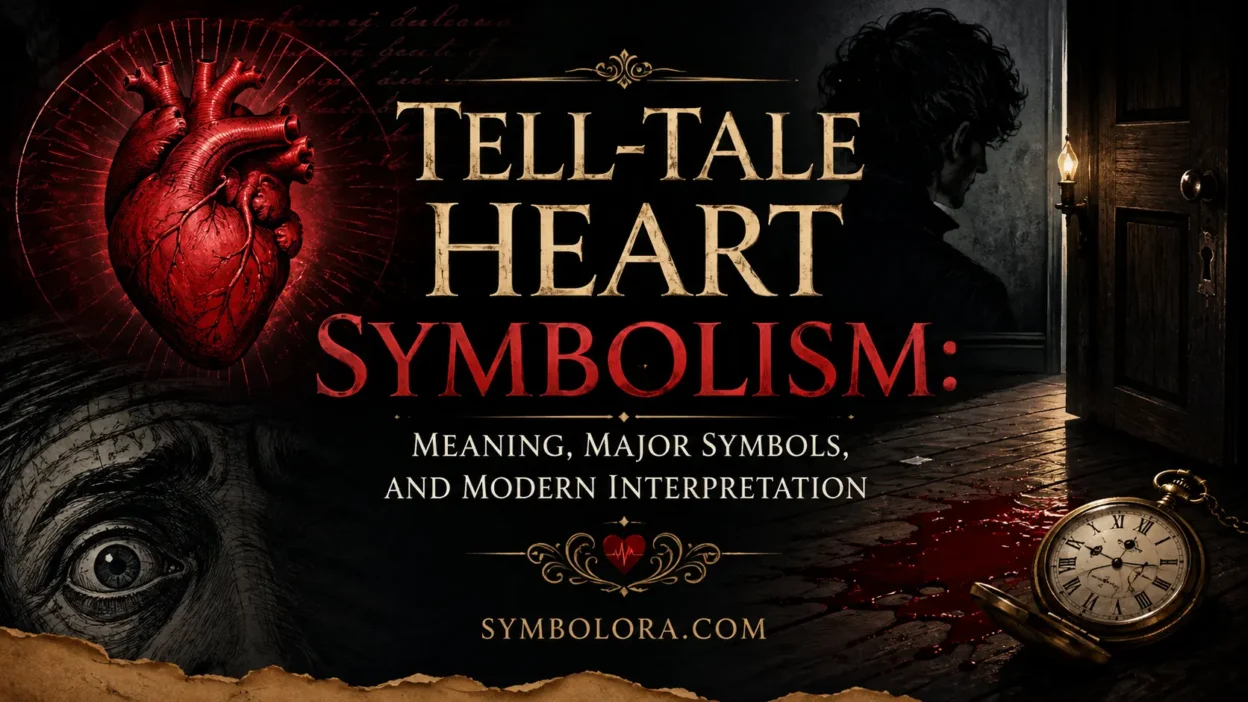
Edgar Allan Poe builds a murder story out of ordinary things: an eye, a heartbeat, a lantern, a watch, a dark bedroom, and a few wooden floorboards. Yet Tell-Tale Heart symbolism turns those simple details into signs of surveillance, fear, guilt, mortality, and a mind losing control.
The story matters because its horror doesn’t depend mainly on ghosts or supernatural creatures. The narrator creates most of the terror himself. He insists that he’s rational while describing behavior that makes his reliability increasingly doubtful, and that contradiction changes how every object in the story feels. For American readers, The Tell-Tale Heart has also become one of the clearest examples of psychological Gothic fiction. Its symbols remain recognizable because they deal with anxieties that haven’t disappeared: being watched, hiding wrongdoing, controlling appearances, and discovering that private guilt may be harder to silence than public accusation.
Quick Answer
Tell-Tale Heart symbolism most commonly represents guilt, obsessive fear, judgment, and the failure to hide the truth from oneself. The old man’s eye suggests threatening scrutiny, while the heartbeat becomes an increasingly unbearable sign of fear, conscience, mortality, or the narrator’s own psychological collapse.
At a glance:
- The eye represents feared observation, judgment, and obsessive projection
- The heartbeat turns hidden guilt into an inescapable sound
- Darkness allows secrecy but never produces psychological safety
- Watches and midnight connect the murder with mortality and pressure
- Floorboards symbolize concealment that eventually fails
- Poe makes the narrator’s own mind the story’s greatest threat
What the Story’s Symbols Are Really Doing
Poe doesn’t give each object one fixed meaning. Instead, he repeatedly links physical sensations with the narrator’s mental state. The narrator sees the old man’s eye and experiences terror; he hears a heartbeat and becomes furious; he controls a lantern, a door, and the floorboards, yet he cannot control his own perception. Objects that appear manageable at first eventually expose how little control he actually has.
That pattern is central to the story. The narrator believes careful planning proves sanity, but Poe lets readers see the opposite: extraordinary attention to detail can coexist with badly distorted judgment.
| Symbol | Main Meaning | Psychological Association | Role in the Story |
|---|---|---|---|
| Vulture eye | Judgment and scrutiny | Paranoia, projection, obsession | Gives the narrator his stated motive |
| Heartbeat | Guilt, fear, mortality | Anxiety, conscience, panic | Drives the narrator toward confession |
| Lantern and light | Selective perception | Control, fixation | Illuminates only what the narrator fears |
| Darkness | Secrecy and uncertainty | Isolation, dread | Protects the crime temporarily |
| Watch and time | Mortality and inevitability | Pressure, anticipation | Makes suspense feel measured and unavoidable |
| Floorboards | Concealment | Repression, denial | Hide the body but not the narrator’s guilt |
The Vulture Eye: Surveillance, Judgment, and Projection
The old man’s eye is the narrator’s first great obsession. He repeatedly separates the eye from the person who possesses it — he claims to love the old man and denies wanting his money, yet decides the eye must be eliminated, describing it as pale blue, filmed over, and resembling a vulture’s eye. That separation matters. The narrator stops responding to the old man as a complete human being and instead turns one physical feature into an independent enemy.
The eye can therefore symbolize scrutiny or judgment — to the narrator, being seen feels intolerable, and the eye appears almost capable of knowing what he wishes to keep private. It also represents projection, since nothing in the story establishes that the old man is actually threatening him. The danger originates largely in the narrator’s own interpretation, and the eye becomes a surface onto which he places his fear. The vulture comparison adds another layer, too — vultures are associated with death and feeding on the dead, so calling the eye “vulture-like” lets the narrator imagine himself as a victim of something predatory even while he’s preparing to become the actual predator.
The Heartbeat: Guilt That Cannot Stay Buried
The heartbeat is the story’s most famous sound and its central symbol. Before the murder, the narrator hears what he identifies as the old man’s rapidly beating heart, and the sound intensifies the tension until he attacks. Later, after the body has been dismembered and hidden beneath the floor, another beating sound seems to grow louder while police officers sit nearby.
At the literal level, the narrator says the sound belongs to his victim. Symbolically, that explanation becomes much less secure — the old man is dead, and the officers apparently hear nothing. The increasingly unbearable noise parallels the narrator’s own fear and agitation instead. The heartbeat can therefore represent guilt made perceptible: what has been hidden physically returns psychologically. It can also represent conscience, though that shouldn’t be treated as the only possible reading — the narrator never calmly admits moral remorse, and his confession appears to emerge from intolerable psychological pressure rather than genuine repentance. The sound may even be his own pulse, amplified by anxiety and interpreted as something outside himself. Poe never resolves that ambiguity, which is exactly why the symbol works so well.
The Eye and Heart as Opposing Forms of Knowledge
The eye and heart form an important symbolic pair. The eye concerns seeing — it represents observation, exposure, and the narrator’s fear of being perceived. The heart concerns inward experience instead, suggesting feeling and bodily fear, knowledge that can’t be managed through visual appearances alone.
The narrator believes he solves the problem of the eye by killing its owner, and afterward takes extraordinary care to ensure no visible evidence remains, hiding the body so effectively that, in his view, no human eye could detect anything wrong. But eliminating sight doesn’t eliminate knowledge — the crime returns through sound instead. That reversal is one of Poe’s sharpest structural choices: the narrator defeats the symbol of external observation but is destroyed by something arising from within himself.
The Lantern and Darkness: Controlled Truth Versus Hidden Reality
Every night, the narrator enters the old man’s room carrying a dark lantern, keeping it closed until he can release a single narrow ray directly onto the eye. The image suggests selective perception — ordinary light reveals an entire room, but the narrator’s light does the opposite, deliberately narrowing reality until only the object of his obsession is visible. The lantern therefore symbolizes his attempt to control what counts as truth. He doesn’t want to see the old man’s complete face or humanity; he wants to see only the eye.
Darkness works alongside the lantern this way. It gives him privacy and concealment, but it also isolates him inside his own interpretation — with almost everything else hidden, his obsession becomes visually dominant. The combination is psychologically revealing: the narrator insists he sees clearly while constructing conditions that let him see almost nothing at all.
Watches, Midnight, and the Pressure of Time
Time appears repeatedly in the story. The narrator enters the bedroom around midnight, boasts about moving more slowly than the minute hand of a watch, and compares the heartbeat itself to the muffled sound of a watch. By four in the morning, after the murder and concealment, the police arrive. These details make time feel mechanical and unavoidable — a watch measures movement toward a future moment whether someone welcomes it or not, and that creates tension between the narrator’s desire for control and the fact that events keep progressing regardless.
The original 1843 publication strengthens this association further. It opened with an epigraph from Henry Wadsworth Longfellow connecting fleeting time, beating hearts, and the movement toward death. The heartbeat and watch are closely related images this way — one measures life biologically, the other measures it mechanically, and both keep moving toward an ending.
Sound and Silence as Psychological Pressure
Poe makes hearing as important as sight throughout the story. The narrator opens by claiming extraordinary auditory sensitivity, treating heightened hearing as proof of his mental sharpness rather than evidence that his perceptions may be unreliable. From there, the story repeatedly contrasts silence with intrusive sound — the bedroom is quiet, the narrator waits motionlessly, and small noises become enormous because almost nothing else can be heard.
This pattern turns silence into pressure rather than peace. After the murder, the same mechanism returns: the officers converse casually, but the narrator becomes increasingly focused on the beating he believes is growing louder. The more desperately he tries to overpower the sound by talking and pacing, the more dominant it becomes. Silence can’t protect him, because the source of the final terror may be entirely internal.
The Floorboards and House: Hiding What Cannot Stay Hidden
After killing the old man, the narrator removes floor planks and places the dismembered body beneath them, replacing the boards carefully and later seating himself directly above the hidden remains while speaking with the police. The floorboards are literal concealment, but they also work as a strong image of repression — on the surface, everything appears normal, while underneath lies the truth.
That vertical arrangement matters. Poe physically places the crime beneath ordinary social behavior; above the boards, the narrator speaks politely and performs confidence, while below them sits the evidence that contradicts his performance entirely. The house functions similarly — it appears secure and private, with shutters closed against intrusion, yet privacy doesn’t bring safety. By the end, the supposedly protected interior becomes the place where the truth gets exposed.
Dismemberment and the Narrator’s Need for Control
The dismemberment is disturbing not only because of its violence but because of the way the narrator describes it — he treats the disposal of the body almost as a technical problem, with head, arms, and legs becoming separate pieces that can be arranged beneath the floor. Symbolically, the act extends the same pattern already visible in his obsession with the eye. First, he reduces the living old man to a single hated body part; later, he literally reduces the entire person to parts.
This suggests a need to make human reality manageable by dividing it into objects. The narrator believes order proves rationality — if the body is neatly concealed and no blood is visible, the situation must be under control. Poe shows the limits of that logic clearly, though. Physical organization cannot repair psychological disorder or erase what actually happened.
The Police and the Collapse of the Perfect Crime
The police introduce external authority, but they aren’t the primary force that defeats the narrator — that distinction matters. They arrive because a neighbor heard a cry, and the narrator welcomes them inside, shows them through the house, and becomes confident enough to place his chair directly over the concealed body. The officers initially appear satisfied, and nothing in the scene clearly indicates they discover the crime independently. The narrator exposes himself.
Symbolically, the officers provide an audience before whom his performance of innocence collapses, their calmness contrasting sharply with his growing agitation. This makes the ending more psychologically unsettling than a conventional detective conclusion. Justice doesn’t arrive because the police outsmart the murderer — the murderer becomes unable to continue living inside his own version of events.
Madness, Guilt, and the Unreliable Narrator
The narrator’s unreliability shapes every symbol in the story. From the first paragraph, he argues against an accusation of madness, believing his detailed planning and sensory sensitivity prove his mind is healthy — yet those same details encourage readers to question his conclusions instead. This means the symbols reach us through a consciousness we can’t fully trust.
Was the old man’s eye genuinely frightening, or did obsession make it so? Was the final heartbeat real? Did the officers suspect anything, or did their ordinary smiles become threatening only because the narrator’s paranoia increased? Poe refuses to provide an outside narrator who could settle those questions. As a result, guilt and madness can’t be separated neatly — the story is less interested in diagnosing a specific condition than in showing a mind whose perceptions and reasoning no longer align reliably with external reality.
The “Evil Eye” and a Common Cultural Misreading
The narrator explicitly calls the old man’s eye an “Evil Eye” in the 1843 text, and that phrase appears after several nights of watching the sleeping man. Readers should distinguish Poe’s usage here from specific living traditions surrounding the evil eye. Beliefs about harmful or envious gazes appear across Mediterranean, Middle Eastern, South Asian, Latin American, and other cultural traditions, and protective eye-shaped amulets used in some of those traditions have their own separate histories that shouldn’t automatically be treated as symbols of something sinister.
Inside Poe’s story, the phrase primarily tells us how the narrator interprets the old man’s gaze — the text never proves the eye possesses any actual supernatural power. That distinction prevents a common mistake: turning the story into a literal supernatural tale when its stronger tension comes from uncertainty about whether the threat exists anywhere outside the narrator’s own mind.
From an 1843 Magazine Story to an American Gothic Classic
The Tell-Tale Heart first appeared in January 1843 in The Pioneer, a Boston literary magazine. The story was revised and republished during Poe’s lifetime, and early newspapers and periodicals also reprinted it. Its symbols fit naturally within American Gothic writing, where enclosed spaces, disturbed perception, and psychological extremity often matter more than realistic everyday events.
Yet the story also helped push horror inward. There’s no need for a visible monster — Poe turns consciousness itself into the threatening space. Over time, this psychological dimension has become central to how the story is interpreted. The eye is no longer merely a grotesque physical detail; it invites discussion of surveillance and projection. The heartbeat is not only a suspense device; it’s become shorthand for guilt that refuses to remain concealed. The symbols have survived because they stay open enough to support several related interpretations without requiring one rigid decoding system.
How Americans Encounter the Story Today
In the United States, The Tell-Tale Heart remains closely associated with classrooms, literary anthologies, dramatic readings, and Halloween programming. The story has been repeatedly adapted for screen and popular entertainment, helping its central images circulate well beyond the original text.
Modern artwork often reduces the story to a few recognizable motifs: a staring eye, an anatomical heart, floorboards, a lantern, or a darkened room. Tattoo designs sometimes combine an eye and heart to represent hidden guilt, obsession, or admiration for Poe — in that context, the meaning usually comes from the story rather than from a traditional independent symbol system. The story also fits modern conversations about perception naturally. Readers are accustomed to discussing unreliable narrators, paranoia, and the gap between what a person experiences internally and what others can verify — a vocabulary that’s modern, even though Poe’s narrative structure already depended on exactly the same gap.
Frequently Asked Questions
What does the eye symbolize in The Tell-Tale Heart?
The old man’s eye most often symbolizes scrutiny, judgment, and the narrator’s fear of being watched or understood. It also reveals projection because the story never establishes that the eye actually threatens him.
What does the beating heart symbolize?
The beating heart can symbolize guilt, fear, conscience, mortality, or psychological pressure. Its meaning becomes especially important after the murder, when the narrator hears a sound that the police apparently do not.
Is the heartbeat at the end actually real?
Poe never confirms that it is. Because the old man is dead and the officers show no reaction, readers can reasonably interpret the sound as imagined, as the narrator’s own heartbeat, or as a literary representation of unbearable guilt.
What does the lantern symbolize?
The lantern represents selective perception and the narrator’s desire to control what he sees. He releases only enough light to illuminate the eye, which mirrors his habit of reducing a complicated human being to one obsessive detail.
What do the floorboards symbolize?
The floorboards symbolize concealment and the attempt to place disturbing truth out of sight. Their ordinary surface hides the body, making them an effective image for the difference between outward appearances and buried reality.
What would a Tell-Tale Heart tattoo symbolize?
A tattoo inspired by the story may represent guilt, mortality, obsession, psychological conflict, or the impossibility of escaping one’s conscience. An eye-and-heart design can also emphasize the contrast between external judgment and internal knowledge.
Conclusion
Poe’s symbols work because none of them remains merely decorative. The eye becomes an object of obsessive fear, the lantern narrows reality, the watch measures approaching death, the floorboards conceal physical evidence, and the heart turns hidden psychological pressure into sound.
At its center, Tell-Tale Heart symbolism is about the failure of concealment. The narrator can shut windows, control light, dismember a body, replace floorboards, and deceive the police for a time, but he cannot create the inner silence he needs.
That’s why the final heartbeat remains so memorable: whether the sound is physical or imagined matters less than the fact that the narrator can no longer escape what it means.


