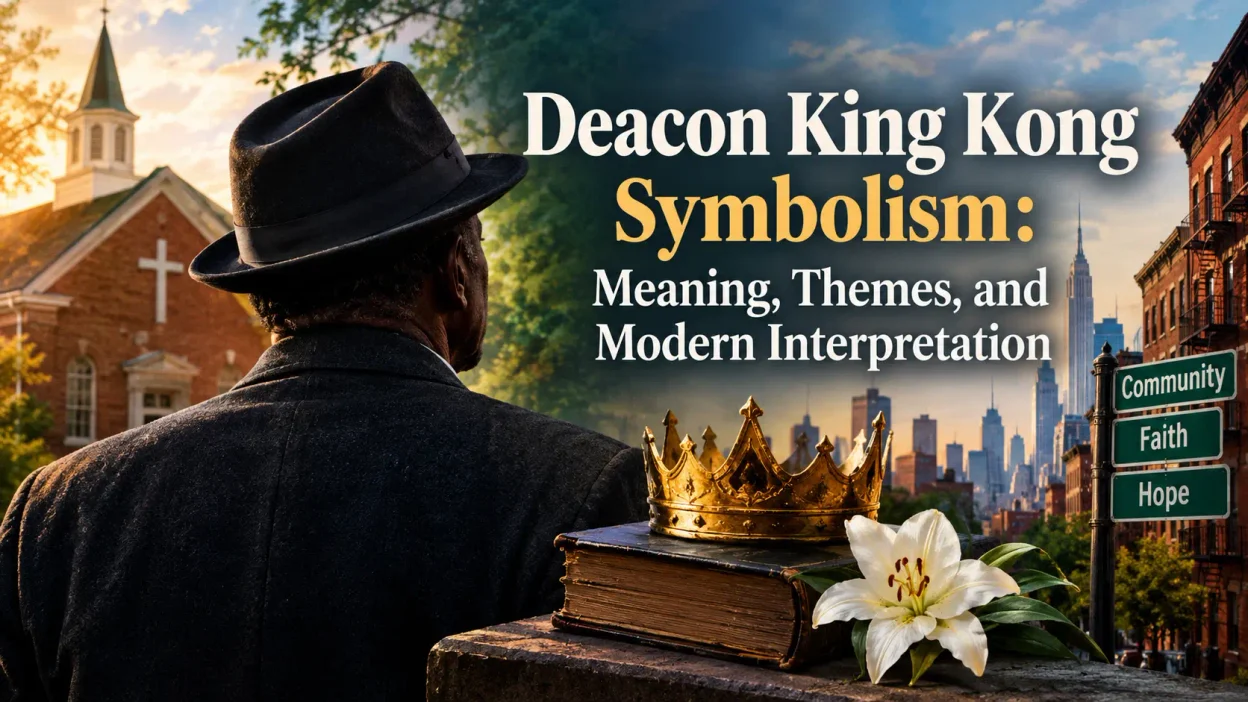
James McBride’s Deacon King Kong uses an unusual nickname, a neighborhood church, a homemade alcoholic drink, and a seemingly senseless act of violence to explore life in 1969 Brooklyn. The novel follows Cuffy “Sportcoat” Lambkin, an aging church deacon whose decision to shoot a young drug dealer sets a complicated chain of events in motion. The story mixes humor, tragedy, religion, and neighborhood life to examine what happens when damaged people remain connected to one another.
Deacon King Kong symbolism centers on redemption, community, faith, grief, and the possibility of change. Rather than assigning one fixed meaning to every character or object, McBride builds symbolism through relationships, recurring details, and events that reveal the difference between how people appear and who they are.
For American readers, the novel also offers a portrait of a Brooklyn community facing poverty, racial inequality, addiction, and social change. Its symbolic meaning comes from the tension between these harsh realities and the kindness, loyalty, and unexpected hope that survive within them.
Quick Answer
Deacon King Kong symbolism most commonly represents redemption, community resilience, faith, and the possibility of renewal despite personal failure. In the novel, Sportcoat’s nickname, his church, his homemade liquor, and the neighborhood’s shared struggles also symbolize grief, racial inequality, human connection, and the difficulty of breaking destructive cycles.
TL;DR
- Redemption: Sportcoat’s mistakes do not erase his capacity for change.
- Community: The Cause Houses connect people across racial and social divisions.
- Faith: The church represents spiritual guidance and practical mutual support.
- Grief: Sportcoat’s behavior reflects unresolved loss and emotional pain.
- Addiction: King Kong liquor symbolizes escape and self-destruction.
- Hope: The story suggests that damaged relationships can still change.
1. What Deacon King Kong Symbolizes Overall
The novel’s central symbolism lies in the contrast between human weakness and the possibility of redemption. Sportcoat is a church deacon, a former baseball coach, a neighborhood handyman, and a man struggling with alcohol and grief. These identities seem difficult to reconcile, yet together they reveal a person who cannot be reduced to a single moral judgment.
His decision to shoot Deems Clemens appears irrational, especially because Sportcoat once coached the young man in baseball. However, the incident exposes deeper fears about addiction, lost potential, and the future of the neighborhood.
The shooting also brings hidden relationships into view. Residents who might otherwise go about their separate lives become involved in the consequences, while rumors and investigations reveal how closely their lives overlap.
The symbolism therefore works on two levels. Sportcoat’s personal struggle represents the possibility of individual renewal, while the neighborhood’s response represents a community attempting to survive violence and social instability without losing its humanity.
2. The Meaning Behind Sportcoat’s Nickname
Sportcoat’s nickname reflects the many identities he carries. His baseball background connects him with mentorship, neighborhood pride, and the promise of youth. His role as a deacon connects him with religious responsibility, while his drinking reveals the distance between his public identity and his private struggles.
This contrast matters because Sportcoat is neither a conventional hero nor simply a foolish drunk. He can be generous and irresponsible, insightful and confused, helpful and destructive. McBride uses these contradictions to challenge the assumption that a person’s most visible weakness tells the whole story.
The nickname also preserves a sense of neighborhood familiarity. People know Sportcoat through stories, habits, friendships, and past experiences. His identity exists partly in the memories other people carry about him.
In this way, Sportcoat symbolizes the complicated nature of human character. A person may disappoint others while still possessing qualities worth recognizing, and genuine understanding requires looking beyond a single incident.
3. Why the Name King Kong Matters
The title’s other key element comes from Sportcoat’s homemade liquor, known as King Kong. The name is comic and memorable, but it also points toward the destructive influence of alcohol in his life.
King Kong becomes a symbol of escape from grief, disappointment, and the responsibilities Sportcoat struggles to manage. Drinking offers temporary relief, but it also contributes to confusion and poor judgment. The substance that helps him avoid painful feelings becomes part of the problem he cannot easily escape.
The name adds another layer because King Kong is a familiar American cultural figure associated with enormous physical strength and destructive force. In McBride’s novel, the nickname is attached to a drink rather than a giant creature. That contrast creates dark humor: something with a grand, intimidating name is part of an ordinary neighborhood man’s private downfall.
The title does not mean that Sportcoat is literally a monster. Instead, it draws attention to the mismatch between his familiar, often comic personality and the serious consequences of his behavior.
4. The Five Ends Church as a Symbol of Faith and Belonging
The Five Ends Baptist Church is one of the novel’s most important symbolic settings. It represents religious faith, but its role extends beyond formal worship. The church provides a shared institution through which people maintain relationships, organize community life, and help one another.
Sportcoat’s position as a deacon makes his personal contradictions especially visible. A deacon is generally expected to demonstrate service and responsibility, yet Sportcoat struggles to live up to those expectations. His behavior raises questions about what faith means when believers are imperfect.
McBride avoids presenting the church as a place filled only with morally exemplary people. Its members have flaws, disagreements, and practical problems. Their religious identity exists alongside ordinary human conflict.
The church therefore symbolizes faith as an ongoing practice rather than proof of personal perfection. Its importance comes partly from the people who gather there and the support they provide when life outside its walls becomes difficult.
5. The Cause Houses and the Symbolism of Community
The Cause Houses, the Brooklyn housing project at the center of the novel, symbolize a neighborhood whose residents share more than a physical address. Their lives intersect through friendships, family ties, rumors, work, church activities, and conflicts.
The setting functions almost like another character. Events affecting one person rarely remain private for long, and an apparently isolated action can reshape the lives of many others.
This interconnectedness has both benefits and costs. Residents can find help and protection through familiar relationships, but they may also struggle to escape their reputations or personal histories. Everyone seems to know something about everyone else.
The neighborhood also challenges the idea that a housing project can be understood through poverty or crime alone. McBride depicts humor, affection, cultural variety, ambition, and everyday competence alongside hardship.
The Cause Houses thus symbolize the social networks that help people endure difficult circumstances. They also show how the strengths of close communities can become entangled with gossip, mistrust, and shared vulnerability.
6. Baseball as a Symbol of Lost Potential and Second Chances
Baseball represents opportunity, discipline, mentorship, and the possibility of a different future. Sportcoat once coached neighborhood boys, and Deems Clemens stood out as a particularly gifted player. For Sportcoat, Deems’s talent offered evidence that a young man from the Cause Houses could build a life beyond the limits imposed by poverty and violence.
Deems’s turn toward drug dealing exposes the economic pressures behind that lost opportunity. Selling drugs offers immediate money and status, while a baseball career requires patience, support, and an uncertain path toward success. His choice reflects a broader problem: talent cannot guarantee a better future when the available routes to advancement are limited.
Baseball also carries a recognizable American cultural meaning. Often associated with childhood, teamwork, and the American Dream, the sport becomes a reminder of what the community hopes its young people might achieve.
Its symbolic role changes as the story progresses. Baseball begins as a memory of promise, becomes a contrast to the drug trade, and ultimately helps express the possibility of rebuilding a life. Deems’s return to the sport suggests that a person’s future need not remain fixed by earlier decisions.
7. The Venus of Willendorf and the Possibility of Renewal
The Venus of Willendorf, a prehistoric figurine that becomes important to the novel’s plot, introduces another layer of symbolism. The real artifact was discovered in Austria in 1908 and is generally dated to the Upper Paleolithic period. Its exaggerated bodily features have prompted interpretations involving fertility, the human body, and prehistoric ideas about life, although its original purpose remains uncertain.
McBride places a fictionalized version of this artifact within a story about a struggling Brooklyn neighborhood. Its presence connects the local characters to a much older human history, while its hidden location gives the object an additional narrative role.
The figurine can be read as a symbol of fertility and renewal, particularly when considered alongside the novel’s concern with the future of the Cause Houses. Fertility here need not mean literal pregnancy. It can also suggest the capacity to produce something new: stronger relationships, repaired institutions, and possibilities that have not yet been realized.
The object’s journey also links people whose lives initially appear unrelated. Its discovery and eventual use help expose connections between the neighborhood, the church, and characters from different social backgrounds.
The symbolism is interpretive rather than definitive. Scholars continue to debate what the prehistoric figurine meant to the people who created it, so it would be inaccurate to treat any single modern interpretation as its proven original meaning.
8. Jesus’s Cheese and the Symbolism of Everyday Generosity
Food can carry meaning beyond nourishment, especially when sharing it becomes a repeated community practice. In Deacon King Kong, the distribution of cheese among residents connects everyday material goods with relationships, obligation, and generosity.
The cheese becomes meaningful partly because its arrival is unusual and its origins are not immediately clear. Residents wonder where it comes from, while the repeated distribution establishes a connection that reaches across the boundaries separating different people.
The story’s religious atmosphere gives this ordinary object another dimension. Generosity becomes visible through practical acts rather than grand declarations. A person who provides food or helps a neighbor demonstrates care in a form others can recognize.
This symbolism fits the novel’s wider portrayal of faith. Religious values matter not only during worship but also when people meet ordinary needs. Food, money, assistance, and time can all become expressions of concern for another person’s well-being.
The cheese also reinforces the theme of interdependence. A community may not fully understand the history of a gift, yet the gift can still create bonds that outlast the circumstances in which it first appeared.
9. Grief, Hettie, and the Search for Meaning
Sportcoat’s grief over his wife, Hettie, shapes how he understands the world. Her absence is not merely a sad detail in his personal history; it affects his judgment, his memories, and his ability to make sense of events around him.
Grief can disrupt ordinary routines and make unresolved questions feel impossible to set aside. Sportcoat’s fixation on the missing Christmas fund and his conversations connected to Hettie suggest a man struggling to live with loss while still trying to perform familiar responsibilities.
The symbolic importance of grief lies in the way it connects private pain to public behavior. Sportcoat’s actions may appear absurd or inexplicable to his neighbors, but his emotional life gives those actions a more complicated context.
This does not mean grief excuses violence or removes responsibility. Rather, McBride asks readers to consider how a person’s behavior can emerge from experiences that others cannot fully see.
Hettie’s absence also highlights the difference between remembering someone and learning to live after their death. Sportcoat must confront not only what he has lost but also how his attachment to the past affects the living people around him.
10. The Ants as a Symbol of Social Forces and Collective Life
The recurring ants are among the novel’s more unusual motifs. Their movements introduce a perspective that shifts attention away from individual characters and toward patterns of collective behavior.
Ants live in organized groups, with individual members forming part of a larger system. In the novel, their presence encourages readers to consider how neighborhoods operate through countless small interactions that no single person controls.
The ants can also be interpreted in relation to the arrival and spread of drugs in the Cause Houses. Their recurring appearance suggests an invading force that becomes part of everyday life, difficult to trace to a single origin and difficult to remove once established.
Yet the ants are not a simple one-to-one metaphor. McBride’s use of them expands the narrative beyond a straightforward account of crime or community conflict. Their perspective allows the story to move between the small details of neighborhood life and larger questions about social systems.
Their symbolism is therefore partly about scale. A resident may focus on one argument, one missing object, or one act of violence, while the wider community experiences a pattern of events whose consequences extend well beyond any individual encounter.
11. Racial Inequality and the Limits of the American Dream
The novel’s 1969 setting matters because the characters live in a United States still confronting the consequences of segregation, discrimination, and unequal access to opportunity. McBride portrays a diverse Brooklyn neighborhood in which Black, Puerto Rican, Italian American, and Irish American characters occupy overlapping social worlds without enjoying equal power or identical experiences.
The Cause Houses symbolize more than a collection of individual hardships. They also represent the structural conditions that shape people’s options, including economic insecurity, housing inequality, racial prejudice, and exposure to violence.
Baseball offers a hopeful alternative to these conditions, but the novel does not suggest that ambition alone can overcome every obstacle. Deems’s decision to leave the sport reflects the appeal of immediate income in circumstances where long-term advancement may seem uncertain.
The story also challenges simplistic divisions between good and bad communities. Characters from different backgrounds can show kindness, prejudice, loyalty, or self-interest. Their actions reveal how personal choices interact with broader social structures.
For American readers, this makes the novel’s symbolism especially relevant to discussions of opportunity. The American Dream depends not only on individual effort but also on whether people have meaningful chances to develop their abilities and build secure lives.
12. How Humor Changes the Meaning of Violence
The novel begins with a shooting, yet much of its storytelling is comic. This contrast is central to its symbolism. Humor allows characters to remain recognizable as people with habits, eccentricities, and ordinary concerns even when their lives are threatened by serious violence.
The comedy does not make the shooting harmless. Instead, it complicates the reader’s response. Sportcoat’s actions are shocking, but the surrounding characters are too varied and unpredictable to fit neatly into a conventional crime story.
McBride’s humor also reveals the absurdity of social situations in which danger, gossip, bureaucracy, and personal loyalty overlap. A seemingly minor event can trigger disproportionate consequences, while an unexpected act of kindness can interrupt a cycle of retaliation.
The result is a form of tragicomedy in which laughter and sorrow coexist. The story suggests that people do not stop being funny, generous, or recognizable when they experience hardship.
Humor becomes a way to preserve human complexity without denying the damage caused by violence.
13. Symbolism in the Relationships Between Older and Younger Men
Sportcoat’s relationship with Deems carries symbolic meaning because it resembles a father-son bond without being a conventional biological family relationship. Sportcoat coached Deems, encouraged his athletic talent, and helped shape his childhood.
When Deems turns to drug dealing, Sportcoat sees more than a young man’s criminal activity. He sees the possible destruction of someone whose future he once imagined differently. His response is misguided and violent, but it emerges from a relationship that includes affection, disappointment, and fear.
Their relationship highlights the importance of mentorship in communities where formal opportunities may be limited. An older adult can provide encouragement, practical knowledge, and a sense of belonging that helps a young person imagine alternatives.
At the same time, the novel refuses to romanticize authority. Sportcoat’s concern does not make his actions right, and Deems must make his own choices.
The symbolism points toward a difficult form of care: wanting someone to change is not the same as knowing how to help them. Real renewal requires more than good intentions; it also requires responsibility, patience, and the willingness to recognize another person’s independence.
14. What the Novel’s Symbols Mean in Modern American Culture
The novel was published in 2020, but its 1969 setting gives its symbols continuing relevance. American readers can connect its concerns with present-day conversations about addiction, community safety, economic inequality, grief, and the importance of social support.
Its symbols are particularly useful because they resist easy conclusions. A church can represent faith and belonging while housing imperfect people. Baseball can embody hope without guaranteeing success. A close-knit neighborhood can offer protection while also making personal problems difficult to escape.
The table below summarizes the major symbolic elements and their possible interpretations.
| Symbol or motif | Meaning in the novel | Broader American association |
|---|---|---|
| Sportcoat | Contradiction, grief, and potential redemption | Human complexity and second chances |
| King Kong liquor | Escape, addiction, and impaired judgment | The struggle with substance use |
| Five Ends Church | Faith, service, and belonging | Religious community and mutual aid |
| Baseball | Mentorship and lost opportunity | The American Dream and teamwork |
| Venus of Willendorf | Fertility, connection, and renewal | New beginnings and the continuity of life |
| Ants | Collective behavior and spreading social problems | Systems larger than any one individual |
These interpretations are not universal meanings attached to the objects themselves. They arise from how McBride uses them in the story, and other readers may emphasize different aspects of the same symbols.
15. Common Misunderstandings About Deacon King Kong Symbolism
One common mistake is to treat Sportcoat as a straightforward symbol of Christian virtue simply because he is a deacon. His religious position matters, but his drinking, confusion, and violence complicate that identity. The novel’s interest lies in the tension between spiritual ideals and imperfect behavior.
Another misunderstanding is to read King Kong liquor as a symbol of strength. The name may suggest size or force, but within the story, the drink is more closely connected with addiction, avoidance, and the consequences of impaired judgment.
Readers should also avoid treating the Cause Houses as a universal portrait of Black American life. The setting reflects a particular fictional community in a specific historical period. Its characters and circumstances illuminate wider social issues, but they do not represent every neighborhood or every experience.
Finally, the novel’s hopeful conclusion should not be mistaken for a claim that violence and inequality disappear through kindness alone. Its emphasis on redemption is meaningful precisely because the characters face real damage and difficult choices.
The strongest interpretation holds these ideas together: people are responsible for their actions, but understanding them also requires attention to grief, history, social conditions, and relationships.
Frequently Asked Questions
What does Deacon King Kong symbolize?
The novel primarily symbolizes redemption, community resilience, faith, and the possibility of change. Its recurring objects and relationships reveal how personal struggles connect to larger social problems.
What does Sportcoat symbolize in the novel?
Sportcoat symbolizes human contradiction: he is generous and flawed, religious yet irresponsible, and capable of harm as well as kindness. His character challenges readers to look beyond a person’s worst decision without ignoring its consequences.
What does baseball represent in Deacon King Kong?
Baseball represents opportunity, mentorship, discipline, and the American Dream. Deems’s departure from and eventual return to the sport reflect the tension between immediate survival and a more hopeful future.
What does the Five Ends Church symbolize?
The church represents Christian faith, community belonging, and practical mutual support. Its members demonstrate that religious institutions can help sustain a neighborhood even when individual believers struggle to meet their own ideals.
What is the significance of the Venus of Willendorf?
Within the novel, the prehistoric figurine can be read as a symbol of fertility, renewal, and connections between people who initially seem unrelated. Its historical meaning remains uncertain, so its symbolic role in the fiction should be distinguished from claims about its original purpose.
How does the novel use symbolism to address racial inequality?
McBride uses the Cause Houses, the characters’ limited opportunities, and Deems’s choices to explore how structural inequality shapes individual lives. The story also emphasizes that personal ambition and community support matter, even when broader conditions remain unfair.
Is Deacon King Kong ultimately a hopeful novel?
Yes, although its optimism does not erase the suffering or injustice in the story. Its hope comes from the possibility that people can repair relationships, change direction, and support one another after serious mistakes.
Conclusion
Deacon King Kong symbolism reveals how redemption, faith, grief, addiction, and community shape one another. Sportcoat’s contradictions, the church’s social role, the promise of baseball, and the neighborhood’s interconnected lives show that people are more complicated than their reputations or worst decisions.
The novel also places personal struggles within a wider American context, examining how racial inequality and limited opportunities affect the choices available to individuals. Its symbols do not promise easy solutions, but they show why human connection remains important even when circumstances seem difficult to change.
Ultimately, Deacon King Kong symbolism asks readers to recognize both personal responsibility and the possibility of renewal. A community’s future depends not on the absence of flawed people, but on whether those people can learn, reconnect, and make room for something better.