
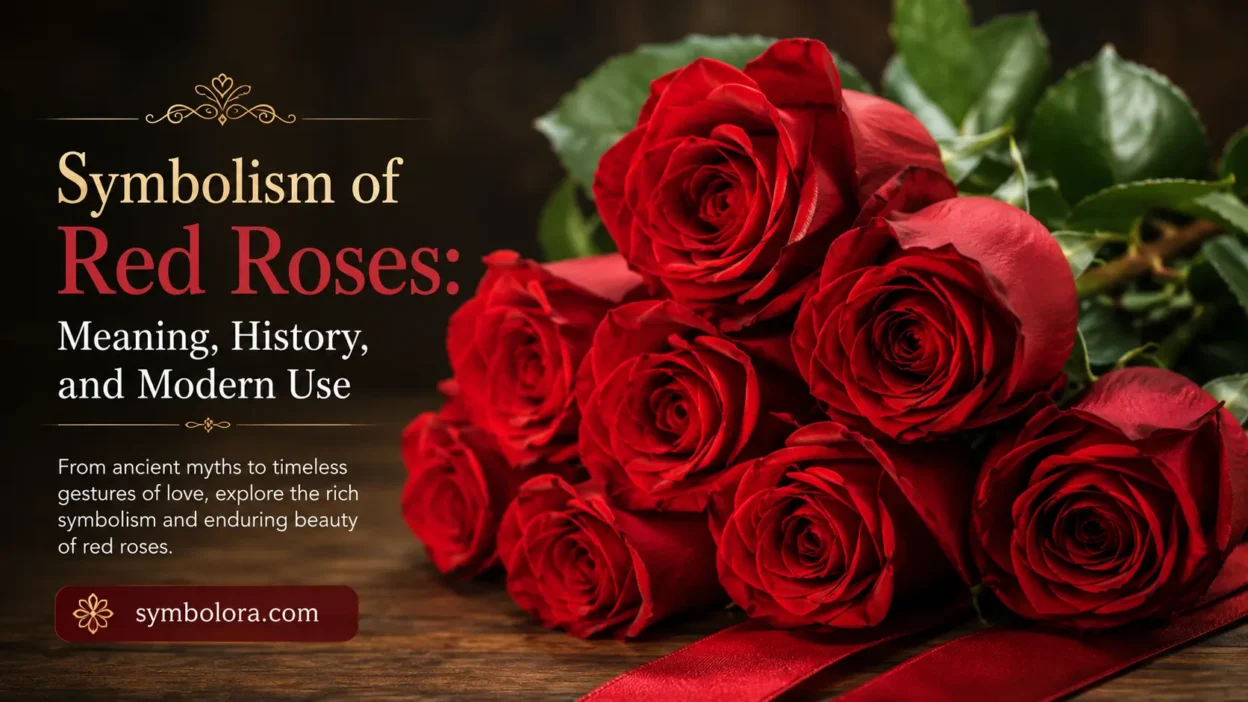
Red roses are among the most recognizable flowers in American culture. The symbolism of red roses centers mainly on romantic love, desire, devotion, and emotional commitment, but their meaning can shift with the setting. The same flower that celebrates an anniversary can also communicate respect, remembrance, sacrifice, or public identity.
Part of the rose’s appeal comes from its visual contrast. Soft, layered petals suggest beauty and tenderness, while stems covered with prickles introduce ideas of vulnerability, risk, and protection. Add the intensity of red, and the flower becomes especially suited to emotions people consider difficult to express casually.
Americans encounter red roses in Valentine’s Day bouquets, weddings, anniversary gifts, funerals, tattoos, jewelry, art, advertisements, and social media. Those modern uses draw from several overlapping traditions rather than one single historical code.
Quick Answer
The symbolism of red roses most commonly represents romantic love, passion, desire, and committed affection in modern American culture. Historically, roses have also carried associations with beauty, religious devotion, sacrifice, remembrance, heraldry, and poetic love.
TL;DR
- Red roses primarily symbolize romantic love and desire.
- Victorian flower traditions strengthened their romantic associations.
- American culture connects roses strongly with love and devotion.
- Religious traditions gave roses meanings beyond romance.
- Red roses may also represent remembrance, sacrifice, or respect.
- Context matters more than any fixed flower code.
What Red Roses Commonly Symbolize
For most Americans, a red rose immediately suggests romantic affection. It may communicate attraction at the beginning of a relationship, established love within a long partnership, or renewed commitment on an anniversary.
Passion is another common interpretation. The color red already carries associations with heat, blood, urgency, and heightened emotion, while the rose has long been connected with love and beauty. Together, they create a stronger romantic signal than either element usually carries by itself.
Red roses can also communicate devotion. A carefully chosen bouquet often suggests that the sender considers the relationship meaningful rather than casual. That emotional message helps explain why roses remain closely connected with Valentine’s Day and romantic gift-giving in the United States. Smithsonian Gardens describes roses as the most prominent flowers used to represent romance and passion in modern floral traditions.
Why the Color Red Changes the Rose’s Meaning
Color affects how people interpret flowers. A rose without a specified color may represent love, beauty, affection, or admiration broadly, while a red rose narrows the message toward stronger emotion.
Red is visually intense. It attracts attention quickly and is commonly connected with blood, warmth, danger, excitement, sexuality, and emotional urgency. When placed on a flower already associated with affection, the color strengthens ideas of desire and romantic attachment.
This does not mean every red rose automatically represents sexual passion. Context remains important. A single rose presented on a date has a different social meaning from red roses placed at a memorial or used in a religious image.
That flexibility is one reason floral symbolism should be treated as a cultural language rather than an exact dictionary.
The Rose’s Early Connections With Love and Beauty
The romantic meaning of roses did not suddenly appear in the modern flower industry. European traditions inherited extensive imagery connecting flowers, gardens, beauty, sexuality, and love from the ancient Mediterranean world.
Greek and Roman artistic traditions prominently associated Aphrodite and Venus with love and desire. Later European writers and artists repeatedly connected roses with these themes, helping establish the flower as an emblem of romantic beauty.
Some later retellings connect red roses specifically with myths involving Aphrodite, Venus, Adonis, blood, and wounded love. These stories vary considerably across periods and sources, so they should not be treated as one universally accepted ancient explanation for why red roses mean love.
A more reliable conclusion is that the rose entered European symbolic culture within a broader network of ideas involving gardens, beauty, sensuality, mortality, and affection. Later traditions made the red rose increasingly specific as a romantic emblem.
Red Roses in Medieval Christian Symbolism
Medieval Europe added religious meanings to the rose that were quite different from modern Valentine’s imagery.
Roses appeared in Christian art in connection with the Virgin Mary, Christ, charity, martyrdom, and sacred love. Medieval artistic traditions could associate the rose with Mary or with the wounds and suffering of Christ, depending on the image and context.
Red roses could take on particularly solemn meanings when their color suggested blood or martyrdom. A medieval representation of Saint Dorothea, for example, includes red roses among symbols associated with her martyrdom.
These religious meanings demonstrate why it is inaccurate to claim that red roses have always meant romantic passion. In Christian visual culture, a rose could communicate sacred devotion, suffering, purity, charity, or redemption rather than courtship.
How Victorian Flower Language Shaped Modern Meaning
The nineteenth-century enthusiasm for floriography, commonly called the language of flowers, had a major influence on the way modern readers think about floral symbolism.
During the Victorian era, books assigned sentiments and messages to individual flowers. Giving, carrying, or displaying certain flowers could suggest feelings that social conventions made difficult to state openly. Flower symbolism became a popular cultural pastime rather than a perfectly standardized communication system.
Different books sometimes assigned different meanings to the same flower. Smithsonian Gardens notes that nineteenth-century flower guides could contradict one another, showing that there was never one universal Victorian floral dictionary.
Even so, the broader link between roses and romantic communication became firmly established. Modern flower marketing inherited and simplified that tradition, making red roses one of the clearest visual signals of romantic love.
What Red Roses Mean in the United States
In the United States, red roses function primarily as relationship symbols. People give them for Valentine’s Day, anniversaries, proposals, dates, milestone celebrations, and other occasions where romantic affection is central.
The rose also has a broader national connection. Congress designated the rose, without limiting the emblem to a particular color or variety, as the National Floral Emblem of the United States in 1986. President Ronald Reagan formally proclaimed the designation on November 20, 1986.
That national designation does not make the red rose a patriotic symbol in the same way as the American flag or bald eagle. Instead, it illustrates how culturally established roses had already become in American gardening, ceremony, gift-giving, and public life.
Today, the red variety remains especially recognizable because romantic culture has given it such a specific emotional role.
| Context | Meaning in the USA | Common Associations | Notes |
|---|---|---|---|
| Valentine’s Day | Romantic love | Desire, affection, courtship | Most familiar modern use |
| Anniversary | Lasting commitment | Loyalty, partnership, intimacy | Often given between couples |
| Wedding | Passionate love | Partnership, celebration | Usually combined with other flowers |
| Memorial | Love and remembrance | Grief, respect, devotion | Context changes the romantic meaning |
| Tattoo or jewelry | Personal love or identity | Beauty, passion, resilience | Meaning depends on the wearer |
| Public imagery | Broader symbolic meaning | Heritage, politics, art | Not always romantic |
Valentine’s Day and Romantic Gift-Giving
Few American holidays are as closely associated with a single flower as Valentine’s Day is with the red rose.
The flower works well as a romantic gift because its meaning is immediately understandable. Giving red roses usually requires little explanation. Their established cultural association does much of the communication for the sender.
The message can still vary according to the relationship. Early in a romance, red roses may signal attraction or serious interest. In a long marriage, they can communicate continuity, gratitude, and renewed affection. After conflict, they may be intended as reconciliation, although flowers alone cannot replace an apology or changed behavior.
Modern commercial use has strengthened this connection, but commerce did not invent the relationship between roses and love. It amplified symbolism that had already developed through literature, art, flower traditions, and social customs.
Red Roses in Weddings and Long-Term Relationships
Red roses can appear in weddings when couples want floral arrangements that emphasize romance rather than innocence or understated elegance.
In bridal bouquets, centerpieces, arches, and reception decor, deep red flowers often create a dramatic mood. They can suggest mature affection, desire, commitment, and emotional intensity.
Wedding symbolism also changes when red roses are mixed with other flowers. White flowers may soften the arrangement and introduce associations with ceremony or purity, while greenery can make the overall design feel less overtly romantic.
For established couples, the rose often becomes less about excitement and more about continuity. A bouquet given after ten or twenty years together may communicate that romantic attention still matters inside a familiar relationship.
Red Roses in Grief, Funerals, and Remembrance
A red rose at a funeral does not usually communicate romance in the same way it would on Valentine’s Day.
Instead, it can represent enduring love, respect, grief, or emotional closeness to the person who died. A spouse may place red roses on a partner’s grave because the romantic relationship remains central to the memory of that person. Family members may use them simply to express profound affection.
This is an important example of how symbolic meaning depends on setting. The flower itself has not changed, but the emotional situation has.
Red also has longstanding connections with blood, sacrifice, and mortality, which can give the flower additional weight in memorial settings. Religious art likewise demonstrates that red flowers have historically carried meanings involving martyrdom and sacrifice as well as earthly love.
Cross-Cultural Meanings of the Rose
Although American culture strongly emphasizes romance, roses have accumulated different meanings across cultures.
European traditions connected them with courtly love, Christianity, heraldry, poetry, and noble identity. Medieval heraldic imagery could use roses as emblems connected with religious devotion, romantic love, family identity, or martial imagery.
Persian artistic and poetic traditions developed another major symbolic framework. The rose could represent the beloved, beauty, or even divine beauty, while the nightingale’s longing for the rose became an enduring poetic image of love and separation.
These traditions should not be collapsed into one universal meaning. A flower can move between cultures while carrying different religious, literary, political, and emotional associations.
The Emotional and Psychological Message of Red Roses
Symbolically, red roses communicate intentionality.
Sending them usually feels more deliberate than giving an ordinary mixed bouquet because the recipient already knows the cultural message associated with them. That familiarity allows the flower to function almost like a visual statement.
They can communicate confidence when attraction is mutual, but they may also feel intense when a relationship is new or undefined. For that reason, context determines whether the gesture feels romantic, ceremonial, affectionate, or excessive.
The flower’s physical form contributes to its emotional appeal. Soft petals paired with protective prickles create a natural contrast that lends itself to metaphors about intimacy: beauty can coexist with vulnerability, and affection may involve risk.
That interpretation is especially common in personal art and tattoos, where people can control the meaning more freely than they can in formal flower etiquette.
Red Rose Tattoos, Jewelry, and Personal Style
A red rose tattoo often represents romantic love, but tattoo symbolism is much more individual than bouquet symbolism.
Some people use the image to honor a partner, parent, child, or deceased loved one. Others connect it with beauty, survival, passion, femininity, masculinity, personal transformation, or the coexistence of tenderness and toughness.
Details can change the message. Thorns may emphasize protection, hardship, or painful love. A wilted rose may suggest loss or the end of a relationship. A rose paired with a name or date usually points toward personal remembrance.
Rose imagery also appears in rings, pendants, clothing, fragrance packaging, embroidery, and decorative art. In these settings, it may function as a design motif rather than a literal declaration of romantic love.
Red Roses in Art, Literature, and Digital Culture
Artists and writers frequently use roses because audiences already recognize their symbolic vocabulary.
A fresh red rose can suggest love at its peak. Falling petals may imply impermanence. A damaged rose can suggest wounded affection, while a preserved rose may imply an attempt to hold onto beauty or memory.
Modern entertainment continues those conventions in album art, film imagery, advertising, fashion photography, and music videos. The red rose provides a fast visual way to communicate romance, seduction, longing, or emotional conflict.
Digital culture has simplified the symbol further. Rose emojis and rose images can communicate affection, appreciation, beauty, celebration, flirtation, or tribute. Unlike a physical bouquet, however, a digital rose is often casual enough that it should not automatically be interpreted as a serious romantic declaration.
When Red Roses Have Political or Public Meanings
Not every red rose is about a relationship.
Roses have appeared in heraldic, civic, religious, and political contexts for centuries. Their visual simplicity makes them useful as emblems because the flower remains recognizable even when highly stylized.
A red rose can therefore signal collective identity rather than personal affection. In European history, rose imagery became connected with dynastic and heraldic traditions, while later political movements also adopted rose designs.
This matters when interpreting logos, flags, protest graphics, badges, or institutional designs. Assuming that every red rose means romantic love can produce an incorrect reading of the image.
Symbolic interpretation should begin with context: who is using the rose, where it appears, and what other symbols surround it?
Common Misunderstandings About Red Rose Symbolism
The biggest misunderstanding is the idea that red roses have one permanent meaning.
Their strongest modern American association is romantic love, but history shows a much wider range of uses. Roses have represented religious devotion, martyrdom, charity, family identity, poetic beauty, remembrance, and national or political affiliation.
Another mistake is treating Victorian flower meanings as fixed historical rules. Nineteenth-century flower books frequently differed from one another, so claims such as “one red rose always means this exact message” should be treated as modern conventions rather than universal historical facts.
Bouquet numbers are sometimes given similarly rigid meanings online. While florists and popular culture may attach messages to quantities such as one rose or a dozen roses, those interpretations vary and are not universal symbolic laws.
How the Meaning of Red Roses Has Evolved
The meaning of the red rose developed by accumulation rather than replacement.
Ancient Mediterranean associations between love, beauty, gods, gardens, and flowers helped create an early symbolic environment. Medieval Christianity gave roses devotional and sacrificial meanings. European heraldry used the flower as an emblem of identity. Persian poetry developed its own influential images of the rose, beauty, and the beloved.
Nineteenth-century flower language then helped organize floral meanings into recognizable social messages. Modern advertising, holiday traditions, film, photography, and gift culture made the romantic interpretation more standardized.
As a result, Americans today can understand a red rose immediately as a sign of love while still using the same image for grief, art, tattoos, religion, or public identity.
That adaptability explains the symbol’s persistence better than any claim that it has carried one unchanged message for thousands of years.
Frequently Asked Questions
What does a red rose symbolize in love?
A red rose usually symbolizes romantic attraction, passionate affection, or committed love. The exact message depends on the relationship, occasion, and way the flower is presented.
Does a red rose always mean romance?
No. Red roses can also express remembrance, respect, religious devotion, sacrifice, personal identity, or grief. Historical art and heraldry show that the rose has long existed outside purely romantic settings.
What does a red rose tattoo symbolize?
A red rose tattoo may represent romantic love, beauty, passion, remembrance, resilience, or someone important to the wearer. Thorns, names, dates, skulls, or other accompanying images can substantially change the interpretation.
What do red roses mean at a funeral?
At a funeral, red roses usually communicate lasting love, respect, or close emotional attachment. They can be especially meaningful when honoring a spouse or partner because they preserve the flower’s association with enduring affection.
Do red roses have a Christian meaning?
They can. In medieval Christian art, roses appeared in imagery involving the Virgin Mary, charity, Christ’s wounds, martyrdom, and sacred devotion, although the meaning varied by artwork and period.
Is the red rose America’s national flower?
The United States’ National Floral Emblem is the rose generally, not specifically the red rose. The national designation was established in 1986 and formally proclaimed on November 20 of that year.
Are Victorian red rose meanings historically exact?
Not always. Victorian flower dictionaries could disagree about what particular flowers represented, so floriography worked more like a flexible cultural convention than a standardized code.
Conclusion
The symbolism of red roses is strongest today in the language of romantic love. In the United States, they commonly communicate attraction, passion, commitment, and lasting affection, especially on Valentine’s Day, anniversaries, weddings, and other relationship-centered occasions.
Their history is broader. Roses have also belonged to religious art, heraldry, poetry, memorial traditions, political imagery, and personal expressions of identity. Those layers explain why a red rose can feel appropriate at both a wedding and a graveside without carrying exactly the same message.
The most accurate interpretation comes from looking at the flower together with its setting. Red roses do not express one fixed idea; they provide a familiar visual language that people adapt to love, memory, devotion, and identity.


