Magpie symbolism in Celtic tradition brings together folklore, beliefs about birds, and the human tendency to look for meaning in encounters with wildlife. Magpies are recognizable by their black-and-white plumage, long tails, and sharp, curious behavior. In modern American culture, people may associate them with intelligence, mystery, luck, or messages from nature, but their Celtic connections require a careful distinction between documented traditions and later interpretations.
The term “Celtic” covers diverse peoples, languages, and historical periods, including communities in ancient continental Europe, Ireland, Scotland, Wales, and Brittany. These communities did not share one unchanging system of beliefs about animals. A bird’s meaning in an Irish folktale, for example, should not automatically be treated as a universal Celtic belief.
Magpies also have a complicated place in European folklore. Some traditions connect them with omens, unusual encounters, or the supernatural, while others give them more ordinary roles as clever and vocal birds. Understanding their symbolism means examining what historical evidence supports, what belongs to broader European folklore, and what modern spiritual writers have added.
Quick Answer
Magpie symbolism in Celtic-inspired interpretations today commonly suggests intelligence, curiosity, transformation, and attention to signs in nature. Historically, however, there is no single, well-established Celtic doctrine assigning magpies one universal meaning; their associations with omens and supernatural messages are better understood within the broader, varied traditions of European bird folklore.
TL;DR
- Magpies are associated with intelligence, curiosity, and striking black-and-white plumage.
- Celtic cultures held diverse beliefs rather than one universal system of animal symbolism.
- European folklore sometimes connects magpies with omens and supernatural encounters.
- Modern Americans often interpret magpies through spirituality, wildlife appreciation, and popular folklore.
- Claims about specific Celtic magpie meanings require historical evidence.
- Magpie tattoos and artwork often express cleverness, duality, and personal transformation.
What Makes the Magpie Symbolically Distinctive?
Magpies are members of the crow family, Corvidae, which also includes crows, ravens, and jays. Their recognizable appearance and behavior help explain why people have attached meaning to them across different cultures.
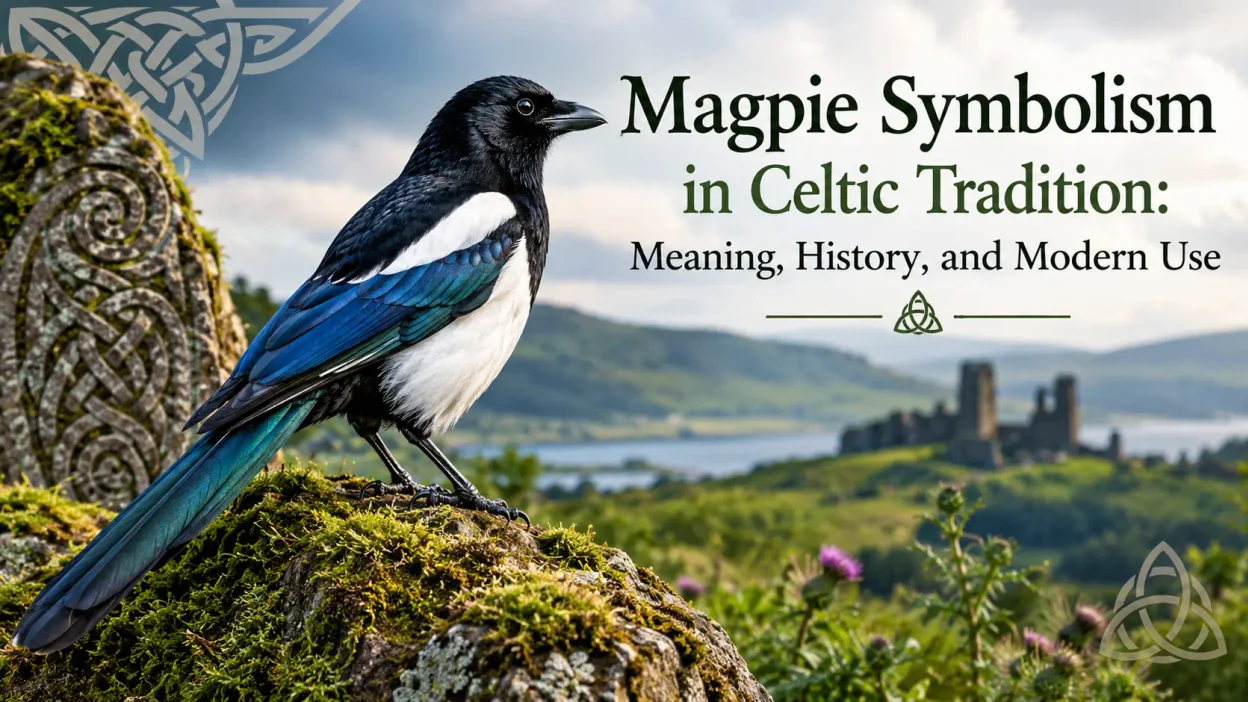
The Eurasian magpie has a black-and-white body, iridescent feathers that can reflect blue or green, and a long tail. It is alert, adaptable, vocal, and capable of solving certain problems. These characteristics make the bird a natural subject for stories about cleverness, observation, and unexpected behavior.
Magpies are also conspicuous. They may investigate unfamiliar objects, collect food, and call loudly when they detect a threat. To a human observer, their behavior can seem deliberate or even mischievous.
Such observations provide a reasonable basis for modern symbolic interpretations. A magpie can represent curiosity because it explores its surroundings, or intelligence because corvids display sophisticated problem-solving abilities. These associations, however, do not establish that ancient Celtic communities understood the bird in exactly the same way.
The bird’s physical appearance also encourages interpretations involving contrasts. Its black-and-white plumage can suggest two sides of a situation, opposing forces, or the coexistence of different qualities. This is a modern interpretive possibility rather than a confirmed, universal Celtic symbol.
Did Magpies Have a Specific Meaning in Celtic Mythology?
The most important historical distinction is that magpies do not occupy a clearly established, universal position in surviving Celtic mythology comparable to certain animals that appear repeatedly in specific stories or religious contexts.
Celtic mythology is not one single body of literature. Medieval Irish and Welsh texts preserve stories shaped by oral traditions, Christian-era scribes, literary conventions, and changing cultural conditions. Evidence from ancient continental Celtic religion also differs from evidence preserved in medieval insular literature.
Birds appear in Celtic-associated stories in several ways. Some function as messengers, some are connected with supernatural figures, and others participate in transformations or unusual encounters. Yet these broader patterns cannot be transferred automatically to magpies.
Modern articles sometimes claim that Celtic people considered the magpie a sacred messenger, a guardian between worlds, or a universal sign of transformation. Such interpretations may be meaningful within contemporary spiritual practice, but they require specific historical evidence before they can be presented as established ancient beliefs.
A more reliable approach is to ask which bird appears in a particular text, what happens in the story, and whether the species is actually identified. If a source refers only to a bird, identifying it as a magpie without supporting evidence creates a historical claim that the text may not justify.
This does not make magpie symbolism irrelevant to Celtic-inspired culture. It simply means that modern interpretation should be distinguished from documented mythology.
Magpies and the Broader European Tradition of Bird Omens
Although a universal Celtic magpie doctrine is not established, magpies have recognizable roles in broader European folklore. In some traditions, people interpreted the appearance, calls, or number of magpies as signs associated with luck, visitors, news, or future events.
One familiar British and Irish folk tradition involves counting magpies and assigning meanings to the number seen. The best-known English-language rhyme begins with one magpie associated with sorrow and two with joy, although versions differ and other numbers receive different interpretations.
This tradition is often discussed alongside Celtic folklore because it exists in parts of Britain and Ireland. However, its geographical presence does not prove that it originated in ancient Celtic religion. It is more accurate to describe it as regional European or British and Irish folk belief unless a particular historical connection can be demonstrated.
Bird omens reflect a broader human practice: interpreting the natural world as a possible source of information about uncertain events. When a bird appears unexpectedly or behaves unusually, people may remember the encounter and connect it with something that happens afterward.
For modern readers, these traditions offer insight into how communities made sense of uncertainty. They do not provide reliable evidence that magpies predict future events.
Intelligence, Curiosity, and Cleverness
Magpie Symbolism in Celtic Tradition
Intelligence is one of the most defensible modern associations with magpies because it connects observable animal behavior with a recognizable symbolic idea.
Corvids have demonstrated abilities involving memory, problem-solving, and adaptation. Magpies can investigate objects, recognize patterns in their environment, and respond flexibly to changing conditions. These behaviors have helped make corvids familiar symbols of cleverness in modern storytelling and popular culture.
A magpie used in an illustration or personal emblem may therefore represent resourcefulness, strategic thinking, or the willingness to look beyond appearances. Someone might choose the bird to express a curious personality or an interest in learning.
These meanings should not be presented as uniquely Celtic. They arise from the bird’s behavior and from wider cultural representations of corvids.
It is also worth avoiding the popular oversimplification that magpies always steal shiny objects. Magpies are opportunistic animals, but their reputation for collecting glittering objects is exaggerated. Their actual behavior is more varied than the familiar folklore suggests.
The bird’s cleverness remains a useful modern association without relying on inaccurate stories about its habits.
Black-and-White Plumage and the Symbolism of Duality
The magpie’s contrasting plumage makes it especially suitable for artistic interpretations of duality. Black and white are visually distinct, and artists often use them to express opposing or complementary qualities.
A magpie can therefore be used in contemporary artwork to suggest the coexistence of light and darkness, caution and curiosity, or visible and hidden aspects of a person’s identity. The image may also communicate balance between contrasting experiences.
These interpretations are not exclusive to Celtic traditions. Similar visual contrasts appear in many cultures and artistic systems, but their meanings vary according to context.
It would be inaccurate to claim that the magpie’s black-and-white feathers prove an ancient Celtic belief in a particular cosmic balance. A bird’s appearance can inspire symbolism without serving as evidence of a historical doctrine.
In a modern design, the contrast can still be effective. A magpie perched between dark branches and a bright sky may communicate uncertainty, transition, or the ability to navigate different environments. The meaning comes from the composition and the viewer’s interpretation rather than from a single fixed rule.
Magpies as Messengers and Signs of Change
The idea of a magpie as a messenger appears in modern spiritual interpretations and overlaps with older European traditions of reading birds as omens. A sudden encounter with a magpie may feel significant because the bird is distinctive, vocal, and often appears unexpectedly.
Within contemporary symbolism, a magpie can represent a prompt to pay attention, reconsider a decision, or remain open to new information. Its alert behavior supports this interpretation, while its folklore associations provide a cultural background for reading an encounter as meaningful.
However, there is an important difference between personal symbolism and historical evidence. A modern individual may regard a magpie as a reminder to make a change, but that experience does not establish that Celtic communities universally treated the bird as a supernatural messenger.
Nor is there reliable evidence that seeing a magpie predicts a specific event. The bird’s appearance can prompt reflection without requiring a belief that the future has been revealed.
This distinction allows people to explore spiritual interpretations while remaining clear about what is known and what is personal belief.
Magpie Symbolism in Ireland, Scotland, and Wales
Ireland, Scotland, and Wales share aspects of Celtic linguistic and cultural heritage, but their folklore developed through distinct histories. It is therefore important to avoid treating all three regions as though they preserved identical beliefs about magpies.
Irish mythology contains numerous stories involving birds, supernatural beings, and transformations. Some birds serve as signs of extraordinary events or appear in association with otherworldly characters. These motifs provide context for understanding why modern readers may place a magpie within a Celtic-inspired symbolic landscape, but they do not establish a universal Irish magpie tradition.
Scottish folklore likewise includes stories about birds, second sight, omens, and encounters with the supernatural. Local beliefs vary, and a bird’s reputation can depend on the particular story or community. A general association between birds and omens does not mean every bird species carried the same significance.
Welsh mythology includes birds in stories involving transformation, knowledge, and supernatural events. Yet those narratives should be examined individually rather than used to support a broad claim about magpies across Celtic culture.
For contemporary American readers interested in Celtic heritage, the practical lesson is simple: regional context matters. A modern magpie design inspired by Irish or Welsh folklore can be a personal artistic interpretation, but its historical accuracy depends on the specific story or tradition being referenced.
What Magpies Symbolize in Modern American Culture
Magpies are less familiar to many Americans than crows and ravens because their distribution in North America differs from that of the Eurasian magpie. Black-billed magpies live across parts of western North America, while other magpie species occur in different regions around the world.
For Americans who regularly encounter them, magpies may represent the character of local wildlife. Their calls, striking appearance, and active behavior can make them memorable parts of a landscape. Birdwatchers may appreciate their behavior, while photographers may focus on their contrasting feathers and long tails.
People who encounter magpies mainly through books, mythology, or online imagery may interpret them differently. In that context, the bird can become a symbol of cleverness, mystery, duality, or unusual news.
Celtic-inspired spirituality also influences how some Americans understand magpies. A person interested in ancestral traditions might incorporate the bird into artwork or meditation as a reminder of observation, adaptability, or personal change. These meanings can be personally significant without representing a universal American belief or an established ancient Celtic teaching.
In the United States, the magpie’s meaning therefore depends heavily on context. A wildlife photograph, a folklore illustration, and a spiritual tattoo may feature the same bird while communicating very different ideas.
Luck, Misfortune, and the Meaning of Seeing a Magpie
Magpies have mixed reputations in European folklore. Some traditions associate them with good fortune or favorable news, while others connect them with sorrow, misfortune, or warnings. This variation is one reason no single positive or negative meaning should be treated as universal.
The number of birds seen is important in some British and Irish folk traditions. The familiar practice of counting magpies reflects a belief that an ordinary wildlife encounter can carry an omen. Other communities and versions of the tradition assign different meanings, so the details are not consistent everywhere.
For modern readers, seeing a magpie can be an opportunity to reflect on an experience that feels personally significant. Someone might associate the encounter with a loved one, a new decision, or a moment of change. That personal association can matter emotionally even when the event has no predictive meaning.
There is no reliable scientific evidence that a magpie’s appearance determines whether good or bad luck will follow. Its presence is better understood as a natural event that people may interpret through family stories, cultural traditions, or individual beliefs.
A balanced interpretation recognizes both sides of the folklore. Magpies have sometimes been viewed with suspicion, but they are also admired for their intelligence and adaptability.
Emotional and Psychological Meaning of the Magpie
Magpies can evoke curiosity, alertness, and a sense of surprise. Their sudden calls and active movements may draw attention, while their contrasting plumage makes them easy to recognize.
For some people, the bird’s symbolism centers on independence. Magpies are adaptable animals that forage in varied environments, making them useful modern emblems of resourcefulness. Others may connect the bird with observation because it seems attentive to its surroundings.
The magpie’s black-and-white appearance can also appeal to people who feel they are balancing different roles, beliefs, or parts of their identity. In this context, the bird represents the ability to live with complexity rather than forcing every experience into a simple category.
These interpretations describe how people may use symbols to express feelings; they are not psychological diagnoses. Choosing a magpie image does not reveal a person’s personality or predict their emotional future.
The most useful personal interpretation begins with the question of what the bird represents to the individual. A magpie may remind one person to stay curious, another to question assumptions, and someone else to appreciate the wildlife around them.
Magpie Tattoos, Jewelry, and Contemporary Art
Magpies can work well in tattoos and jewelry because their silhouettes are distinctive and their appearance offers strong visual contrast. Artists can depict the bird realistically or combine it with symbolic elements to create a more personal design.
A magpie perched on a branch may suggest patience and observation. Two magpies facing one another might express companionship, contrast, or a relationship between different aspects of identity. A magpie placed among Celtic knotwork can communicate an interest in Celtic-inspired art, although the combination itself does not prove that the bird was a traditional Celtic emblem.
Other designs combine magpies with moons, forests, flowers, or circular patterns. Such compositions can suggest cycles, change, and the relationship between nature and personal experience. Their meanings depend on the elements chosen and the intentions behind them.
Before choosing a tattoo described as an ancient Celtic symbol, it is worth checking whether the specific motif has a documented historical basis. Contemporary artists frequently create new combinations inspired by older visual traditions.
A design does not need to be ancient to be meaningful. It can express an individual’s heritage, appreciation for wildlife, or personal philosophy while remaining honestly described as modern symbolic art.
How Magpie Symbolism Differs Across Cultures
Magpie traditions vary beyond Celtic-associated regions, demonstrating why the bird cannot be assigned one universal meaning.
In Chinese cultural traditions, the magpie is commonly associated with happiness and favorable news. Its name and role in traditional stories contribute to positive associations, including celebrations and relationships. This meaning differs from some European traditions in which magpies may be treated as warnings or signs of misfortune.
In parts of Britain and Ireland, counting magpies has been associated with folk beliefs about luck and future events. These traditions vary in wording and interpretation, and they should not be confused with a single ancient Celtic system.
In North American wildlife culture, magpies may be understood primarily as members of the crow family. Birdwatchers and naturalists often focus on their behavior, habitat, and ecological role rather than supernatural symbolism.
These examples show how the same animal can carry different meanings depending on local history and cultural practice. Chinese associations with happiness, European counting rhymes, and contemporary Celtic-inspired interpretations should be understood in their own contexts rather than combined into one supposedly ancient belief.
Misconceptions About Celtic Magpie Symbolism
Several common claims about magpies deserve careful scrutiny.
The first is that the magpie was universally sacred to the ancient Celts. Surviving evidence does not support such a broad conclusion. Celtic-speaking communities were diverse, and a specific claim about religious importance requires evidence from a particular place, period, or tradition.
The second is that every magpie sighting represents a supernatural message. This belief may be meaningful within a modern spiritual framework, but it is not a fact established by historical records or scientific evidence.
The third is that black-and-white plumage proves the magpie was an ancient Celtic symbol of opposing cosmic forces. The bird’s appearance invites that artistic interpretation, but visual contrast alone cannot demonstrate historical meaning.
Another misconception is that European folklore can be treated as interchangeable with Celtic mythology. A belief recorded in England, for example, should not automatically be attributed to pre-Christian Ireland or Scotland. Traditions can cross regional boundaries, but establishing when and how that happened requires evidence.
Finally, modern Celtic-inspired artwork should not automatically be described as historically authentic. Artists may combine birds, knotwork, runes, and other motifs from different sources. The result may be attractive and culturally meaningful, but its historical claims should match the evidence.
Magpie Symbolism: Meaning and Context at a Glance
| Context | Common association | Historical or cultural basis | Important distinction |
|---|---|---|---|
| Celtic-inspired symbolism | Curiosity, change, and observation | Modern interpretation | Not one established ancient doctrine |
| British and Irish folklore | Luck, sorrow, or news | Regional bird-omen traditions | Meanings vary by version |
| Chinese tradition | Happiness and favorable news | Cultural symbolism and folklore | Different from many European interpretations |
| Modern American wildlife culture | Intelligence and adaptability | Observable corvid behavior | Not uniquely Celtic |
| Tattoos and jewelry | Identity, duality, and personal meaning | Contemporary design choices | May combine historical and modern motifs |
The table separates cultural traditions from modern personal interpretations, helping prevent one region’s beliefs from being mistakenly attributed to another.
How Magpie Symbolism Has Changed Over Time
The symbolism associated with magpies has developed through oral folklore, regional storytelling, literature, wildlife observation, and contemporary spiritual practice. These influences overlap, but they do not all provide evidence of ancient Celtic belief.
Older European communities sometimes interpreted animal behavior as a possible sign of future events. Such beliefs existed in societies where weather, agriculture, travel, and local wildlife were closely connected to everyday life. Birds that were conspicuous or behaved unexpectedly could become subjects of stories and omens.
Later literature and popular culture helped preserve some of these associations while changing their emphasis. A magpie might appear as a clever or troublesome character in one story and as an omen-bearing bird in another.
In modern American culture, online spirituality and visual art have introduced additional meanings. Magpies may be described as symbols of transformation, intuition, balance, or personal awakening. These ideas often combine general animal symbolism with interpretations inspired by Celtic heritage.
This development illustrates how symbols evolve. People continue to find meaning in familiar animals, but a modern interpretation should not be presented as ancient merely because it uses Celtic imagery. Understanding the difference allows contemporary symbolism to remain creative without losing historical accuracy.
Frequently Asked Questions
What does a magpie symbolize in Celtic tradition?
In modern Celtic-inspired interpretations, a magpie may symbolize curiosity, intelligence, change, or attention to signs in nature. However, surviving evidence does not establish one universal magpie meaning shared by all ancient Celtic communities.
Is seeing a magpie a good or bad omen?
The answer depends on the folklore tradition. Some British and Irish counting rhymes associate magpies with sorrow or joy according to their number, but these beliefs vary and do not reliably predict future events.
What does a magpie tattoo mean?
A magpie tattoo can represent cleverness, adaptability, duality, or a personal connection with nature. When combined with Celtic knotwork, it may express an interest in Celtic-inspired art, but the combination is not automatically an ancient Celtic symbol.
Were magpies sacred to the ancient Celts?
There is insufficient evidence to claim that magpies were universally sacred across Celtic cultures. Specific claims should be tied to identifiable historical sources rather than generalized from broader beliefs about birds.
What does a magpie symbolize spiritually?
Modern spiritual interpretations may connect magpies with awareness, change, intuition, or meaningful encounters. These associations can support personal reflection, but they should be distinguished from documented historical beliefs and scientific explanations.
How is magpie symbolism different in Chinese and Celtic-inspired traditions?
Chinese tradition commonly associates magpies with happiness and favorable news, while European folklore includes both positive and negative omens. Celtic-inspired interpretations today often emphasize curiosity or transformation, although those meanings are not established as universal ancient Celtic beliefs.
Why do magpies appear in folklore about luck?
Magpies are noticeable birds with distinctive calls and behavior, making them memorable subjects for stories about unusual encounters. Folklore developed different interpretations of these encounters, but there is no reliable evidence that magpies control or predict luck.
Conclusion
Magpie symbolism in Celtic tradition is best approached as a combination of historical inquiry and modern interpretation. Although magpies appear in broader European folklore about omens, luck, and unusual encounters, there is no single, well-established Celtic doctrine that assigns the bird one universal meaning. Its associations with intelligence, curiosity, and transformation are often more useful as contemporary interpretations than as claims about ancient religious practice.
For American readers, a magpie can represent a connection with wildlife, an interest in Celtic-inspired art, or a reminder to approach unfamiliar situations with curiosity. The clearest interpretation respects the differences between historical evidence, regional folklore, and personal belief while leaving room for the individual meaning that a striking bird can hold.