Blue daisy symbolism often centers on individuality, hope, calmness, and the appeal of something rare. Blue daisies stand out because their unusual color differs from the white, yellow, and pink shades commonly associated with daisy flowers. Their distinctive appearance makes them an appealing choice for floral art, gifts, garden designs, and personal expressions of identity.
The meaning of a blue daisy depends partly on the flower itself. The familiar daisy has long been associated with innocence, simplicity, and new beginnings in popular flower symbolism, while blue often suggests tranquility, trust, and reflection. Combining these ideas creates a modern interpretation that feels both gentle and unconventional.
There is an important distinction, however, between traditional flower symbolism and meanings developed through contemporary design or personal spirituality. Blue daisies do not have one universally recognized historical meaning, and the color may result from artistic illustration, artificial dye, or a flower variety that resembles a traditional daisy. Understanding these differences helps explain why the flower can carry several meanings today.
Quick Answer
Blue daisy symbolism commonly represents individuality, calmness, hope, and the beauty of being different in modern American culture. It combines the daisy’s familiar associations with innocence and new beginnings with blue’s cultural connections to peace, trust, and reflection, although these combined meanings are primarily modern interpretations.
TL;DR
- Blue daisies commonly suggest individuality, calmness, hope, and originality.
- Traditional daisies are associated with innocence, simplicity, and fresh beginnings.
- Blue adds associations with trust, peace, reflection, and emotional balance.
- Naturally blue daisy-like flowers are uncommon compared with white and yellow varieties.
- Blue daisy gifts can express encouragement, friendship, or appreciation for individuality.
- Modern meanings depend on the flower species, setting, and giver’s intention.
What Does a Blue Daisy Look Like?
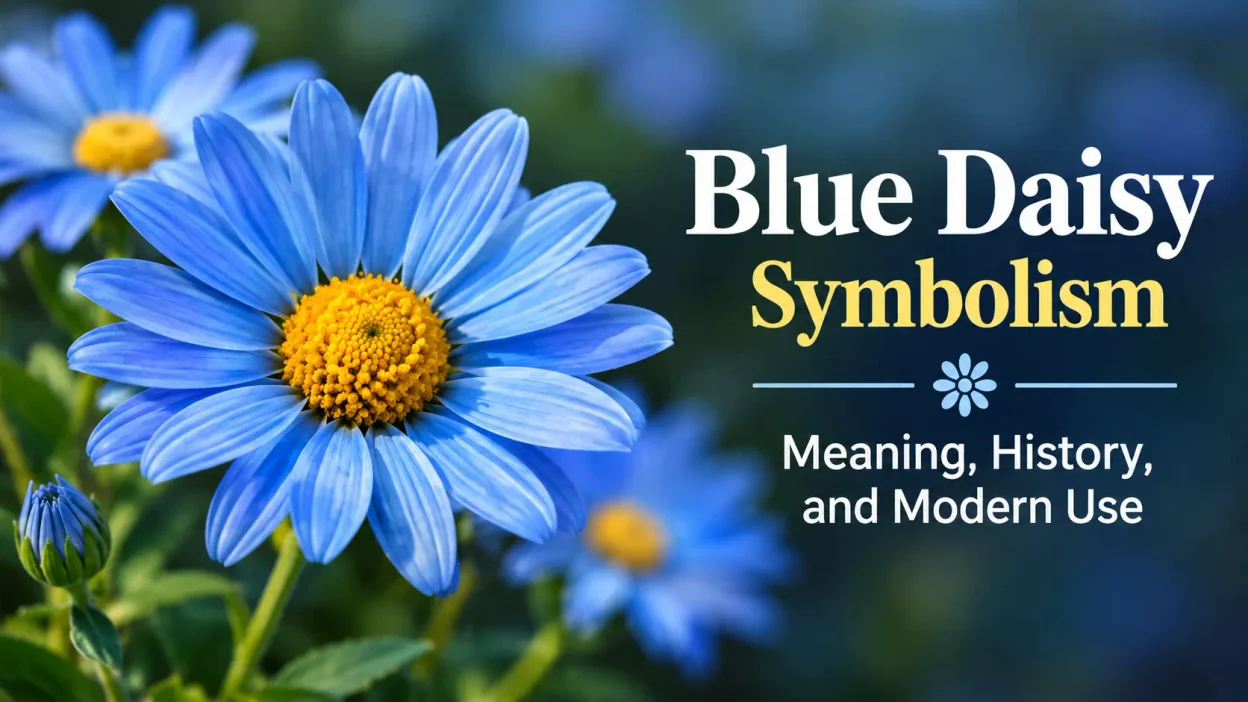
A blue daisy usually appears as a flower with a rounded central disk surrounded by narrow petals in shades of blue. Depending on the design or plant, the petals may look sky blue, pale blue, turquoise, or deep blue, sometimes with a yellow or dark center.
The term does not always refer to one specific botanical species. Some flowers marketed or illustrated as blue daisies are daisy-like plants, while others are white flowers colored artificially or blue blooms created through digital illustration. The botanical identity matters when discussing natural characteristics, but the visual image can still carry symbolic meaning.
Blue daisies appear in floral arrangements, garden-inspired illustrations, stationery, decorative prints, greeting cards, and online graphics. Their unusual color makes them especially noticeable in designs dominated by familiar white or yellow flowers.
The contrast between the flower’s simple shape and its unexpected color is central to its appeal. The daisy looks recognizable and approachable, while the blue petals make it feel unusual. Symbolically, that combination can suggest someone who remains authentic while standing apart from the crowd.
The Core Meaning of Blue Daisy Symbolism
Blue daisies bring together two sets of associations: the familiar meanings attached to daisies and the cultural meanings often assigned to blue. Their symbolism is therefore best understood as a combination rather than a fixed meaning inherited from one ancient tradition.
The daisy commonly suggests innocence, cheerfulness, simplicity, and new beginnings in modern flower symbolism. Its open petals and uncomplicated form contribute to an impression of friendliness and natural beauty.
Blue, meanwhile, is frequently connected with calmness, trust, stability, and reflection in American visual culture. Light blue may feel gentle and reassuring, while darker shades can suggest seriousness, depth, or formality.
Together, these associations create several common interpretations:
- Individuality: An unusual blue flower can represent the choice to be different without seeking attention.
- Calmness: The blue color can suggest a peaceful attitude or a desire for emotional balance.
- Hope: A distinctive flower may represent optimism, especially during a period of change.
- Innocence: The daisy’s traditional associations can remain present even when its color is unusual.
- Originality: Blue petals can turn a familiar flower into an image of creative expression.
These meanings are interpretive, not universal rules. A blue daisy used in a birthday card may express cheerful affection, while the same image in a painting may represent solitude or imagination.
What Blue Adds to Traditional Daisy Symbolism
The color blue changes how people interpret a daisy because colors carry cultural associations of their own. In the United States, blue often appears in settings that communicate reliability, calmness, openness, and confidence. It is also associated with sadness in expressions such as “feeling blue,” so its meaning depends on context.
When blue is paired with the daisy’s familiar shape, the result can feel both comforting and unusual. The flower retains its friendly appearance, but the unexpected color makes it more expressive.
Different shades can suggest different moods:
- Light blue: Gentleness, peacefulness, and emotional ease.
- Sky blue: Optimism, openness, and a fresh outlook.
- Turquoise blue: Creativity, playfulness, and individuality.
- Deep blue: Reflection, loyalty, and a more serious emotional tone.
These are common artistic associations, not a standardized code. A pale blue daisy on a greeting card may feel cheerful, while a dark blue flower against a black background might suggest solitude or remembrance.
The Historical Origins of Daisy Flower Symbolism
The daisy has a longer documented symbolic history than the blue daisy specifically. In European art and literature, daisies have been connected with innocence, purity, love, and springtime. Their simple shape and familiar appearance made them accessible subjects for poets, painters, and storytellers.
In medieval European culture, daisies appeared in literary and artistic contexts associated with love and the renewal of spring. Later Christian artwork sometimes used flowers to communicate religious ideas, although a flower’s meaning could change depending on the scene in which it appeared.
The daisy also became associated with innocence through the European and American language of flowers, especially during the 19th century. This practice, known as floriography, assigned sentiments to particular flowers and helped people communicate emotions through bouquets, floral illustrations, and gifts.
However, Victorian flower dictionaries did not always agree. Their meanings reflected a mixture of folklore, literary invention, religious tradition, and contemporary social conventions. It is therefore more accurate to describe daisy symbolism as an evolving cultural tradition than as a single ancient system.
The blue daisy’s modern meanings developed from this broader background. There is no well-established historical tradition that assigns the blue daisy one specific, universally accepted message.
Are Blue Daisies Naturally Occurring Flowers?
The botanical reality behind the blue daisy is an important part of its symbolism. Daisies belong to a broad group of plants, and the common name covers multiple species and varieties. A flower that looks like a blue daisy may not be a true daisy in the strict botanical sense.
Some daisy-like flowers naturally display blue or blue-violet petals. The felicia, often called the blue daisy, is one example of a plant with blue petals surrounding a contrasting central disk. Other flowers sold or depicted as blue daisies may belong to different botanical groups or may have been colored artificially.
Many familiar true daisies, including the common English daisy, are not naturally bright blue. Blue floral arrangements may therefore include dyed flowers, while digital illustrations can use shades that do not correspond to a naturally occurring variety.
This distinction can influence the flower’s symbolic appeal. A naturally blue bloom may suggest the unusual beauty found in nature, whereas an artificially colored daisy may communicate creativity, celebration, or a deliberate departure from convention.
Rarity should not be confused with impossibility. Blue daisy-like flowers do exist, but the familiar image of a vivid blue daisy is not representative of every plant commonly called a daisy.
Blue Daisy Symbolism in American Culture
In modern American culture, flowers are used to communicate feelings in settings ranging from birthdays and weddings to memorials and everyday home decoration. Their meanings often come from shared visual associations rather than formal rules.
A blue daisy can fit comfortably into this culture because it combines a recognizable flower with an uncommon color. It may suggest a person who values originality, a fresh start, or a calmer approach to life.
Its interpretation also depends on where it appears. A bouquet given to a friend might communicate encouragement and appreciation. A blue daisy printed on a notebook could express a creative personality, while a floral illustration in a bedroom might contribute to a peaceful atmosphere.
Unlike established holiday flowers, such as poinsettias at Christmas, the blue daisy does not have one dominant place in American seasonal traditions. Its meaning remains flexible, allowing individuals to use it for personal reasons rather than following a widely recognized custom.
That flexibility is part of its appeal. The flower can communicate a personal sentiment without requiring the recipient to know a specific historical legend or cultural tradition.
What a Blue Daisy Means as a Gift
Giving flowers is a familiar way to express appreciation, affection, sympathy, or encouragement in the United States. A blue daisy offers a less conventional alternative to familiar choices such as red roses or white lilies.
The recipient’s circumstances matter more than any fixed definition. A blue daisy given before a new job or move might represent optimism and confidence. As a gift between friends, it could communicate appreciation for someone’s distinctive personality.
Blue daisies can also work in arrangements intended to feel light and informal. Their unusual color creates a focal point without necessarily carrying the romantic expectations that sometimes accompany red roses.
For a thoughtful gift, consider pairing the flower with a short message that explains the intention. For example, a note about appreciating someone’s originality gives the flower a personal meaning that a generic symbolism chart cannot provide.
There is no established rule that blue daisies are appropriate only for romantic partners, friends, or family members. Their flexible symbolism makes them suitable for different relationships, provided the overall arrangement fits the occasion.
Blue Daisies in Weddings, Birthdays, and Celebrations
Blue daisies can contribute to celebrations where color and personal expression matter as much as traditional floral meanings.
At weddings, blue flowers may complement a blue-and-white palette or a garden-inspired setting. A daisy’s informal appearance can soften more structured arrangements, while blue petals can introduce a distinctive accent. The choice may reflect the couple’s preferred colors rather than a traditional wedding custom.
For birthdays, blue daisies can suggest originality and a cheerful outlook. They may be especially appropriate for someone who enjoys unusual flowers or creative design.
During graduation celebrations, the combination of a fresh-looking flower and an uncommon color can be used to represent a new chapter. This interpretation is a contemporary choice, not an established historical meaning.
Blue daisies can also appear in baby showers, spring celebrations, and handmade greeting cards. In these contexts, their meaning usually comes from the event, the chosen colors, and the message accompanying the flower.
Because blue daisies are not tied to one particular American holiday, they can be used throughout the year without suggesting a specific seasonal or religious observance.
Emotional and Psychological Associations of Blue Daisies
Flowers often communicate emotion through color, shape, and the setting in which people encounter them. Blue daisies can feel soothing because blue is frequently used in visual environments intended to convey calmness, while the daisy’s open form can create an impression of simplicity.
The flower’s unusual color may also invite curiosity. People recognize the familiar daisy shape but notice that something about it differs from expectation. That contrast can make the flower feel imaginative, playful, or personal.
For some people, a blue daisy may represent the wish to remain distinctive without feeling isolated. Its familiar form suggests belonging, while its color introduces difference. This can make it a useful personal symbol for individuality within a community.
Still, flower colors do not have identical psychological effects on everyone. Personal memories, cultural background, preferences, and the immediate situation can change how a person responds to a particular image.
A blue daisy may remind one person of a peaceful garden and another of a meaningful gift. Those associations are part of the flower’s personal significance, even when they are not shared by everyone.
Blue Daisy Tattoos, Jewelry, and Personal Style
In contemporary tattoo culture, flowers are often chosen for their appearance as well as their symbolic meaning. A blue daisy can offer a distinctive design that feels softer than a large, dramatic floral tattoo.
A small blue daisy tattoo might represent a personal milestone, a meaningful friendship, or a preference for unconventional beauty. A larger design could incorporate leaves, several flowers, geometric patterns, or a watercolor effect to emphasize creativity.
Jewelry featuring blue daisies can communicate similar ideas in a more understated way. A pendant, enamel pin, or pair of earrings may serve as a reminder of a relationship, a favorite place, or an individual value.
The choice of color also affects the design. Pale blue petals can create a delicate appearance, while saturated blue creates stronger contrast and draws more attention.
There is no universal tattoo meaning that every blue daisy wearer shares. If the design represents something specific, its personal story is often more meaningful than a general symbolic definition.
Blue Daisy Symbolism in Art, Home Decor, and Digital Culture
Blue daisies appear naturally suited to visual design because their familiar form is easy to recognize and their color creates contrast. Artists can use them to make a conventional floral scene feel more imaginative without changing the flower’s basic structure.
In home decor, blue daisy prints may suit bedrooms, craft rooms, kitchens, and informal living spaces. Pale blue flowers can complement white walls and light fabrics, while stronger shades can provide contrast against neutral backgrounds.
Digital illustrations and social media graphics offer even greater freedom. Artists can create vivid blue flowers without needing to reproduce the exact appearance of a real plant. In this setting, the blue daisy may represent creativity, optimism, or an aesthetic preference for unusual natural imagery.
The flower can also be used in digital stickers, profile graphics, invitations, and personal stationery. Its meaning depends on the surrounding text and imagery, which can make it an effective visual accent.
However, a blue daisy emoji or illustration does not have one standardized meaning across social platforms. Some people may use it decoratively, while others may attach a personal or emotional message to it.
Blue Daisy Symbolism Across Different Cultures
Flower meanings vary across cultures, and the same flower or color may carry different associations depending on its religious, literary, or social context.
In many European and North American flower-symbolism traditions, daisies are associated with innocence and simplicity. In some Christian artistic contexts, flowers have also been used to express purity, renewal, or spiritual ideas, depending on the particular plant and composition.
Blue carries different meanings across societies and historical periods. In modern Western settings, it is frequently connected with calmness and trust, but it can also represent sadness. In religious art, particular shades of blue may have associations that depend on the figure, garment, or tradition being depicted.
These broader traditions can inform the interpretation of a blue daisy, but they do not establish an ancient or universal meaning for the flower itself. It would be misleading to claim that all cultures understand blue daisies as symbols of hope or spiritual protection.
For cross-cultural gifts or artwork, the most respectful approach is to consider the recipient’s background and the setting in which the flower will be used.
Is Blue Daisy Symbolism Spiritual or Religious?
Blue daisies sometimes appear in contemporary spiritual content as symbols of peace, intuition, emotional balance, or personal growth. These interpretations draw mainly on broader associations with flowers and the color blue rather than on a specific, widely documented religious tradition centered on blue daisies.
Someone may use the flower as a reminder to slow down, remain open to change, or approach a difficult period with hope. Another person may include it in a meditation space simply because its colors and shape create a calming visual impression.
Such uses can be personally meaningful without being historically universal. There is no widely established religious doctrine that assigns blue daisies a single spiritual message, and claims that the flower guarantees protection or predicts future events should not be presented as facts.
The distinction between personal belief and documented tradition allows people to explore symbolism without confusing modern interpretations with historical evidence.
Common Misunderstandings About Blue Daisy Meaning
One common misunderstanding is that blue daisies have a single ancient meaning. Unlike some flowers with well-documented roles in particular religious or literary traditions, the blue daisy does not have one broadly established historical symbolism of its own.
Another mistake is assuming that every blue daisy is a naturally blue variety of the common daisy. The image may represent a blue daisy-like species, a dyed flower, or an artistic interpretation.
It is also inaccurate to treat blue as a universal symbol of happiness or peace. Blue may suggest trust or calmness in one setting and sadness or distance in another.
Finally, modern spiritual interpretations should not be confused with botanical facts or formal religious teachings. A person can reasonably choose a blue daisy as a personal emblem of hope without claiming that everyone throughout history has understood it the same way.
Recognizing these distinctions makes the symbolism more useful. It leaves room for creativity while preserving the difference between cultural convention, historical evidence, and personal meaning.
Blue Daisy Symbolism at a Glance
| Context | Common interpretation | Why it fits |
|---|---|---|
| Personal identity | Individuality and originality | The unusual color distinguishes a familiar flower |
| Friendship gifts | Appreciation and encouragement | The flower feels cheerful without requiring a romantic message |
| Weddings and celebrations | Fresh beginnings and creative expression | Blue can complement a chosen color palette |
| Tattoos and jewelry | Personal growth or meaningful memories | The wearer can assign an individual story to the design |
| Home decor and art | Calmness and imagination | Blue and the daisy’s simple shape create a gentle visual effect |
| Spiritual reflection | Peace and emotional balance | Contemporary interpretations combine broader color and flower associations |
These meanings are flexible cultural interpretations, not a formal or universally recognized symbolic code.
How the Meaning of Blue Daisies Continues to Evolve
Flower symbolism has never been entirely fixed. In 19th-century Europe and America, flower dictionaries helped popularize the idea that particular flowers could communicate specific emotions. Modern design, gardening, social media, and personal expression have continued to expand the ways people use floral imagery.
Blue daisies fit this evolution because their meaning can be built from recognizable elements. The flower contributes associations with innocence and simplicity, while blue introduces a different mood and visual identity.
Digital art has made unusual floral colors more familiar, and modern floral design can incorporate flowers selected for their appearance rather than for an established symbolic history. As a result, a blue daisy can carry a personal message without needing an ancient legend behind it.
Its meaning may change from one person to another, but that flexibility does not make the symbolism meaningless. It reflects the way people use familiar images to express feelings that are sometimes difficult to communicate directly.
Frequently Asked Questions
What does a blue daisy symbolize spiritually?
A blue daisy may represent calmness, hope, intuition, or personal growth in contemporary spiritual interpretations. These meanings are not part of one universally recognized religious tradition, so the flower’s significance depends on individual beliefs.
Does a blue daisy symbolize love?
A blue daisy can express affection, appreciation, or a gentle form of romantic interest. Unlike a red rose, however, it does not have one widely recognized romantic meaning, making the message more dependent on the giver’s intention.
Is a blue daisy a real flower?
Yes, some daisy-like plants naturally produce blue or blue-violet blooms, including felicia. Other flowers presented as blue daisies may be artificially colored or illustrated, so the exact plant matters when identifying a real specimen.
What does a blue daisy tattoo mean?
A blue daisy tattoo may express originality, calmness, hope, or a personal connection to nature. Its meaning can also reflect a relationship or life experience that the wearer wants to remember.
Are blue daisies a symbol of good luck?
Blue daisies are not widely established as traditional good-luck symbols. Someone may choose to associate one with optimism or a fresh start, but that is a personal or contemporary interpretation rather than a universal historical belief.
What is the difference between blue and white daisy symbolism?
White daisies are commonly associated with innocence, purity, and simplicity in Western flower symbolism. Blue daisies retain some of those associations while adding modern interpretations linked to calmness, originality, and emotional reflection.
Are blue daisies appropriate for sympathy gifts?
They can be, especially when the recipient appreciates unusual flowers or calming colors. A thoughtful note explaining the intended message of comfort or remembrance is more reliable than assuming the flower has a universally recognized meaning for mourning.
Conclusion
Blue daisy symbolism combines the daisy’s traditional associations with innocence and new beginnings with blue’s modern connections to calmness, trust, and individuality. Although the flower does not have one universally documented historical meaning, it offers a flexible way to express encouragement, originality, affection, or personal reflection.
In modern American culture, the blue daisy can appear in gifts, artwork, tattoos, home decor, and digital illustrations, with each setting shaping its message. Its appeal comes from the contrast between a familiar flower and an unexpected color, allowing people to make the image their own without relying on a fixed symbolic rule.