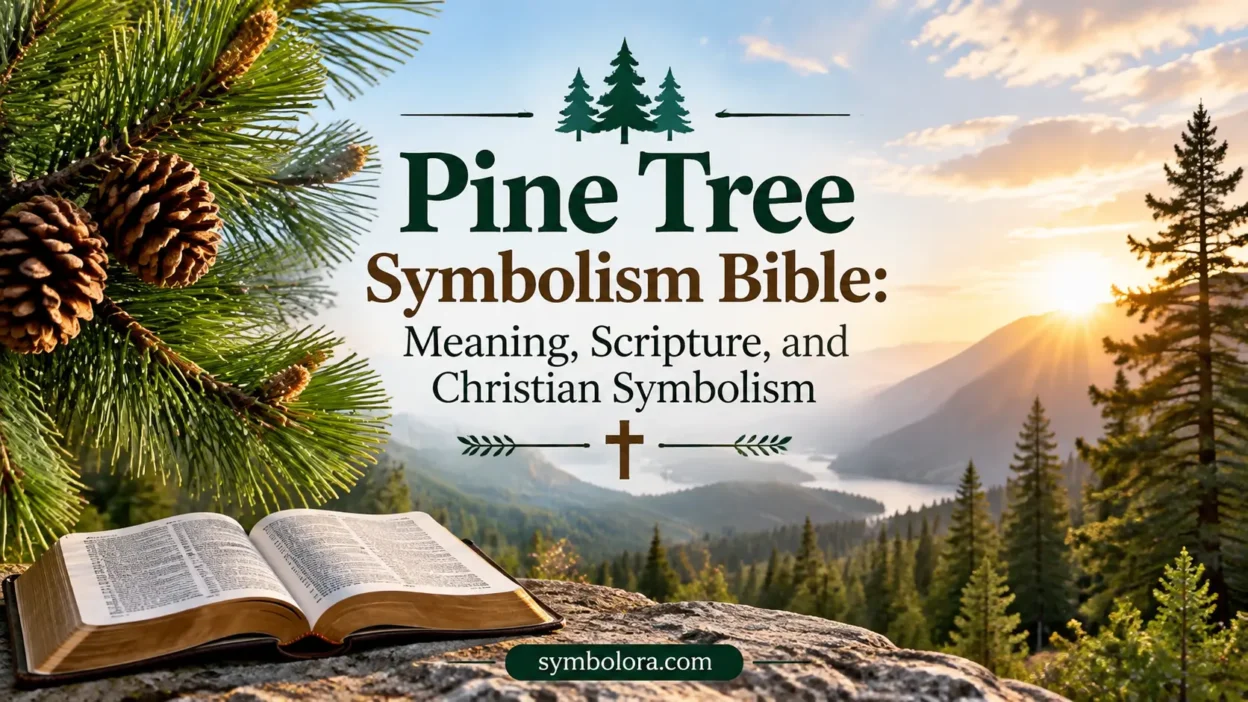
Pine trees are known for staying green when many other trees lose their leaves. That natural quality makes pine tree symbolism Bible passages especially interesting to readers looking for the biblical meaning of evergreens. In Scripture, trees translated as pine, fir, cypress, or juniper can appear in images of restored land, flourishing life, beauty, and God’s sanctuary.
The Bible does not give the pine tree one fixed symbolic definition. Instead, its meaning comes from the setting in which an evergreen or related tree appears. In prophetic passages, these trees can transform barren landscapes, beautify holy places, or illustrate flourishing under God’s care.
There is also an important translation issue. Biblical Hebrew tree names do not always correspond neatly to modern English species. A tree called “pine” in one Bible translation may appear as “cypress,” “juniper,” “fir,” or another evergreen in a different translation. Understanding that distinction prevents modern assumptions from being mistaken for explicit biblical teaching.
Quick Answer
Pine tree symbolism Bible interpretations commonly associate the evergreen tree with endurance, restoration, flourishing, divine provision, and beauty devoted to God. These meanings come mainly from biblical passages where pine-like or evergreen trees appear in restored wilderness, sacred settings, and images of God’s sustaining care.
TL;DR
- Evergreen trees can represent flourishing and continued life.
- Isaiah connects pine-like trees with wilderness restoration.
- Evergreen wood also appears in imagery surrounding God’s sanctuary.
- Translation differences make exact tree identification difficult.
- Christian tradition later expanded evergreen symbolism beyond biblical texts.
- The Bible never assigns pine trees one universal symbolic meaning.
What Does a Pine Tree Represent in the Bible?
The safest way to understand pine symbolism in Scripture is through context rather than assigning the tree a single secret meaning.
Several themes stand out.
Pine-like and evergreen trees can suggest restoration because biblical prophets picture trees growing where the land was previously barren. They can suggest flourishing because healthy green vegetation contrasts with dryness and destruction. They can also communicate beauty and honor when valuable trees are associated with sacred spaces.
In some passages, evergreen imagery contributes to ideas of God’s care and provision. The emphasis is not simply that a tree survives for a long time. Rather, healthy vegetation becomes visible evidence that conditions have changed.
That distinction matters. Modern readers often associate evergreens automatically with immortality. While that interpretation can fit later Christian symbolism, biblical passages should first be read according to their immediate literary setting.
| Biblical Context | Symbolic Association | Why It Matters |
|---|---|---|
| Wilderness becoming fertile | Restoration | Barren land becomes productive |
| Green evergreen imagery | Flourishing | Healthy growth contrasts with desolation |
| Trees near sacred imagery | Beauty and honor | Valuable trees adorn holy space |
| Divine care | Provision | Life and fruitfulness depend on God |
| Prophetic renewal | Hope | Destruction is not presented as permanent |
| Modern Christian use | Enduring life | Evergreen foliage supports later symbolism |
Why Evergreen Trees Naturally Suggest Endurance
A pine does not behave visually like a deciduous tree. Oaks, maples, and many other trees lose their leaves seasonally, while pines and many other conifers retain green foliage through winter.
That difference makes evergreen trees natural images of continuity.
For modern Christians, a green tree surrounded by bare winter branches can suggest steadfastness, hope, and life that continues through difficult circumstances. This interpretation is understandable, but it should not automatically be projected onto every biblical tree passage.
Biblical writers often use vegetation more broadly. A flourishing tree may represent prosperity or righteous stability, while a dead or cut tree may communicate judgment, destruction, or loss.
Therefore, the pine’s modern association with endurance fits a larger biblical pattern of healthy trees representing sustained life, even when a particular passage does not specifically emphasize evergreen foliage.
Pine Trees and Restoration in Isaiah 41
One of the strongest passages for understanding the symbolism appears in Isaiah 41.
The chapter describes a dramatic reversal of barren conditions. Water becomes available where there had been thirst, and different kinds of trees appear in wilderness and desert landscapes.
Some English translations identify a pine among those trees. Others translate the relevant ancient plant names as cypress, plane, juniper, elm, or box.
The important symbolic point does not depend entirely on identifying the exact modern species.
The setting is one of transformation.
A wilderness filled with healthy trees is the opposite of a dry, lifeless wasteland. Vegetation therefore becomes a sign that deprivation has ended and renewal has begun.
For readers, the image can communicate:
Restoration after loss. What was barren becomes capable of supporting life.
Divine provision. The transformation occurs because God provides what the wilderness lacks.
Visible renewal. Restoration is not merely an abstract promise. It changes the landscape.
Hope under difficult conditions. A desert does not appear to be a natural place for a thriving grove, which makes the prophetic contrast especially striking.
This is stronger than interpreting the pine merely as a symbol of “strength.” The passage uses trees as part of a larger picture of God changing conditions that appeared hopeless.
The Pine Tree and God’s Sanctuary in Isaiah 60
Isaiah 60 provides another important biblical setting.
The chapter describes the future glory of Zion. Valuable materials and resources come to beautify the sanctuary, and trees from Lebanon are included in that imagery.
Here translation differences become particularly noticeable. Depending on the English Bible, readers may encounter pine, fir, cypress, juniper, elm, plane, box, or cedar.
In translations that use “pine,” the tree appears in connection with the beautification of God’s holy place.
That gives the imagery a different emphasis from Isaiah 41.
The wilderness passage emphasizes transformation and renewal. Isaiah 60 emphasizes beauty, honor, worship, and sacred purpose.
A valuable tree brought into a holy setting is no longer simply part of a forest landscape. Its material beauty contributes to something dedicated to God.
For Christian readers, this can support a broader principle: natural beauty and valuable resources can be directed toward worship rather than treated as ends in themselves.
Still, the passage should not be turned into a claim that pine wood itself was inherently sacred. The significance comes from its role in the prophetic description of the sanctuary.
Why Lebanon Matters in Biblical Tree Imagery
Lebanon has an important place in biblical descriptions of impressive trees and valuable timber.
Its forests, particularly its famous cedars, became associated with height, strength, quality, and grandeur. Biblical writers could therefore invoke Lebanon to create an immediate image of magnificent vegetation.
When Isaiah describes the “glory of Lebanon” coming to beautify a sacred place, the expression carries more weight than a generic reference to lumber.
The trees represent some of the finest natural resources available within the geographical imagination of the biblical world.
This background helps explain why tree imagery can communicate honor and splendor without requiring every species to have its own independent symbolic code.
Modern symbolism websites sometimes treat cedar, pine, fir, and cypress as though Scripture assigns each tree a precise spiritual definition. The biblical texts are usually less rigid. The forest, its quality, and its relationship to the surrounding passage often matter more than a modern symbolic dictionary suggests.
Pine, Fir, Cypress, or Juniper? Why Bible Translations Differ
This is one of the most important issues when discussing biblical pine symbolism.
Modern readers are accustomed to precise botanical categories. We distinguish pine from fir, cedar, juniper, spruce, and cypress. Ancient plant terminology does not always transfer cleanly into those categories.
As a result, English Bible translations sometimes identify the same Hebrew tree term differently.
A passage that says “pine” in one translation may say:
- cypress
- fir
- juniper
- plane
- elm
- box tree
- another evergreen species
This does not necessarily mean one translation is careless. Translators are working with ancient vocabulary, historical ecology, linguistic evidence, and uncertain species identification.
That uncertainty changes how symbolism should be interpreted.
It is reasonable to discuss pine symbolism when an English translation explicitly uses “pine.” It is less responsible to claim that every passage proves a theological doctrine specifically about the modern genus Pinus.
The broader category of evergreen or valuable forest tree is often more reliable.
Evergreen Imagery and God’s Sustaining Care
Hosea 14 provides another useful example, although translations disagree about the tree involved.
Near the end of Hosea, the book shifts toward repentance, healing, renewed growth, and fruitfulness. God is compared in some translations to a flourishing evergreen, cypress, fir, juniper, or pine-like tree.
The surrounding message is especially important: Israel is being called away from idols, while genuine fruitfulness comes from God.
The tree imagery therefore supports care, provision, vitality, and dependence on God.
It would be easy to reduce this image to “evergreen equals eternal life,” but that misses the immediate point. The passage connects healthy growth with the source from which blessing and fruitfulness come.
The evergreen image works because a vigorous green tree looks alive, established, and capable of providing shelter or abundance.
For Christian interpretation, the passage can therefore serve as an image of dependable divine care without requiring the tree itself to become an object of spiritual power.
Restoration Is More Central Than Immortality
Many modern explanations say the pine tree represents immortality because it remains green through winter.
That idea has a long life in later symbolism, but it needs qualification when applied directly to the Bible.
In passages such as Isaiah 41, restoration is clearer than immortality.
The landscape begins as wilderness. God provides water and vegetation. Trees then become part of a renewed environment.
The movement is:
barrenness → divine intervention → growth → visible renewal
That sequence explains the symbolism more accurately than simply saying “pine equals eternal life.”
For a Christian reader, restoration can have spiritual resonance. It can recall renewal, hope after hardship, and God’s ability to bring life into situations characterized by scarcity.
Yet the original prophetic image also has a communal and environmental dimension. It concerns a transformed landscape and the fortunes of God’s people, not merely an individual’s private spiritual journey.
Strength and Resilience in Christian Interpretation
Pine trees also lend themselves naturally to symbolism of resilience.
Many pine species tolerate environments that challenge other plants. They can grow in cold regions, mountainous terrain, rocky soils, and areas with long winters.
That physical resilience has encouraged Christians and non-Christians alike to use pine imagery for perseverance.
A pine tattoo, memorial design, painting, or devotional image may therefore communicate:
steadfast faith during hardship, survival after loss, emotional endurance, or commitment that remains intact through changing circumstances.
These are modern symbolic applications rather than fixed biblical definitions.
The distinction is useful because it allows contemporary symbolism to develop without rewriting Scripture. A person can reasonably choose a pine tree as a personal image of perseverance while recognizing that the Bible does not explicitly state, “The pine tree symbolizes resilience.
Pine Trees, Fruitfulness, and Spiritual Growth
Biblical tree symbolism frequently links healthy growth with a healthy spiritual condition.
Psalms and prophetic writings use flourishing vegetation to communicate stability, blessing, righteousness, renewal, or restored community. Fruit-bearing trees are especially useful because their health produces visible results.
Pine trees are not normally valued for edible fruit in the way figs, olives, dates, or grapes were in biblical agricultural life. Therefore, biblical discussions of fruitfulness should not be transferred mechanically to pine biology.
The connection is primarily symbolic.
A healthy tree is rooted, growing, and visibly alive. That makes it a natural metaphor for a life sustained by the right source.
This principle also helps explain Hosea’s evergreen imagery. The emphasis falls not merely on appearance but on where fruitfulness ultimately originates.
For Christians, that can represent dependence on God rather than self-sufficiency.
Pine Trees and Christmas in the United States
For many Americans, the strongest Christian association with an evergreen tree is Christmas.
A decorated evergreen can symbolize continuing life during winter, hope, celebration, family tradition, and, for Christians, the birth of Jesus Christ.
However, the Christmas tree should not be confused with an explicit biblical pine-tree tradition.
The Bible does not describe Mary and Joseph decorating an evergreen, nor does it command Christians to use Christmas trees. The familiar Christmas tree developed much later through European customs that eventually spread widely in the United States.
Christian communities subsequently gave evergreen trees additional religious interpretations. Their persistent greenery could represent enduring life or hope. Lights could be associated with Christ as light, while a star placed at the top could recall the Star of Bethlehem.
Those meanings belong mainly to later Christian tradition.
Today, Christmas trees in the United States occupy both religious and secular settings. Churches may use them within explicitly Christian celebrations, while homes, businesses, government buildings, and shopping centers may display them primarily as seasonal decorations.
The same tree can therefore carry different meanings depending on context.
What Pine Trees Mean in Modern American Christianity
American Christian uses of pine and evergreen imagery extend beyond Christmas.
Churches, retreat centers, Christian publishers, memorial programs, wedding decorations, and devotional artwork sometimes use evergreen branches or forest scenes.
The imagery tends to communicate qualities such as constancy, peace, renewal, endurance, or continued hope.
Pines also fit naturally into outdoor Christian ministries. Camps and retreat centers located in forests may use tree imagery in logos because it reflects their physical surroundings while also suggesting spiritual growth or stability.
Memorial contexts add another layer.
Evergreen branches can represent remembrance and continuity after death. For Christians who believe in resurrection and eternal life, evergreen imagery may visually complement that hope.
Again, these uses should be distinguished from direct biblical statements. They are interpretations shaped by the tree’s physical characteristics, Christian theology, and later cultural traditions.
Emotional and Psychological Meaning of the Pine Tree
Symbolism works partly because physical objects trigger recognizable emotional associations.
A tall pine forest can create a sense of shelter and quiet. Its vertical trunks draw the eye upward, while the smell of pine may evoke wilderness, winter, childhood holidays, or family gatherings.
For Americans raised with Christmas traditions, pine fragrance can carry unusually strong memories. It may recall decorating a tree, visiting relatives, attending church services, or spending winter holidays at home.
Other people associate pines primarily with mountains, camping, national forests, or outdoor solitude.
These experiences help explain why modern pine symbolism can communicate:
Stability — the tree remains visually consistent across seasons.
Endurance — it survives difficult environmental conditions.
Memory — evergreen scent and appearance can trigger holiday or family associations.
Hope — green foliage remains visible during winter.
Peace — forests are often connected with quiet and retreat.
These emotional meanings are culturally shaped. They should not be presented as universal reactions shared by every person.
Pine Tree Tattoos and Personal Christian Meaning
Pine tree tattoos are common enough that their symbolism extends well beyond religion.
A single pine can represent independence or perseverance. A line of trees may represent wilderness, travel, home, or attachment to a particular landscape. A forest silhouette can commemorate outdoor experiences or a person’s connection to nature.
For Christians, the same design can take on additional meaning.
A pine combined with a cross might represent faith that remains steady through hardship. Mountains and pines may suggest finding spiritual reflection in nature. An evergreen used in a memorial tattoo can communicate remembrance and Christian hope beyond death.
Personal context matters more than any universal tattoo dictionary.
Two people may wear nearly identical pine tattoos for completely different reasons. One may associate the tree with God, another with a deceased relative, and another simply with hiking in the Rocky Mountains.
A biblical interpretation is therefore possible, but it should not automatically be assumed.
Common Misunderstandings About Biblical Pine Symbolism
One common mistake is claiming that the Bible gives pine trees one exact meaning.
It does not.
Biblical tree imagery changes with context, and the identification of particular ancient species can be uncertain.
Another mistake is treating Christmas-tree symbolism as though it came directly from biblical narratives. Christmas evergreens became Christian cultural symbols much later.
A third misunderstanding involves Jeremiah 10, which describes wood being cut, shaped or worked, and decorated. Some modern discussions claim that this passage is specifically condemning Christmas trees. The historical context concerns idolatry and manufactured religious objects rather than a direct discussion of the later Christmas-tree custom.
There is also a broader problem with overly mystical interpretations.
The Bible does not teach that encountering a pine tree is a supernatural message, omen, or coded prediction about a person’s future. Readers may use the tree as a devotional reminder, but that is different from claiming Scripture assigns prophetic messages to ordinary encounters with pines.
Keeping these distinctions clear makes biblical symbolism more meaningful rather than less.
How Pine Tree Symbolism Evolved
The meaning attached to pine and evergreen trees developed through several overlapping stages.
In biblical texts, pine-like trees appear primarily within larger images involving landscape, restoration, valuable timber, flourishing vegetation, divine provision, or sacred beauty.
Later cultures placed additional emphasis on the evergreen’s ability to remain green during winter.
Christian traditions then incorporated evergreen imagery into seasonal celebrations and religious art. The connection with enduring life became particularly useful in Christmas and memorial settings.
In the United States, these religious associations mixed with broader cultural meanings.
Pine forests became connected with wilderness, recreation, national landscapes, mountain living, rustic design, and environmental identity. Christmas commercialization also made evergreen imagery recognizable even to people with no religious interpretation of the tree.
The modern pine therefore carries several layers at once: biblical associations, later Christian tradition, seasonal imagery, ecological identity, and personal memory.
Biblical Meaning Versus Modern Symbolism
Keeping biblical interpretation and modern symbolism separate makes the subject much clearer.
Biblically, pine-like or evergreen trees are most convincing as images within larger themes of renewal, flourishing, provision, beauty, and restored conditions.
In later Christian interpretation, evergreens became stronger symbols of enduring life, steadfast faith, resurrection hope, and continuity.
In secular American culture, pine trees can represent nature, wilderness, winter, resilience, outdoor identity, and Christmas without carrying an explicitly religious message.
None of these meanings automatically cancels the others.
Symbolism changes according to setting. A pine branch decorating a church sanctuary, a pine tattoo on a hiker, and a pine logo on an outdoor company may look similar while communicating very different ideas.
Understanding context is therefore more useful than searching for one universal definition.
Frequently Asked Questions
What does a pine tree symbolize biblically?
A pine or pine-like evergreen can be associated with restoration, flourishing, divine provision, and beauty used for sacred purposes. The exact meaning depends on the passage rather than on a universal biblical definition.
Where is the pine tree mentioned in the Bible?
Some English translations use “pine” in passages such as Isaiah 41:19 and Isaiah 60:13. Other translations identify the same ancient tree terms as cypress, fir, juniper, plane, elm, or another species, so wording varies considerably.
Does a pine tree symbolize eternal life in Christianity?
It can in later Christian symbolism, largely because evergreen foliage remains green through winter. However, “pine equals eternal life” is better understood as a Christian symbolic interpretation than as a definition explicitly stated by the Bible.
What does a green tree represent spiritually?
Biblical green-tree imagery can indicate vitality, flourishing, abundance, or healthy growth, depending on context. Some passages also use trees in negative religious contexts, which is why “green tree” does not have one automatic spiritual meaning.
Is a Christmas tree biblical?
The Bible neither describes nor commands the modern Christmas-tree custom. Christians later adopted and interpreted evergreen traditions in ways that could represent continuing life, hope, Christ, and celebration of the Nativity.
Is Jeremiah 10 talking about Christmas trees?
Jeremiah 10 addresses idolatry and human-made objects used within religious worship. Applying the passage directly to the much later custom of decorating Christmas trees overlooks the historical setting and the chapter’s focus on idols.
What does a pine tree tattoo mean for a Christian?
A Christian may use a pine tattoo to represent steadfast faith, endurance, hope, remembrance, or continuing life. That meaning is personal and devotional rather than a tattoo symbol specifically prescribed by Scripture.
Conclusion
The biblical meaning of the pine tree is best understood through the passages in which pine-like and evergreen trees appear. Rather than giving the tree one fixed definition, Scripture places these trees within scenes of restored wilderness, flourishing vegetation, divine provision, valuable beauty, and sacred purpose.
Later Christian tradition expanded those associations. Because evergreen trees retain their foliage through winter, they became fitting images of endurance, hope, continuing life, and eventually Christmas celebration. Modern American culture added further associations with wilderness, family memories, outdoor identity, and seasonal tradition.
For that reason, pine tree symbolism Bible interpretations are strongest when they distinguish what Scripture actually says from meanings developed later. The pine’s enduring greenery makes it an effective symbol, but its biblical significance ultimately comes from context: life replacing barrenness, beauty serving a sacred purpose, and flourishing that depends on God’s provision.