Black raven symbolism often centers on mystery, intelligence, transformation, and the unknown. With glossy black feathers, a strong beak, and a distinctive call, the raven has appeared in myths, folklore, literature, and visual art as a bird associated with both wisdom and death. In the United States, it can represent independence, personal change, spiritual curiosity, or an interest in the darker side of nature.
The raven’s reputation comes from more than its appearance. Ravens are highly intelligent birds known for problem-solving, social behavior, and adaptability. Their ability to survive in varied environments has helped make them compelling figures in stories about cleverness, endurance, and survival.
Yet a raven does not mean the same thing in every culture. Some traditions connect it with creation and knowledge, while others associate it with warfare, death, or messages from the unseen world. Understanding these differences makes it easier to separate historical beliefs from modern spiritual interpretations.
Quick Answer
Black raven symbolism commonly represents intelligence, mystery, transformation, and the unknown in modern American culture, especially in tattoos, literature, and gothic art. Historically, ravens have also been associated with creation, prophecy, warfare, death, and divine knowledge in different mythological and cultural traditions.
TL;DR
- Black ravens commonly symbolize intelligence, mystery, and transformation.
- Norse mythology connects ravens with Odin, knowledge, and observation.
- Edgar Allan Poe helped associate ravens with grief and death in American literature.
- Some Indigenous traditions honor ravens as creators, tricksters, or culture heroes.
- Raven tattoos often express independence, remembrance, or personal change.
- A raven’s presence does not automatically predict death or misfortune.
What Makes the Black Raven a Distinctive Symbol?
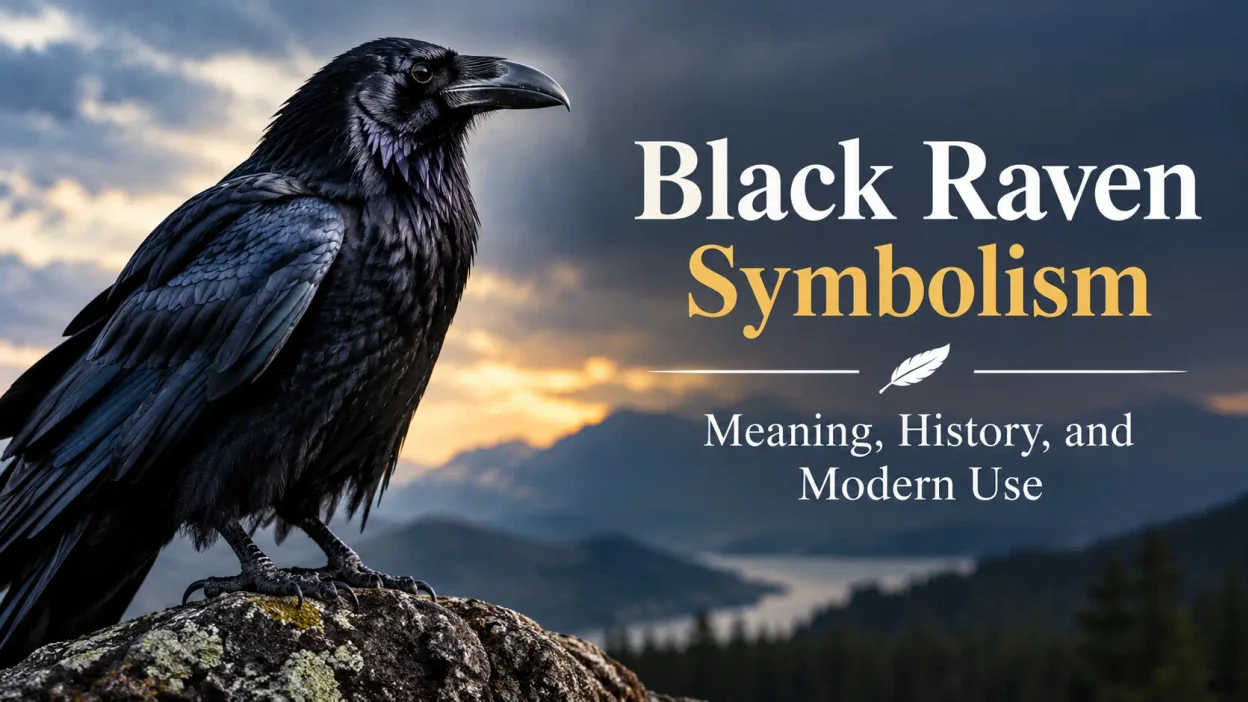
The common raven (Corvus corax) is a large, dark-feathered bird found across much of the Northern Hemisphere, including parts of the United States. Its heavy bill, shaggy throat feathers, wedge-shaped tail, and deep, rough call distinguish it from many other birds.
Its appearance contributes to its symbolic reputation. Black feathers can create strong visual associations with night, shadows, mourning, and the unknown, while the bird’s alert behavior suggests awareness and intelligence. When a raven appears alone against a pale sky or perched on a bare branch, the contrast can make it seem watchful or foreboding.
Ravens are also capable of solving problems, learning from experience, and adapting their behavior to changing circumstances. These traits provide a real-world basis for interpreting the bird as clever or resourceful rather than relying entirely on supernatural explanations.
It is important to distinguish ravens from crows. Both belong to the corvid family and share some cultural associations, but they are different birds. Popular art sometimes uses the names interchangeably, which can blur the specific stories and traditions associated with each one.
The Core Meaning of Black Raven Symbolism
The black raven carries several overlapping meanings, and the context usually determines which one stands out.
Intelligence and wisdom reflect the bird’s problem-solving abilities and its role in myths involving knowledge, observation, or divine messengers. A raven in artwork may suggest someone who watches carefully, thinks independently, or notices what others overlook.
Mystery and the unknown grow from the raven’s dark appearance, unusual vocalizations, and frequent presence in stories set at night or in remote landscapes. The bird can represent questions without easy answers rather than anything necessarily frightening.
Transformation and change are common modern interpretations. Because ravens appear in stories about death, revelation, and new beginnings, contemporary readers may use them to represent the end of one life chapter and the start of another.
Death and remembrance are among the bird’s best-known associations in Western literature. These meanings are particularly noticeable in gothic fiction, mourning imagery, and poems that use the raven as a reminder of grief or the permanence of loss.
These associations are not universal rules. A raven can represent a creator in one tradition, an omen in another, and a clever survivor in everyday wildlife photography.
Raven Symbolism in Norse Mythology
In Norse mythology, ravens are closely associated with Odin, a god connected with wisdom, war, poetry, and knowledge. Two ravens, Huginn and Muninn, are described as traveling throughout the world and returning to tell Odin what they have observed.
Their names are commonly translated as “Thought” and “Memory,” although the precise nuances of Old Norse words can vary with interpretation. Together, the birds connect raven imagery with observation, awareness, and the collection of information.
This role helps explain why a raven in Norse-inspired art may symbolize knowledge rather than misfortune. The bird is not simply a dark creature hovering around death; it serves a god who depends on information from the wider world.
Ravens also fit the wider setting of Norse stories, where warfare, fate, death, and wisdom often intersect. Their presence around battlefields in historical and literary contexts contributed to associations with conflict and the dead, but those associations should not overshadow their connection with Odin’s knowledge.
Today, Huginn and Muninn appear in jewelry, tattoos, illustrations, and modern interpretations of Norse heritage. Some designs use the two ravens to represent thought and memory, while others emphasize the broader themes of awareness and wisdom.
Raven Symbolism in Celtic and Other European Folklore
Ravens and crows appear in several European mythological traditions, sometimes in stories involving battle, prophecy, sovereignty, or supernatural transformation. The details vary considerably, so there is no single European raven meaning.
In Irish mythology, the figure of the Morrígan is associated with war, fate, sovereignty, and battle. She is sometimes connected with crow or raven imagery in later interpretations and artistic representations. The precise relationship between the Morrígan and particular bird species depends on the source and translation, so it is better not to treat every raven image as a direct representation of her.
In broader European folklore, dark birds were sometimes interpreted through their behavior around battlefields, settlements, or places of death. Scavenging habits made them visible in environments associated with loss, helping create links between ravens and mortality.
These associations developed alongside stories in which birds could serve as messengers or reveal information unavailable to humans. A raven’s appearance might therefore be read as a warning in one story and as a sign of knowledge in another.
Modern fantasy art often blends these traditions into one visual language. Such combinations can be creative, but they do not necessarily reflect a single historical belief system.
Raven Symbolism in Indigenous North American Traditions
Raven stories hold important places in several Indigenous cultures of the Pacific Northwest and other regions, but these traditions are distinct and should not be treated as interchangeable.
In some Northwest Coast traditions, Raven appears as a creator, transformer, or trickster figure. Stories describe Raven bringing important things into the world, changing circumstances through cleverness, or helping make essential resources available to people. In well-known versions of certain creation narratives, Raven is associated with bringing light into the world.
The trickster role does not simply mean that Raven is evil or dishonest. Trickster figures can challenge rules, expose weaknesses, create disorder, and bring about changes that would not occur through conventional behavior. Their actions may be humorous, selfish, beneficial, or complicated, depending on the story.
These narratives are living cultural traditions, not merely collections of symbols for modern spiritual use. Their meanings are shaped by particular communities, languages, histories, and practices. It would be inaccurate to claim that all Indigenous peoples in North America understand ravens in the same way.
For American readers, the key distinction is that raven symbolism in these traditions can center on creation, cultural knowledge, and transformation rather than death. Respectful interpretation requires naming the specific tradition when known and avoiding the assumption that every Indigenous raven story shares one meaning.
Raven Symbolism in Greek and Roman Traditions
Ravens and crows also appear in ancient Greek and Roman stories, although ancient texts do not always distinguish bird species in the same way modern ornithology does.
In Greek mythology, a crow or raven is associated with Apollo in stories involving prophecy and the delivery of unwelcome news. Some versions explain the bird’s dark coloring through a mythological punishment connected with its report to the god. Details differ among retellings, and modern accounts sometimes blur distinctions between crows and ravens.
Birds associated with gods could serve as signs, messengers, or participants in systems of divination. Their behavior was interpreted in religious and cultural settings where people looked for meaning in the natural world.
These stories contributed to the broader association between dark birds and messages from beyond ordinary human knowledge. However, it is inaccurate to say that all ancient Greeks or Romans regarded ravens as bad omens. The meaning depended on the deity, story, and circumstances involved.
The comparison also shows that raven symbolism developed in many places independently. Similar themes may arise because people observe the same bird behaviors, but resemblance alone does not prove that different cultures shared one original belief.
Black Raven Symbolism in American Literature
American literature has played a major role in shaping the raven’s modern reputation. One of the most influential examples is Edgar Allan Poe’s 1845 poem The Raven, in which a raven visits a grieving narrator who is struggling with the loss of Lenore.
The bird repeatedly responds with the word “Nevermore,” turning its presence into a reminder of the narrator’s sorrow and his inability to recover what he has lost. The raven becomes closely tied to grief, memory, psychological distress, and the painful permanence of death.
Poe’s poem did not invent every association between ravens and mortality, but it gave those associations a distinctive place in American popular culture. The raven became a recognizable figure in gothic literature, dark illustration, Halloween imagery, and discussions of melancholy.
Its meaning in Poe’s work is also more complicated than a simple prediction of death. The bird’s repeated response interacts with the narrator’s own questions and emotional state. Much of the poem’s unsettling effect comes from the narrator’s interpretation of what the raven says.
Modern American artists continue to draw on this literary tradition. A black raven perched beside a window, tombstone, or solitary figure may evoke remembrance, loneliness, or unresolved grief, even when the artwork has no direct connection to Poe.
What Does a Black Raven Mean Spiritually?
In contemporary spirituality, a black raven is often interpreted as a symbol of intuition, awareness, change, or attention to something that has been overlooked. People may view the bird as a reminder to observe their surroundings carefully, reconsider an assumption, or reflect on a transition in life.
Some modern spiritual traditions also associate ravens with messages from ancestors or the unseen world. These interpretations may draw inspiration from mythology, personal experiences, or contemporary ideas about animal symbolism.
However, there is no single spiritual meaning accepted across all religions or historical traditions. The role of Odin’s ravens differs from the role of Raven in Indigenous creation stories, and both differ from the literary raven in Poe’s poem.
Seeing a raven in everyday life does not establish that a supernatural message has been sent. A bird may simply be searching for food, communicating with other ravens, or moving through its territory.
For someone who finds the encounter personally meaningful, the experience can still serve as a prompt for reflection. The distinction is between choosing to interpret an event symbolically and claiming that the event objectively predicts something.
Black Raven Symbolism in Modern American Culture
In the United States, the black raven occupies several cultural spaces at once. It appears in wildlife photography, horror films, fantasy stories, Halloween decorations, gothic fashion, tattoos, and spiritual artwork.
Its cultural meaning often depends on how it is presented. A raven perched on a branch in a nature photograph may represent wilderness and intelligence. A raven surrounded by fog, bare trees, and a moonlit sky may create an atmosphere of suspense or supernatural possibility.
Halloween imagery reinforces the bird’s association with the macabre, but the raven is not exclusively a symbol of fear. Artists also use it to express independence, observation, resilience, and an interest in mythology.
The bird can be particularly appealing to people who prefer symbols that leave room for interpretation. Unlike an image with a universally recognizable meaning, a raven can communicate several ideas without requiring the viewer to settle on just one.
American culture also contains practical relationships with ravens. In some regions, people encounter them in forests, mountains, deserts, and remote landscapes. Their real-world behavior can shape local perceptions as much as fictional stories do.
Why Black Ravens Are Associated With Death and Bad Omens
Ravens have long been connected with death in some cultural narratives, partly because they are scavengers and may feed on animal remains. Their presence around battlefields or other places where animals and people have died made them noticeable in circumstances associated with loss.
Their dark plumage and harsh calls also lend themselves to ominous imagery. In stories, a raven appearing at an unsettling moment can create tension before the audience knows what will happen.
Literature and film have reinforced these associations, especially in gothic and horror genres. A raven outside a house or near a grave can function as a visual warning, even when the story never explains its presence as supernatural.
Still, a raven is not a reliable predictor of death, disaster, or bad luck. The belief that seeing one must signal misfortune is a cultural interpretation, not an established fact about the bird.
It is also important not to treat all traditions as fearful of ravens. In some mythologies, the bird carries knowledge, brings essential resources, or plays a constructive role in creation stories. Its association with death is only one part of a much wider symbolic history.
Emotional and Psychological Meanings of the Black Raven
The raven can communicate different emotional states because its appearance and behavior support several contrasting impressions.
For some people, it suggests solitude and introspection. A raven sitting quietly in a bare tree can create a feeling of distance from everyday activity, making it a natural choice for artwork about reflection or personal independence.
For others, the bird suggests intelligence and adaptability. Ravens can learn, solve problems, and respond to changing circumstances, so they offer a real-world example of resourcefulness.
The raven’s connection with mourning can also make it meaningful to people processing loss. A raven image may serve as a personal reminder of someone who has died, particularly when paired with a date, name, or other memorial element. The meaning comes from the individual’s experience rather than from a universal rule about the bird.
These interpretations should not be used to judge a person’s character. Choosing a raven as a personal symbol does not prove that someone is mysterious, pessimistic, unusually intelligent, or emotionally troubled.
Instead, the symbol provides a visual language through which people can express ideas that may be difficult to summarize in words.
Black Raven Tattoos, Jewelry, and Personal Style
Black raven designs are common in tattoo culture because the bird’s silhouette remains recognizable even in relatively simple artwork. Its dark feathers also create strong contrast, making it suitable for black-and-gray tattoos and detailed illustrative designs.
A raven tattoo can represent several personal ideas:
- Wisdom and awareness: A reference to Odin’s ravens or the bird’s intelligence.
- Transformation: A reminder of a major life change or a new direction.
- Remembrance: A memorial for someone who has died.
- Independence: An expression of individuality or a preference for solitude.
- Interest in gothic art: An appreciation for dark imagery, literature, and atmosphere.
Design elements help clarify the intended meaning. Two ravens may refer to Huginn and Muninn, while a raven beside a world tree may signal interest in Norse mythology. A raven paired with a crescent moon may communicate a broader interest in night imagery or contemporary spirituality.
Jewelry, clothing, prints, and home decor offer similar opportunities for personal expression. A small raven pendant can serve as a private reminder, while a large black-raven illustration can establish a darker visual style in a room.
These designs do not need to reproduce an ancient tradition exactly to have personal value. However, anyone seeking historical accuracy should distinguish documented mythological motifs from modern combinations of runes, religious symbols, and decorative elements.
Common Misunderstandings About Black Raven Symbolism
The most common misconception is that every black raven represents death or evil. This interpretation is especially familiar in horror fiction, but it leaves out the bird’s associations with intelligence, creation, knowledge, and transformation.
Another mistake is treating raven symbolism as a single belief system. Norse mythology, Indigenous traditions, Greek stories, and American literature developed in different cultural contexts. Their similarities are worth exploring, but their meanings should not be combined indiscriminately.
People also sometimes confuse ravens with crows in historical and symbolic discussions. The birds are related, and some older texts or translations may use names that do not map neatly onto modern species distinctions. A claim about a specific raven story should therefore be checked against the original context when accuracy matters.
Finally, contemporary spiritual interpretations are sometimes presented as universal ancient beliefs. Claims that a raven always signals an awakening, guarantees protection, or predicts a life-changing event are not established facts.
A more useful approach is to ask three questions: Which tradition does the image come from? What does the original story actually describe? What personal meaning is being added today? These questions allow people to appreciate raven symbolism without confusing interpretation with history.
How Raven Symbolism Has Changed Over Time
The raven’s symbolic history is not a straight line from one ancient meaning to a modern one. Different cultures developed their own stories, and later writers, artists, and religious interpreters gave the bird additional associations.
In Norse literature, ravens are linked with Odin’s awareness and knowledge. In some Indigenous traditions, Raven appears as a creator or trickster whose actions change the world. In European folklore, ravens and crows sometimes appear in stories about battle, prophecy, and death.
American literature added another influential layer, especially through Poe’s treatment of grief and memory. Later gothic fiction, horror cinema, fantasy games, and visual art expanded the raven’s presence in popular culture.
Today, these layers often overlap. A modern raven tattoo may combine Norse mythology, gothic aesthetics, and a personal story of survival. Such a design reflects the way symbols evolve as people reuse them in new contexts.
The important point is not to force every interpretation into one definition. The raven’s continuing appeal comes partly from its ability to carry different meanings in different settings.
Black Raven Symbolism at a Glance
| Context | Common meaning | Why it is associated |
|---|---|---|
| Norse mythology | Thought, memory, and awareness | Odin’s ravens observe the world and report back |
| Indigenous North American traditions | Creation, transformation, or trickery | Specific cultural stories portray Raven as a transformative figure |
| American literature | Grief, loss, and remembrance | Poe’s The Raven connects the bird with mourning |
| Modern spirituality | Intuition and personal change | Contemporary interpretations draw on mythology and personal experience |
| Tattoos and fashion | Independence, identity, or mystery | The bird’s distinctive appearance supports personal expression |
| Gothic and horror art | Death, suspense, and the unknown | Dark imagery and literary traditions reinforce ominous associations |
Frequently Asked Questions
What does a black raven symbolize spiritually?
A black raven commonly represents intuition, awareness, transformation, or the unknown in contemporary spiritual interpretations. These meanings vary by individual and tradition, and they should not be treated as universal religious beliefs.
Is seeing a black raven a good or bad omen?
Seeing a black raven is not reliable evidence of good or bad fortune. Some folklore treats the bird as an omen, but in everyday life, its presence is usually explained by normal bird behavior and environmental conditions.
What does a black raven tattoo mean?
A black raven tattoo can symbolize wisdom, independence, grief, transformation, or an interest in mythology. The addition of elements such as Yggdrasil, a memorial date, or a pair of ravens can make the intended meaning more specific.
What do ravens symbolize in Norse mythology?
Ravens are associated with Odin, whose two ravens, Huginn and Muninn, travel through the world and bring back information. Their names are commonly translated as Thought and Memory, linking them with awareness and knowledge.
Why is the raven associated with death?
Ravens are scavengers, and their presence around remains contributed to associations with death in some cultural settings. American gothic literature, particularly Edgar Allan Poe’s The Raven, further strengthened the bird’s connection with grief and mourning.
What is the difference between a raven and a crow symbolically?
Ravens and crows share many associations because both are intelligent members of the corvid family, but their mythological roles are not always interchangeable. For example, Odin’s famous pair are ravens, while other stories refer to crows or use bird terminology that varies across translations.
Is the black raven a symbol of transformation?
Yes, transformation is a common modern interpretation of raven imagery, particularly in tattoos, art, and contemporary spirituality. However, it is best understood as a modern symbolic association rather than a meaning that every historical culture assigned to the bird.
Conclusion
Black raven symbolism brings together intelligence, mystery, transformation, mourning, and the unknown. Its historical meanings vary across traditions, from Odin’s watchful companions in Norse mythology to Raven’s transformative role in specific Indigenous stories and the grieving bird in American literature.
In modern American culture, the raven can express personal change, remembrance, independence, or an appreciation for gothic art and wildlife. Its meaning depends on the story, design, and person interpreting it. Understanding those differences allows the black raven to remain a compelling symbol without reducing it to a simple sign of death or bad luck.