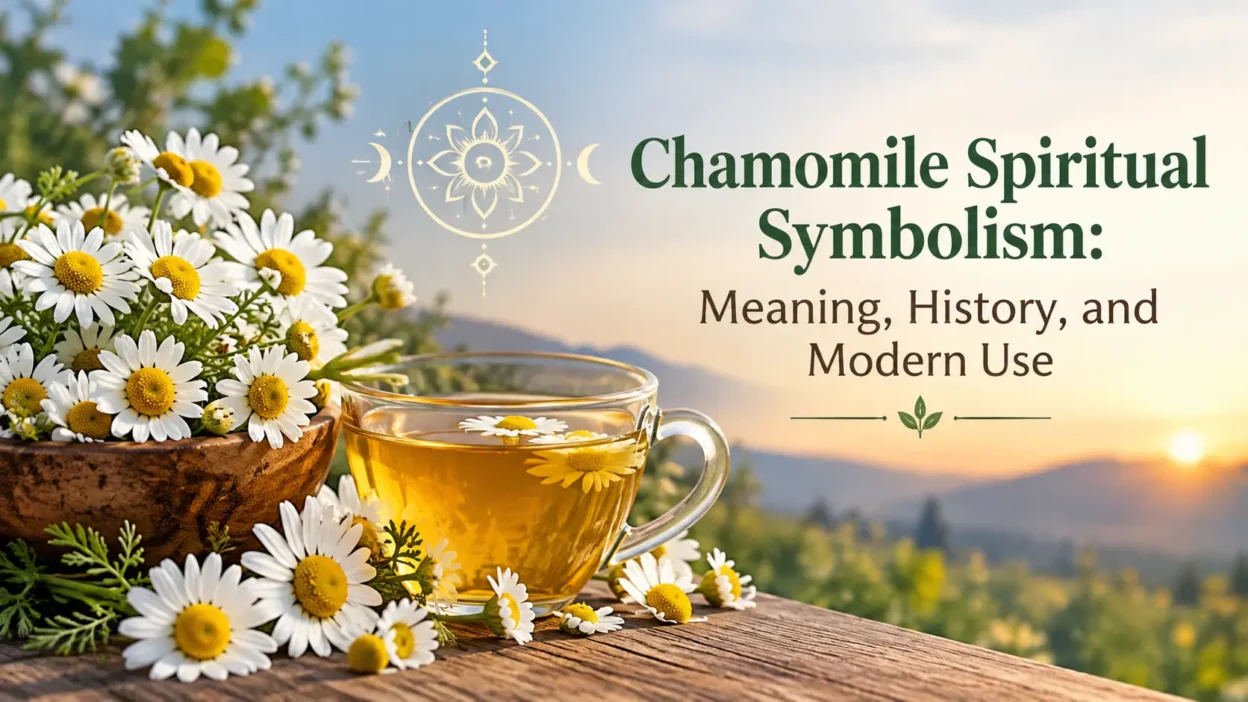
Chamomile spiritual symbolism centers on peace, patience, healing, protection, and the ability to remain gentle during difficult times. With its small white petals and golden center, chamomile is often associated with calmness, emotional balance, and the quiet strength needed to recover from stress. Its meaning comes partly from its appearance and partly from its long history as a useful medicinal and household herb.
In the United States, chamomile is familiar from herbal tea, gardens, natural wellness products, and botanical designs. People may also encounter it in spiritual practices, where flowers and herbs serve as reminders of personal intentions, renewal, and a more balanced way of living.
Chamomile does not have one universal spiritual meaning. Its interpretation depends on the cultural tradition, personal experience, and setting in which it appears. Understanding the difference between documented herbal history and modern spiritual beliefs makes its symbolism more meaningful and prevents folklore from being mistaken for established fact.
Quick Answer
Chamomile spiritual symbolism commonly represents peace, patience, healing, emotional comfort, and resilience in modern American culture. Historically, the herb was valued for its practical uses in traditional herbal medicine and later became associated in some folk and spiritual practices with protection, good fortune, and calm.
TL;DR
- Peace: Chamomile represents calmness, rest, and relief from everyday tension.
- Healing: Its herbal history connects it with care and recovery.
- Patience: Its modest flowers suggest steady growth and gentle persistence.
- Protection: Some folk practices associate chamomile with spiritual safeguarding.
- Good fortune: Certain modern traditions connect it with luck and prosperity.
- Modern use: Tea, gardens, tattoos, and rituals express its comforting symbolism.
1. What Chamomile Looks Like and Why Its Appearance Matters
Chamomile is a daisy-like flowering plant with narrow white petals, a rounded yellow center, and delicate green foliage. German chamomile (Matricaria chamomilla) and Roman chamomile (Chamaemelum nobile) are the two best-known varieties. Although they differ in growth habits and botanical characteristics, both have long histories of traditional use.
The flower’s appearance helps explain its modern symbolic associations. Its white petals suggest simplicity, innocence, and gentleness, while its golden center can evoke sunlight, warmth, and optimism. These are interpretive associations rather than universal meanings shared by every culture.
Chamomile also grows in a relatively modest form. It does not have the dramatic appearance of a rose or the towering structure of a sunflower. For many people, this understated quality makes it a fitting symbol of ordinary happiness, quiet care, and the value of small comforts.
Its scent adds another layer of meaning. The familiar herbal aroma connects chamomile with rest, familiar routines, and the feeling of returning to a comfortable environment.
2. The Core Spiritual Meanings of Chamomile
Chamomile carries several overlapping meanings in contemporary spiritual and symbolic practices. Most connect its traditional reputation as a useful herb with qualities people want to cultivate in their own lives.
Peace and tranquility are among its most recognizable associations. A cup of chamomile tea at the end of a demanding day can represent the decision to slow down and make room for rest.
Healing and restoration reflect the plant’s long use in herbal traditions. Symbolically, chamomile may represent recovery after disappointment, emotional exhaustion, or a difficult period of change. This does not mean the flower itself guarantees physical or emotional healing.
Patience and resilience come from a different aspect of its symbolism. Chamomile is sometimes associated with the idea that steady growth can continue under challenging conditions. The message is not that suffering is necessary, but that progress does not always require force.
Protection and good fortune appear in some European folk traditions and contemporary magical practices. People may use chamomile as a symbolic reminder of safety, prosperity, or confidence when facing uncertainty.
Together, these meanings present chamomile as a symbol of gentle strength: the ability to care for yourself, remain patient, and make thoughtful choices without demanding immediate results.
3. Ancient Roots and Early Herbal Traditions
Chamomile’s history is older than many of its modern spiritual interpretations. Historical and medical literature documents the use of chamomile-type plants in ancient Egypt, Greece, and Rome, although the identification of particular species in some ancient records is uncertain.
In the classical Mediterranean world, herbal knowledge was closely connected to everyday health and the natural environment. Physicians and herbal practitioners described plants according to their observed properties and traditional uses. Chamomile became associated with practical care because it was used in preparations intended to address various common complaints.
This history provides an important foundation for understanding its later symbolism. A plant repeatedly used in household care can come to represent comfort, support, and the hope of recovery. The symbolic association does not need to have originated as a formal religious doctrine.
Stories about chamomile being dedicated to the Egyptian sun god Ra also circulate in modern herbal and spiritual literature. However, popular retellings do not always provide sufficient evidence to establish the exact historical role of the plant in ancient religious ceremonies. It is more accurate to distinguish such traditions from the better-supported history of chamomile as an herbal remedy.
The broader historical connection remains clear: chamomile’s reputation developed partly through its practical place in human life, which later helped shape its symbolic associations with care and well-being.
4. Chamomile Symbolism in European Folklore Chamomile Spiritual Symbolism
European herbal traditions added meanings beyond the plant’s practical uses. Chamomile became connected in some folk practices with luck, household well-being, and protection.
One notable association is resilience. In William Shakespeare’s Henry IV, Part 1, chamomile appears in a comparison about a plant that grows more vigorously when trodden on, while the comparison’s human subject responds differently to hardship. This literary image helped preserve the idea of chamomile as a plant associated with persistence.
The passage should not be treated as proof that all Europeans shared one established belief about chamomile. It does, however, show how the plant could serve as a recognizable image for endurance and the effects of adversity.
Other herbal folklore associates chamomile with prosperity and favorable outcomes. Some contemporary practitioners carry these associations into rituals involving money, work, or personal opportunities. The specific practices vary, and their historical origins are not equally well documented.
The important distinction is that European folklore contributed several possible interpretations rather than one fixed spiritual definition. Depending on the context, chamomile might suggest endurance, household comfort, good fortune, or the hope that a difficult situation will improve.
5. What Chamomile Symbolism Means in the United States
In the United States, chamomile is most familiar as an ingredient in herbal tea, a garden plant, and a component of wellness products. Its everyday use gives it a recognizable connection with relaxation and personal care.
A person who keeps chamomile tea beside the bed may associate it with a peaceful evening routine. Someone who grows it in a garden might connect it with simplicity, nature, or the satisfaction of tending plants. Neither interpretation requires a formal spiritual belief.
Chamomile also fits into contemporary American interest in mindfulness, self-care, and natural living. In these settings, the flower may represent setting boundaries, taking a break, or making time for restorative habits.
Some Americans encounter chamomile through witchcraft, herbal magic, or other personal spiritual practices. In those settings, it may be assigned meanings related to luck, protection, cleansing, or prosperity. These are tradition-specific interpretations, not beliefs shared by all Americans.
| Context | Common symbolic meaning | Typical association |
|---|---|---|
| Herbal tea | Calm and comfort | Evening routines and rest |
| Home gardens | Simplicity and resilience | Everyday connection with nature |
| Spiritual rituals | Protection or good fortune | Personal intentions and folk practices |
| Gifts and floral art | Care and gentleness | Encouragement and emotional support |
| Tattoos and jewelry | Patience and renewal | Personal growth and identity |
Chamomile’s American meaning is therefore practical as well as symbolic. Its significance often comes from how people use it, the memories they attach to it, and the values they want it to represent.
6. Chamomile, Healing, and Emotional Recovery
Healing is one of chamomile’s most understandable symbolic associations because the plant has a long history of use in traditional herbal medicine.
When interpreted symbolically, healing can mean more than recovering from a physical illness. It can represent rebuilding confidence after rejection, learning to live with a loss, or regaining a sense of stability after a stressful period.
Chamomile offers a gentle image for these experiences. Its symbolism does not demand a dramatic transformation or suggest that a person should recover on someone else’s schedule. Instead, it can represent the small steps that help someone feel more settled.
For example, someone might place a chamomile illustration in a journal devoted to personal recovery. Another person might give a chamomile-themed card to a friend who is going through a difficult transition. In both cases, the flower communicates care without requiring elaborate explanations.
There is an important distinction between symbolic healing and medical treatment. Chamomile’s traditional use does not establish that it can cure an illness or replace professional care. Its spiritual meaning is best understood as a representation of comfort, hope, and the intention to nurture well-being.
7. Patience, Resilience, and the Ability to Begin Again
Chamomile can represent the kind of strength that is easy to overlook because it develops gradually.
People often associate resilience with overcoming major obstacles, but chamomile offers a quieter interpretation. It suggests that persistence may involve adjusting to circumstances, accepting help, and continuing at a manageable pace.
Its connection with patience also reflects the realities of personal growth. Relationships take time to repair. New skills require practice. Emotional recovery may involve setbacks as well as progress. Chamomile can serve as a reminder that slow movement is not necessarily a lack of progress.
The literary image of chamomile growing more vigorously when trodden on adds an interesting contrast. It can suggest that pressure sometimes reveals a person’s capacity to adapt, although real resilience does not mean that every hardship makes someone stronger.
In modern life, this symbolism may appeal to people who are changing careers, rebuilding routines, or learning to set healthier boundaries.
A small chamomile flower on a desk, notebook, or piece of jewelry can act as a personal reminder: steady effort matters, and rest can be part of persistence rather than its opposite.
8. The Spiritual Significance of Chamomile’s Colors
Chamomile’s familiar white-and-yellow appearance creates another layer of symbolism. Color meanings vary across cultures and individuals, so these interpretations are best understood as common associations rather than fixed rules.

White: Simplicity and renewal
White petals may suggest clarity, innocence, sincerity, or a fresh start. In a personal spiritual practice, they can represent the intention to approach a situation with honesty and an open mind.

Yellow: Warmth and optimism
The golden center can evoke sunlight, friendliness, and hope. It may represent the possibility of finding comfort or encouragement even when circumstances are uncertain.

Green: Growth and balance
The foliage connects the flower with the natural world. Green may symbolize renewal, patience, and the ongoing work of maintaining a balanced life.
When these colors appear together, they can create a visual message of freshness, warmth, and grounded growth. This interpretation is especially useful in floral design, artwork, and personal objects where the symbolism comes from the overall composition rather than a single color.
9. Chamomile in Spiritual Rituals and Personal Reflection
Some people use chamomile in spiritual practices to establish a mood, mark a transition, or focus their attention on a personal intention.
The practice does not have to involve a formal religious system. A person might prepare a cup of tea before journaling, keep dried flowers near a meditation space, or use a botanical image as a reminder to approach a problem patiently.
In contemporary folk magic, chamomile may be associated with protection, good fortune, prosperity, or purification. The meaning depends on the particular practice, and not everyone who uses chamomile spiritually accepts the same interpretations.
A simple reflective practice can focus on the symbolism without making supernatural claims:
- Choose one intention, such as patience, rest, or a fresh start.
- Place a chamomile flower or illustration somewhere visible.
- Spend a few minutes considering one practical action that supports that intention.
- Return to the reminder when you need to refocus.
For example, an intention centered on peace might lead to setting aside uninterrupted time for rest or having a difficult conversation more thoughtfully.
The value of this practice lies in the attention and meaning a person gives it. There is no established evidence that a chamomile ritual independently guarantees protection, attracts money, or changes outside events.
10. Chamomile in Tattoos, Jewelry, and Personal Style
Chamomile’s compact flower shape makes it suitable for small, understated designs. Unlike symbols with a widely established religious or political meaning, a chamomile image often leaves considerable room for personal interpretation.
A chamomile tattoo may represent recovery after a challenging period, a preference for a slower lifestyle, or a commitment to caring for oneself. Someone else might choose it simply because the flower reminds them of a family member, a garden, or a familiar cup of tea.
Design choices can influence the message.
- A single flower: May express simplicity, individuality, or a quiet approach to life.
- A cluster of blossoms: Can suggest connection, friendship, or a sense of belonging.
- Chamomile with new leaves: May represent renewal and the willingness to grow.
- Chamomile paired with a date or name: Often makes the design more personal, linking it to a memory or relationship.
Jewelry and clothing designs use the same visual associations in a smaller, everyday form. A person may wear a chamomile pendant as a reminder to remain patient or give a floral charm to someone who appreciates botanical imagery.
These interpretations are not universal. A chamomile tattoo does not automatically indicate a particular spiritual identity, belief system, or life experience.
11. Chamomile in Home Decor, Gardens, and Gifts
Chamomile can communicate a welcoming, uncomplicated atmosphere when used in domestic spaces.
In home decor, botanical prints, dried arrangements, and floral patterns may create an association with nature and everyday comfort. Chamomile can work particularly well in spaces intended for rest, reading, or quiet reflection because its appearance is familiar and visually understated.
Growing chamomile adds a practical dimension to the symbolism. Caring for a plant requires attention to its growing conditions and development. For some gardeners, this becomes a reminder that care is expressed through consistent actions rather than occasional grand gestures.
As a gift, chamomile may communicate encouragement, sympathy, or a wish for someone to have a more peaceful period ahead. It can be appropriate when the intention is to express kindness without making an overly dramatic statement.
However, the meaning depends on the relationship and circumstances. A chamomile-themed gift might feel comforting to one person but ordinary to another. Personal familiarity, cultural expectations, and the recipient’s preferences matter more than an assumed universal flower code.
12. Chamomile Across Cultures and Spiritual Traditions
Chamomile has been used in different parts of the world, but its cultural meanings should not be treated as identical.
In ancient Egyptian, Greek, and Roman contexts, the plant is primarily documented through its place in herbal knowledge and traditional medicine. Some accounts also describe ritual or sacred associations, but the details and certainty of individual claims vary.
In European traditions, chamomile became part of household herbal practices and folklore. Associations with resilience, luck, and protection appear in some historical and modern interpretations, though their prevalence differed by region and period.
Chamomile also has a history of use in Asian herbal traditions, including Chinese medical literature and Uyghur medicine. These systems have their own concepts of health and plant properties. It would be inaccurate to assume that they assign chamomile the same spiritual meanings found in contemporary Western herbal magic.
Modern American spiritual practices often combine botanical symbolism, personal reflection, and selected elements of European folk traditions. Some practitioners regard this as a personal spiritual framework, while others prefer to keep their interpretations rooted in gardening, traditional herbal knowledge, or personal experience.
Cultural respect requires distinguishing documented practices from modern adaptations. Chamomile’s long international history does not mean that every culture considers it sacred or associates it with the same spiritual qualities.
13. Common Misunderstandings About Chamomile Symbolism
Because chamomile appears in wellness products and spiritual content, several claims about its meaning can become exaggerated.
Chamomile does not have one official spiritual meaning. Peace and healing are common contemporary interpretations, but other meanings depend on the tradition and individual experience.
Its history as an herb does not prove supernatural powers. Historical medicinal use explains why people may associate chamomile with care and restoration. It does not establish that the plant can remove negative energy or guarantee protection.
Not every ancient story is equally well documented. Claims about specific deities, ceremonies, or ancient magical practices should be treated cautiously when their historical evidence is unclear.
Symbolic healing is not the same as medical effectiveness. Chamomile has been studied for various health uses, but evidence remains insufficient to establish its effectiveness for many promoted conditions. It may also cause allergic reactions, particularly in people sensitive to related plants, and can interact with some medications.
A chamomile image does not identify someone’s beliefs. It may represent spiritual practice, an interest in plants, a personal memory, or simply an appreciation of the flower.
These distinctions allow people to enjoy chamomile’s symbolism without confusing personal belief, cultural tradition, and scientific evidence.
14. How Chamomile’s Meaning Has Evolved in Modern Life
Chamomile’s symbolic associations have developed alongside changes in how people use and understand plants.
In older herbal traditions, its practical role in household care helped connect it with comfort and recovery. European folklore added interpretations involving persistence, favorable outcomes, and protection. Literary references helped preserve some of these ideas beyond the settings in which they first developed.
In contemporary American life, chamomile is strongly associated with herbal tea, wellness routines, gardening, and botanical design. These everyday experiences make it a natural symbol of rest and self-care, even for people who do not follow spiritual traditions.
Social media and modern spiritual communities have also expanded the range of interpretations. Chamomile may now appear in content about intentions, rituals, emotional balance, and natural living. Such uses can be meaningful to individuals, but they should not automatically be described as ancient customs.
The shift is not simply from medicine to spirituality. Both practical and symbolic meanings coexist. A person may value chamomile as a garden plant, drink it as tea, appreciate its history, and use its image as a personal reminder.
That flexibility explains why the flower remains relevant. Its symbolism can adapt to contemporary concerns without requiring every interpretation to have the same historical origin.
Frequently Asked Questions
1. What does chamomile symbolize spiritually?
Chamomile commonly symbolizes peace, patience, healing, emotional comfort, and resilience. In some folk and contemporary spiritual traditions, it is also associated with protection and good fortune.
2. Is chamomile considered a positive spiritual symbol?
Yes, chamomile is generally interpreted positively in modern spiritual contexts. Its associations with rest, care, and renewal make it a common choice for expressing encouragement and hope, although symbolism varies between individuals and traditions.
3. What does a chamomile tattoo mean?
A chamomile tattoo may represent patience, personal recovery, simplicity, or a commitment to self-care. Its meaning can become more specific when paired with a name, date, or other design connected to a personal experience.
4. What does chamomile symbolize in Christianity?
Chamomile does not have one universally recognized meaning in Christian doctrine. Individual Christians may associate its appearance with peace, gratitude, or God’s creation, but these are personal interpretations rather than a standard Christian teaching about the flower.
5. Is chamomile associated with luck or prosperity?
Some European folk traditions and contemporary magical practices connect chamomile with luck, favorable outcomes, or prosperity. These associations belong to particular traditions and should not be treated as evidence that the plant can cause financial success.
6. What does it mean to dream about chamomile flowers?
A dream featuring chamomile might personally suggest a desire for rest, comfort, or a fresh start, especially if the flower already has those associations for the dreamer. There is no scientifically established universal meaning for dreaming about chamomile, so the surrounding events and personal memories are more useful than a fixed interpretation.
7. Can chamomile be used in spiritual rituals?
Some people incorporate chamomile into personal reflection, meditation, or folk-magic practices involving peace, protection, or good fortune. Others simply use it as a visual reminder of their intentions, without believing that the plant has supernatural effects.
Conclusion
Chamomile spiritual symbolism brings together peace, patience, healing, resilience, and the comfort found in everyday routines. Its history as a traditional herb helps explain its association with care, while European folklore and modern spiritual practices have added interpretations involving protection and good fortune.
In the United States, chamomile is meaningful both as a familiar household plant and as a symbol people use in gardens, gifts, tattoos, and personal rituals. Its interpretation depends on context rather than a universal spiritual rule.
Ultimately, chamomile offers a simple reminder that care does not always need to be dramatic. Sometimes it means allowing time to rest, taking one manageable step forward, or offering kindness when someone needs it most.


