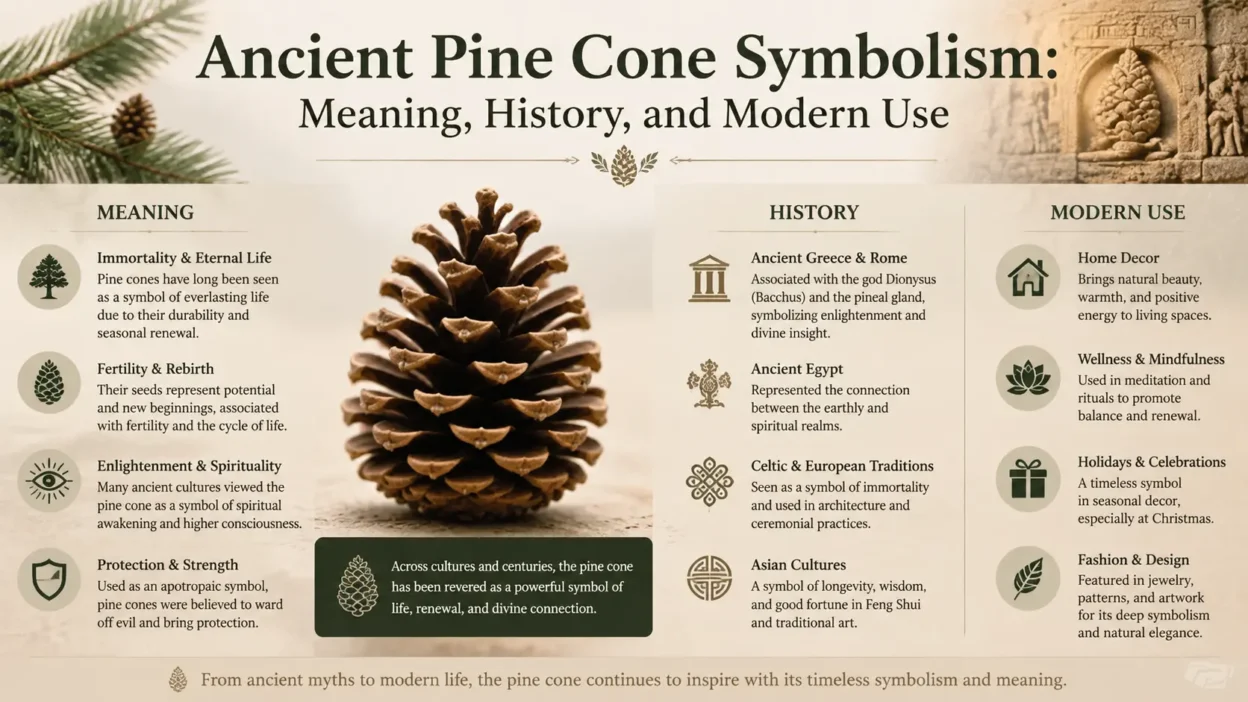
Pine cones are familiar natural objects found in forests, gardens, holiday decorations, and artistic designs across the United States. Beyond their simple appearance, ancient pine cone symbolism reflects ideas connected to growth, renewal, fertility, wisdom, and the cycles of nature. Different cultures interpreted the pine cone in their own ways, often linking it with life, protection, and spiritual awareness.
Today, people encounter pine cone imagery in home decor, jewelry, tattoos, seasonal crafts, and environmental movements. While some older traditions gave the pine cone religious or mystical meanings, modern Americans often view it as a symbol of resilience, natural beauty, and connection with the outdoors.
Quick Answer
Ancient pine cone symbolism commonly represents growth, renewal, wisdom, and the ongoing cycle of life in modern American interpretations. Historically, pine cones appeared in ancient art and traditions as symbols connected with fertility, immortality, spiritual awareness, and nature’s creative power.
TL;DR
- Pine cones symbolize growth, renewal, and natural cycles.
- Ancient cultures linked pine cones with fertility and life.
- Americans often use pine cones in seasonal and nature-inspired designs.
- Pine cone imagery appears in art, tattoos, and home decor.
- Some spiritual meanings come from older religious traditions.
What A Pine Cone Represents As A Symbol
A pine cone is the reproductive structure of a pine tree, designed to protect and release seeds that create new growth. This natural function strongly influences its symbolism.
Because pine cones carry seeds that can become new trees, many traditions associate them with:
- New beginnings
- Continuity of life
- Fertility
- Growth after change
- Preservation of nature
Unlike flowers that bloom briefly, pine trees remain strong through different seasons. This has helped the pine cone become associated with endurance and the ability to survive changing conditions.
In the United States, people often recognize pine cones as symbols of forests, wilderness, and a peaceful connection with nature rather than as strictly religious objects.
Ancient Roots And Early Symbolism Ancient Pine Cone Symbolism
The symbolic use of pine cones goes back thousands of years. Ancient civilizations observed the relationship between pine trees, seeds, and seasonal renewal, which shaped their interpretations.
In many early cultures, plants that produced seeds represented continuation and creation. Pine trees were especially meaningful because many species remain green throughout winter, making them associated with persistence and life.
The pine cone became an artistic symbol because it visually represented the potential for new life hidden inside a protective structure.
Ancient artists used pine cone imagery in architecture, sculptures, and religious artwork to express ideas about creation, fertility, and spiritual understanding.
Pine Cone Symbolism In Ancient Mediterranean Cultures
The Mediterranean world gave the pine cone several important meanings. Ancient Greeks and Romans connected pine trees with fertility, nature, and certain religious traditions.
The Greek god Dionysus was sometimes associated with a staff called a thyrsus, which was often decorated with a pine cone at its top. The object represented fertility, celebration, and the forces of nature.
Romans also used pine cone imagery in decorative art and architecture. The symbol appeared in gardens, sculptures, and public spaces, where it could represent abundance and natural prosperity.
These meanings influenced later European artistic traditions, where pine cone designs continued appearing in religious and decorative settings.
Pine Cone Symbolism In Egyptian And Ancient Near Eastern Traditions
Some interpretations connect pine cone imagery with ancient Egyptian and Near Eastern artwork. Scholars have debated the exact meanings of these images because similar shapes appeared in different contexts.
In some ancient artworks, cone-like objects represented plants, fertility, offerings, or sacred items. Later interpretations sometimes connected these images with knowledge or spiritual awareness.
However, modern discussions sometimes exaggerate these connections by presenting every ancient cone-shaped object as a pine cone symbol. Historical interpretation requires caution because symbols changed depending on location, time period, and artistic purpose.
Pine Cone Meaning In Religious Symbolism
Pine cones have appeared in several religious and spiritual traditions, although their meanings vary.
In Christianity, pine trees and evergreen plants became associated with eternal life because they remain green during winter. Pine cones sometimes appear in Christian art and architecture as decorative elements connected with creation and renewal.
In some Eastern traditions, the pine cone has been connected with spiritual awakening or higher awareness. These interpretations often come from the natural observation that seeds hidden inside the cone eventually create new life.
The symbol does not have one universal religious meaning. Its interpretation depends on the culture and tradition using it.
How Americans Understand Pine Cone Symbolism Today
In modern American culture, pine cones are usually connected with nature, comfort, and seasonal traditions.
Common American associations include:
| Context | Meaning in the USA | Common Associations | Notes |
|---|---|---|---|
| Home Decor | Natural warmth and simplicity | Rustic style, cabins, forests | Popular in nature-inspired interiors |
| Holidays | Seasonal tradition | Winter, Christmas, gatherings | Often used in wreaths and crafts |
| Tattoos | Personal growth | Strength, renewal, resilience | Meaning depends on the wearer |
| Environmental Themes | Connection with nature | Conservation, forests, sustainability | Represents respect for natural systems |
Many Americans see pine cones as reminders of forests, outdoor experiences, and family traditions. Their symbolism is often personal rather than tied to a single belief system.
The Emotional And Psychological Meaning Of Pine Cones
Symbols often gain meaning because they connect with human experiences. Pine cones naturally suggest ideas of protection, patience, and potential.
A pine cone keeps seeds protected until conditions are suitable for growth. Because of this, some people interpret it as a reminder that personal development takes time.
The symbol can represent:
- Preparing for future opportunities
- Protecting personal values
- Growing through challenges
- Remaining connected to one’s roots
For people who enjoy hiking, gardening, or outdoor activities, pine cones may also represent peaceful memories and a connection to natural spaces.
Pine Cone Symbolism In Tattoos And Personal Expression
Pine cone tattoos are popular among people who appreciate nature-based imagery. The design can carry different meanings depending on personal experiences.
Common tattoo interpretations include:
- Personal transformation
- Family roots
- Survival and resilience
- Love of forests
- Respect for nature
Some people combine pine cones with trees, mountains, animals, or geometric patterns to create a larger personal story.
Unlike symbols with fixed meanings, tattoo symbolism is usually shaped by the individual’s own experiences.
Pine Cone Symbolism In Art, Design, And Decor
Pine cones have remained popular decorative elements because their shape combines natural beauty with visual structure.
Designers use pine cone patterns in:
- Furniture details
- Textile designs
- Jewelry
- Holiday decorations
- Garden artwork
Their repeating scales create a pattern that feels organized and organic at the same time. This makes pine cones appealing in styles ranging from rustic American homes to modern nature-inspired interiors.
The symbol often creates a feeling of warmth, simplicity, and connection with the outdoors.
Pine Cones In American Holidays And Seasonal Traditions
In the United States, pine cones are strongly connected with autumn and winter celebrations.
During the holiday season, people use pine cones in:
- Wreaths
- Centerpieces
- Garlands
- Handmade crafts
- Outdoor decorations
Their connection with evergreen trees makes them especially common during Christmas traditions.
However, pine cones are not limited to one holiday. Many people use them throughout fall and winter because they represent the changing seasons and appreciation for natural beauty.
Cross-Cultural Meanings Of Pine Cone Symbolism
Although meanings differ, several cultures have recognized pine cones as symbols connected with life and nature.
Examples include:
- Mediterranean traditions: fertility and natural abundance
- European traditions: endurance and evergreen life
- Asian traditions: longevity and harmony with nature
- Indigenous perspectives: respect for natural cycles and ecosystems
It is important to avoid treating all cultures as having identical interpretations. A symbol’s meaning develops within specific historical and social contexts.
Common Misunderstandings About Pine Cone Symbolism
Pine cone symbolism is sometimes surrounded by claims that are not supported by strong historical evidence.
One common misunderstanding is that every ancient cone-shaped image represents the same spiritual idea. In reality, historians examine symbols within their original cultural setting.
Another misconception is that pine cones have only mystical meanings. While some traditions gave them spiritual interpretations, many people simply view them as natural symbols of forests, growth, and seasonal beauty.
Understanding the symbol requires balancing historical traditions with modern personal meanings.
How Pine Cone Symbolism Has Changed Over Time
The meaning of pine cones has evolved as societies changed.
Ancient cultures often emphasized fertility, creation, and spiritual connections. Later European traditions focused more on evergreen life and seasonal symbolism. Modern Americans frequently connect pine cones with nature, sustainability, comfort, and personal growth.
This evolution shows how symbols remain relevant by adapting to new cultural environments.
A pine cone can represent ancient traditions while also fitting naturally into modern lifestyles.
Why Pine Cone Symbolism Remains Relevant Today
Pine cones continue to appear because they represent ideas that remain meaningful in contemporary life.
Many people today seek stronger connections with nature, especially in a world shaped by technology and urban living. Natural symbols provide simple reminders of seasons, growth, and environmental responsibility.
Whether used in artwork, jewelry, or decoration, pine cones communicate a relationship between humans and the natural world.
Frequently Asked Questions
What Does A Pine Cone Symbolize Spiritually?
A pine cone can symbolize spiritual growth, awareness, and renewal in some traditions. These meanings come from the idea that hidden seeds represent future potential and new life.
What Does A Pine Cone Tattoo Mean?
A pine cone tattoo often represents personal growth, resilience, nature connection, or a meaningful relationship with forests and outdoor experiences. The exact meaning depends on the person wearing it.
Are Pine Cones A Christian Symbol?
Pine cones are not a central Christian symbol, but evergreen plants and related imagery can represent eternal life and renewal in some Christian traditions.
Why Were Pine Cones Important In Ancient Cultures?
Ancient cultures valued pine cones because they represented seeds, fertility, and the continuation of life. Their connection with evergreen trees also influenced ideas about endurance.
Are Pine Cones Considered Good Luck Symbols?
Some people view pine cones as positive symbols associated with growth and abundance. However, beliefs about luck vary between cultures and individuals.
What Do Pine Cones Mean In American Culture?
In American culture, pine cones commonly represent nature, seasonal traditions, rustic design, and appreciation for forests. They are often seen as comforting and familiar natural objects.
Conclusion
The meaning of ancient pine cone symbolism comes from a long relationship between humans and the natural world. Across different cultures, pine cones have represented ideas such as growth, fertility, renewal, and the continuation of life.
In modern America, the pine cone is often understood through a more everyday lens. It appears in seasonal decorations, personal art, and nature-inspired designs as a reminder of resilience, natural beauty, and connection with the environment.
Although interpretations have changed over time, the pine cone remains meaningful because it represents something simple and universal: the possibility of new growth contained within nature itself.


