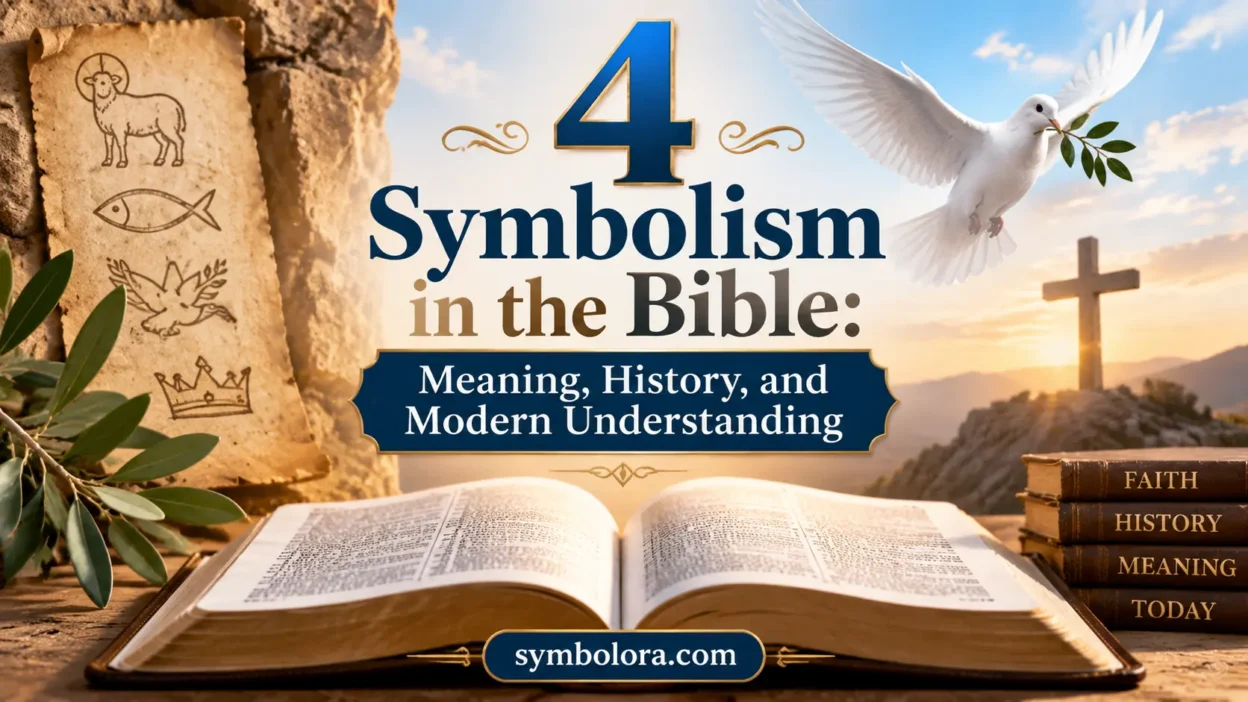
The number 4 symbolism in the Bible is connected with creation, the physical world, completeness, and the order established by God. From the four directions of the earth to the four Gospel accounts of Jesus’ life, the number appears in many biblical passages where it represents structure, balance, and earthly existence.
Numbers in the Bible often carry meanings beyond simple counting. Ancient writers used numbers in ways that reflected cultural ideas, religious beliefs, and patterns found in nature. While not every appearance of a number has a hidden message, some numbers became associated with repeated themes across biblical texts.
Understanding the symbolism of 4 helps readers explore how biblical authors described the relationship between God, humanity, creation, and the world people experience every day. In modern American Christianity, the number continues to appear in Bible studies, artwork, sermons, and personal reflection.
Quick Answer
4 symbolism in the Bible commonly represents creation, the physical world, and God’s order over earthly life. It is often connected with the four directions, four seasons, four living creatures, and the four Gospels, showing ideas of completeness and structure within creation.
TL;DR
- Four often represents the created world and earthly completeness.
- Biblical examples connect four with directions and seasons.
- The four Gospels present different views of Jesus’ life.
- Ancient traditions linked four with balance and order.
- Christians interpret the number through faith and scripture.
- Modern uses appear in art, study, and religious teaching.
What Does the Number 4 Represent in the Bible?
In biblical symbolism, the number 4 is commonly associated with the created world rather than divine perfection. Many biblical references involving four focus on things humans experience: the earth, nature, nations, directions, and physical life.
The number appears in patterns connected to the world around people. There are four directions—north, south, east, and west. There are four seasons in many parts of the world. These natural patterns helped ancient cultures connect the number four with earthly completeness and stability.
Unlike numbers such as 3, which is often linked with divine ideas like the Trinity, or 7, which frequently represents completion or fulfillment, 4 usually points toward the physical realm.
For many biblical readers, the number suggests that God’s work extends across the entire created world.
Ancient Roots of Number Symbolism in Scripture
Ancient societies often gave symbolic meaning to numbers. People used numbers not only for mathematics but also to describe patterns, relationships, and ideas.
The writers of biblical texts lived in cultures where numbers could communicate broader concepts. Hebrew and ancient Near Eastern traditions frequently used repeated numbers to organize stories and express theological ideas.
The meaning of a number depended on its context. A group of four objects did not automatically contain a secret message. Instead, meaning came from how the number appeared and what themes surrounded it.
The biblical use of four developed from several ideas:
- The structure of the natural world
- The four directions of the earth
- The idea of reaching all nations
- The organization of creation
- Human life within the physical universe
This approach helps readers avoid treating every number as a hidden code while still recognizing meaningful patterns.
The Four Corners of the Earth and Global Symbolism
One of the strongest connections between the number four and biblical symbolism is the idea of the four corners of the earth.
Several biblical passages use this expression to describe the entire world. The phrase does not describe a literal square-shaped planet. Instead, it represents the complete extent of the earth.
The four corners symbolize:
| Context | Meaning in the Bible | Common Association | Notes |
|---|---|---|---|
| Four corners of earth | Entire world | Global reach | Represents all directions |
| Four winds | Forces across creation | Movement and change | Appears in prophetic writings |
| Four seasons | Natural cycles | Earthly order | Connected with creation |
| Four Gospels | Jesus’ message | Different perspectives | Central Christian tradition |
For ancient people, directions represented the boundaries of human experience. Saying something reached the four corners meant it extended everywhere.
In Christianity, this idea became connected with the spread of the Gospel message to all nations.
Four Directions: North, South, East, and West
The four directions appear as a major symbolic theme connected with the number four.
Ancient communities viewed the world through geographic boundaries. The four directions represented the complete human environment.
Biblical references to directions often communicate ideas such as:
- God’s authority over all lands
- The gathering of people from every region
- The worldwide nature of God’s promises
For example, prophetic writings sometimes describe people coming from the east and west, or from the north and south. These expressions show that God’s influence extends beyond one location or group.
In modern American Christian interpretation, the four directions are often used to represent unity among different cultures and nations.
The Four Gospels and Their Symbolic Importance
One of the most recognized uses of the number four in Christianity is the four Gospels:
- Matthew
- Mark
- Luke
- John
Together, these books form the foundation of the New Testament’s account of Jesus Christ.
Each Gospel presents Jesus from a different perspective:
Matthew emphasizes Jesus as the promised Messiah connected with Jewish tradition.
Mark presents a fast-moving account focused on Jesus’ actions and ministry.
Luke highlights compassion, mercy, and Jesus’ connection with all people.
John focuses on Jesus’ divine identity and spiritual meaning.
Early Christian traditions often connected the four Gospels with the completeness of Christ’s message reaching the world.
Some ancient Christian writers also associated the Gospel writers with four symbolic creatures mentioned in biblical visions.
The Four Living Creatures in Biblical Visions
The number four appears in important visions recorded in biblical books such as Ezekiel and Revelation.
The four living creatures are described with features connected to:
- A lion
- An ox
- A human
- An eagle
These creatures have been interpreted in different ways throughout Christian history. Some traditions connect them with qualities such as:
- Strength
- Service
- Intelligence
- Spiritual vision
Later Christian symbolism connected these four creatures with the four Gospel writers:
- Matthew — human figure
- Mark — lion
- Luke — ox
- John — eagle
This interpretation is a tradition developed by early Christian thinkers rather than a direct statement made in the biblical text itself.
The symbolism shows how later communities found connections between biblical images and their understanding of Jesus’ story.
Four Seasons and God’s Created Order
Although the Bible does not present the four seasons as a central numerical symbol, seasons are often connected with the broader meaning of four.
Spring, summer, autumn, and winter represent cycles of nature. They remind people of change, renewal, growth, and the passing of time.
Biblical writers frequently used agricultural seasons and natural cycles as examples when explaining spiritual ideas.
For example:
- Planting and harvest represented growth and reward.
- Winter imagery could represent hardship or waiting.
- Spring often suggested renewal.
In modern American Christian culture, seasonal imagery continues to appear in church decorations, religious art, and holiday traditions.
The number four can represent the organized rhythm of creation and the belief that nature follows a meaningful pattern.
Four Elements and the Physical World
The idea of four elements—earth, water, air, and fire—comes mainly from ancient Greek philosophy rather than directly from the Bible. However, these four elements influenced later Christian art, philosophy, and symbolic traditions.
Because the Bible frequently uses images from nature, later interpreters sometimes connected the number four with the physical building blocks of the world.
Biblical themes related to these elements include:
- Earth as the place where humans live and work
- Water as a symbol of cleansing, life, and renewal
- Air or wind as a representation of God’s breath or Spirit
- Fire as a symbol of purification and divine presence
It is important to separate later symbolic traditions from direct biblical teaching. The Bible uses natural imagery often, but it does not teach a specific doctrine of four physical elements.
Still, the connection shows how religious communities have continued developing symbolic meanings around the number four.
The Four Horsemen of Revelation
One of the most famous biblical references involving the number four appears in the Book of Revelation: the four horsemen.
These figures appear when the first four seals are opened in John’s vision. They are commonly associated with major events affecting humanity.
The four horsemen are traditionally understood as representing:
- Conquest
- War
- Famine
- Death
Interpretations vary among Christian groups. Some view the horsemen as future events, while others understand them as symbols of recurring human struggles throughout history.
The importance of four here relates to the worldwide nature of these experiences. The horsemen are not limited to one nation or one period. They represent conditions that affect humanity broadly.
In American Christian discussions, the four horsemen are often mentioned when studying prophecy, literature, movies, and religious art.
Four in Creation and the Natural World
The number four appears repeatedly in connection with the natural world.
Examples include:
- Four directions
- Four winds
- Four corners of the earth
- Four seasons
- Four living creatures
These examples share a common theme: the organized structure of creation.
For biblical writers, the world was not viewed as random. Nature followed patterns that reflected order and purpose.
The number four often helps express the idea that God’s creation has boundaries, movement, and balance.
This interpretation is especially meaningful for readers who see nature as a reflection of divine organization.
Symbolism of Four in Jewish Tradition
The symbolism of four also appears in Jewish traditions connected with biblical history.
Several important religious concepts use groups of four, including:
- Four questions asked during Passover traditions
- Four cups of wine during the Passover Seder
- Four species used during Sukkot
These practices developed through Jewish interpretation and tradition over time.
The number four often represents remembering, teaching, and passing beliefs from one generation to another.
Because Christianity developed from Jewish roots, some Christian interpretations of numbers are influenced by earlier Jewish symbolic traditions.
Symbolism of Four in Christianity Today
In modern American Christianity, the number four appears in many settings.
People encounter it in:
- Bible study materials
- Religious artwork
- Church teaching
- Christian books
- Decorative designs
- Personal faith discussions
Many Christians use biblical numbers as tools for reflection rather than strict rules. The meaning usually depends on the passage, tradition, and personal interpretation.
For example, someone studying the four Gospels may focus on the different ways each writer explains Jesus’ message. Another person may reflect on the four directions as a reminder that faith extends to all people.
The modern understanding of four is often less about discovering hidden messages and more about appreciating repeated themes in scripture.
Emotional and Psychological Meaning of Four
Beyond religious interpretation, the number four can carry emotional associations connected with stability and structure.
People often connect four with ideas such as:
- Balance
- Foundation
- Organization
- Security
- Wholeness
These associations come partly from everyday experiences. Many physical structures rely on four points of support. Tables, buildings, and maps often use four-sided designs because they create a sense of stability.
When people see four used symbolically in religious contexts, they may associate it with the idea of a well-ordered world.
For believers, this can represent confidence that creation has purpose and direction.
Four Symbolism in Christian Art and Design
Artists have used the number four in Christian artwork for centuries.
Common examples include:
- Four Gospel symbols
- Four angels or creatures
- Four directions represented around a central figure
- Four-part decorative patterns
Church architecture and religious artwork often use balanced designs because symmetry communicates harmony.
The four Gospel symbols became especially common in paintings, manuscripts, stained glass windows, and church decorations.
In American churches today, these images may appear in:
- Sanctuary artwork
- Cross designs
- Educational materials
- Religious jewelry
The symbolism allows visual storytelling without requiring long explanations.
Tattoos and Personal Meaning of Biblical Number 4
Biblical number tattoos have become popular among people who want a permanent reminder of their beliefs, values, or personal experiences.
A tattoo featuring the number four may represent different ideas depending on the person.
Common meanings include:
- Connection with the four Gospels
- Faith extending around the world
- Family or personal balance
- A meaningful Bible verse containing the number four
Some people choose the number because of a personal event rather than traditional symbolism.
For example, someone may associate four with four family members, four important life stages, or a meaningful spiritual experience.
Like many symbols, the meaning comes from the person using it.
Common Misunderstandings About Four Symbolism
Number symbolism can sometimes become exaggerated. Some people claim every appearance of four in the Bible contains a hidden message. This approach can overlook the importance of historical and literary context.
A balanced interpretation recognizes that:
- Some uses of four are symbolic.
- Some uses are simply numerical.
- Meaning depends on the surrounding passage.
Biblical scholars often examine language, culture, and historical background before assigning symbolic meaning.
The number four has meaningful patterns in scripture, but not every example should be treated as a secret code.
Positive and Negative Interpretations of Four
The number four does not always represent only positive ideas.
Positive interpretations include:
- Creation
- Balance
- Worldwide reach
- Order
- Stability
Negative associations may appear when four is connected with difficult biblical events, such as the four horsemen of Revelation.
However, these meanings are not contradictions. The same symbol can represent different aspects depending on context.
A number connected with the physical world may include both beauty and struggle because human life contains both experiences.
How the Meaning of Four Has Changed Over Time
The interpretation of four has developed across centuries.
In ancient biblical contexts, it often focused on the created world and geographic completeness. Early Christian writers expanded these ideas by connecting four with the Gospels and symbolic creatures.
During medieval Christianity, artists and theologians used four as a visual and theological pattern.
Today, many American Christians approach biblical numbers with more personal reflection. The number may inspire study, artwork, prayer, or discussion without requiring one fixed interpretation.
The evolution shows how symbols remain meaningful because communities continue to interpret them within changing cultures.
Four Symbolism Across Different Cultures and Traditions
Although this article focuses on biblical meaning, the number four has appeared as a meaningful symbol in many cultures around the world.
In some traditions, four represents balance because of its connection with the natural world. The four directions, four seasons, and four phases of many natural cycles have influenced human understanding of order.
Examples from different traditions include:
- Native American traditions: Some Indigenous cultures use four directions as part of spiritual teachings, ceremonies, and relationships with nature. Specific meanings vary greatly among different nations and should not be treated as one universal belief system.
- Ancient Chinese traditions: Four directions and four seasons played important roles in traditional views of the universe.
- Hindu traditions: The number four appears in several religious concepts, including ideas connected with social, cosmic, and spiritual structures.
These examples show that people across cultures often use numbers to describe patterns in the world around them. However, each tradition develops its own meanings based on its history and beliefs.
Four Symbolism in Modern American Culture
In the United States, biblical number symbolism continues to appear in both religious and everyday settings.
People encounter four symbolism in:
- Church education materials
- Christian artwork
- Bible study groups
- Jewelry designs
- Home decorations
- Social media discussions
- Personal faith practices
For many Americans, the number four represents ideas connected with faith, family, and stability.
A person may view four as a reminder of:
- The four Gospel accounts of Jesus
- God’s presence throughout the world
- The importance of balance in life
- The structure of creation
Modern interpretations are often personal. Two people may see the same number and connect it with different experiences.
The Role of Four in Christian Holidays and Traditions
The number four appears indirectly in several Christian traditions connected with seasons and worship.
One example is the Christian calendar, which follows seasonal patterns throughout the year. Many churches organize worship around cycles that connect human experience with events from biblical history.
The four seasons can represent:
- Growth and renewal
- Waiting and preparation
- Celebration and remembrance
- Change and reflection
During holidays such as Christmas and Easter, churches often use natural imagery to communicate spiritual ideas. Although the number four is not always central, the connection between seasons and faith remains important in American religious culture.
Four as a Symbol of Completeness Without Perfection
A common misunderstanding is that every biblical number represents perfection. The number four usually does not carry that meaning.
Instead, four often represents completeness within the created world.
This difference matters.
For example:
- Four directions describe the whole earth.
- Four seasons describe the yearly cycle.
- Four Gospels provide a complete witness of Jesus’ life from different viewpoints.
The idea is not that four represents absolute perfection, but that it represents a complete human or earthly system.
This distinction helps readers understand biblical symbolism more accurately.
The Difference Between Biblical Meaning and Numerology
Biblical symbolism and numerology are not the same thing.
Biblical symbolism examines how numbers function within scripture, history, language, and religious traditions.
Numerology often involves assigning meanings to numbers outside their original context, sometimes suggesting that numbers reveal hidden messages about future events or personal destiny.
Some people find personal meaning in numbers, but biblical interpretation usually depends on the actual text and its historical setting.
Understanding this difference helps readers approach number symbolism with curiosity while avoiding unsupported conclusions.
Why People Still Study Number Symbolism Today
People continue exploring biblical numbers because they provide another way to understand scripture.
Number symbolism can help readers notice:
- Repeated themes
- Literary patterns
- Cultural background
- Connections between different biblical books
For many believers, studying numbers adds another layer of appreciation for biblical writing.
For others, it provides historical insight into how ancient communities communicated ideas.
The interest continues because numbers are simple, familiar, and often connected with larger human questions about meaning and order.
Frequently Asked Questions
What does the number 4 symbolize in the Bible?
The number 4 in the Bible commonly symbolizes the created world, earthly completeness, and God’s order over creation. It is often connected with the four directions, four winds, and the four Gospels.
Is the number 4 considered a holy number in Christianity?
The number 4 has important symbolic uses in Christianity, but it is not usually considered a holy number in the same way some traditions view numbers like 3 or 7. Its importance comes from specific biblical patterns and meanings.
What do the four Gospels symbolize?
The four Gospels represent four accounts of Jesus Christ’s life and message. Together, Matthew, Mark, Luke, and John provide different perspectives that Christians consider part of the complete biblical witness about Jesus.
What does the number 4 mean in a Christian tattoo?
A Christian tattoo featuring the number 4 may represent different ideas, including the four Gospels, worldwide faith, personal balance, or a meaningful Bible connection. The meaning depends on the individual’s intention.
Are the four horsemen related to the symbolism of the number 4?
Yes, the four horsemen in Revelation are one of the major biblical examples involving the number four. They are traditionally associated with conquest, war, famine, and death, although interpretations differ among Christian groups.
Does every number 4 in the Bible have a hidden meaning?
No. Some uses of the number 4 are symbolic, while others are simply numerical. Meaning depends on the passage, historical context, and the purpose of the writing.
How do Americans interpret biblical number symbolism today?
Many Americans view biblical numbers as tools for reflection, study, and spiritual discussion. Interpretations vary between individuals, churches, and Christian traditions.
Conclusion
The number 4 symbolism in the Bible is mainly connected with creation, the physical world, and the organized structure of life on earth. Its appearances in the four directions, four living creatures, four Gospels, and other biblical patterns show how ancient writers used numbers to express ideas about God’s relationship with the world.
Today, people continue to explore the meaning of four through Bible study, art, personal faith, and cultural traditions. While interpretations may differ, the number remains a reminder of order, connection, and the relationship between spiritual beliefs and human experience.
Understanding biblical symbols requires attention to context. The meaning of four is not found in the number alone, but in the stories, traditions, and ideas surrounding it.


