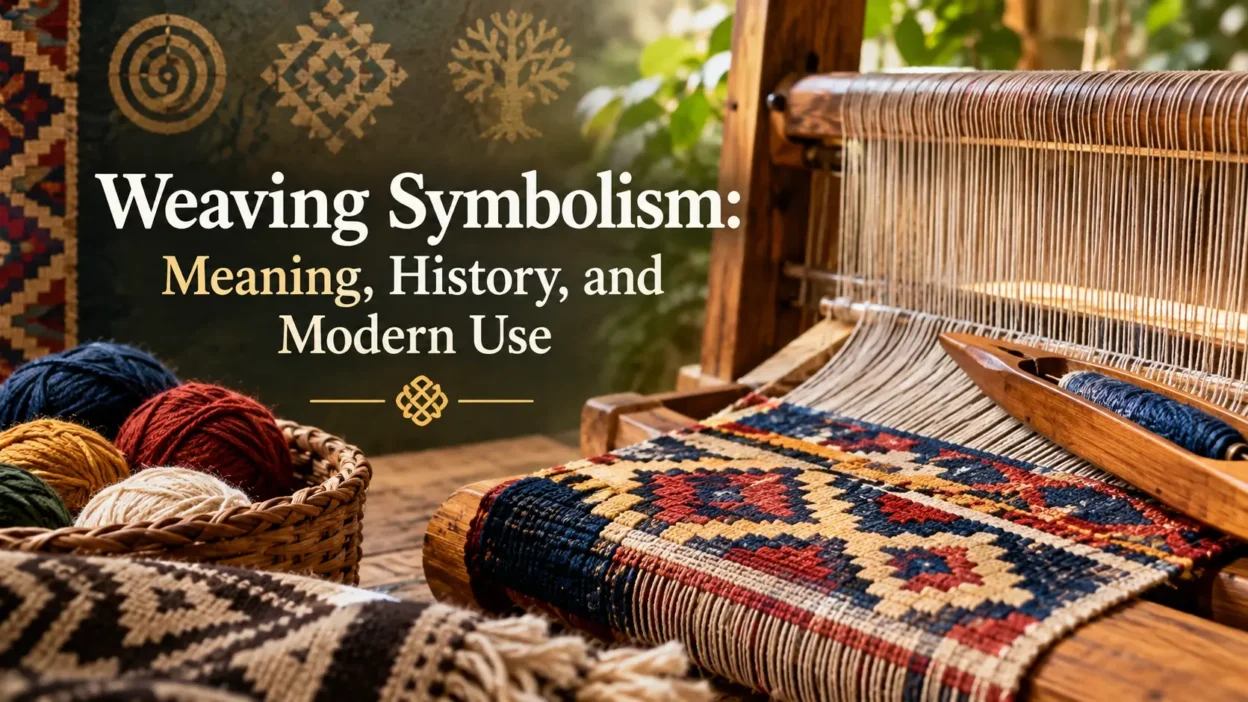
Weaving symbolism is often associated with connection, creation, destiny, and the way individual parts come together to form a meaningful whole. Because weaving transforms separate threads into a unified fabric, people frequently use it as a metaphor for relationships, community, storytelling, and life itself.
Most people encounter weaving through textiles, clothing, rugs, baskets, and traditional crafts. Yet the symbolic meaning of weaving extends far beyond fabric. It appears in myths, literature, religion, art, social movements, and personal expressions of identity.
In modern American culture, weaving remains a powerful image because it reflects how people build families, communities, careers, and personal narratives from many different experiences. The symbol continues to evolve while retaining connections to some of humanity’s oldest traditions.
Quick Answer
Weaving commonly symbolizes connection, unity, and the creation of something meaningful from separate parts in modern American culture. Historically, it has also represented destiny, storytelling, community, and the interconnected nature of life in many cultures around the world.
TL;DR
- Weaving often symbolizes unity and connection.
- Many traditions link weaving to fate and destiny.
- Americans use it as a symbol of diversity.
- It represents creativity and craftsmanship.
- Modern artists use weaving to explore identity.
- The symbol combines individual and collective meaning.
What Weaving Is and Why It Became Symbolic
Weaving is the process of interlacing threads, fibers, or materials to create fabric or other objects. It is one of the oldest human technologies, dating back thousands of years.
Its symbolic power comes from a simple visual truth: separate strands become stronger and more useful when combined. People naturally saw a parallel between woven fabric and human life. Families, communities, traditions, and experiences all consist of individual elements brought together into a larger whole.
Because of this, weaving became more than a practical skill. It became a symbol of how order emerges from many separate pieces.
The Core Meaning of Weaving Today
In contemporary American culture, weaving most commonly represents connection and integration.
People often use weaving as a metaphor when discussing:
- Building relationships
- Strengthening communities
- Combining different ideas
- Creating a personal identity
- Preserving traditions
- Telling stories across generations
The image of woven threads suggests that individual differences do not disappear. Instead, they become part of a larger pattern. This idea makes weaving a positive symbol of cooperation without requiring uniformity.
Ancient Roots and Early Symbolism
Long before modern societies existed, weaving was essential for survival. Communities depended on woven textiles for clothing, shelter, storage, and trade.
As weaving became central to daily life, symbolic meanings developed around it. In many ancient cultures, skilled weavers were respected not only for their craft but also for their role in sustaining society.
The transformation of loose fibers into organized patterns seemed almost magical. As a result, weaving often became associated with creation itself. Some traditions viewed the universe as something woven together by divine forces, while others used weaving as a metaphor for the structure of society.
Weaving and the Symbolism of Fate
One of the most enduring meanings of weaving is its connection to destiny.
Across different cultures, stories emerged about supernatural beings who controlled the course of human lives through spinning and weaving. The thread became a symbol of an individual’s life, while the woven pattern represented a larger destiny that connected many lives together.
The symbolism worked because weaving requires planning, patience, and coordination. Just as a weaver creates a design one thread at a time, life unfolds through countless interconnected choices and events.
Even today, people speak metaphorically about the “fabric” of life or the “threads” that connect experiences.
Storytelling and the Woven Narrative
Weaving and storytelling have long shared symbolic connections.
Both involve bringing separate pieces together to create something meaningful. A storyteller combines events, characters, and ideas into a narrative. A weaver combines threads into a fabric.
Many traditional cultures used textiles to preserve stories, family histories, and cultural knowledge. Patterns could communicate social identity, historical events, or spiritual beliefs.
Because of this relationship, weaving often symbolizes memory and the transmission of knowledge across generations.
What Weaving Symbolizes in the United States
In the United States, weaving often carries meanings tied to diversity, inclusion, and community.
Americans frequently describe the nation as a collection of different backgrounds, cultures, and experiences. The image of weaving provides a visual way to express this idea.
The symbol appears in discussions about:
- Cultural diversity
- Community building
- Shared identity
- Collaborative work
- Social unity
- National heritage
Rather than suggesting that differences disappear, weaving implies that individual contributions strengthen the larger whole.
Native American Traditions and Weaving
Many Native American communities have rich weaving traditions that carry cultural, spiritual, and historical importance.
In these traditions, weaving can symbolize relationships between people, land, ancestors, and cultural identity. Specific meanings vary significantly among tribes, regions, and artistic traditions.
For many Indigenous communities, woven objects are not merely decorative. They can represent heritage, responsibility, and continuity between generations.
Modern discussions of weaving symbolism in the United States often recognize the importance of these longstanding traditions and their influence on American art and culture.
Cross-Cultural Meanings of Weaving
Although details differ from culture to culture, several symbolic themes appear repeatedly.
| Cultural Context | Meaning | Common Associations | Notes |
|---|---|---|---|
| Ancient Europe | Fate and destiny | Life threads | Often linked to mythological figures |
| Indigenous Traditions | Community and heritage | Ancestors and identity | Meanings vary by culture |
| Asian Traditions | Harmony and balance | Social order | Often tied to craftsmanship |
| African Traditions | Shared history | Collective identity | Seen in many textile traditions |
| Modern United States | Diversity and connection | Community and inclusion | Common social metaphor |
These recurring themes show how different societies independently recognized the symbolic potential of woven patterns.
Emotional and Psychological Symbolism
On a psychological level, weaving often represents integration.
People use the image when discussing how various parts of life come together. Experiences, relationships, memories, challenges, and achievements form a personal narrative much like threads form fabric.
The symbol can evoke feelings of:
- Stability
- Belonging
- Security
- Cooperation
- Continuity
- Purpose
For individuals navigating change or uncertainty, weaving may symbolize the process of creating order from complexity.
Weaving as a Symbol of Creativity
Weaving is also strongly associated with creativity and craftsmanship.
Unlike mass-produced objects, woven pieces often reveal the choices and skills of the maker. Every pattern reflects intentional design.
Because of this, weaving symbolizes:
- Artistic expression
- Patience
- Problem-solving
- Innovation
- Human ingenuity
Artists and designers frequently use weaving imagery to emphasize the value of handmade work and creative labor.
Weaving in Art, Fashion, and Home Decor
Modern artists continue to explore weaving as both a physical technique and a symbolic language.
In contemporary art, woven forms often address themes such as:
- Identity
- Migration
- Cultural memory
- Family history
- Social connection
Fashion designers use woven patterns to communicate craftsmanship and heritage. Interior designers often incorporate woven textures to create feelings of warmth, comfort, and authenticity.
These uses help keep weaving symbolism relevant in everyday life.
Tattoos and Personal Identity
Weaving-inspired tattoos have become increasingly popular because they offer layered symbolic meanings.
A woven pattern may represent:
- Family bonds
- Personal growth
- Life experiences
- Cultural roots
- Friendship
- Resilience
Some people choose woven designs because they reflect how different aspects of their identity fit together. Others appreciate the visual reminder that strength often comes from interconnected relationships rather than isolation.
Digital Culture and Modern Metaphors
Even in a highly digital world, weaving remains a useful metaphor.
People regularly describe social networks, communities, and collaborations using language associated with weaving. Phrases such as “social fabric” and “woven together” continue to appear in public discussions.
The symbol has adapted to modern realities without losing its historical meaning. Today, weaving can represent both traditional craftsmanship and modern interconnectedness.
This flexibility helps explain why the symbol remains widely understood across generations.
Common Misunderstandings About Weaving Symbolism
One misunderstanding is that weaving always represents harmony.
While connection is a major theme, woven patterns can also symbolize complexity, tension, and interdependence. Different threads may cross, overlap, and interact in unexpected ways.
Another misconception is that all cultures interpret weaving identically. Although common themes exist, meanings differ depending on historical, religious, and cultural contexts.
Recognizing these differences provides a more accurate understanding of the symbol.
How the Meaning of Weaving Has Evolved
The symbolism of weaving has changed alongside society.
In ancient times, weaving often reflected survival, social order, and divine creation. During later periods, it became associated with craftsmanship, economic activity, and cultural identity.
Today, Americans frequently view weaving through the lens of diversity, collaboration, and interconnected lives. The core idea remains remarkably consistent: separate elements become stronger and more meaningful when combined.
What has changed is the range of contexts in which people apply that idea.
FAQ
What does weaving symbolize spiritually?
Spiritually, weaving often symbolizes interconnectedness and the relationship between individual lives and a larger pattern. Many traditions use woven imagery to express unity, purpose, and continuity.
Is weaving a symbol of fate?
Yes. Numerous cultural traditions associate weaving with destiny, viewing life’s events as threads that form a larger design. This interpretation remains one of the most recognizable historical meanings.
What does a weaving tattoo symbolize?
A weaving tattoo commonly represents connection, family bonds, resilience, and personal identity. The exact meaning depends on the pattern and the individual’s personal story.
Why is weaving associated with community?
Weaving combines many separate strands into a single fabric. This visual process makes it an effective symbol for cooperation, shared goals, and collective strength.
Is weaving symbolism positive or negative?
Most interpretations are positive and focus on unity, creativity, and connection. However, some uses acknowledge the complexity of relationships and the challenges that come with interdependence.
How is weaving used in modern American culture?
Americans often use weaving as a metaphor for diversity, inclusion, storytelling, and community building. It appears in art, education, public discourse, and cultural discussions.
Does weaving have religious symbolism?
In some religious traditions, weaving symbolizes creation, order, and the interconnected nature of existence. Specific meanings vary depending on the faith and cultural context.
Conclusion
Weaving symbolizes connection, creation, and the way individual elements come together to form something larger and more meaningful. From ancient ideas about destiny to modern discussions of community and diversity, the symbol has remained remarkably adaptable.
In the United States, weaving is often understood as a representation of inclusion, collaboration, and shared identity. Its imagery appears in art, storytelling, personal expression, and public life because it offers a clear way to understand how separate experiences can become part of a larger pattern.
The enduring appeal of weaving symbolism lies in its simple but meaningful message: strong and lasting structures are often built from many different threads working together.