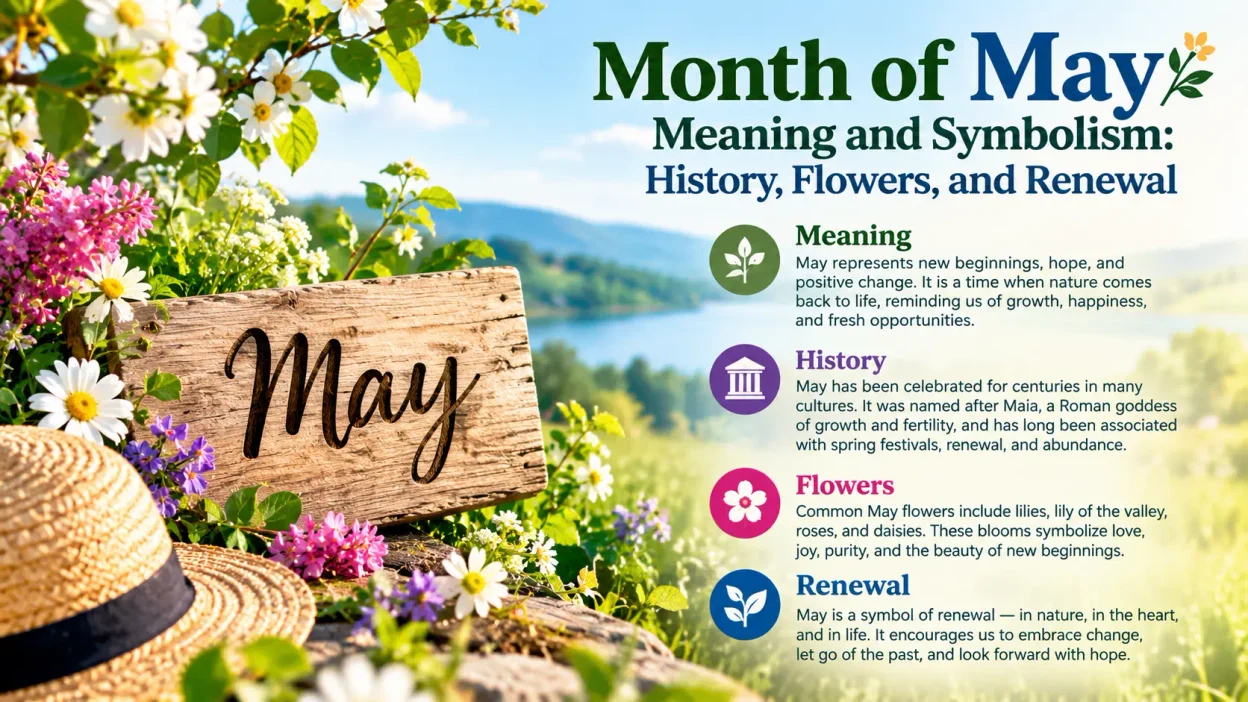
The month of May meaning and symbolism centers on spring renewal, growth, love, and the promise of warmer days. In the United States, May is associated with blooming flowers, longer daylight hours, graduations, Mother’s Day, and the approach of summer. Its place in the calendar makes it a natural symbol of fresh starts and new opportunities.
May also has a history that reaches beyond modern seasonal celebrations. Its name comes from the Roman world, where it was associated with Maia, a goddess connected with growth and the natural world. Over time, the month acquired additional meanings through European customs, religious observances, flower traditions, and American holidays.
Understanding May’s symbolism means looking at both its historical roots and the ways people experience it today. For some, May represents romance and beauty; for others, it marks achievement, family connection, or the transition into a new season of life.
Quick Answer
The month of May commonly symbolizes renewal, growth, love, and new beginnings in modern American culture, especially through spring flowers, Mother’s Day, and graduation celebrations. Historically, May has been connected with the Roman goddess Maia, European spring customs, and traditions that celebrate fertility, abundance, and the natural world’s return to life.
TL;DR
- May represents spring growth, renewal, optimism, and new opportunities.
- Its name is traditionally connected with Maia, a Roman goddess.
- Lily of the valley and hawthorn are traditional May birth flowers.
- Emerald is the modern birthstone associated with May.
- Mother’s Day and Memorial Day give May distinct American significance.
- May Day traditions celebrate spring, flowers, and seasonal change.
What the Month of May Symbolizes
May often represents a turning point between the fresh growth of spring and the fullness of summer. Trees have developed new leaves, gardens begin producing flowers, and many regions of the United States experience milder weather.
These visible changes explain why May is associated with renewal. The month provides a seasonal image of progress: something that began as a small sign of life in early spring becomes more developed and easier to see.
May also symbolizes hope and possibility. Students approach graduation, families plan summer activities, and people begin spending more time outdoors. These experiences can make May feel like a month of movement rather than waiting.
Its symbolism is not limited to happiness, however. May can also mark the end of school years, the remembrance of military service members, and the emotional transitions that accompany changing routines. The month holds both celebration and reflection.
At its core, May represents growth becoming visible. It suggests that change can develop gradually and that new stages often begin before the previous one has completely ended.
The Origin of the Name May
The English word May comes through Latin Maius, the Roman name for the month. Ancient Roman tradition associated the name with Maia, a goddess linked with growth and the natural world.
The exact historical development of the name and the goddess’s role should be treated carefully. Roman religious traditions evolved over time, and later writers connected Maia with different aspects of fertility, growth, and the earth.
May was the fifth month in the earliest Roman calendar traditions that began the year in March. It became the fifth month in the modern Gregorian calendar as well, although January and February were placed before it in the calendar system that developed over time.
The name’s association with growth fits the season in much of the Northern Hemisphere. However, the English name alone does not prove that every May custom originated in Roman worship. Many modern traditions developed through separate cultural and religious histories.
For contemporary readers, the Roman connection provides a historical starting point for understanding why May became associated with the flourishing natural world.
Maia and the Symbolism of Growth
Maia is commonly linked with growth, fertility, and the flourishing of nature in Roman tradition. Her name is often discussed in explanations of May’s origin, although ancient Roman religious practices were more complex than a single goddess representing every aspect of spring.
The association between Maia and May contributes to the month’s modern symbolic language. Growth is not merely about plants becoming larger; it can also represent the development of relationships, skills, plans, and personal ambitions.
In modern American writing, a reference to May may suggest a fresh chapter or a period when earlier efforts begin to show results. A garden that finally blooms can serve as a literal example, while a student completing years of study offers a human parallel.
These interpretations are modern extensions rather than direct descriptions of ancient Roman belief. Still, the connection between May, Maia, and growth gives the month a meaningful historical backdrop.
Why May Represents Spring Renewal
In the United States, May arrives during spring in the Northern Hemisphere. Temperatures rise in many regions, daylight lasts longer, and plants respond to changing conditions.
The exact experience depends on geography. May may bring late-season snow to some mountain communities, warm garden weather to much of the South, and cool but increasingly pleasant days to parts of the Northeast. Even within one state, the season can vary.
Despite these differences, May is widely associated with the visible progress of spring. Trees produce leaves, flowers open, and outdoor spaces become more inviting.
This seasonal pattern helps explain the month’s connection with renewal. People often use spring as a natural reference point for changing habits, beginning projects, or spending more time outside.
May’s symbolism also reflects the difference between potential and progress. Early spring suggests that change is coming, while May often shows that the change is already underway. This makes the month a fitting symbol for development, persistence, and renewed confidence.
May Flowers and Their Symbolic Meanings
Flowers are among the clearest visual expressions of May’s meaning. Gardens, bouquets, weddings, and seasonal decorations use blossoms to represent beauty, affection, celebration, and the arrival of warmer weather.
The meaning depends on the flower. Roses commonly communicate love, while daisies may suggest innocence or cheerfulness in familiar Western floral traditions. Tulips often appear in spring arrangements and can express affection, freshness, or elegance.
May also has two traditional birth flowers: lily of the valley and hawthorn. Lily of the valley is associated with sweetness, humility, and the return of happiness in several European floral traditions. Hawthorn has connections with springtime and older European customs, although its cultural meanings vary.
Flower symbolism is not universal. A flower’s meaning can change across cultures, historical periods, and personal experiences. A bouquet may carry a romantic message for one person and serve as a reminder of a family member for another.
In modern America, May flowers work especially well as gifts because they combine the season’s visible beauty with messages of gratitude, celebration, and new beginnings.
Lily of the Valley: Happiness and Humility
Lily of the valley is a traditional May birth flower recognized by its small, bell-shaped white blossoms and sweet fragrance. The flowers grow along slender stems, often in shaded gardens or woodland settings.
In Western floral symbolism, lily of the valley has been associated with humility, sweetness, purity, and the return of happiness. Its appearance in spring makes the last association particularly fitting: the delicate flowers emerge after colder weather and provide a clear sign of seasonal change.
The flower also has connections with weddings and expressions of affection. Its understated appearance can suit bouquets that communicate devotion without relying on large, dramatic blooms.
These meanings developed through several strands of European custom and floral language. They should not be treated as universal beliefs shared by every culture.
One practical point matters when using the flower in homes and gardens: lily of the valley is poisonous if eaten. Its attractive appearance does not make it safe for children or pets to consume.
Hawthorn: Protection, Spring, and Traditional Folklore
Hawthorn, the other traditional May birth flower, is a flowering shrub or small tree known for its blossoms and often thorny branches. It appears in European landscapes and has a long presence in folklore and seasonal customs.
In some European traditions, hawthorn has been connected with spring, fertility, protection, and the boundary between ordinary life and the supernatural. These associations vary by place and period, and they should not be presented as a single belief system shared across Europe.
Hawthorn’s flowering season helped make it an important part of older May celebrations. Its blossoms provided a natural marker of the changing season, especially in communities where agricultural life depended on close observation of plants and weather.
In contemporary symbolism, hawthorn can represent resilience as well as beauty. Its flowers are delicate, but its thorny branches remind viewers that growth and protection can exist together.
For May birthdays, hawthorn offers a less familiar alternative to more widely recognized flowers. Its meaning is strongest when the person giving or receiving it understands the particular cultural or personal associations behind the plant.
Emerald: May’s Birthstone and Its Symbolism
Emerald is the traditional birthstone for May. This green variety of beryl is valued for its rich color, which connects naturally with the month’s associations with leaves, gardens, and new growth.
In Western jewelry traditions, emerald has been associated with love, hope, renewal, and prosperity. Its green color also makes it a fitting emblem of spring, when vegetation becomes more prominent after winter.
Emerald’s history extends well beyond May birthdays. Ancient societies valued the gemstone for its beauty, and different cultures developed their own beliefs about its qualities. Those historical associations should not be collapsed into one universal meaning.
In modern American culture, emerald jewelry is a popular birthday gift and can mark anniversaries, personal milestones, or family celebrations. Some people choose it because it represents their birth month; others simply appreciate its color and appearance.
As a symbol, emerald adds a personal dimension to May. While the flowers represent seasonal change, the birthstone connects the month with identity, affection, and the celebration of individual milestones.
May Day and the Celebration of Spring
May Day, observed on May 1, is associated with spring celebrations in several European traditions. Customs have included gathering flowers, decorating homes, dancing around maypoles, and welcoming the growing season.
These practices developed through different historical influences, including older seasonal customs and medieval European festivities. Their meanings varied between communities, so it would be inaccurate to describe all May Day celebrations as remnants of one ancient religious ritual.
The maypole is one of the most recognizable images associated with the holiday. Participants traditionally dance around a decorated pole while ribbons form patterns, creating a communal activity that emphasizes movement, color, and celebration.
In the United States, May Day is less widely observed as a major public holiday than it is in some European communities. Schools, cultural organizations, and local festivals may still organize spring activities, flower displays, or traditional dances.
May 1 also has a separate significance as International Workers’ Day in many countries. This observance focuses on labor movements and workers’ rights rather than spring flowers. Recognizing the difference helps explain why May Day can communicate either seasonal celebration or social solidarity, depending on the context.
Mother’s Day and the Symbolism of Love Month of May Meaning and Symbolism
Mother’s Day is one of the most recognizable American observances in May. Celebrated on the second Sunday of the month, it gives families an opportunity to express appreciation for mothers and other important caregivers.
The modern American holiday developed through campaigns to establish a dedicated day honoring mothers. In 1914, President Woodrow Wilson signed a proclamation establishing the second Sunday in May as a national observance.
Flowers, greeting cards, meals, and personal gifts have become familiar parts of the celebration. These customs reinforce May’s associations with affection, gratitude, family bonds, and care.
Mother’s Day can also be emotionally complicated. People who have lost their mothers, experienced difficult family relationships, struggled with infertility, or grieve a child may experience the occasion differently. For them, the holiday can bring sadness alongside public messages of happiness.
This range of experiences shows that May’s symbolism is not limited to cheerful beginnings. Love may involve appreciation, memory, grief, and the recognition of relationships that have changed.
Memorial Day: Remembrance and Sacrifice
Memorial Day gives May a solemn meaning in the United States. Observed on the last Monday of the month, it honors military personnel who died while serving their country.
The modern observance developed after the Civil War through traditions of decorating the graves of fallen soldiers. The practice became known as Decoration Day, and flowers played an important role in commemorating the dead. Federal law moved the observance to the last Monday in May in 1971.
Memorial Day is now associated with cemetery visits, memorial ceremonies, American flags, and moments of remembrance. For many families, it is also a time to honor relatives and friends who died in military service.
The holiday carries an important distinction: it honors those who died in service, rather than serving as a general celebration of all living veterans. Veterans Day, observed in November, recognizes military veterans more broadly.
Memorial Day weekends are also associated with travel, cookouts, and the unofficial beginning of summer. These customs can coexist with remembrance, but the holiday’s central purpose remains honoring the fallen.
This dual character adds another dimension to May’s meaning. The month can represent growth and celebration while also asking people to pause, remember, and recognize sacrifice.
Religious Traditions and the Month of May
May has religious significance in several Christian communities, particularly in Roman Catholic tradition, where the month is associated with devotion to the Virgin Mary.
Catholic parishes and families may mark May with special prayers, Marian hymns, floral decorations, or ceremonies known as May crownings. In these ceremonies, a statue or image of Mary may receive a crown of flowers, expressing reverence and devotion.
The relationship between May and Marian devotion developed through Christian devotional traditions over time. It is reasonable to see connections between spring’s flowers and imagery of beauty, motherhood, and new life, but the practice should not be reduced to a direct continuation of Roman religious worship.
Other Christian communities may emphasize Easter-related observances when Easter falls in May, while Jewish, Muslim, Hindu, Buddhist, and other religious calendars follow their own systems and observances. Their important dates do not remain fixed within the Gregorian calendar.
For Americans, this variety matters because May’s religious meaning depends on the faith community and the calendar year. The month may be a time of Marian devotion for one family, a period of ordinary religious practice for another, and a month shaped by different observances for someone else.
May’s Emotional and Psychological Meaning
May can evoke optimism because its seasonal changes are visible. New leaves, flowering gardens, and longer evenings offer everyday reminders that conditions can improve after a difficult period.
For some people, the month also creates a sense of momentum. Students finish exams, graduates prepare for their next stage, and families begin planning summer activities. These events can make May feel like a bridge between effort and reward.
Its emotional meaning is not the same for everyone. People who experience seasonal allergies, financial pressure around graduation, family grief, or uncertainty about the future may find May demanding rather than uplifting.
This difference is important when using the month as a personal symbol. May can represent hope without requiring constant happiness. It can also represent patience, adjustment, and the work involved in moving into a new stage of life.
A May-themed gift, journal entry, or piece of art might communicate encouragement to someone beginning a project. For another person, it might mark a graduation, honor a loved one, or preserve a memory of a particular spring.
The symbolism works best when it reflects a real experience rather than an assumption that everyone feels the same way about the season.
How May Appears in Modern American Life
May’s symbolism is visible in ordinary American activities as well as formal celebrations. Garden centers display seasonal plants, wedding venues use fresh flowers, schools prepare graduation ceremonies, and communities organize outdoor festivals as the weather becomes more inviting.
The month also appears frequently in greeting cards, calendars, social media captions, and home decor. Phrases about May flowers, fresh starts, and springtime often use the season to communicate optimism or appreciation.
Graduation imagery gives May another recognizable role. Caps, gowns, diplomas, and photographs mark the completion of one stage and the beginning of another. For students and families, May can become a personal symbol of achievement.
Fashion and interior design reflect the season through lighter fabrics, floral prints, pastel colors, and green accents. These choices are not fixed symbolic codes; they are visual conventions that help people express a seasonal mood.
In digital culture, a photograph of a flowering tree or a May garden can communicate a moment of calm, beauty, or anticipation. The image gains personal meaning from its caption, the occasion, and the person sharing it.
May Symbolism Across Cultures
May’s meaning changes across cultures partly because seasons differ around the world. In the Northern Hemisphere, May generally falls during spring, while in the Southern Hemisphere it falls during autumn.
That geographical difference affects how people interpret the month. Someone in the United States may connect May with new leaves and garden flowers, while someone in Australia may associate it with cooler temperatures and the transition toward winter.
European May Day customs have also influenced spring celebrations in other places, while local traditions give the season distinctive meanings. Hawaii’s Lei Day, observed on May 1, celebrates the lei and its place in Hawaiian culture. The occasion has its own cultural context and should not be treated as simply another version of a European maypole festival.
Religious calendars add further variation. May may contain important Christian observances in a particular year, but the dates of holidays in many other faith traditions shift relative to the Gregorian calendar.
These differences demonstrate that May does not have one universal symbolic meaning. Its associations emerge from seasonal experience, history, community traditions, and the events people observe during the month.
Common Misunderstandings About May’s Meaning
One common misconception is that May represents happiness for everyone. Spring imagery often conveys optimism, but personal circumstances and regional weather can produce very different experiences.
Another is that all May traditions originate from the Roman goddess Maia. The name has a traditional connection with Maia, but May Day celebrations, Christian Marian devotion, Mother’s Day, and Memorial Day developed through distinct historical processes.
It is also inaccurate to assume that May always represents spring. That association applies to the Northern Hemisphere, including the United States, but not to the entire world.
May’s flowers and birthstone also have traditional associations rather than fixed meanings that every person must accept. Lily of the valley, hawthorn, and emerald can carry personal or cultural significance, but their interpretations differ across contexts.
Finally, Memorial Day should not be treated only as the start of summer. Although the holiday weekend is widely associated with travel and recreation, its primary purpose is to remember military personnel who died in service.
Understanding these distinctions makes May’s symbolism more useful. The month can hold several meanings at once without requiring every tradition or personal experience to fit a single story.
May Meaning and Symbolism at a Glance
| Symbol or occasionCommon meaning in the United StatesHistorical or cultural connection | ||
|---|---|---|
| Spring flowers | Renewal, beauty, and affection | Seasonal growth and floral traditions |
| Maia | Growth and fertility | Ancient Roman religious tradition |
| Lily of the valley | Humility and the return of happiness | European floral symbolism |
| Emerald | Love, hope, and personal identity | Traditional May birthstone |
| Mother’s Day | Love, gratitude, and family bonds | National observance established in 1914 |
| Memorial Day | Remembrance and sacrifice | Commemoration of military personnel who died in service |
These associations provide a starting point, not a universal dictionary of meanings. A symbol’s significance depends on the tradition, occasion, and personal experience behind it.
Frequently Asked Questions
What is the spiritual meaning of the month of May?
May can represent renewal, growth, gratitude, and a willingness to begin again. In particular religious traditions, its spiritual meaning may also involve specific devotional practices or seasonal observances.
Why is May associated with love and fertility?
May’s connection with growth and fertility partly reflects ancient Roman associations with Maia and older European spring customs. Modern American celebrations, especially Mother’s Day and spring weddings, add familiar associations with affection and family life.
What are the birth flowers and birthstone for May?
May’s traditional birth flowers are lily of the valley and hawthorn, and its birthstone is emerald. These symbols are often used in birthday bouquets, jewelry, and personalized gifts.
Is May considered a lucky month?
Some traditions and personal beliefs associate May with good fortune, growth, or favorable beginnings, but there is no universal rule that May brings luck. Its positive reputation often comes from springtime imagery and the celebrations that occur during the month.
What does May symbolize in Christianity?
In Roman Catholic tradition, May is especially associated with devotion to the Virgin Mary, including prayer and May crowning ceremonies. Other Christian communities may emphasize different observances depending on their traditions and the date of Easter.
Why is May important in American culture?
May combines family celebrations, school graduations, spring activities, and Memorial Day. These occasions give the month meanings connected with love, achievement, community, remembrance, and the transition toward summer.
Does May symbolize new beginnings?
Yes, May commonly symbolizes new beginnings because plants flourish, outdoor activities increase, and many students reach educational milestones. People also use the month as a personal marker for starting projects, changing routines, or recognizing progress.
Conclusion
The month of May meaning and symbolism brings together renewal, growth, affection, achievement, and remembrance. Its historical associations with Maia and European spring traditions help explain its connection with the natural world, while American observances such as Mother’s Day, graduation season, and Memorial Day give it additional cultural significance.
May does not have to mean the same thing to everyone. It can represent a garden beginning to bloom, a family gathering, a long-awaited achievement, or a quiet moment of remembrance. Its meaning comes from the meeting point between seasonal change, shared traditions, and the experiences people carry into the month.