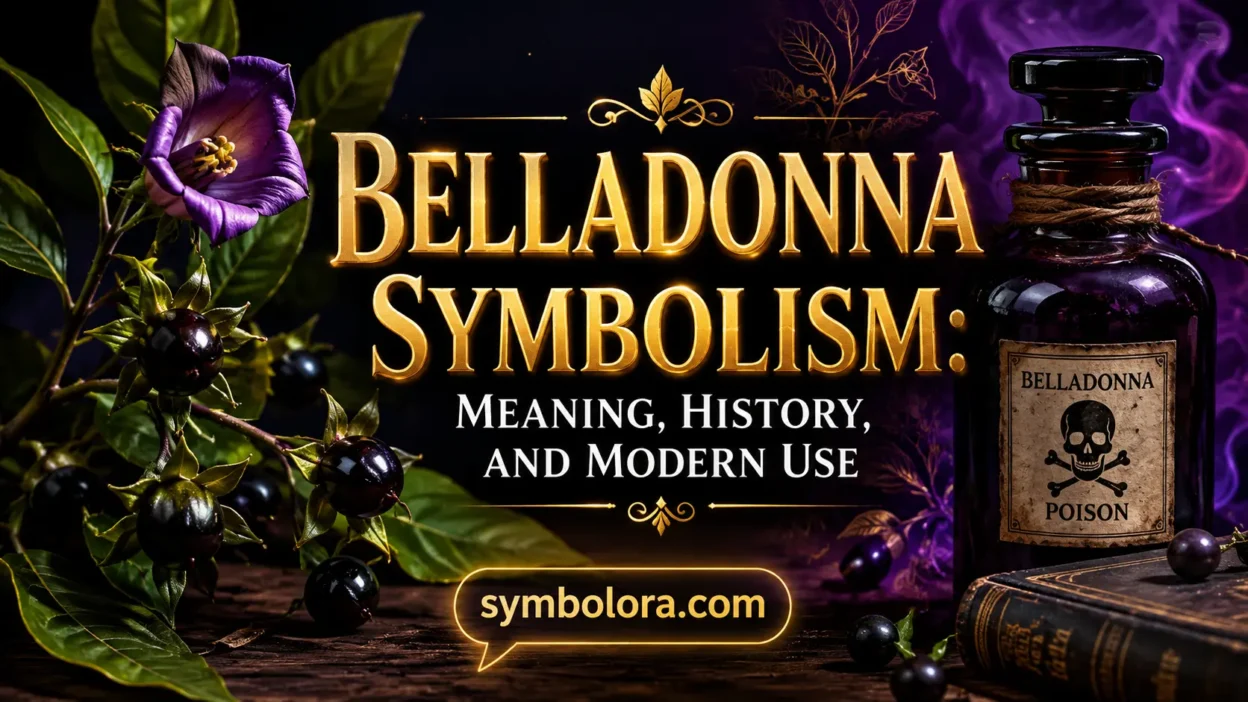
Belladonna symbolism begins with a contradiction: the plant is visually attractive, yet dangerously toxic. Its dusky purple, bell-shaped flowers and glossy black berries give it an elegant appearance, while its alkaloids can cause severe poisoning. That tension has made belladonna a lasting emblem of beauty with consequences, seductive danger, secrecy, death, and forbidden knowledge.
In the United States, most people encounter belladonna less as a living garden plant than as an image in Gothic art, tattoo designs, fantasy stories, and historical discussions of poison. Its meaning is shaped by several overlapping traditions: Greek ideas about fate, European poison lore, Renaissance beauty practices, Victorian flower language, and a modern fascination with dark femininity.
Quick Answer
Belladonna symbolism commonly represents dangerous beauty, mortality, secrecy, and attraction that carries a hidden cost. Historically, the plant also became associated with fate, poison, altered consciousness, witchcraft folklore, medicine, and the Victorian idea of silence.
At a glance:
- Belladonna joins physical beauty with genuine mortal danger
- Its botanical name connects it with Atropos and death
- European folklore tied it to poison and alleged witchcraft practices
- Victorian flower guides commonly assigned belladonna the meaning “silence
- Americans often use it in Gothic art, tattoos, and fantasy
- Its medical history adds themes of duality, control, and consequence
What Belladonna Looks Like and Where It Grows
Belladonna, or deadly nightshade, is a branching herbaceous perennial in the nightshade family, typically bearing oval green leaves, hanging purple-brown flowers, and round berries that ripen from green to glossy black. The berries can look inviting, which sharpens the plant’s symbolic contrast between an appealing surface and a genuinely dangerous reality underneath.
The species is native across much of Europe and extends into parts of North Africa and western Asia, and it’s since been introduced beyond its original range, including parts of the United States. Because it isn’t a broadly familiar native American wildflower, its U.S. meaning comes mainly from imported folklore, literature, and botanical history rather than from one continuous national tradition.
What Belladonna Commonly Means Today
The plant’s most recognizable meaning is danger hidden inside beauty. Unlike a thorny plant that visibly warns people away, belladonna presents soft flowers and polished berries — the threat isn’t obvious to an uninformed observer, which is exactly why it works so well as a symbol for a person, promise, or situation that appears desirable but carries real risk underneath.
It also represents mortality and irreversible consequences. Belladonna isn’t merely associated with sadness or mourning; it suggests an active boundary that shouldn’t be crossed, and in visual storytelling it often signals that curiosity, desire, or ambition has moved into genuinely dangerous territory.
| Context | Common U.S. Meaning | Typical Associations | Important Nuance |
|---|---|---|---|
| Gothic art | Beautiful danger | Poison, darkness, elegance | Often aesthetic rather than literal |
| Tattoos | Survival or guarded identity | Boundaries, transformation, warning | Meaning depends on the wearer |
| Fantasy stories | Forbidden knowledge | Witches, potions, altered states | Usually draws from European lore |
| Floral symbolism | Silence or secrecy | Unspoken truth, concealed intent | Based on historical flower guides |
| Medical history | Remedy and poison | Dosage, control, double-edged power | The plant itself remains toxic |
Why Beauty and Danger Became Linked
The Italian name bella donna means “beautiful woman,” a name long connected with reports that women used preparations derived from the plant to enlarge their pupils, a look considered attractive in some European beauty traditions. Atropine does dilate the pupils, but it can also blur vision and produce harmful systemic effects — so the beauty came bundled with a real cost from the start.
This history gave the plant a symbolism more specific than ordinary poison. Belladonna suggests beauty pursued past the point of safety, and it can stand for vanity, social pressure, or the willingness to accept harm in exchange for admiration. In a modern American reading, it often fits conversations about dangerous beauty standards and the gap between polished appearances and private costs.
That symbolism shouldn’t be reduced to a moral judgment against women, though. The more useful interpretation concerns the system around beauty itself — who defines attractiveness, what risks people are encouraged to take, and how desire can be manipulated. Belladonna’s name preserves admiration and warning in the same phrase.
Atropos and the Symbolism of Fate
Carl Linnaeus formally published the plant’s scientific name in 1753, and the genus Atropa refers to Atropos, one of the three Fates in Greek mythology — the figure who cut the thread of life, making death final and unavoidable. That name expanded the plant’s symbolic field from poison to destiny, letting belladonna suggest a decisive ending or a consequence that cannot be undone. In art, pairing the plant with thread, scissors, clocks, or a severed cord makes this connection especially clear.
Atropos also introduces the idea of limits. The symbol doesn’t always mean death is imminent — it may simply indicate that time is finite, that choices matter, or that some stages of life must end before another can begin.
Poison, Death, and Irreversible Consequences
All parts of deadly nightshade contain toxic compounds, including atropine, scopolamine, and hyoscyamine. Poisoning can produce an anticholinergic syndrome involving dilated pupils, dry mouth, rapid heartbeat, confusion, agitation, hallucinations, and potentially severe medical complications.
Because the danger here is physical rather than legendary, belladonna functions as a credible warning symbol — it can mark betrayal, lethal temptation, or a boundary protected by real consequences. A character wearing belladonna jewelry, for example, may be presented as attractive but untouchable, or quietly capable of retaliation. That said, its symbolic use should stay strictly visual. The plant is not a safe edible garnish, homemade remedy, or ritual ingredient, and confusing aesthetic fascination with safe handling turns symbolism into a genuine poisoning risk.
European Folklore and the Witchcraft Association
Belladonna became linked with witchcraft through European folklore, medical writing, and later retellings, frequently grouped with mandrake, henbane, and other tropane-containing plants in stories about charms, trance states, and so-called flying ointments. Some historical scholarship finds evidence for psychoactive ointment traditions, while also warning that later popular accounts often combine separate practices and legends into one dramatic narrative.
This distinction matters. The plant’s witchcraft image isn’t proof that one standardized “witch religion” used belladonna the same way across Europe — early modern witchcraft accusations were shaped by theology, fear, social conflict, and judicial pressure, and the surviving record mixes actual plant knowledge with hostile fantasy. In modern American culture, the association is usually symbolic rather than historical, with belladonna representing independence, taboo knowledge, or an outsider identity — meanings that reflect contemporary reinterpretation as much as old European folklore.
Silence in Victorian Flower Language
Nineteenth-century flower guides assigned specific messages to plants, letting bouquets and botanical images communicate feelings indirectly, though meanings could vary between books. A widely circulated Victorian guide listed belladonna as meaning silence — a meaning that fits the plant in several ways: poison can silence permanently, secrecy protects dangerous knowledge, and a concealed threat may go unnoticed until it’s too late.
Today, “silence” can be read less literally. In a tattoo or fictional scene, belladonna may suggest an unspoken truth, a secret identity, or a refusal to explain oneself — one of the plant’s quieter meanings, distinct from its more obvious themes of death and poison.
Medicine, Poison, and Double-Edged Power
Belladonna’s chemistry also contributed to medicine. Compounds associated with the plant, especially atropine, have recognized pharmaceutical uses, including effects on the eye and nervous system — the same biological activity that makes uncontrolled exposure dangerous can be useful when isolated, measured, and administered medically.
Symbolically, this creates a strong medicine-poison duality. Belladonna can represent power that’s neither automatically good nor evil, where the outcome depends entirely on knowledge and control — fitting for stories about healers or rulers whose abilities can protect or harm depending on how they’re used. This differs from the cliché that “everything dangerous is secretly healing,” though. The plant itself isn’t made safe by positive intention; its symbolic lesson is stricter than that, centered on the idea that specialized knowledge and disciplined limits genuinely matter.
How Americans Interpret the Plant
American audiences usually read belladonna through a mixture of Gothic literature, horror imagery, fantasy entertainment, and renewed interest in folk practices. Contemporary popular culture often presents witches as healers or complex antiheroes rather than only villains, which has made poisonous plants available as symbols of agency as well as menace.
Because the plant’s main historical associations developed outside North America, it shouldn’t be presented as a universal Native American symbol or a standard ingredient in every U.S. folk-magic tradition — American regional practices have their own plants, histories, and local knowledge. Belladonna’s U.S. symbolism is better understood as a European-derived image that’s been adapted by modern subcultures, which is exactly why it can mean several things at once: feminine autonomy, dangerous attraction, concealed strength, grief, fate, or refusal, depending entirely on context.
Emotional and Psychological Meaning
Psychologically, belladonna often communicates ambivalence — the simultaneous pull of attraction and fear. Viewers may be drawn to its beauty while recognizing that closeness is unsafe, which makes it useful for representing unhealthy relationships, compulsive desire, or fascination with forbidden subjects.
It can also represent defensive identity. Someone who chooses the plant as a personal emblem may be saying, in effect, “I am not harmless simply because I appear soft” — belladonna becomes a boundary symbol rather than a threat, warning against entitlement or underestimation. A third reading centers on transformation through confrontation: poison imagery often appears in stories about surviving betrayal or shedding innocence, with belladonna marking the point at which a person stops confusing beauty with safety.
Belladonna Tattoos and Personal Identity
In American tattoo culture, belladonna designs commonly combine dark berries and drooping purple flowers with snakes, moths, skulls, moons, daggers, or feminine portraits — and each added object shifts the message. A skull emphasizes mortality, a snake adds renewal or danger, a moon strengthens nocturnal and occult associations, and a dagger can suggest betrayal or self-protection.
A belladonna tattoo may express survival after manipulation, attraction to Gothic aesthetics, respect for personal boundaries, or identification with misunderstood femininity — it can also memorialize a difficult period without depicting the event directly. The wearer’s own explanation matters more than any dictionary meaning here; plant symbolism is flexible, and assuming every belladonna tattoo celebrates poison or witchcraft can erase the individual reason it was actually chosen.
Fashion, Jewelry, Decor, and Digital Culture
In fashion and jewelry, belladonna works well as visual shorthand for dark elegance. Designers may use black berries, purple flowers, or antique botanical plates to create an atmosphere of danger and old-world mystery, and in home decor the image appears in framed botanical prints, Halloween displays, and Gothic interiors, where it generally communicates mood rather than a literal wish for harm.
Online, belladonna imagery is often paired with phrases about boundaries, feminine rage, or being underestimated. These posts can simplify the plant into a fashionable “dark feminine” emblem, but they also show how an old poison symbol has become a genuine modern identity marker in its own right.
Belladonna in Stories and Pop Culture
Writers and visual artists use belladonna because it can reveal character before the plot explains anything. A garden containing deadly nightshade may foreshadow betrayal; a perfume or character named Belladonna may signal charm with concealed danger; a botanical illustration in a scene can imply medicine, murder, or inherited secrets. The plant is especially effective in stories about unreliable appearances, since its beauty doesn’t disguise danger through magic — the contrast exists in the real plant, which gives fictional symbolism a factual foundation and makes the image feel more convincing than an invented poisonous flower.
Still, pop culture often exaggerates its effects, sometimes treating belladonna as an instant, predictable poison or a controlled visionary substance. Real exposure is medically dangerous and unpredictable, so fictional depictions shouldn’t be mistaken for practical information.
Common Misunderstandings and Distorted Meanings
One common mistake is treating belladonna as a standard symbol of romance simply because its name means “beautiful woman.” The name contributes a beauty association, but the plant’s stronger symbolic force comes from the collision of beauty with toxicity, not from romance alone.
Another mistake is claiming it has one fixed spiritual meaning. Belladonna has documented botanical, mythological, medicinal, and floral-language associations, but no single interpretation governs every religion or culture — modern spiritual uses are usually personal or community-specific. It’s also misleading to present every witchcraft story as confirmed history. Some plant-based ointments may have existed, but witch-trial narratives were shaped by accusation, coercion, and later sensationalism, so responsible interpretation separates documented pharmacology from folklore, and folklore from propaganda.
How the Meaning Changed Over Time
Belladonna first carried practical meaning as a dangerous plant with medicinal and poisonous effects. Its formal scientific name added a classical reference to fate and death, while Renaissance beauty stories strengthened the link between attraction and risk, and European folklore connected it with altered states and alleged witchcraft.
Victorian flower language then condensed the plant into the single message of silence, and modern American culture widened the symbol again — using it for Gothic beauty, guarded femininity, trauma survival, mortality, and self-possession. The result isn’t a random collection of meanings, though; each interpretation grows from the same central contradiction, that something can be beautiful, useful, feared, and dangerous all at once.
Frequently Asked Questions
What does belladonna symbolize?
Belladonna most often symbolizes dangerous beauty, poison, secrecy, mortality, and attraction with consequences. Depending on context, it can also represent fate, silence, guarded power, or knowledge that requires caution.
Is belladonna a positive or negative symbol?
It can be either, but it’s rarely neutral. Negative readings emphasize death, deception, or betrayal, while positive readings focus on boundaries, survival, independence, and respect for dangerous knowledge.
What does a belladonna tattoo mean?
A tattoo may represent dark femininity, protection, mortality, transformation, or recovery from a harmful relationship. The surrounding imagery and the wearer’s personal story determine the most accurate meaning.
Does belladonna have a religious meaning?
It doesn’t have one universal religious meaning. Its strongest historical associations come from Greek mythology, European folklore, medicine, and later occult imagery rather than from a single established doctrine.
Why is belladonna associated with witches?
European stories linked belladonna and related plants with trance-inducing preparations, folk magic, and alleged flying ointments. Some practices may have had a botanical basis, but many later accounts blend evidence, accusation, folklore, and fantasy.
What did belladonna mean in Victorian flower language?
A well-known Victorian flower guide assigned it the meaning “silence.” Modern readers may interpret that as secrecy, unspoken truth, suppression, or the final silence associated with poison.
Conclusion
Belladonna symbolism centers on the uneasy meeting of beauty and danger. The plant can represent mortality, fate, silence, poison, guarded identity, and the risks hidden beneath an attractive surface — and its history explains why these meanings belong together rather than appearing as unrelated modern inventions.
For American audiences, belladonna is most useful as a symbol of discernment: appearance alone cannot establish safety, and knowledge without restraint can become destructive. Its image remains compelling because it doesn’t ask viewers to reject beauty — it asks them to look beyond it.


