
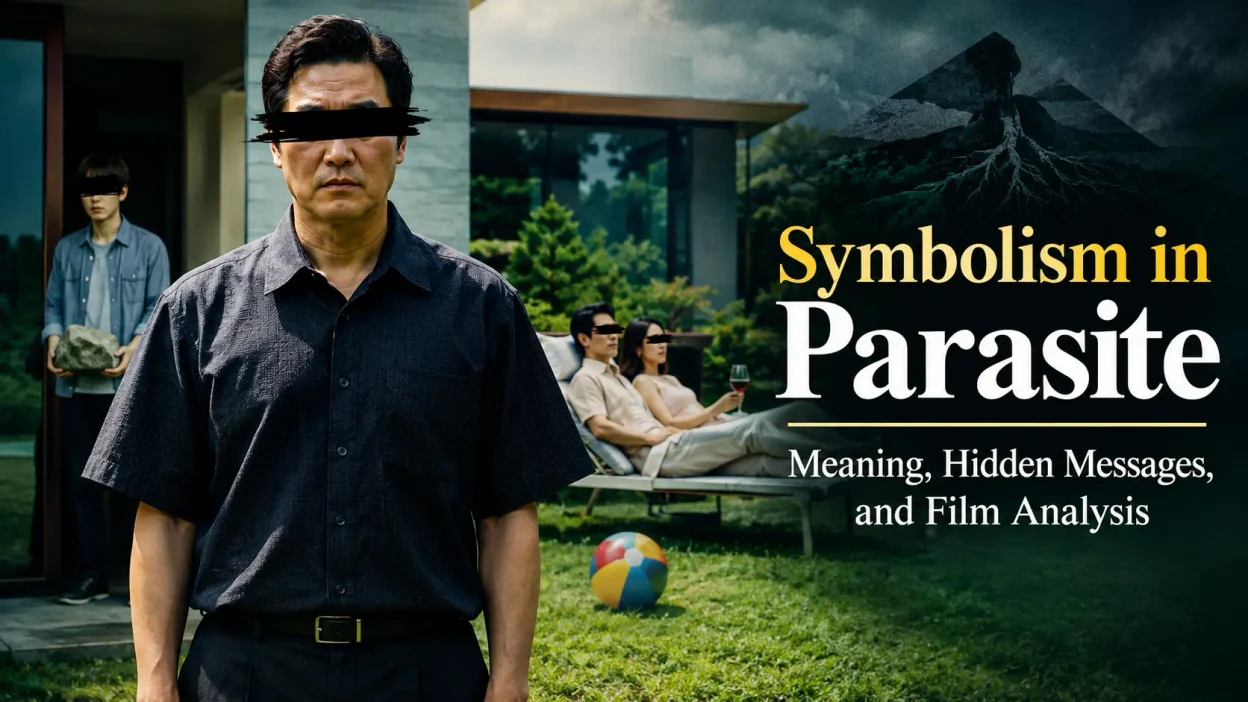
The symbolism in Parasite reveals how wealth, poverty, social status, and ambition shape everyday life. Directed by Bong Joon-ho, the 2019 South Korean film uses ordinary objects and familiar spaces to expose the distance between people who have financial security and those struggling to survive. Its staircases, semi-basement apartment, luxurious mansion, recurring references to smell, and unusual scholar’s stone all carry meaning beyond their immediate roles in the story.
For American viewers, Parasite offers a recognizable look at economic inequality, the pressure to move up socially, and the ways people judge one another by appearance. Although the film is rooted in contemporary South Korean society, its questions about housing, employment, dignity, and opportunity reach audiences far beyond Korea.
Spoiler warning: This analysis discusses major plot developments and the film’s ending.
Quick Answer
Symbolism in Parasite commonly represents class inequality, economic insecurity, social exclusion, and the unequal pursuit of success. Historically and culturally, the film draws on South Korean housing conditions and social hierarchies, using stairs, smell, architecture, and the scholar’s stone to show how wealth shapes people’s opportunities and relationships.
TL;DR
- Staircases represent social hierarchy and the struggle for upward mobility.
- The semi-basement reflects poverty, insecurity, and limited opportunities.
- The Park mansion symbolizes privilege, privacy, and economic separation.
- Smell exposes class prejudice that money and appearances cannot conceal.
- The scholar’s stone represents ambition, hope, and the danger of material obsession.
- Rain and flooding reveal how inequality shapes people’s experiences of disaster.
What Makes Symbolism So Important in Parasite?
Parasite tells the story of the Kim family, who struggle financially while living in a cramped semi-basement apartment in Seoul. Their circumstances change when their son, Ki-woo, receives an opportunity to tutor the daughter of the wealthy Park family. Through a series of calculated deceptions, the Kims gradually secure jobs in the Parks’ household.
At first, the arrangement resembles a clever comedy about ambition and social climbing. As the story develops, however, hidden spaces, uncomfortable encounters, and escalating violence reveal the costs of the characters’ attempts to improve their lives.
Bong Joon-ho uses symbolism to communicate these conflicts without relying on long explanations. A staircase can show the distance between social classes; a person’s reaction to another person’s smell can reveal prejudice; and a beautifully designed house can conceal a desperate human situation beneath its surface.
These details also make the film open to multiple interpretations. The symbols reinforce the story’s criticism of inequality, but they do not reduce every character to a simple representative of good or evil. Both families make choices, protect their interests, and respond to circumstances in ways that complicate the moral picture.
The Staircases as Symbols of Social Class
Staircases are among the clearest symbols in Parasite. Characters repeatedly move upward toward comfort, opportunity, and privilege or downward toward cramped spaces and hidden dangers.
The Kim family lives below street level, while the Park family occupies a spacious home associated with wealth and elevated status. The secret bunker beneath the mansion adds another layer to this vertical arrangement. The building becomes a physical map of social hierarchy.
The stairs also shape the viewer’s emotional experience. When the Kims climb toward the Parks’ home, their movement suggests progress and access to a better life. When they descend through the city during a storm, the same downward movement becomes a reminder of how difficult it is to escape their circumstances.
The director has described stairs as a central metaphor in the film, making the vertical arrangement more than a visual coincidence.
For American audiences, the image can evoke the familiar expression of climbing the economic ladder. Yet Parasite questions whether individual effort alone can overcome structural barriers. The characters may move between social spaces, but their access to security remains unequal.
The Kim Family’s Semi-Basement and the Reality of Poverty
The Kim family’s home is a semi-basement apartment, a type of residence found in South Korea that sits partly below ground level. Its small windows provide limited views of the outside world, and the apartment offers little protection from street noise, pests, or flooding.
This setting is historically and socially specific. Semi-basement housing in Seoul has been associated with affordability and the pressures of urban housing costs. It should not be treated as a universal representation of every low-income person’s living conditions in South Korea.
The apartment’s position creates a visual tension between being inside and outside, visible and overlooked. The Kims can see fragments of street life through their window, but they lack the privacy and comfort that the Park family takes for granted.
The opening scenes also show the family searching for free Wi-Fi and trying to earn money by folding pizza boxes. These details present poverty as a daily practical challenge rather than an abstract condition.
For viewers in the United States, the apartment may bring to mind overcrowded housing, rising rents, unstable living conditions, or neighborhoods exposed to environmental risks. The specific architecture differs, but the underlying question remains familiar: how much control do people have over their lives when their housing options are limited?
The Park Mansion as a Symbol of Wealth and Privilege

The Park family’s mansion contrasts sharply with the Kims’ semi-basement. It features clean lines, large windows, open spaces, carefully arranged furniture, and a private garden. Its design communicates wealth without requiring the characters to discuss money directly.
The house represents more than financial success. It symbolizes the privacy, comfort, and control that wealth can provide. The Parks can decide who enters their home, which services they purchase, and how they organize their daily lives. Their surroundings protect them from many difficulties experienced by the people who work for them.
Yet the mansion also contains hidden spaces and uncomfortable secrets. The underground bunker reveals that even an apparently perfect home has a concealed underside. Its existence complicates the idea that wealth automatically produces a secure or morally superior life.
The house’s beauty also depends on labor that remains largely invisible. Drivers, housekeepers, tutors, and other workers help maintain the family’s comfortable lifestyle. The Parks enjoy the results of that work without necessarily understanding the workers’ personal circumstances.
For American viewers, the mansion may resemble the luxury homes featured in real estate advertising and celebrity media. The film asks viewers to look beyond attractive interiors and consider the economic relationships that make such comfort possible.
The Hidden Bunker and the People Society Overlooks
The secret bunker beneath the Park mansion is one of the film’s most important symbols. It houses Geun-sae, the husband of the former housekeeper, Moon-gwang, who has been hiding there to escape dangerous creditors.
The bunker transforms the meaning of the mansion. What initially appears to be an open, elegant space contains a concealed world of fear and dependency beneath it.
Geun-sae occupies an even more precarious position than the Kim family. The Kims struggle to find stable employment, but they can still move through the city and interact with the outside world. Geun-sae depends on secrecy and the limited resources Moon-gwang brings him.
His existence also reveals that the Kims are not the only people competing for access to the Parks’ resources. Once they discover the bunker, the conflict becomes a struggle between people facing different forms of economic desperation.
The hidden room therefore symbolizes exclusion, debt, and the lengths people may go to survive. It also challenges the assumption that poverty forms a single, unified social group. People with limited resources can become rivals when opportunities are scarce.
The bunker is particularly significant because its occupant remains invisible to the wealthy household. The Parks’ comfortable lives continue above him, even though another person’s desperate circumstances exist beneath their floor.
Smell as a Symbol of Class Prejudice
Smell is one of the film’s most unsettling recurring motifs because it makes social inequality personal. The Park family notices a distinctive odor associated with the Kim family’s living conditions, and Mr. Park repeatedly expresses discomfort about it.
Unlike clothing or professional qualifications, smell cannot be changed instantly by putting on a new outfit. The Kims can learn new manners, adopt convincing professional identities, and enter an affluent household, but their living conditions leave traces that threaten to expose them.
The motif also reveals how social judgment operates without being openly acknowledged. Mr. Park does not need to announce a theory about class to communicate his discomfort. His facial expressions, comments, and references to an invisible boundary reveal his assumptions about the people who work for him.
The film does not suggest that poverty makes people inherently dirty or less worthy. Instead, it exposes the unfairness of judging people by circumstances they may have little power to change.
For American viewers, smell can be understood as a symbol of stigma. Similar judgments may be attached to clothing, accents, neighborhoods, occupations, or personal belongings. These signals can become shortcuts people use to classify others, even when they reveal little about a person’s abilities or character.
Smell becomes especially important because it crosses the boundaries the Kims try to establish between their working lives and private identities. Their deception may conceal their family relationships, but it cannot completely remove the material conditions that shape their experience.
The Scholar’s Stone and the Illusion of Material Success

The scholar’s stone, often called a scholar rock or viewing stone, is a distinctive object in the film. Min-hyuk gives it to Ki-woo near the beginning of the story, presenting it as something associated with material wealth and good fortune.
The stone becomes an object of hope. Ki-woo connects it with the possibility of changing his family’s financial circumstances, and its presence gives physical form to his desire for a better life.
Its significance changes as the plot develops. Rather than remaining a harmless gift, the stone becomes associated with the risks and violence surrounding the Kims’ attempt to improve their position.
The object is especially revealing because it is not money, a job offer, or a practical resource. It represents the promise of success more than success itself. Ki-woo invests it with expectations about what the future could become.
The stone also has a cultural context beyond the film. Scholar’s stones have been appreciated in East Asian literati traditions for their unusual shapes and associations with landscape, contemplation, and aesthetic appreciation. In the movie, this artistic object acquires an additional narrative role connected with ambition and wealth.
For modern American viewers, the stone may resemble a good-luck charm or a keepsake believed to represent a hoped-for future. The film’s treatment of it, however, raises a difficult question: when does hope encourage someone to act, and when does attachment to an imagined future distort their judgment?
Windows as Symbols of Visibility and Social Position
Windows appear in both the Kim family’s apartment and the Park family’s home, but they offer very different experiences.
In the Kims’ semi-basement, the window sits close to street level. The family sees passing pedestrians, delivery workers, and people using the street outside. Their private space remains exposed to the surrounding environment.
The Park mansion’s large windows create a different relationship with the outside world. They frame the garden and bring natural light into a carefully controlled interior. The residents can enjoy the view without experiencing the street at close range.
The contrast illustrates how architecture shapes privacy and perspective. Both families have windows, but their surroundings determine what they see and how much control they have over what enters their homes.
Visibility also has a social dimension. The Kims must remain alert to opportunities and threats that arrive from outside. The Parks have more freedom to treat the outside world as scenery.
For American audiences, the windows can suggest differences between housing security and exposure. A home may provide shelter, but its design and location influence how protected, visible, or vulnerable its residents feel.
Rain and Flooding as Symbols of Unequal Risk
The rainstorm is a turning point in Parasite. For the Park family, heavy rain disrupts a camping trip and creates an inconvenience. For the Kims, the same storm floods their neighborhood and destroys the fragile stability of their home.
The contrast reveals that a shared event can have radically different consequences depending on a person’s resources. The Parks can return to a comfortable house, while the Kims must deal with contaminated water, damaged belongings, and the loss of their living space.
Rain itself is not inherently a symbol of injustice. Its meaning emerges from the characters’ unequal circumstances and the way the film connects weather with housing vulnerability.
The scene also complicates the idea that hard work guarantees security. The Kims may take on multiple jobs and attempt to improve their circumstances, but a natural disaster can erase what little stability they have.
For American viewers, the sequence may evoke floods that disproportionately affect households with limited financial resources, inadequate insurance, or fewer options for relocating. It also illustrates how environmental risks interact with housing inequality.
The storm is not simply a dramatic plot device. It exposes the difference between experiencing a disaster as an inconvenience and experiencing it as a threat to basic survival.
Food, Consumption, and the Unequal Experience of Comfort
Food in Parasite helps distinguish the two families’ circumstances. The Kims are concerned with finding work and making limited resources last, while the Parks can treat food and household services as conveniences.
The contrast becomes particularly visible when the Park family’s plans change and domestic workers must respond quickly. Preparing food, arranging transportation, and managing household needs appear effortless to the people receiving the services because other people perform the labor.
One important example is the Parks’ late-night demand for ram-don, a dish combining instant noodles with expensive Korean beef. The combination brings an inexpensive convenience food into the world of luxury consumption.
The dish is not merely a contrast between cheap and expensive ingredients. It shows how wealth can transform ordinary things into personalized luxuries while leaving the work behind them largely unnoticed.
For American viewers, the scene may recall the difference between preparing meals under financial pressure and paying for restaurant service, grocery delivery, or private household assistance. The foods and customs differ, but the underlying relationship between consumption and labor is recognizable.
Food also helps ground the film’s social criticism in ordinary domestic life. Inequality is not expressed only through grand houses and large bank accounts. It appears in who cooks, who serves, who waits, and who has the freedom to make demands.
The Invisible Line and the Boundaries of Respect
Mr. Park’s references to a line that employees should not cross reveal another important aspect of class inequality. He expects workers to remain professional, maintain distance, and avoid intruding on his private life.
Such boundaries can be reasonable in some employment relationships. The film’s criticism emerges from the unequal power behind them and the way respect is distributed between the employer and the employee.
The Parks depend on the Kims’ labor, yet they expect the workers to remain almost invisible. The employees must enter intimate spaces, anticipate personal needs, and maintain the household without becoming socially equal participants in the family’s life.
The invisible line therefore represents more than physical distance. It marks the difference between being useful to someone and being accepted by that person.
For American viewers, this motif can connect with workplace hierarchies, domestic labor, and the distinction between professional courtesy and genuine respect. Employees may be trusted to handle sensitive responsibilities while still being treated as outsiders.
The film also suggests that class boundaries become particularly painful when people are physically close but socially separated. The Kims work inside the Parks’ home, yet access to the house does not give them equal standing within it.
Deception, Performance, and the Desire to Belong
The Kim family succeeds in entering the Park household by creating convincing professional identities. Ki-woo becomes a tutor, Ki-jung presents herself as an art therapist, and their parents secure jobs as chauffeur and housekeeper.
Their deception works partly because they understand how the Parks evaluate people. They use confidence, carefully constructed credentials, and recommendations to appear qualified for positions that offer greater financial security.
This performance symbolizes the pressure to meet social expectations. The Kims must not only demonstrate practical abilities; they must also present themselves in ways that the wealthy family recognizes as credible.
Their actions are ethically complicated. They manipulate the Parks and displace existing workers, but their behavior also develops within a system where employment opportunities and social connections are unevenly distributed.
The film does not erase the harm caused by their choices. Instead, it invites viewers to consider how economic desperation can encourage competition and dishonesty without making those actions harmless.
In the United States, the motif can evoke the pressure to appear successful through education, clothing, professional language, and social connections. It raises questions about whether opportunity depends on ability alone or also on knowing how to perform the identity that employers expect.
The Birthday Party and the Collapse of Social Order
The Park family’s birthday party brings the film’s separate tensions into a single public event. What should be a pleasant family celebration becomes the setting for violence, panic, and the collapse of carefully maintained appearances.
The gathering symbolizes the fragility of social order when the people supporting it remain under pressure. The Parks attempt to preserve the atmosphere of an ordinary celebration even as events beyond their control expose the hidden conflicts surrounding their household.
The party also brings together people who occupy different positions in the film’s social hierarchy. Workers are expected to perform their duties, guests enjoy the occasion, and the hidden consequences of the families’ decisions emerge in full view.
The violence is not a simple demonstration that one class is good and another is bad. The characters’ choices, fears, resentments, and misunderstandings contribute to the tragedy.
For viewers, the scene exposes the distance between a polished public image and the realities that sustain it. A celebration can appear orderly while the people involved carry unresolved problems that the event cannot conceal.
The Ending: Hope, Ambition, and the Limits of Social Mobility
The ending of Parasite is especially significant because it distinguishes between imagining a better future and actually achieving one.
After the violent events, Ki-woo imagines a plan to earn enough money to purchase the Park mansion and free his father, Ki-taek, who has taken refuge in the hidden bunker. The film presents the imagined reunion and purchase as a vision of success.
However, the sequence returns to Ki-woo in the family’s modest apartment, making clear that the future he describes has not yet occurred. His plan expresses hope, but the film offers no guarantee that he can achieve it.
This distinction prevents the ending from becoming a straightforward story of triumph through hard work. Ki-woo’s ambition remains understandable, yet the financial obstacles facing him are substantial.
The final contrast between imagination and reality is central to the film’s criticism of social mobility. Wanting to escape poverty is not the same as having a realistic path out of it, particularly when access to wealth is unequal.
For American audiences, the ending may evoke the promise that anyone can succeed through determination. The film does not claim that individual effort is meaningless. It questions whether effort alone can overcome structural barriers, especially when the desired goal requires resources far beyond a person’s current reach.
Comparing the Major Symbols in Parasite
| Symbol | Meaning in the film | Broader social issue |
|---|---|---|
| Staircases | Movement between social positions | Unequal access to opportunity |
| Semi-basement | Precarious living conditions | Housing insecurity |
| Park mansion | Wealth, privacy, and comfort | Economic privilege |
| Smell | Social stigma and exclusion | Class-based prejudice |
| Scholar’s stone | Hope for material success | Ambition and unrealistic expectations |
| Rain and flooding | Unequal consequences of disaster | Environmental and economic vulnerability |
These symbols work together rather than independently. The architecture establishes the social hierarchy, smell exposes its emotional effects, and the stone and ending explore the tension between aspiration and reality.
Why Parasite’s Symbolism Resonates With American Audiences
Although Parasite is rooted in South Korean society, its symbols connect with experiences that American viewers may recognize. Housing costs, economic insecurity, workplace hierarchies, and the pressure to demonstrate success are familiar subjects in U.S. public life.
The film’s Korean setting remains essential to its meaning. Its semi-basement housing, domestic arrangements, food, and social references cannot simply be transferred into an American context without losing cultural specificity.
At the same time, the broader conflict between wealth and insecurity crosses national boundaries. People in different societies may face different systems, but they can recognize the emotional effects of financial dependence and social exclusion.
The film also resists an easy moral division between rich and poor. The Parks are not portrayed as responsible for every hardship the Kims experience, and the Kims’ difficult circumstances do not excuse every decision they make. Their interactions reveal a system in which unequal power creates pressure, resentment, and competition.
That complexity helps explain why the film remains useful for discussions about class. Its symbolism encourages viewers to examine how ordinary spaces, habits, and assumptions can reinforce social divisions.
Common Misunderstandings About Parasite’s Symbolism
One misconception is that the film argues every wealthy person is cruel and every poor person is virtuous. The characters are more complicated than that. The Parks benefit from privilege, while the Kims demonstrate both resourcefulness and harmful behavior.
Another mistake is to interpret the mansion as the only symbol of wealth. The film’s social criticism depends on several connected details, including employment, privacy, smell, transportation, housing, and access to protection during a disaster.
Some viewers also interpret the scholar’s stone as a straightforward promise of good fortune. Its role changes throughout the film, and its association with ambition becomes increasingly unsettling as the story progresses.
Finally, the film’s ending should not be read as a confirmed account of Ki-woo’s eventual success. His imagined future is presented as a plan, not as an event that has already happened.
Careful interpretation means paying attention to what the film shows, distinguishing visual evidence from personal readings, and recognizing that a symbol can support more than one related idea.
Frequently Asked Questions
What is the main message of symbolism in Parasite?
The film’s central symbolic message concerns the ways economic inequality shapes living conditions, personal relationships, and access to opportunity. Its recurring images show that social class affects not only what people own but also how they are treated and what futures seem possible.
What does the scholar’s stone symbolize in Parasite?
The scholar’s stone represents Ki-woo’s hope for financial improvement and his belief that a better future may be within reach. As the story develops, the object also becomes associated with violence and the risks of attaching too much importance to material success.
Why are stairs so important in Parasite?
Stairs make the film’s social hierarchy visible by repeatedly separating spaces associated with wealth from those associated with poverty. Their use also emphasizes how upward mobility can appear possible while remaining difficult to achieve.
What does smell represent in Parasite?
Smell represents the stigma attached to poverty and the social boundaries that wealthier characters impose on workers. It reveals how people can be judged by the material conditions of their lives even when they try to conceal those circumstances.
What does the ending of Parasite mean?
Ki-woo’s imagined plan to buy the mansion expresses his determination to rescue his father and reunite the family. The return to his current circumstances shows that this future remains a dream rather than an accomplished goal.
Is Parasite a criticism of capitalism?
The film strongly examines class inequality, economic dependence, and competition for limited opportunities within a capitalist society. However, it does not reduce every conflict to a simple argument about one economic system; it also explores personal responsibility, deception, resentment, and the ways people treat one another.
How does Parasite use architecture to tell its story?
The film uses the layout of homes, stairs, windows, and hidden rooms to communicate differences in wealth and security. Architecture becomes part of the narrative, showing which characters control their surroundings and which must adapt to spaces shaped by others.
Conclusion
The symbolism in Parasite turns everyday objects and familiar spaces into a study of class inequality, ambition, and social exclusion. The staircases, semi-basement, mansion, smell, scholar’s stone, and rainstorm each reveal a different aspect of how economic circumstances influence people’s choices and relationships.
For American audiences, the film offers a way to consider familiar questions about housing, work, wealth, and opportunity while remaining grounded in its South Korean setting. Its lasting significance comes from the connections between these symbols and the characters’ lived experiences. The film ultimately asks viewers to look beyond appearances and consider who has access to security, who remains invisible, and what it truly takes to change one’s circumstances.