Yew symbolism connects one of the longest-lived trees in the world with death, endurance, renewal, and remembrance. The yew is an evergreen conifer known for its dark foliage, red arils, and remarkable longevity. In the United States, people may encounter its symbolism in cemetery landscapes, historic gardens, religious settings, and artwork inspired by European folklore.
The tree’s associations developed over centuries rather than from one universal belief. Its ability to remain green through winter made it a natural image of continuity, while its presence in burial grounds connected it with death and memory. Its toxic foliage and seeds also contributed to its reputation as a plant requiring respect and caution.
Understanding yew symbolism means looking beyond claims that the tree represents immortality or supernatural protection. Celtic traditions, Christian landscapes, European folklore, and modern environmental perspectives have all influenced how people interpret it. Separating documented history from later symbolic readings helps explain why this quiet evergreen can communicate both loss and the persistence of life.
Quick Answer
Yew symbolism commonly represents longevity, remembrance, death, and renewal in modern American culture, especially in cemetery landscapes, memorial gardens, and nature-inspired artwork. Historically, the evergreen tree became associated with endurance and the boundary between life and death in European traditions, including Christian burial customs and later interpretations of Celtic folklore.
TL;DR
- Yew trees symbolize longevity because some specimens survive for thousands of years.
- Evergreen foliage connects the tree with continuity through winter.
- Cemetery plantings have strengthened its associations with death and remembrance.
- Christian traditions often connect evergreen plants with enduring life and hope.
- Celtic associations are frequently discussed but sometimes exaggerated in modern spirituality.
- Yew wood remains valued for its flexibility, durability, and historical uses.
What the Yew Tree Looks Like and Why It Matters
The common yew, Taxus baccata, is native to parts of Europe, North Africa, and western Asia. Several related yew species grow elsewhere, including North America, where native species such as the Pacific yew and Canadian yew have their own ecological histories.
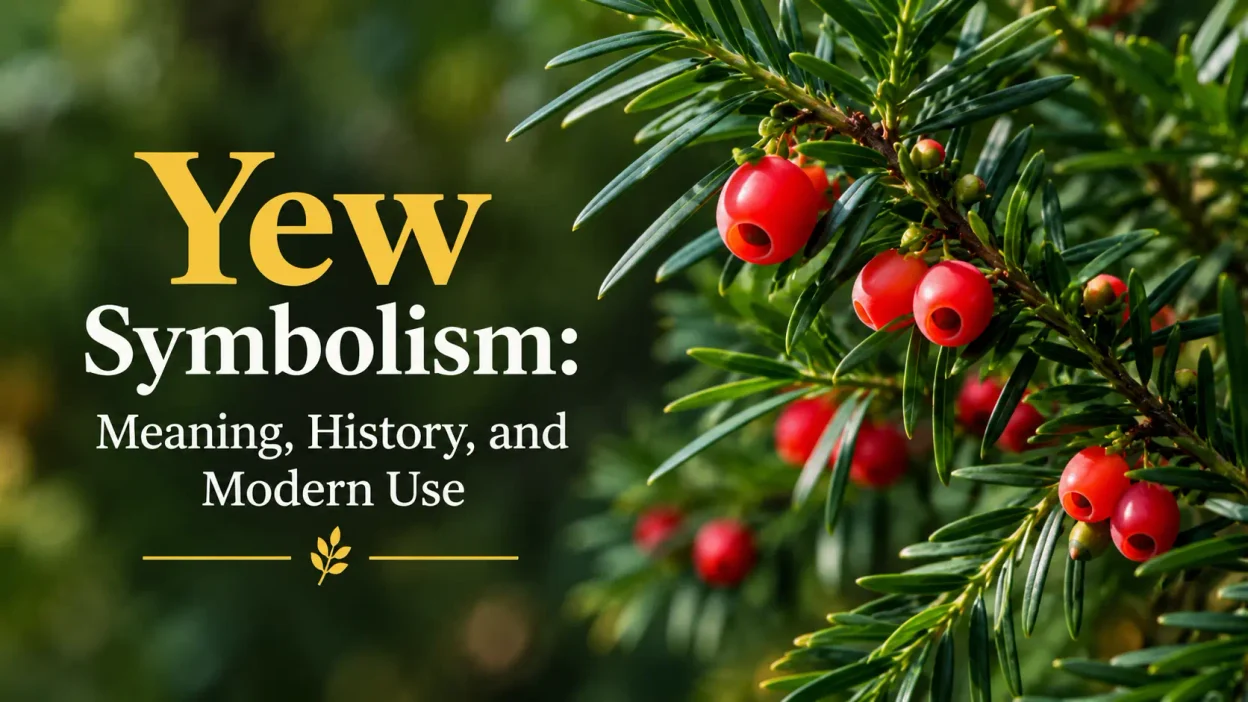
Yews are evergreen conifers, but they do not produce the familiar woody cones associated with many other conifers. Instead, their seeds are partly surrounded by a fleshy, usually red structure called an aril. Their flat, dark-green needles and dense branches make them easy to recognize in landscapes and formal gardens.
The tree’s physical characteristics contribute to its symbolic associations. Its evergreen foliage remains visible during winter, when many deciduous trees lose their leaves. Some yews also develop thick, twisted trunks and hollow-looking interiors as they age, giving old specimens an appearance shaped by centuries of growth.
In the United States, yews commonly appear in foundation plantings, hedges, parks, and traditional gardens. Their presence in historic European churchyards and burial grounds also influences how Americans understand them, even when the tree grows far from its original range.
Longevity and the Symbolism of Endurance
Longevity is one of the most recognizable associations of the yew. Some trees are extraordinarily old, and certain European specimens have been associated with historic churches and settlements for centuries. However, accurately dating very old yews can be difficult because their trunks often become hollow or develop irregular growth patterns.
Their survival encourages a natural connection with endurance. A yew can continue growing while its trunk changes shape, its branches spread, and the landscape around it is transformed. Unlike a monument made to commemorate one person or event, a living tree continues to grow and respond to its environment.
For modern readers, the yew can therefore symbolize patience, persistence, and the passage of generations. An old tree beside a church may appear to connect contemporary visitors with people who lived long before them.
These meanings are interpretations inspired by the tree’s biological characteristics, not a universal code shared by every historical culture. Still, the relationship between exceptional longevity and the idea of enduring memory is one of the clearest reasons the yew retains its symbolic appeal.
Death and Remembrance in Cemetery Landscapes
The yew’s association with death is especially visible in European churchyards and cemeteries. Old yews grow beside churches, near graves, and around sacred enclosures, where their evergreen foliage provides a lasting presence in places associated with mourning.
Several explanations have been offered for the tradition of planting yews in burial grounds. Their longevity made them suitable companions to long-established religious sites, while their evergreen appearance provided a visual contrast to the seasonal changes surrounding them. Their toxicity may also have influenced attitudes toward the tree, although it should not be treated as the sole explanation for cemetery planting.
The exact origins of individual churchyard yews are often uncertain. Some may predate the churches beside them, while others were planted later. A tree’s age and location alone cannot establish that it was part of a pre-Christian ritual.
In American memorial settings, yew symbolism often comes through landscape design rather than direct familiarity with ancient customs. A neatly trimmed yew hedge, an old evergreen near a grave, or a yew in a memorial garden can suggest continuity, dignity, and remembrance.
The tree does not necessarily symbolize death as an ending. Its living presence beside graves can also suggest that memory continues after a person’s life has ended.
Renewal and the Continuity of Life
The yew remains green when many surrounding trees become bare. This seasonal contrast helps explain why evergreen plants have long served as images of life continuing through difficult conditions.
In yew symbolism, renewal does not have to mean a sudden transformation or a fresh start. It can refer to the quieter persistence of life over time. A tree may survive winter, produce new growth, and continue occupying the same place while the people who once knew it grow old or disappear.
This makes the yew particularly suitable for memorial gardens and landscapes designed to mark anniversaries, family histories, or personal transitions. It can represent continuity without denying loss.
The tree’s biology also complicates a simplistic image of immortality. Yews are living organisms that can suffer disease, environmental stress, damage, and death. Their longevity is remarkable, but it is not endless.
A grounded interpretation therefore sees the yew as a symbol of endurance and recurring life rather than literal immortality. Its continued growth offers a visible reminder that change and persistence can exist together.
Yew Symbolism in Celtic Traditions and Folklore
The yew holds a significant place in Irish and broader European cultural history. In early Irish literature and folklore, the tree appears in connections with sacred places, skilled woodworking, kingship, and supernatural events. These traditions help explain why the yew is often discussed as a tree associated with both life and death.
Its reputation was not based on symbolism alone. Yew wood was valuable for making tools, weapons, and ceremonial objects. The tree’s slow growth and durable timber made it useful to communities that depended on woodland resources.
Modern discussions frequently describe the yew as sacred to the ancient Celts or as a central Druidic symbol. Some historical and folkloric traditions support the tree’s religious importance, but the evidence does not justify treating all Celtic-speaking peoples as having shared one uniform belief system.
It is also important to distinguish ancient practices from medieval Irish literature and later folklore. A story recorded in the Middle Ages may preserve older cultural elements, but its date of recording does not automatically establish that every detail originated in pre-Christian times.
For modern Americans interested in Celtic heritage, the yew can represent a connection to Irish history, sacred landscapes, and traditional woodland knowledge. The most responsible interpretation acknowledges these associations without assigning every modern spiritual meaning to ancient Celtic religion.
Christian Symbolism: Eternal Life, Hope, and Resurrection
Christian traditions helped shape the yew’s enduring association with life after death. Its evergreen foliage provided a natural image of life continuing through winter, making it suitable for landscapes associated with Christian hope and remembrance.
Yew trees became familiar features of many churchyards in Britain and Ireland. Some may have stood before nearby church buildings were constructed, while others were planted during later periods. Their presence reflects a complicated history of landscape use, religious practice, and local custom rather than one clearly documented origin.
Evergreen branches have also appeared in Christian seasonal customs. In some European traditions, yew branches were used on Palm Sunday and at funerals. These practices connected the tree with religious observance and the remembrance of the dead.
For Christian readers in the United States, the yew’s symbolism can be understood through broader themes of resurrection, enduring life, and hope beyond death. However, the yew is not a universal Christian emblem, and its meaning varies by denomination, community, and setting.
The distinction matters because the tree’s religious significance developed through particular customs. Its association with Christian burial grounds does not mean that every yew planted in a cemetery was intended to represent resurrection specifically.
Why Yew Trees Became Associated With Protection
Yew trees appear in European folklore as plants connected with protection, sacred boundaries, and supernatural forces. Their presence near churches, wells, and other significant places encouraged people to regard them as more than ordinary landscape features.
In parts of Ireland, historical accounts and traditional stories connect yews with protected places and serious consequences for damaging particular trees. Such stories suggest that some yews held considerable local importance, although the reasons differed across communities and periods.
The tree’s physical properties may also have contributed to its reputation. Its dense foliage provides shelter for wildlife, while its toxic leaves and seeds make it hazardous to many animals and people. These characteristics could encourage both respect and caution.
Modern spiritual interpretations sometimes describe the yew as a universal protective tree that wards off negative energy. That claim belongs to contemporary spiritual practice unless a specific historical tradition can be identified to support it.
A historically grounded interpretation is more modest: some communities treated particular yews as important trees associated with sacred places and local customs. Their protective meaning came from the relationship between the tree, its setting, and the people who valued it.
The Dark Side of Yew Symbolism: Poison and Mortality
The yew’s reputation for death has a practical basis as well as a symbolic one. Most parts of many yew species contain toxic compounds called taxines, including the needles, bark, and seeds. Ingestion can cause severe poisoning and may be fatal.
The fleshy red aril surrounding the seed is generally considered nontoxic, but the seed inside it is poisonous. The bright appearance of the fruit should not be taken as a sign that the plant is safe to eat.
This toxicity has contributed to the yew’s association with danger, death, and the boundary between life and mortality. European folklore sometimes portrays the tree as ominous, particularly when it grows in cemeteries or appears in stories involving death.
Yet the tree’s toxicity does not explain every part of its symbolic history. Its longevity, evergreen foliage, usefulness as timber, and association with sacred landscapes also shaped its reputation.
The yew illustrates how a single plant can acquire contrasting meanings. It can signify endurance and hope while also reminding observers that nature contains hazards that demand respect.
Safety note: Never eat yew seeds, needles, bark, or other plant parts. Keep clippings away from children, pets, and livestock, and seek urgent professional guidance if ingestion is suspected.
What Yew Symbolism Means in Modern American Culture
In the United States, yew symbolism is less widely recognized than the symbolism of the oak, willow, or pine. Many Americans encounter yews as landscaping plants without knowing their historical associations.
Their use in hedges, formal gardens, memorial spaces, and older institutional landscapes creates several possible interpretations. A yew beside a memorial may suggest remembrance, while an old specimen in a garden may invite thoughts about longevity and the passage of time.
Interest in Celtic history and European folklore has also introduced the tree to contemporary spiritual and decorative settings. Some people choose yew imagery because they value its associations with ancestry, transformation, or the relationship between life and death.
These interpretations are not shared by all Americans. A gardener may appreciate the yew for its dense foliage and ability to tolerate pruning, while a history enthusiast may see it as a connection to medieval European landscapes.
Its modern cultural role is therefore relatively specialized. The yew’s symbolic meaning often depends on context, especially whether it appears in a memorial landscape, a religious setting, a historical interpretation, or a personal design.
Yew Wood: Strength, Craftsmanship, and Historical Memory
Yew symbolism is not limited to the living tree. Its wood has a long history of practical use, particularly in Europe, where it was valued for its strength and flexibility.
Yew wood was traditionally used to make longbows, including the famous English longbow. Its combination of properties made it useful for skilled craftspeople, although the quality of a bow also depended on how the wood was selected, shaped, and prepared.
Archaeological discoveries have also demonstrated the long history of human interaction with yew. People used it to create tools, weapons, and other objects long before modern landscaping made the tree familiar as an ornamental evergreen.
These uses add another layer to its symbolism. The yew can represent craftsmanship, resourcefulness, and the practical knowledge passed from one generation to another.
In contemporary design, carved yew wood may appeal to people who value natural materials, traditional woodworking, or the visible grain of slow-grown timber. Such associations arise from the tree’s material history rather than from a single ancient religious doctrine.
Yew Symbolism in Tattoos, Jewelry, and Home Decor
Modern yew-inspired designs often feature a branch of dark-green needles, red arils, a twisted trunk, or an old tree growing beside a stone wall. These images can communicate several ideas depending on the surrounding design.
A yew branch in a memorial tattoo may represent a continuing connection with someone who has died. A mature tree can symbolize endurance or family heritage, while an evergreen sprig may express a desire to remain steady through periods of change.
Jewelry and home decor sometimes incorporate yew imagery alongside Celtic knotwork, crescent moons, woodland scenes, or other nature-inspired motifs. These combinations can create a personal symbolic language, but the individual elements do not necessarily share a single historical origin.
Someone who chooses yew imagery for a tattoo may be drawn to its connection with remembrance rather than its toxicity. Another person may appreciate the tree’s longevity or its place in Irish folklore.
When a design is marketed as an ancient Celtic symbol, it is worth asking whether the particular image comes from a documented historical object or a modern artist’s interpretation. Contemporary artwork can be meaningful without being an exact reconstruction of an ancient design.
Comparing the Yew’s Main Symbolic Meanings
| Context | Common meaning | Why the association developed |
|---|---|---|
| Ancient and old-growth trees | Longevity and endurance | Some yews survive for exceptionally long periods |
| Cemeteries and memorial gardens | Death and remembrance | Evergreen trees became established features of burial landscapes |
| Christian settings | Hope and continuing life | Evergreen foliage provides an image of life through winter |
| Celtic-inspired art | Heritage and sacred nature | Irish literature and folklore connect yews with significant places and traditions |
| Woodworking and historical craft | Skill and resilience | Yew timber has been used for bows, tools, and crafted objects |
| Modern nature-inspired decor | Renewal and personal continuity | People draw symbolic meanings from the tree’s appearance and life cycle |
How Yew Symbolism Has Changed Over Time
The yew’s symbolism developed through practical experience, local customs, religious traditions, literature, and changing attitudes toward nature. Its value as timber existed alongside beliefs about sacred trees, while its evergreen foliage offered a visible image of continuity.
As Christianity spread across Europe, some established landscapes and tree traditions became part of Christian environments. Churchyard yews eventually became strongly associated with burial and remembrance, even though the origins of individual trees are often uncertain.
Later literature and folklore reinforced the tree’s connection with death. Poets and storytellers used its presence in cemeteries to create images of mortality, solitude, and the passage of time. At the same time, its longevity continued to support associations with endurance and life beyond an individual lifespan.
Today, environmental awareness and renewed interest in traditional plant knowledge have added other perspectives. The yew may represent biodiversity, habitat, conservation, and the need to protect old trees as living historical features.
The result is not one fixed meaning but a collection of associations that depend on historical period and cultural setting. Understanding those layers makes it easier to appreciate the yew without assuming that every interpretation is ancient or universally accepted.
Frequently Asked Questions
What does the yew tree symbolize spiritually?
The yew is commonly interpreted as a symbol of endurance, remembrance, transformation, and the relationship between life and death. Specific spiritual meanings vary, and claims about protection or spiritual energy should be connected to a particular tradition rather than treated as universal beliefs.
Why are yew trees planted in cemeteries?
Yews became established in many European churchyards because of their longevity, evergreen appearance, and place in local religious customs. The precise reason for planting any individual tree may be unknown, so not every cemetery yew can be attributed to one ancient ritual.
Is the yew tree a Celtic symbol?
Yews have meaningful connections with Irish history, medieval literature, and Celtic-associated folklore. However, there is no single Celtic belief system that explains every yew tradition, and modern claims about universal Druidic meanings often exceed the available historical evidence.
Does the yew symbolize death or immortality?
It can represent both, depending on the context. Its presence in burial grounds connects it with mortality and remembrance, while its evergreen foliage and exceptional longevity encourage associations with continuity and life beyond an individual generation.
What does a yew tree tattoo mean?
A yew tattoo may represent remembrance, resilience, family history, or an interest in European folklore. Designs that include graves, evergreen branches, or Celtic-inspired patterns can emphasize different aspects of the tree’s symbolism.
Is the yew tree considered good luck?
Some European folk traditions associate particular yews with protection or sacred places, but the tree is not universally regarded as a good-luck symbol. Its meaning depends on the specific folklore, religious setting, or personal interpretation involved.
Is the yew tree poisonous?
Yes. Most parts of common yew and many related species contain toxic compounds, and ingestion can cause severe or fatal poisoning. The red fleshy covering around the seed is generally nontoxic, but the seed itself is poisonous, so no part should be treated casually as food.
Conclusion
Yew symbolism brings together longevity, remembrance, renewal, and mortality. Its evergreen foliage and long life explain its association with endurance, while its presence in European churchyards and folklore connects it with death, sacred places, and the memory of earlier generations.
In modern America, the yew remains a relatively subtle symbol, appearing in gardens, memorial landscapes, and nature-inspired artwork. Its meaning becomes clearer when historical evidence is separated from later spiritual interpretations. The yew reminds us that a living tree can preserve a sense of continuity while standing beside places devoted to remembering the dead.