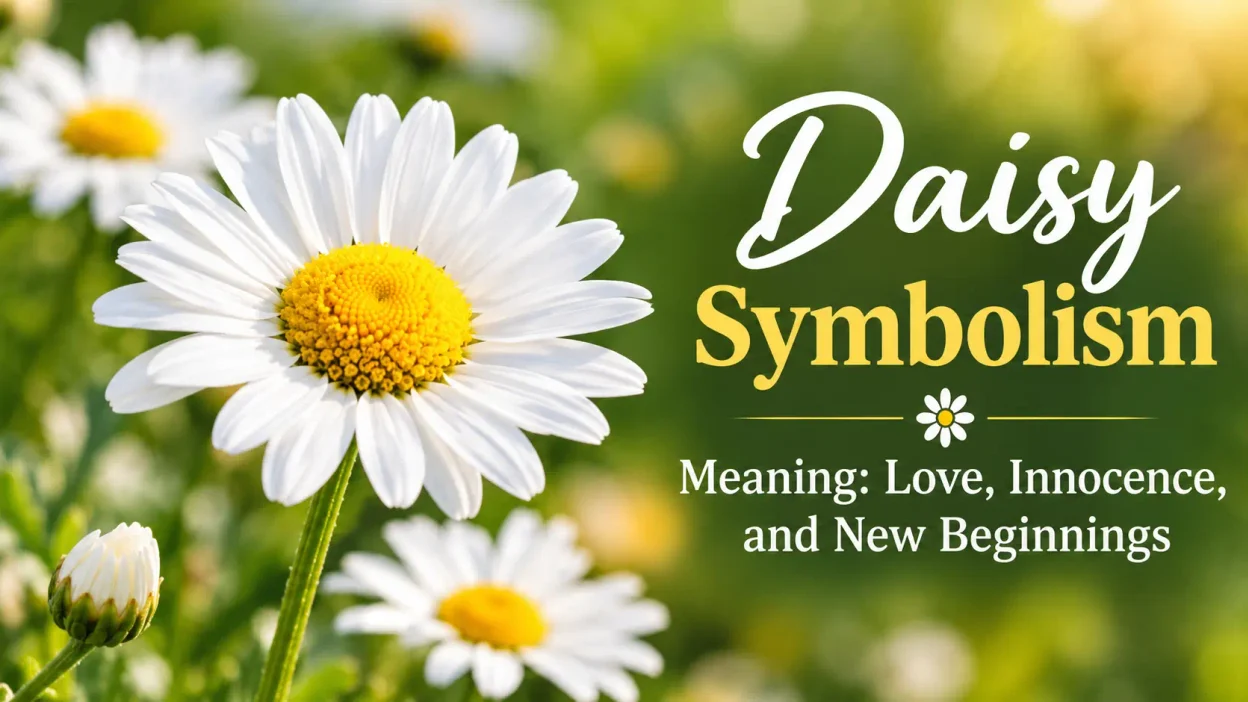
The daisy symbolism meaning is commonly associated with innocence, purity, happiness, and new beginnings. With its bright center and delicate petals, this familiar flower often represents uncomplicated affection, fresh starts, and the beauty of everyday life. In the United States, daisies appear in bouquets, gardens, wedding arrangements, and floral designs that communicate warmth without the formality associated with roses or lilies.
Yet the daisy’s meaning is not limited to cheerful feelings. Its history includes European folklore, associations with childhood and young love, and traditions that connect flowers with emotional messages. Different colors, occasions, and cultural settings can change what a daisy communicates.
Understanding these associations helps explain why the daisy remains popular in modern floral arrangements, jewelry, tattoos, home decor, and personal gifts. It also helps separate meanings supported by established traditions from newer interpretations that people develop for themselves.
Quick Answer
Daisy symbolism meaning most commonly represents innocence, purity, happiness, and fresh beginnings in modern American culture, especially in gifts, gardens, weddings, and springtime designs. Historically, daisies have also been associated with young love, folklore, and the return of life in spring.
TL;DR
- Daisies commonly symbolize innocence, happiness, purity, and new beginnings.
- European folklore connects daisies with childhood, love, and seasonal renewal.
- White petals traditionally suggest simplicity, while yellow centers add cheerful contrast.
- American culture uses daisies in gifts, weddings, fashion, and home decor.
- Daisy tattoos often express optimism, personal growth, or meaningful relationships.
- Flower meanings vary by culture, occasion, color, and personal experience.
What Does a Daisy Look Like, and Why Does It Matter?
A typical daisy has a central disk surrounded by narrow, petal-like florets. In the familiar white-and-yellow form, the white outer portion creates a clean contrast with the golden center, giving the flower a bright and uncomplicated appearance.
The common daisy, Bellis perennis, is a low-growing perennial associated with lawns and grassy areas. Other flowers commonly called daisies belong to different botanical groups, including oxeye daisies and Shasta daisies. They share a similar flower-head structure, but they are not all the same species.
The daisy’s appearance helps explain its modern symbolism. Its open shape feels approachable rather than elaborate, and its association with lawns, meadows, and gardens makes it familiar to many Americans.
Unlike flowers with strong fragrances or dramatic shapes, daisies often communicate through simplicity. A small bouquet can feel thoughtful without appearing extravagant, while a field of daisies can suggest freedom, summer, and an unplanned encounter with nature.
These visual associations are not universal rules. They are part of the cultural experience through which people develop meanings for familiar flowers.
The Core Meaning of Daisies in Modern Culture
Daisies most often represent innocence, purity, happiness, and uncomplicated affection. These meanings overlap, but each emphasizes a different aspect of the flower.
Innocence relates to the daisy’s delicate appearance and its frequent use in imagery associated with childhood. It can suggest openness, sincerity, and an uncomplicated outlook.
Purity is especially connected with white daisies. Their pale petals can communicate simplicity and sincerity, although white flowers do not have the same meaning in every cultural tradition.
Happiness comes partly from the flower’s bright appearance and its association with sunny gardens and spring landscapes. Daisies often feel friendly and informal, making them suitable for celebrations and everyday gifts.
New beginnings connect the flower with spring, renewed growth, and fresh starts. A daisy can be a fitting gift for someone starting a new job, moving into a home, beginning a relationship, or recovering from a difficult period.
Daisies can also symbolize loyal affection. Their meaning is usually gentler and less dramatic than the traditional romantic associations of red roses. This makes them useful when the intended message is warmth, friendship, or care rather than intense passion.
The Historical Roots of Daisy Symbolism
Daisy symbolism developed through language, folklore, seasonal observation, and the long European tradition of assigning meanings to flowers.
The English word daisy comes from the Old English expression dæges ēage, meaning “day’s eye.” The name refers to the common daisy’s tendency to open in daylight and close at night or under certain conditions. This daily movement gave the flower a memorable connection with light and the rhythm of the day.
The common daisy was familiar in European meadows and grassy landscapes long before modern floral gift customs developed. Its accessibility helped make it part of ordinary life rather than an exclusive flower associated only with wealthy households.
Medieval and later European traditions also connected flowers with love, virtue, and symbolic messages. Over time, daisies became associated with youthfulness, innocence, and romantic playfulness.
However, there was never one fixed meaning shared by every European community. Flower symbolism changed with language, religion, literature, and local custom. Modern lists of flower meanings often simplify this varied history into a single definition.
The daisy’s enduring associations make more sense when viewed as a gradual cultural development rather than the result of one ancient symbolic code.
Daisy Symbolism in Love and Romantic Relationships
Daisies have a special place in romantic symbolism because they can express affection without the intensity traditionally associated with red roses. They are often chosen to communicate sincere feelings, youthful attraction, loyalty, or the hope that a relationship will grow.
One of the best-known traditions involves plucking a daisy’s petals while repeating, “He loves me, he loves me not.” The final petal supposedly reveals whether the person being imagined returns the affection. This is a playful folk custom rather than a reliable way to discover another person’s feelings, but it has helped connect daisies with romantic hope and uncertainty.
Daisies also suit relationships in which friendship matters as much as attraction. A bouquet can mark a new relationship, celebrate an anniversary, or remind a partner of a shared memory without appearing overly formal.
In modern American culture, the flower’s romantic message depends on the situation. Daisies given on a first date may suggest easygoing interest, while a bouquet presented after a difficult period may communicate reassurance and a desire to begin again.
What Different Daisy Colors Symbolize
Although white daisies with yellow centers are the most familiar variety, daisies come in several colors. Floral symbolism often assigns different emotional associations to these colors, but the meanings are cultural conventions rather than fixed rules.

White daisies: Innocence and sincerity
White daisies are commonly associated with purity, simplicity, honesty, and fresh starts. They work well in understated bouquets, spring arrangements, and gifts intended to express genuine care.

Yellow daisies: Happiness and friendship
Yellow flowers often suggest sunshine, optimism, warmth, and cheerful companionship. Yellow daisies can be appropriate for birthdays, thank-you gifts, and gestures of encouragement.

Pink daisies: Affection and admiration
Pink daisy varieties are frequently used to express tenderness, appreciation, and gentle affection. Their associations make them suitable for friends, relatives, partners, and celebratory arrangements.

Orange daisies: Enthusiasm and energy
Orange daisy-like flowers can convey excitement, confidence, and a lively personality. They are often used in colorful arrangements intended to create a festive or energetic atmosphere.
These interpretations are especially common in contemporary floral design. They should not be treated as a universal color code: a person’s favorite color, the occasion, and the relationship between giver and recipient may matter more than a traditional flower dictionary.
The Daisy in American Weddings and Celebrations
Daisies are popular choices for weddings and other celebrations because they combine an informal appearance with associations of sincerity and fresh beginnings.
In a wedding bouquet, white daisies may complement a simple dress, a garden ceremony, or a rustic outdoor setting. Their natural appearance can create a relaxed atmosphere rather than the highly formal effect of elaborate floral arrangements.
The symbolism also fits the transition into married life. Innocence, trust, and the hope of a new chapter are reasonable contemporary interpretations, although there is no universal American wedding tradition that requires daisies to represent these ideas.
Outside weddings, daisies work well in graduation arrangements, baby showers, birthday bouquets, and gifts celebrating a new home. Their bright appearance can make an ordinary occasion feel thoughtful without requiring an expensive or dramatic display.
They are also used in seasonal decor. Artificial daisies, printed floral patterns, and fresh arrangements can give a room a springlike appearance, especially when paired with light colors and natural materials.
The flower’s appeal comes partly from its flexibility. It can suit a romantic celebration, a family gathering, or a casual gift between friends.
Daisy Symbolism Across Cultures and Religions
Daisies have accumulated different associations in different cultural settings. Although innocence and renewal appear frequently in modern interpretations, the flower does not carry exactly the same meaning everywhere.
In European folklore, daisies are associated with childhood games, springtime, young love, and the natural world. The petal-picking game reflects the uncertainty of romance, while daisy chains have been connected with childhood play and seasonal celebrations.
Christian interpretations of flowers sometimes associate white blossoms with purity and virtue. However, the daisy does not have one universally prescribed meaning across Christian denominations, and its significance depends on the artwork, story, or local tradition in which it appears.
In Victorian Britain and America, the language of flowers made floral arrangements a way to communicate emotions indirectly. Daisy meanings commonly included innocence or simplicity, though individual flower dictionaries sometimes differed.
Other cultural traditions may value daisies primarily for their appearance, medicinal history, or place in the local landscape rather than for a specific spiritual message. It is therefore better to discuss a particular tradition than to claim that daisies universally symbolize the same quality across religions.
Emotional and Psychological Meaning of the Daisy
A flower’s symbolic meaning often begins with the feelings its appearance brings to mind. Daisies are familiar, relatively simple in shape, and often associated with gardens, open fields, and warm weather. These qualities can make them feel approachable and comforting.
Their bright centers and open petals may also encourage associations with openness, friendliness, and optimism. A person who receives daisies might interpret them as a gesture of affection without pressure or expectation.
For some people, daisies are tied to childhood memories: making flower chains, picking flowers with a family member, or playing the petal-picking love game. In those cases, the emotional significance comes from personal experience rather than from a formal symbolic tradition.
Daisies can also communicate resilience in a modest way. Common daisies grow close to the ground and can appear in lawns and other frequently disturbed spaces. Their persistence can inspire a contemporary interpretation of endurance and the ability to flourish under ordinary conditions.
None of these associations determines what a person feels or who they are. A daisy can be comforting to one person and simply decorative to another. Its emotional meaning depends on the experiences and intentions surrounding it.
Why Daisies Appear in Tattoos, Jewelry, and Fashion
Daisy imagery is popular in modern personal style because the flower is recognizable even when reduced to a small outline or simplified graphic.
A daisy tattoo may represent a fresh start after a difficult period, a cherished relationship, a childhood memory, or a preference for uncomplicated beauty. Some people choose the flower because it reminds them of a family member, a favorite place, or a meaningful season of life.
Jewelry featuring daisies can communicate similar ideas. A small flower pendant may serve as a reminder of a loved one, while daisy earrings or a charm bracelet may express a cheerful, playful style.
In fashion, daisies often appear on dresses, shirts, bags, hair accessories, and embroidered fabrics. Their association with spring and casual outdoor settings makes them especially suitable for lighthearted designs.
Social media has also helped make daisy imagery recognizable as an aesthetic choice. Flower illustrations, pastel graphics, and daisy motifs are frequently used to create a soft, youthful, or nature-inspired visual style. These uses do not necessarily carry a formal symbolic message.
When choosing a daisy design, consider whether you want to emphasize innocence, affection, personal growth, or simply your appreciation for the flower. The image does not need to represent every traditional meaning at once.
Daisy Symbolism in Dreams and Spiritual Interpretations
Some people interpret a daisy appearing in a dream as a sign of hope, emotional renewal, innocence, or the desire for a simpler life. A field of flowers might remind a dreamer of freedom, while receiving a bouquet could bring attention to affection or a relationship.
These interpretations are personal rather than scientifically established predictions. A dream about daisies does not prove that a new relationship is approaching or that a particular event will occur.
Contemporary spiritual interpretations may also connect the daisy with the present moment, natural cycles, and an appreciation for ordinary experiences. Someone might use the flower as a reminder to approach a challenge with patience or to make room for small pleasures.
Such meanings can be valuable as tools for reflection, provided they are not presented as universal religious teachings or guaranteed messages from the supernatural. A person’s memories, feelings, and circumstances are more useful guides to interpreting a dream than a fixed list of flower meanings.
Common Misunderstandings About Daisy Symbolism
One common misconception is that daisies always represent innocence. Although this is an established association in European and Victorian flower symbolism, the meaning of a flower changes with its setting. A daisy in a romantic gift may communicate affection, while one used in a memorial arrangement may represent remembrance or a personal connection.
Another misconception is that every color has one official meaning. Contemporary floral guides often assign meanings to white, yellow, pink, and orange flowers, but these associations are not consistent across all cultures or historical periods.
It is also misleading to treat all flowers called daisies as botanically identical. The name applies to many species across different plant groups. Their appearance may be similar, but their growing habits, origins, and physical characteristics can vary.
Finally, popular spiritual interpretations should not be confused with historical evidence. A modern claim that daisies guarantee good luck or signal a specific life change may be meaningful to an individual, but it is not an established universal rule.
The best way to understand the daisy is to consider the tradition, setting, and intention behind its use instead of assuming that every flower carries the same message.
Daisy Symbolism Meaning at a Glance
| Context | Common meaning | Typical use |
|---|---|---|
| White daisies | Innocence and sincerity | Weddings, thoughtful gifts, simple bouquets |
| Yellow daisies | Happiness and friendship | Birthdays, celebrations, encouragement |
| Romantic gifts | Affection and hope | Dates, anniversaries, personal gestures |
| Tattoos and jewelry | Growth, memories, or individuality | Personal expression and keepsakes |
| Gardens and spring decor | Renewal and everyday beauty | Home styling and seasonal arrangements |
Frequently Asked Questions
What is the spiritual meaning of a daisy?
In modern spiritual interpretations, a daisy may represent renewal, simplicity, hope, and appreciation for the present moment. These are personal or contemporary associations rather than universal teachings shared by every spiritual tradition.
Does a daisy symbolize true love?
A daisy can represent sincere affection, young love, or the hope that romantic feelings will be returned. Its symbolism is generally gentler and more playful than the passionate love traditionally associated with red roses.
What does a daisy tattoo mean?
A daisy tattoo often represents innocence, personal growth, happiness, or a meaningful memory. Its meaning can change with the design, such as the addition of a date, another flower, or a particular color.
Are daisies a symbol of good luck?
Some people use daisies as personal reminders of optimism and positive change, but there is no universal tradition establishing them as guaranteed signs of good luck. Their cheerful appearance may contribute to these modern associations.
What does a white daisy symbolize?
White daisies commonly represent innocence, purity, sincerity, and simplicity. They are often used in arrangements where the sender wants to express genuine care or mark a fresh beginning.
Why are daisies associated with childhood?
Daisies are familiar in grassy spaces where children play, and traditions such as making daisy chains have helped strengthen their connection with childhood. The petal-picking love game also links the flower with youthful curiosity and romantic imagination.
Are daisies appropriate for sympathy flowers?
Daisies can be appropriate for sympathy arrangements when their simplicity, hopefulness, or personal significance suits the recipient. White varieties may provide a gentle, understated tribute, but the family’s cultural traditions and preferences should guide the choice.
Conclusion
The daisy symbolism meaning centers on innocence, purity, happiness, affection, and new beginnings. Its familiar shape, European folklore, and role in the Victorian language of flowers have helped establish these associations, while modern American culture continues to use daisies in gifts, weddings, personal style, and home decor.
A daisy does not need an elaborate story to carry meaning. Whether it appears in a garden, a bouquet, a tattoo, or a cherished memory, its symbolism comes from the connection between the flower, the occasion, and the person who gives or receives it.


