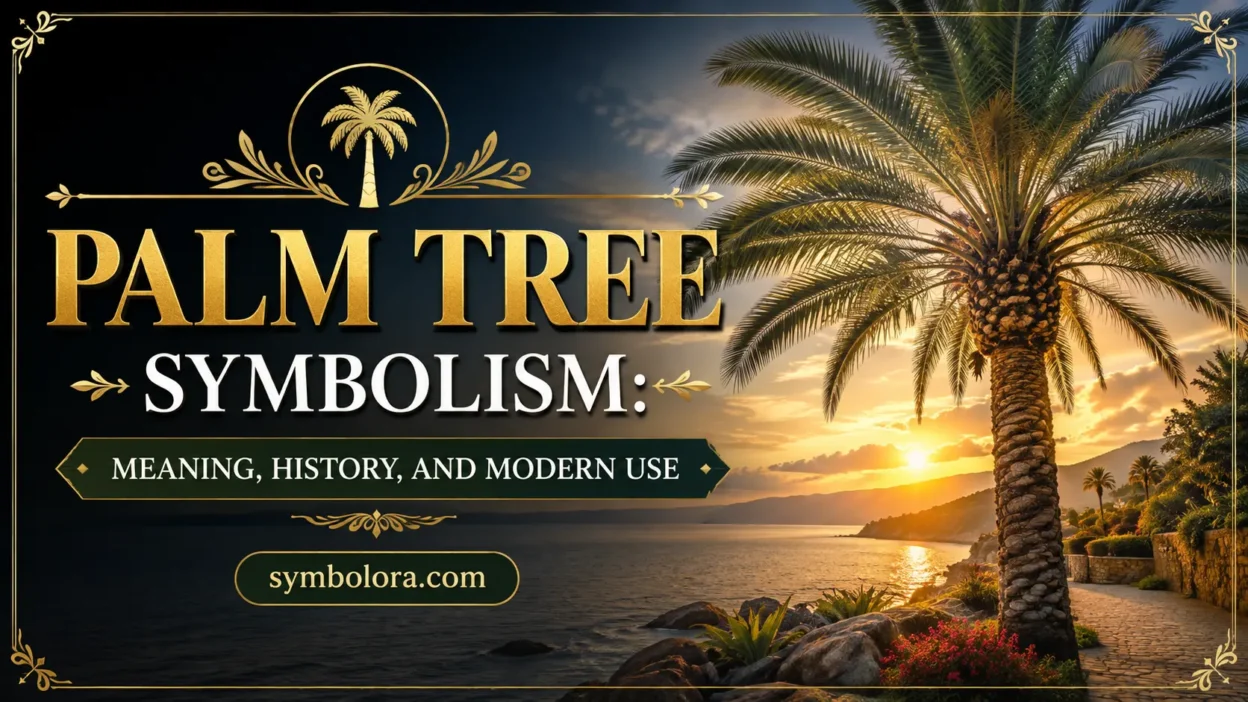
A palm rising above a beach, desert oasis, city boulevard, or hotel entrance communicates more than warm weather. In the United States, palm tree symbolism often centers on relaxation, freedom, success, resilience, and an idealized tropical lifestyle — the image can suggest a vacation, a fresh start, or the belief that better days lie ahead.
Those modern associations sit on top of much older meanings. Date palms supplied food, shade, building material, and income in dry regions where survival depended on reliable resources, and palm branches later became signs of victory in the Mediterranean world before taking on distinct religious meanings in Jewish and Christian traditions. The symbol changes with its setting: a palm on a California postcard doesn’t communicate the same thing as a palm branch carried during a religious observance or a palmetto on a state flag. Understanding those differences keeps the symbol meaningful and stops broad cultural traditions from collapsing into one generic “tropical” idea.
Quick Answer
Palm tree symbolism commonly represents relaxation, resilience, success, freedom, and tropical escape in modern American culture. Historically, palms have also signified victory, abundance, spiritual triumph, hospitality, and life sustained in difficult environments.
At a glance:
- Palms commonly suggest relaxation, travel, freedom, and warm climates
- Their survival in harsh settings supports meanings of resilience and endurance
- Ancient communities valued date palms as sources of food and shelter
- Palm branches became signs of victory in Greece and Rome
- Jewish and Christian traditions give palm branches specific religious meanings
- American regional symbols connect palms with California, Florida, and South Carolina
What a Palm Tree Looks Like and Why Its Shape Matters
“Palm tree” refers to a large plant family rather than one species — the palm family contains more than 180 genera and roughly 2,500 species, including date palms, coconut palms, fan palms, palmettos, and climbing rattans. Their appearances vary, but the familiar image usually features a narrow, mostly unbranched trunk topped by a crown of large fan-shaped or feather-like leaves.
That structure shapes how people read the tree. The tall vertical trunk can suggest ambition or reaching upward, while the crown of spreading fronds resembles an open canopy that communicates welcome and shade. When wind bends the trunk and moves the leaves without uprooting the tree, viewers often read flexibility and endurance into the form. The silhouette is also instantly recognizable — a few curved lines identify a palm on a logo, road sign, or tattoo, and that visual simplicity has helped turn the tree into shorthand for beaches, resorts, and island travel generally.
The Main Meanings at a Glance
| Context | Common Meaning in the USA | Typical Associations | Important Distinction |
|---|---|---|---|
| Beaches and travel | Relaxation and escape | Vacations, sunlight, freedom | Often shaped by tourism advertising |
| Personal symbolism | Resilience and growth | Endurance, flexibility, fresh starts | Usually based on the tree’s appearance |
| Ancient Mediterranean imagery | Victory and honor | Athletes, military triumph, celebration | The branch mattered more than the whole tree |
| Christian settings | Spiritual victory and sacrifice | Palm Sunday, martyrs, resurrection | Meaning comes from religious narratives |
| Jewish observance | Worship, gratitude, and communal tradition | Sukkot and the Four Species | The palm branch has a specific ritual role |
| American regional identity | Pride, place, and local history | California, Florida, South Carolina | Meaning differs significantly by state |
Resilience, Endurance, and Renewal
The palm’s association with resilience comes partly from plain observation. Many species grow in hot, windy, or seasonally dry environments, and their flexible leaves and distinctive growth habits make them appear capable of enduring conditions that would damage more rigid plants. In symbolic use, that becomes a lesson about adapting without surrendering identity — someone might choose a palm image after recovering from loss or completing a difficult period, not because hardship leaves no mark, but because life can clearly continue after disruption.
New fronds emerging from the crown add another layer to this meaning, representing recovery or the start of a different chapter. That’s part of why the palm works so well as a graduation, retirement, or sobriety symbol — it combines endurance with forward movement. Worth noting, though: this interpretation is modern and personal rather than a fixed meaning shared across every culture. It’s an analogy drawn from the plant, not a universal ancient belief.
Ancient Roots in Food, Shade, and Survival
Before the palm became a decorative emblem, it was a practical resource. Date palms have been cultivated for thousands of years, supplying fruit, sweeteners, fibers, and shade — groves could even create cooler conditions where other crops grew beneath them. In ancient West Asia, that value encouraged associations with fertility, abundance, and continuing life, and palm motifs appeared in art by the third millennium BCE, though sacred-tree imagery of the period often represented vegetal life more broadly. Historians can’t always identify a stylized ancient tree with certainty, so it’s best not to label every sacred-tree design as a literal date palm.
The symbolic link is still easy to understand, though. A productive palm could support a household for years, and a grove could turn an arid settlement into a habitable place — abundance here didn’t mean luxury, it meant dependable food, shade, and continuity between generations. That history is exactly why palms can still suggest provision and security today; the meaning began with the tree’s real capacity to support human life, not fantasy.
Victory in Ancient Greece and Rome
The palm branch became a recognized sign of victory in the classical Mediterranean world. Victorious athletes and public figures could appear with palms, Roman art used the branch in scenes of triumph, and the Latin term palma became closely tied to winning and public honor. Unlike a laurel wreath worn on the head, the palm usually appeared as a branch held or displayed — a direct visual statement that someone had prevailed or earned recognition, no inscription required.
That classical meaning carried forward into later European art, where palm branches kept appearing beside victorious or spiritually triumphant figures long after the political world of Greece and Rome had changed. Modern awards rarely use actual palm branches anymore, but the old association survives indirectly — a palm tattoo or brand emblem can still communicate success or the reward that follows perseverance.
Jewish Meaning and the Festival of Sukkot
In Jewish practice, a palm branch has a specific ritual identity. During Sukkot, it forms part of the Four Species alongside myrtle, willow, and the etrog, a citron; the term lulav can refer specifically to the palm frond and, in common usage, to the bound group of branches held with the etrog. The Four Species are carried and waved during parts of the festival’s religious services, a practice connected with gratitude, the agricultural character of the festival, and the unity of different people or human qualities.
Later symbolic explanations compare the straight palm branch to the human spine, with the ritual gathering different parts of the body and community into one coordinated act of worship. It would be inaccurate to reduce the lulav to a generic symbol of “good luck,” though — its meaning comes from a living religious practice with its own laws, prayers, calendar, and communal setting.
Christian Symbolism: Palm Sunday and Spiritual Victory
For Christians, the palm branch is most familiar from Palm Sunday, which recalls Jesus entering Jerusalem as crowds welcomed him with branches. In Christian interpretation, the scene combines public acclamation with the suffering that follows during Holy Week, so the branch carries more tension than a simple victory sign — it can represent kingship, hope, and a form of triumph achieved through faithfulness rather than military force. Churches in the United States often distribute palm leaves or use locally available branches during Palm Sunday services.
Early Christian art also gave palms to martyrs, where the branch signified spiritual victory over persecution or death — a saint holding a palm in a painting is usually being identified as a martyr rather than as a traveler from a tropical region. In funerary and memorial art, the same tradition can connect the palm with eternal life. Context remains essential here: a branch beside a saint or tomb communicates something very different from a coconut palm printed on vacation clothing.
Palms in Islamic and Middle Eastern Cultural Contexts
Date palms carry practical, literary, and artistic importance across many Muslim-majority societies, evoking nourishment, hospitality, and divine provision. Images of fertile gardens, water, and fruit trees can also recall paradise in Islamic literature and visual culture. Even so, the palm shouldn’t be described as a universal emblem of Islam the way a cross functions within Christianity — Muslim cultures extend across Africa, Asia, Europe, and the Americas, and their artistic traditions don’t assign one fixed meaning to every palm motif.
Art historians also caution against treating all vegetation in Islamic art as coded symbolism; floral and tree designs may simply express beauty, craftsmanship, or admiration for gardens without any hidden religious message. Paradise associations become more likely when a palm appears within an idealized garden or near flowing water in a clearly religious or literary context. A culturally respectful interpretation asks where the image appears, who created it, and what tradition surrounds it.
What the Palm Commonly Means in the United States
In contemporary American life, the dominant meanings are warm weather, leisure, and escape. Palms appear across vacation advertisements, beachwear, hotel design, and products marketed for summer, and the image often promises temporary freedom from routine — a palm against a sunset can imply that work has ended and the viewer has entered a slower environment. That emotional promise explains why the symbol shows up even on businesses located far from any climate where palms grow naturally.
The tree can also communicate prosperity: palm-lined drives and carefully maintained resort landscapes associate it with private space and expensive leisure, meaning not simply “nature” but access to a desirable lifestyle. At the same time, many Americans see palms as ordinary parts of home rather than vacation imagery — for residents of Florida, Southern California, Hawaii, and Puerto Rico, the tree can represent neighborhood identity, climate, and family memory instead.
The California Dream and the Los Angeles Skyline
Few American cities are as closely connected with palms as Los Angeles. Tall fan palms appear constantly in movies, postcards, and photographs of the city’s skyline — and many of the most recognizable street palms are actually Mexican fan palms rather than California natives. Large numbers were planted during the 1920s and 1930s while civic leaders and developers promoted Southern California to people living in colder parts of the country, helping construct an image of Los Angeles as sunny, modern, and almost tropical.
That image became inseparable from Hollywood. A palm silhouette can establish a Los Angeles setting before a character or landmark ever appears, suggesting entertainment, reinvention, and the possibility of becoming someone new. Yet the California palm carries real irony, too — it can represent aspiration and beauty while also suggesting manufactured paradise, drought, or the gap between a city’s advertised image and everyday life.
Florida, South Carolina, and Regional Identity
In Florida, the sabal palm represents more than beach tourism. The state designated it the official state tree in 1953, and it appears on Florida’s Great Seal, supporting an image of Florida as subtropical and ecologically distinct from much of the continental U.S.
South Carolina gives the palmetto a very different historical meaning. The state’s emblem refers to palmetto logs used in the fortifications associated with the American defense of Sullivan’s Island in 1776 — because the soft trunks helped absorb cannon fire, the tree came to represent courage and resistance, and it remains central to the state flag and the identity of the “Palmetto State.” These examples show why American palm imagery can’t be reduced to beaches alone: in California it expresses aspiration and the manufactured dream of the West Coast, in Florida it conveys environment and state identity, and in South Carolina the palmetto recalls a specific military history.
Emotional and Psychological Associations
The palm often creates an immediate sense of openness. Its high crown leaves visual space beneath it, while its moving fronds suggest air and an outdoor life — features that can make a scene feel less confined in photographs and illustrations. For someone who associates palms with childhood trips or a former home, the symbol may evoke nostalgia; for another person, it may represent an imagined future — travel, retirement, or a home near the ocean.
Palms can also signal emotional flexibility, their bending form offering a convenient metaphor for adjusting to pressure instead of confronting every difficulty rigidly. That interpretation appeals especially to people who value adaptability without wanting it mistaken for weakness. Still, the emotional response isn’t universal — someone who has experienced hurricanes, wildfires, or economic hardship in a palm-filled region may connect the tree with vulnerability rather than calm.
Palm Tree Tattoos and Personal Meaning
Palm tattoos frequently represent freedom, travel, resilience, and attachment to a coastal place. A single black silhouette may record a memorable trip, while a detailed date palm can carry religious or heritage associations instead. Design elements shift the message considerably — a palm combined with waves usually emphasizes the ocean or surfing culture, a sunset adds closure or transition, and coordinates or place names turn the design into a geographical memorial.
A broken or storm-surrounded palm often represents survival, while two palms might mark a relationship or shared journey. A palm growing from a skull or ruined landscape can create a sharper contrast between life and mortality. Because palm branches carry distinct Jewish and Christian uses, anyone choosing an explicitly religious tattoo should understand the tradition being referenced rather than treating the branch as a general decorative flourish.
Jewelry, Decor, Fashion, and Digital Culture
Palm motifs appear on pendants, wallpaper, bedding, swimwear, and event decorations, where the image usually communicates summer or resort-inspired style. Interior design often uses large palm leaves to introduce a tropical atmosphere without showing a complete tree — bright green leaves make a room feel lively, while gold or black palm patterns create a more glamorous Art Deco look.
On social media, the palm emoji and palm graphics commonly accompany vacation announcements and captions about rest, effectively replacing a full sentence with “I am away” or “this place feels like paradise.” Commercial use has made the symbol highly flexible but also less specific — a palm printed on packaging may carry no historical or cultural meaning at all beyond a general impression of freshness and escape.
Negative Meanings, Misuse, and Environmental Debate
The palm is usually treated as a positive image, but it carries some complicated associations worth naming. Tourism campaigns can use it to present inhabited places as empty paradises designed for visitors, a framing that overlooks local labor, Indigenous history, and environmental limits. The symbol can also promote unrealistic ideas about nature — palm-lined streets look lush but actually provide less shade than broad-canopied trees, and in Los Angeles, officials and residents have increasingly debated whether aging palms should be replaced with species offering more cooling and ecological value.
Wildfire concerns have added urgency to that debate, too. Certain palms can retain dry material, and poorly maintained fronds may ignite or spread burning debris during severe fires — that doesn’t make every palm inherently dangerous, but it does challenge the carefree image created by postcards and advertising. Cultural misuse is a separate issue worth flagging: calling every palm a sacred “tree of life” erases real differences among species, periods, and regions. A responsible interpretation keeps documented traditions separate from modern personal associations.
How the Meaning Has Changed Over Time
The earliest meanings grew from practical relationships. Palms provided food, shade, and materials, so people connected them with fertility and continued life. Classical Mediterranean societies then turned the palm branch into a public sign of victory, while Jewish and Christian traditions added their own ritual and theological meanings, and medieval artists used palms in images of paradise and martyrdom.
Modern American culture shifted attention from the branch to the whole tree — the silhouette became a symbol of climate, tourism, and personal freedom, and commercial design spread the image far beyond places where palms naturally grow. Today all these meanings remain available at once, though they don’t operate equally in every setting: a palm may express ancient victory, religious observance, regional pride, environmental debate, or nothing more complicated than the pleasure of a summer vacation.
Frequently Asked Questions
Is a palm tree a symbol of good luck?
A palm can represent good fortune when it appears in designs connected with success or a new beginning, though “good luck” is a modern generalization rather than the tree’s single historical meaning.
What does a palm tree tattoo symbolize?
A palm tattoo commonly represents freedom, travel, resilience, or connection to a warm coastal place. Its precise meaning depends on accompanying details such as waves, sunsets, dates, or religious imagery.
What does the palm tree mean in Christianity?
Christian palm imagery represents Jesus’s entry into Jerusalem, spiritual triumph, and victory over death. In older Christian art, a saint holding a palm branch is often identified as a martyr
Does a palm symbolize peace?
It can, especially when victory is understood as the end of conflict or when the tree appears in an idealized garden. Historically, though, victory and religious triumph are more firmly established meanings than peace alone.
What does a palm represent in dreams?
Dream interpretations are personal rather than fixed. A healthy palm may reflect rest, ambition, or a desire to escape, while a damaged palm may point to disappointment or instability.
Are palm trees symbols of California or Florida?
Both, but in different ways. California palms often evoke Los Angeles, Hollywood, and the West Coast dream, while Florida’s sabal palm represents the state’s subtropical environment and official identity.
Is the palm tree always a positive symbol?
No. It can also suggest artificial luxury, commercialized paradise, environmental strain, or nostalgia for a place that has changed. Personal experience and cultural setting determine whether the image feels hopeful or unsettling.
Conclusion
Palm tree symbolism brings together several distinct ideas: survival in demanding conditions, nourishment, victory, spiritual commitment, regional pride, freedom, and the promise of rest. Its meaning depends on whether the viewer encounters a date palm in historical art, a branch in worship, a palmetto on a flag, or a tall silhouette beside an American highway.
The symbol remains popular because it can look both rooted and free — its trunk stands in one place while its crown moves with the wind, a grounded image of adaptation, aspiration, and life continuing under changing conditions.


