Hermes symbolism comes from one of the most versatile figures in ancient Greek religion. Hermes was the divine messenger, but he was also connected with travelers, roads, merchants, language, clever deception, boundaries, good fortune, and the movement of souls into the afterlife. Those roles may seem unrelated until one idea connects them: Hermes operates wherever something or someone is moving from one state, place, or person to another.
That is why his symbols remain recognizable. Winged sandals suggest speed. His herald’s staff represents communication and authority. Roads and boundary markers reflect his role as a guide. Even his reputation for trickery belongs to the same pattern, because Hermes succeeds by moving around rules and finding unexpected paths through difficult situations.
For American audiences today, Hermes is often less a religious figure than an emblem of communication, mobility, intelligence, adaptability, entrepreneurship, and freedom. His imagery appears in tattoos, art, classical-inspired design, literature, fantasy, and even symbols that have acquired meanings quite different from their ancient Greek origins.
Quick Answer
Hermes symbolism commonly represents communication, movement, adaptability, cleverness, travel, and crossing boundaries in modern American culture. Historically, Hermes also represented trade, messengers, thieves, roads, negotiation, good fortune, and the safe passage of souls between the worlds of the living and the dead.
TL;DR
- Hermes represents communication, travel, cleverness, commerce, and transition.
- Winged sandals symbolize speed, freedom, and constant movement.
- His staff reflects authority, negotiation, and the messenger’s role.
- Ancient boundary markers connected Hermes with roads and thresholds.
- His trickster side represents ingenuity but also deception.
- Americans often interpret Hermes as an emblem of adaptability and independence.
What Hermes Most Commonly Represents
At the center of Hermes’s meaning is movement between boundaries. He travels between gods and humans, moves along roads, carries messages between people, facilitates exchanges between buyers and sellers, and guides the dead from one realm toward another.
That mobility explains why he acquired so many responsibilities in Greek tradition. Communication moves information. Commerce moves goods and money. Travel moves people. A boundary separates one place from another, while Hermes helps people cross it. Even persuasion moves another person’s thinking.
In modern symbolism, this makes Hermes especially suitable for representing:
- communication and eloquence
- travel and exploration
- speed and mobility
- adaptability
- negotiation
- entrepreneurship and commerce
- intelligence and improvisation
- freedom from rigid limitations
- transitions between stages of life
Unlike deities whose symbolism centers on a single domain, Hermes represents the ability to function in changing circumstances.
How to Recognize Hermes and His Symbols
Hermes can be identified through several recurring attributes, although ancient and later artists did not always show all of them together.
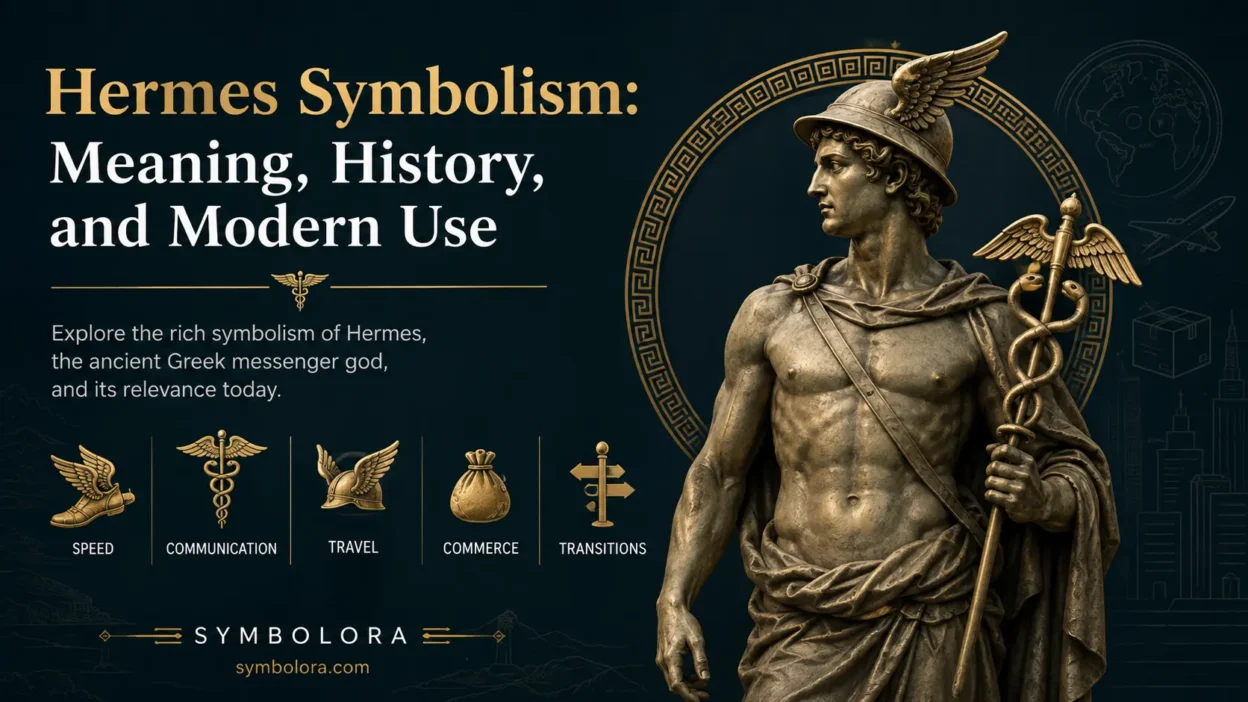
His best-known attribute is the herald’s staff, called the kerykeion in Greek and commonly known by its Latin name, the caduceus. Later versions usually show two serpents winding around a staff, sometimes with wings above them.
Hermes is also associated with winged sandals, suggesting supernatural speed. The traveler’s hat known as the petasos may appear as well, with wings becoming particularly familiar in later artistic traditions.
Other symbols include the traveler’s cloak, tortoise, ram, lyre, and occasionally pastoral animals. Ancient artworks can therefore portray Hermes not only as a flying messenger but also as a traveler, shepherd, athletic young man, or boundary guardian.
| Symbol or AttributeMain MeaningModern Interpretation | ||
|---|---|---|
| Winged sandals | Speed and travel | Freedom, mobility, ambition |
| Caduceus | Heraldry and communication | Exchange, negotiation, messaging |
| Traveler’s hat | Roads and journeys | Exploration and independence |
| Herm or boundary pillar | Borders and protection | Thresholds and transition |
| Tortoise and lyre | Invention and music | Creativity and resourcefulness |
| Ram and pastoral imagery | Flocks and protection | Guidance and guardianship |
The Ancient Greek Origins of Hermes
Hermes was the son of Zeus and Maia in Greek mythology and belonged to the Olympian divine family. One of the fullest early accounts of his character appears in the ancient Homeric Hymn to Hermes.
The story presents him as astonishingly capable from birth. He leaves his cradle, encounters a tortoise, creates a lyre, steals Apollo’s cattle, conceals what he has done, and then talks his way through the resulting confrontation.
This myth establishes several traits that remain central to his interpretation: invention, persuasive speech, theft, secrecy, speed, music, cleverness, and the ability to turn conflict into exchange. After the dispute, Hermes and Apollo reach an accommodation rather than becoming permanent enemies.
The point is not simply that Hermes is a mischievous child. His mythology presents intelligence as flexible and practical. He sees opportunities, creates something new from available materials, challenges expectations, and negotiates his way into a respected position.
Messenger Symbolism: Language, News, and Communication
Hermes’s role as divine messenger is probably his most familiar one today.
A messenger occupies an unusual position. The message belongs to someone else, but the messenger must deliver it accurately, quickly, and often across difficult territory. That made Hermes a natural divine patron for heralds and helped associate him with language, speech, diplomacy, and persuasion.
Modern Americans can easily extend that idea into contemporary forms of communication. Hermes may symbolically fit writers, journalists, couriers, broadcasters, salespeople, translators, negotiators, travelers, and people whose work depends on moving information efficiently.
His symbolism is not limited to truthful communication, however. Hermes is also a master of persuasive language and strategic ambiguity. His mythology acknowledges that language can clarify, negotiate, entertain, conceal, or deceive.
That complexity makes him a more realistic symbol of communication than a simple emblem of honesty.
Roads, Crossroads, and the Meaning of Boundaries
Hermes was closely associated with roads, entrances, boundaries, and places of passage.
Ancient Greeks erected monuments known as herms, usually rectangular pillars topped by a head. Many represented Hermes and stood beside roads, at entrances, and along territorial boundaries. They could function as markers and protective images. The practice is documented from the late sixth century BCE onward.
Some ancient herms also included explicit fertility imagery. In their original cultural setting, this could connect protection, fertility, masculine generative force, and territorial boundaries rather than carrying the primarily sexual meaning a modern viewer might assume.
This historical role helps explain Hermes’s broader symbolic character. He belongs at the threshold: the doorway between inside and outside, the road between home and destination, and the border separating one jurisdiction from another.
Today, that can make Hermes a fitting personal symbol during immigration, travel, graduation, career changes, relocation, or any experience involving entry into unfamiliar territory.
Trade, Commerce, Negotiation, and Good Fortune
Travel and commerce were closely connected in the ancient world. Merchants had to transport goods, encounter strangers, negotiate prices, and accept substantial uncertainty.
Hermes consequently became associated with merchants and exchange.
Symbolically, commerce adds another dimension to his identity. A successful transaction requires communication between people with different interests. It involves bargaining, timing, opportunity, trust, persuasion, and sometimes shrewd calculation.
This helps explain why Hermes can symbolize entrepreneurial intelligence in a modern American context.
Someone choosing Hermes as a business-related emblem may be emphasizing quick thinking and the ability to recognize opportunities rather than simply wealth. He represents the process of exchange more naturally than accumulated riches.
There is also an element of luck. Commerce and travel both contain uncertainties that cannot be completely controlled, making Hermes suitable for situations in which preparation must work alongside opportunity.
The Trickster: Cleverness, Theft, and Rule-Bending
Hermes should not be reduced to a polite deliveryman. He is one of Greek mythology’s great trickster figures.
His theft of Apollo’s cattle establishes this almost immediately. He hides evidence, manipulates appearances, speaks cleverly, and demonstrates that intelligence can overcome someone with greater established authority.
That is why the god can symbolize resourcefulness and unconventional thinking.
Modern readers often respond positively to this side of Hermes because American culture frequently celebrates the quick-thinking outsider, clever entrepreneur, improviser, hacker archetype, or rule-breaker who finds a solution that nobody else noticed.
Yet the same trait has a negative side.
Cleverness without ethics becomes manipulation. Persuasion becomes dishonesty. Flexibility becomes unreliability. Opportunism becomes theft.
Hermes therefore works well as a symbol of intelligence with moral ambiguity. His mythology does not pretend that wit is automatically virtuous.
Winged Sandals and the Symbolism of Speed
Few attributes communicate Hermes’s character more immediately than his winged footwear.
In ancient literary and artistic traditions, his supernatural sandals allow him to cross enormous distances rapidly. The Metropolitan Museum of Art identifies winged sandals and the herald’s staff among the features used to recognize him as messenger of the gods.
Symbolically, wings attached to the feet combine two ideas: movement and liberation.
The image suggests someone who does not remain confined to one location. Consequently, modern interpretations often associate Hermes with independence, rapid progress, curiosity, travel, and a dislike of stagnation.
For a tattoo or piece of personal art, winged sandals can therefore mean “keep moving,” “travel freely,” or “adapt quickly.”
They can also represent restlessness. Constant movement can be exciting, but it can prevent stability. As with much of Hermes’s imagery, the positive meaning has a corresponding shadow.
Hermes as a Guide Between Life and Death
One of Hermes’s less obvious roles is also one of his most important: he could act as a psychopomp, a guide who conducts the souls of the dead.
This does not make Hermes a god of death in the same way that Hades rules the underworld. Hermes functions more like an escort. His responsibility is passage.
The role fits his broader identity remarkably well. Death represents the most absolute boundary humans experience, and Hermes is the deity who specializes in crossing boundaries.
This aspect gives his imagery a more serious meaning than speed or cleverness alone.
In memorial art or personally meaningful tattoos, Hermes can represent safe passage, guidance through grief, accepting irreversible transition, or accompanying someone symbolically on the final journey.
For ancient Greeks, however, this was part of religious cosmology rather than merely a psychological metaphor. Modern interpretations should not be projected backward as though ancient worshippers used the symbolism in exactly the same way.
The Tortoise, Lyre, and Creative Intelligence
The tortoise seems like a strange companion for the fastest of the Greek gods, but its connection to Hermes comes through the mythic creation of the lyre.
In the Homeric Hymn to Hermes, the newborn god encounters a tortoise and turns its shell into a musical instrument. The episode is important because it shows a different form of Hermes’s intelligence.
He does not simply travel quickly. He transforms things.
An ordinary object becomes an instrument. A theft eventually leads to negotiation. A confrontation with Apollo becomes an exchange that establishes relationships and responsibilities.
For modern audiences, the lyre and tortoise can therefore represent invention, improvisation, craftsmanship, creative problem-solving, and the ability to notice possibilities other people miss.
This is one reason Hermes can appeal to artists and inventors as much as travelers or entrepreneurs.
Hermes and the Roman God Mercury
When Greek religious and artistic traditions interacted with Rome, Hermes became closely identified with Mercury.
Mercury shared major characteristics with him, particularly commerce, travel, mediation, speed, and communication. Roman imagery reinforced features that later Western art strongly associated with the figure, including the caduceus and winged attributes.
The name Mercury also became attached to the planet Mercury, whose rapid apparent movement across the sky suited the god’s reputation for speed.
In later European culture, “Hermes” and “Mercury” can therefore appear almost interchangeably in art, allegory, and symbolism even though they originated within different religious systems.
This Roman inheritance matters in the United States because much American classical imagery arrived through centuries of European artistic tradition rather than directly from ancient Greece.
Hermes, Thoth, and the Hermetic Tradition
A separate development occurred in the Greco-Egyptian world, where Greeks identified Hermes with the Egyptian god Thoth, who was connected with writing, knowledge, wisdom, and sacred learning.
From this cultural blending emerged Hermes Trismegistus, the legendary authority attached to writings now called the Hermetic tradition. Hermes Trismegistus should not simply be treated as another adventure of the Olympian messenger god. He belongs to a later intellectual and religious tradition shaped by Greek and Egyptian ideas.
This distinction matters because modern discussions sometimes mix Greek mythology, Hermetic philosophy, alchemy, astrology, and occult traditions into one supposedly ancient system.
Historically, they developed in different contexts.
The connection nevertheless expanded Hermes-related imagery toward writing, secret knowledge, mediation between divine and human realms, and the search for hidden principles governing nature.
What Hermes Means in the United States Today
Most Americans who recognize Hermes encounter him through mythology classes, museums, books, tattoos, fantasy stories, classical art, commercial imagery, or discussions of Greek gods rather than formal worship.
As a result, his ancient religious roles are often translated into personal characteristics.
Communication becomes confidence in speaking or writing.
Travel becomes independence and curiosity.
Trade becomes entrepreneurship.
Cunning becomes strategic intelligence.
Boundaries become personal transformation.
Divine messengership becomes the ability to connect different people or communities.
American interpretations also tend to emphasize individual identity. A person may choose Hermes because they see themselves as a traveler, communicator, adaptable thinker, salesperson, artist, entrepreneur, or someone who repeatedly moves between social worlds.
That is a modern reinterpretation, but it grows from genuine ancient characteristics rather than being entirely invented.
Hermes in Tattoos, Jewelry, Art, and Pop Culture
Hermes works especially well in tattoos because artists can represent him through a full figure or a single recognizable attribute.
A tattoo of winged sandals usually emphasizes freedom, travel, speed, or personal momentum.
A caduceus may indicate communication, commerce, balance, or Hermes himself, although Americans may also read it as medical imagery because of a later historical confusion.
A portrait of Hermes can emphasize intelligence, independence, eloquence, mischief, or the ability to move between different worlds.
The god also appears naturally in fantasy fiction and modern retellings of classical mythology. These works frequently emphasize his humor, speed, cleverness, or messenger function because they translate easily into contemporary storytelling.
In jewelry and decorative art, wing motifs and caduceus designs can convey classical sophistication even when the wearer has no religious connection to Greek mythology.
Emotional and Psychological Interpretations
Used as a personal archetype rather than a literal ancient religious symbol, Hermes often represents a person who survives through adaptability.
This personality does not depend primarily on strength. It depends on noticing changes quickly, reading other people, communicating effectively, improvising, and refusing to become trapped by a single strategy.
That can make Hermes appealing during periods when identity feels unsettled.
He may represent someone who moves between countries, languages, careers, social groups, or different sides of their own personality. The emotional theme is not simply freedom. It is comfort with in-between states.
His shadow traits are equally important. The same personality can become restless, evasive, manipulative, dishonest, or unable to commit.
A balanced psychological reading therefore sees Hermes as an emblem of flexibility that still requires judgment and responsibility.
The Caduceus and the Medical Symbol Confusion
One of the biggest modern misunderstandings surrounding Hermes involves his staff.
The caduceus generally shows two snakes around a staff, often with wings. It belongs historically to Hermes and is associated with his work as herald and with ideas such as communication, exchange, and commerce.
The traditional Greco-Roman emblem of healing belongs instead to Asclepius, the god of medicine. His symbol is the Rod of Asclepius, which has one serpent around a staff.
The two symbols became widely confused in the United States, and the caduceus acquired a medical association that it did not originally possess. Medical historical research has repeatedly documented the distinction and the particularly strong use of the double-serpent caduceus in American medical imagery.
Therefore, seeing a caduceus on a modern clinic does not mean the organization is intentionally invoking Hermes as a god of healing.
It is an excellent example of how symbols can gain new meanings after leaving their original cultural context.
Common Misunderstandings About Hermes
Several assumptions can distort his historical meaning.
First, Hermes was not simply “the god of speed.” Speed was a consequence of his messenger and traveler roles, not the whole of his identity.
Second, the caduceus was not originally the standard Greek symbol of medicine. That association belongs primarily to later usage.
Third, Hermes should not be described as purely benevolent. His connection with theft and deception was an established part of his mythology, alongside guidance, communication, and protection.
Fourth, not every winged helmet in modern design accurately reproduces ancient Greek imagery. Classical depictions varied, and later Roman and European art helped popularize the highly recognizable winged version.
Finally, Hermès the luxury fashion house should not be treated as a modern cult symbol of the Greek god. The company developed from the saddlery business established by Thierry Hermès in 1837, and its equestrian identity reflects that heritage.
How the Meaning of Hermes Has Changed
Hermes began as a divine figure within Greek religion, not as an abstract motivational emblem.
Ancient people could encounter him through worship, myth, roadside monuments, religious rituals, burial imagery, athletic settings, travel, commerce, and public spaces. Herms even stood beside thoroughfares and at entrances, making the god physically present within everyday landscapes.
Roman identification with Mercury broadened his influence.
Later European art turned him into an allegorical figure for commerce, eloquence, travel, and speed. Greco-Egyptian religious thought produced the separate Hermetic tradition. Modern medicine unexpectedly gave his caduceus another identity. Contemporary popular culture then transformed Hermes yet again into a character, personality type, tattoo motif, and emblem of restless intelligence.
Despite those changes, one thread survives: connection through movement.
Hermes links speaker and listener, traveler and destination, merchant and customer, one territory and another, the ordinary and the divine, and ultimately life and death.
Frequently Asked Questions
Is Hermes a positive or negative symbol?
Hermes can carry both meanings. He represents communication, invention, travel, intelligence, and guidance, but his mythology also associates cleverness with theft, manipulation, and deception, making him more morally complex than purely positive.
What does a Hermes tattoo symbolize?
A Hermes tattoo can symbolize freedom, travel, quick thinking, communication, adaptability, or crossing into a new stage of life. The exact meaning depends heavily on whether the design features Hermes himself, winged sandals, the caduceus, or another attribute.
What do Hermes’s winged sandals symbolize?
Winged sandals primarily represent supernatural speed and the ability to travel freely across great distances. In modern personal symbolism, they often suggest independence, exploration, momentum, or refusing to remain stuck in one place.
Is Hermes connected with death?
Yes, but Hermes is not primarily the Greek god of death. One of his roles is guiding souls toward the underworld, which makes him a symbol of passage and transition rather than death itself.
What animal symbolizes Hermes?
Several animals were connected with Hermes, including the tortoise and ram. The tortoise is especially memorable because mythology links its shell with Hermes’s creation of the lyre, while pastoral animals reflect his older connections with flocks and shepherds.
Does the caduceus symbolize Hermes or medicine?
Historically, the caduceus belongs to Hermes. Its medical meaning developed much later and is particularly familiar in the United States, while the single-serpent Rod of Asclepius has the stronger ancient connection with healing and medicine.
What is the spiritual meaning of Hermes today?
For people who approach him spiritually, Hermes can represent guidance, communication, travel, fortunate encounters, negotiation, and movement across boundaries. Modern Hellenic polytheists may also relate to Hermes as a deity rather than treating him only as a psychological or artistic symbol.
Conclusion
Hermes symbolism centers on movement, communication, adaptability, cleverness, exchange, and the crossing of boundaries. His winged sandals, traveler’s identity, herald’s staff, roadside monuments, trickster stories, and role as guide of souls all express different versions of that central idea.
Modern American culture has turned many of those ancient roles into personal qualities such as independence, entrepreneurship, creativity, eloquence, and resilience during change. At the same time, Hermes retains a useful tension: intelligence can guide or deceive, movement can liberate or unsettle, and persuasion can create understanding or manipulate it.
That complexity is precisely what keeps the figure relevant. Hermes represents the skills needed when the road ahead is changing and standing still is no longer an option.


