
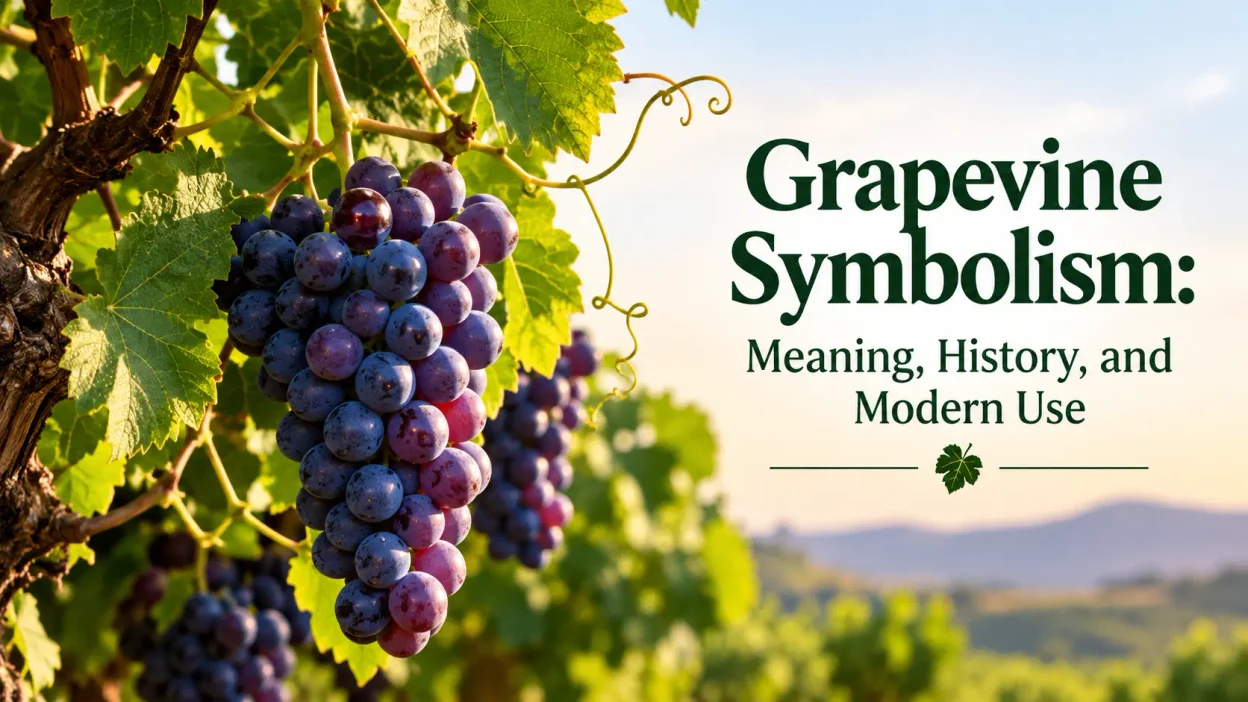
Grapevine symbolism connects the natural process of growth with ideas of abundance, connection, celebration, and renewal. A grapevine grows through winding stems, spreads across supporting structures, and produces clusters of fruit, making it a natural image for relationships, prosperity, and the rewards of patience. In the United States, grapevines appear in garden designs, wine culture, decorative patterns, religious imagery, and artwork inspired by ancient traditions.
The vine’s meaning depends on its setting. A grapevine in a vineyard may suggest hard work and a successful harvest, while a vine carved into a religious building can represent spiritual life or a community joined by shared beliefs. In a wedding decoration, it may evoke fertility, continuity, or a growing relationship.
These meanings developed over centuries through agriculture, mythology, religion, and art. Understanding their origins helps distinguish established historical associations from newer interpretations that people use in personal expression and modern design.
Quick Answer
Grapevine symbolism commonly represents abundance, growth, connection, and the rewards of patience in modern American culture, especially in gardens, home decor, celebrations, and wine-related imagery. Historically, grapevines have also been associated with fertility, hospitality, religious devotion, and divine or communal life in ancient Mediterranean traditions.
TL;DR
- Grapevines commonly symbolize growth, abundance, connection, and renewal.
- Ancient Mediterranean cultures linked grapevines with wine, harvests, and celebration.
- Greek and Roman traditions associated grapevines with Dionysus and Bacchus.
- Christianity uses the vine to express spiritual life and unity.
- American gardens and decor often use vines to suggest warmth and prosperity.
- Modern tattoos and artwork can represent patience, resilience, or personal growth.
What a Grapevine Symbolizes
A grapevine’s symbolism begins with the way it grows. Its flexible stems reach outward, attach to supports, and spread through a space. Over time, the plant produces clusters of grapes that can be harvested, shared, or turned into wine. These visible qualities provide the foundation for several common interpretations.
Growth and development are among the most natural associations. A vine does not produce fruit immediately; it develops through successive growing seasons. This makes it a useful symbol for progress that requires time, care, and suitable conditions.
Abundance and prosperity arise from its clusters of fruit and its role in agriculture. A productive vine can represent a successful harvest, a well-supplied household, or the benefits of sustained effort.
Connection and belonging emerge from the vine’s branching, winding structure. Multiple stems and clusters can suggest relationships, family ties, or a community whose members remain connected.
Renewal and continuity relate to the plant’s seasonal cycle. Grapevines may become dormant during colder months and grow again when conditions improve, offering a natural image of recovery and continued life.
These meanings overlap, but they are not interchangeable in every context. A harvest image emphasizes abundance, while a winding vine used as a border may focus on continuity or connection.
The Ancient Origins of Grapevine Symbolism
Grapevines have a long history in the Mediterranean, where people cultivated grapes for food, dried fruit, and wine. Wine became important in agriculture, trade, hospitality, religious offerings, and social life. Because the vine supported both daily needs and ceremonial practices, it acquired meanings beyond its practical value.
In ancient societies, a productive vineyard could represent wealth, stability, and the ability to provide for a household or community. The annual cycle of tending, pruning, harvesting, and processing grapes also linked the plant with labor and the changing seasons.
Grapevine motifs appeared in decorative arts, including architecture, pottery, and other crafted objects. Artists could use curling stems and clusters of grapes to fill a surface while also suggesting fertility, abundance, and the cultivated landscape.
The meaning was never completely uniform. A vine in a festive scene might evoke pleasure and celebration, while a vine in a religious setting could carry a sacred association. Its interpretation depended on the people using the image and the circumstances in which it appeared.
The historical importance of grapes therefore rests on a combination of practical experience and cultural meaning. People valued the plant as a source of food and drink, and its role in social and ritual life made it an enduring artistic motif.
Grapevines in Greek and Roman Mythology
In ancient Greek mythology, grapevines are closely associated with Dionysus, the god of wine, festivity, and ecstatic religious experience. His Roman counterpart is Bacchus, whose imagery also includes grapes, vines, drinking vessels, and the thyrsus, a staff often decorated with ivy and sometimes associated with grapevines.
Dionysus represented more than drinking. His myths explored celebration, altered states of consciousness, theatrical performance, fertility, and the complicated boundaries between social order and wildness. The grapevine fit this range of meanings because it supplied wine, a substance used in both communal celebrations and religious rites.
In Greek and Roman art, grape clusters and curling vines frequently appear in scenes involving feasting, abundance, and seasonal pleasure. Such imagery could communicate hospitality and prosperity, but it could also evoke the pleasures and excesses associated with wine.
The vine’s association with Dionysus and Bacchus helps explain why grape imagery continues to appear in modern wine labels, restaurant decor, and classical-inspired artwork. However, not every grapevine decoration is a reference to either deity. Sometimes the motif is simply a traditional way to represent vineyards, harvests, or hospitality.
Grapevine Symbolism in Christianity
Christianity gives the grapevine a distinct religious meaning through the biblical image of the vine and its branches. In the Gospel of John, Jesus describes himself as the true vine and his followers as branches that depend on him for life and fruitfulness.
This image presents spiritual growth as a relationship rather than an isolated achievement. Just as branches depend on a living vine, believers are described as depending on Christ to remain spiritually fruitful. The metaphor also connects faith with conduct: fruitfulness represents the results of an active spiritual life.
Grapes and wine have additional importance in Christian worship, especially in the Eucharist or Communion. In many Christian traditions, wine represents the blood of Christ, although the theological interpretation of Communion differs among denominations.
Grapevine imagery consequently appears in Christian paintings, stained glass, church carvings, manuscripts, and religious objects. Branches surrounding grapes may communicate spiritual nourishment, unity, sacrifice, or the relationship between Christ and the church.
This religious context should be distinguished from the broader symbolism of abundance. A grapevine carved into a church may carry a specific theological meaning that a similar design on a kitchen wall does not.
Grapevines in Jewish Tradition and Biblical Imagery
Grapevines also have an important place in Jewish tradition, particularly through their connection with the land, agricultural life, and biblical descriptions of prosperity.
In the Hebrew Bible, vineyards and grapes often appear in discussions of cultivation, harvests, blessings, and the responsibilities associated with land. Grapes were valuable as food and as a source of wine, making vineyards an important part of the agricultural world described in biblical literature.
The grapevine could therefore evoke a productive homeland and the ability to live from the land. The biblical report of scouts returning from Canaan with a large cluster of grapes, for example, presents the fruit as evidence of the land’s agricultural richness.
Vine imagery also appears in passages that describe Israel collectively, sometimes presenting the people as a vine or vineyard whose condition reflects their relationship with God. These passages can communicate prosperity, responsibility, neglect, or judgment depending on the context.
Jewish and Christian interpretations share some agricultural imagery, but their religious meanings should not be treated as identical. A grapevine may represent the land and its people in one passage and a relationship with Christ in another.
What Grapevines Mean in Modern American Culture
In the United States, grapevines are familiar through vineyards, home gardens, wine production, food traditions, and decorative design. Their symbolism often reflects practical associations rather than direct knowledge of ancient mythology.
A vineyard can represent patience, skilled work, and the rewards of a successful growing season. Wine culture adds associations with hospitality, shared meals, celebrations, and special occasions. Grapevines in a backyard garden may suggest self-sufficiency, an interest in gardening, or an appreciation for the harvest.
The plant also fits American ideas about personal development. A vine that grows over time can serve as a visual reminder that results often depend on consistent care. This interpretation appears naturally in artwork, gifts, and personal designs, although it is a modern symbolic reading rather than a fixed historical doctrine.
Regional context matters, too. In established wine-producing areas, grapevines may evoke local identity, agriculture, tourism, and family businesses. In other parts of the country, they may be little more than an attractive botanical motif.
There is no single American meaning for the grapevine. Its significance depends on whether people encounter it in a religious setting, a vineyard, a home, a restaurant, or a piece of personal artwork.
Grapevine Symbolism in Weddings, Hospitality, and Celebrations
Grapevines can suit weddings and celebrations because their branches and fruit lend themselves to themes of continuity, shared abundance, and a life cultivated over time.
In wedding decorations, vines may appear in table runners, floral arrangements, invitations, wreaths, or illustrations. Their winding stems can suggest two lives becoming connected, while clusters of grapes may evoke hospitality and a plentiful future. These interpretations are chosen by couples and designers rather than required meanings of the plant.
Grapes and wine also have a practical role in celebrations. Sharing wine at a meal can express welcome, companionship, or participation in a special occasion. In that context, the vine symbolizes the agricultural source of something people enjoy together.
The same imagery can work for anniversaries, housewarming gifts, and family gatherings. A grapevine motif may suggest that relationships grow through repeated acts of attention, much as a cultivated vine requires ongoing care.
These associations are especially useful in decorative design because they communicate warmth without relying on a single religious or mythological tradition. However, wine imagery may not suit every celebration, particularly when alcohol is unwelcome for religious, personal, or health-related reasons.
Growth, Fertility, and Abundance: Why the Vine Became a Symbol of Plenty
The association between grapevines and abundance has a clear agricultural foundation. A healthy vine can produce many grapes in a single season, and a successful harvest can provide food, trade goods, and wine for a community.
Before modern food distribution, a productive vineyard required substantial knowledge and labor. Growers needed to manage soil, weather, pruning, pests, and harvest timing. A fruitful vine therefore represented not only natural fertility but also the successful relationship between human effort and favorable growing conditions.
Fertility symbolism can extend beyond agriculture. In some historical and artistic contexts, fruit-bearing plants represent the ability to produce new life or sustain future generations. Yet it would be inaccurate to assume that every grapevine motif was intended as a reference to pregnancy or reproduction.
Today, abundance is often understood more broadly. A grapevine might symbolize a flourishing business, a full home, strong friendships, or a period of personal progress. The common thread is not simply having more possessions; it is having conditions that allow life and relationships to thrive.
The Emotional and Psychological Meaning of Grapevines
Grapevines can communicate several emotional qualities at once. Their flexible stems may suggest adaptability, their gradual growth may evoke patience, and their fruit may represent satisfaction after sustained effort.
These associations help explain why the vine works as a personal symbol. Someone recovering from a difficult period might choose a growing vine to represent rebuilding a life. Another person might associate it with family because a grapevine reminds them of a grandparent’s garden or a vineyard visited during childhood.
The symbol can also express belonging. Branches that spread from a common plant provide a natural image for relationships that develop in different directions while remaining connected. In a family artwork, for example, individual clusters might be used to represent different generations.
Psychological meanings are not universal facts about personality. A person who chooses a grapevine tattoo is not necessarily patient or family-oriented, and a home decorated with grape motifs does not reveal the owner’s beliefs. Symbols communicate possible meanings, not reliable diagnoses of character.
The most accurate interpretation considers the setting, the design, and the personal associations of the person using the image.
Grapevines in Tattoos, Jewelry, and Modern Design
Grapevines appear in contemporary tattoos, jewelry, textiles, home accessories, and decorative artwork because their shapes are adaptable. Long stems can wrap around a wrist or ankle, branches can frame a name, and grape clusters can provide detail within a larger botanical design.
A grapevine tattoo may represent growth, family ties, patience, fertility, or an appreciation for wine culture. A vine encircling another object can suggest continuity or connection, while a fruit-bearing branch may emphasize accomplishment or abundance.
In jewelry, grape clusters can draw on classical decorative traditions. Vine patterns may also appear in engraved rings, pendants, and ornamental metalwork, where the design matters as much as any symbolic interpretation.
In American home decor, grapevines are often used in kitchens, dining rooms, gardens, and wine-themed spaces. Their association with food and hospitality makes them a natural fit for places where people prepare meals or gather together.
The style can change the impression. A realistic botanical illustration may emphasize cultivation and nature, while an ornate classical vine may evoke older artistic traditions. A minimalist line drawing may focus on growth and movement.
Before choosing a design for its historical significance, consider whether its details come from a specific religious or mythological tradition or from general botanical decoration.
Grapevines Across Cultures: Similar Images, Different Meanings
Grapevines are especially prominent in Mediterranean and Middle Eastern cultural history because grape cultivation and winemaking have long-standing regional importance. Their meanings vary with religious practice, agricultural life, and artistic conventions.
In ancient Greek and Roman traditions, vines and grapes often appeared in imagery related to wine, festivity, fertility, and abundance. In Christian art, the vine could express a relationship with Christ and the spiritual life of believers. In Jewish biblical imagery, vineyards could represent the land, its people, prosperity, or moral responsibility.
In Persian poetry and artistic traditions, wine and the vine can carry both literal and figurative meanings. Some literary works use wine imagery to explore pleasure, longing, spiritual insight, or the tension between worldly and sacred experience. Interpretations depend on the individual poet and text, so wine symbolism should not be reduced to one universal Persian meaning.
In contemporary cultures, grapevines also function as familiar agricultural and decorative images without necessarily carrying religious significance.
The similarities across these traditions partly reflect the plant’s real-world importance. Grapes produce a valued crop, and vines have distinctive forms that artists can easily adapt. Similar imagery, however, does not prove that all cultures share the same symbolic system.
Common Misunderstandings About Grapevine Symbolism
One common misunderstanding is that grapevines always symbolize wealth. Their association with a successful harvest can suggest prosperity, but a vine may instead represent faith, family, cultivation, or a specific religious idea.
Another mistake is to treat the grapevine as a universal symbol of fertility. Fruit-bearing plants have been used to communicate fertility in some settings, but the meaning depends on the culture and the artwork. A church carving, a vineyard sign, and a wedding centerpiece may use similar forms for different reasons.
It is also easy to assume that every grapevine design comes from ancient Greece or Rome. Although classical art helped establish enduring vine motifs, grapevines also appear in biblical traditions, later European decorative arts, and modern botanical design.
Finally, the symbolism of the grapevine should not be confused with the symbolism of wine itself. Wine can represent celebration, sacred ritual, excess, hospitality, or social status depending on the context. The plant that produces it may share some of these associations, but it can also stand independently for growth and cultivation.
Understanding these distinctions makes the symbol more meaningful, not less. Historical context explains why a motif matters without forcing every example into the same interpretation.
Grapevine Symbolism at a Glance
| Context | Common symbolic meaning | Why it fits |
|---|---|---|
| Gardens and vineyards | Growth and abundance | The vine develops and produces fruit through cultivation |
| Greek and Roman mythology | Wine, festivity, and fertility | Grapevines are associated with Dionysus and Bacchus |
| Christian imagery | Spiritual life and unity | The vine and branches represent a relationship with Christ |
| Jewish biblical imagery | Land, prosperity, and responsibility | Vineyards appear in agricultural and collective metaphors |
| Weddings and home decor | Connection and hospitality | Branches and grapes suggest continuity and shared enjoyment |
| Tattoos and personal art | Patience, identity, and renewal | The growing vine can represent an individual’s chosen meaning |
How Grapevine Symbolism Has Changed Over Time
Grapevine symbolism developed from the plant’s practical importance in agriculture and gradually expanded through religious traditions, mythology, literature, and decorative art. Its meanings accumulated rather than replacing one another in a single sequence.
In ancient Mediterranean cultures, grapevines were tied to harvests, wine, and religious celebrations. Biblical traditions developed their own imagery around vineyards and fruit-bearing branches. Later artists adapted vine patterns for buildings, manuscripts, furniture, and personal objects.
In modern America, grapevines remain visible in wine-producing regions, gardens, restaurants, and home decor. Their historical religious meanings continue in appropriate settings, while many decorative uses are simply expressions of an interest in nature or traditional design.
Digital culture has also made it easier for people to combine symbols from different eras. A contemporary illustration might place a grapevine alongside a moon, a family name, or a geometric pattern. Such a composition can have personal meaning without representing a historically documented tradition.
The vine’s continuing appeal comes partly from this flexibility. It can suggest the work required to cultivate something, the fruit that work produces, or the relationships that develop over time. Its meaning changes with the context, while its connection to growth remains easy to recognize.
Frequently Asked Questions
What does a grapevine symbolize spiritually?
A grapevine can symbolize spiritual growth, dependence, and the development of a fruitful life, particularly in Christian traditions. In other spiritual contexts, people may use it to represent renewal or connection, but those meanings depend on the tradition and individual interpretation.
Is grapevine symbolism positive or negative?
Grapevines are generally associated with positive ideas such as growth, abundance, fertility, and connection. Their association with wine can introduce themes of excess or temptation in particular religious and literary contexts, so the surrounding imagery matters.
What does a grapevine tattoo mean?
A grapevine tattoo may represent personal growth, family connections, patience, abundance, or an appreciation for vineyards and wine. Its exact meaning depends on the wearer, the design, and any accompanying symbols.
What does a grapevine symbolize in Christianity?
In Christianity, the vine and branches are associated with Christ and the spiritual life of his followers. The image emphasizes the relationship between faith and spiritual fruitfulness rather than simply material prosperity.
Why are grapevines associated with abundance?
A productive grapevine can yield many grapes, making it a natural image of a successful harvest and a plentiful supply of food or wine. This practical connection helped establish the vine as a symbol of prosperity and fertility in several historical settings.
What does a grapevine symbolize in a wedding?
In wedding decor, grapevines may suggest connection, continuity, and a relationship that grows through care. Grapes can also evoke hospitality and shared celebration, although these are chosen symbolic associations rather than universal wedding customs.
Are grapevines associated with Greek mythology?
Yes. Grapevines and grapes are strongly associated with Dionysus, the Greek god of wine and festivity, and his Roman counterpart, Bacchus. Their mythological associations include celebration, fertility, religious experience, and the pleasures and risks connected with wine.
Conclusion
Grapevine symbolism brings together growth, abundance, connection, and renewal, with meanings shaped by agriculture, mythology, religion, and everyday experience. Ancient Mediterranean traditions linked the plant with wine and celebration, while Christian and Jewish texts developed distinct meanings involving spiritual life, land, and community.
In modern American culture, grapevines appear in gardens, wedding decorations, tattoos, jewelry, and home design. Their significance may be historical, religious, decorative, or personal. Understanding the setting helps reveal whether a grapevine represents a successful harvest, a spiritual relationship, a welcoming home, or the steady work of building something worthwhile.
At its simplest, the grapevine reminds us that growth depends on conditions, care, and time, and that what develops from those efforts can be shared with others.