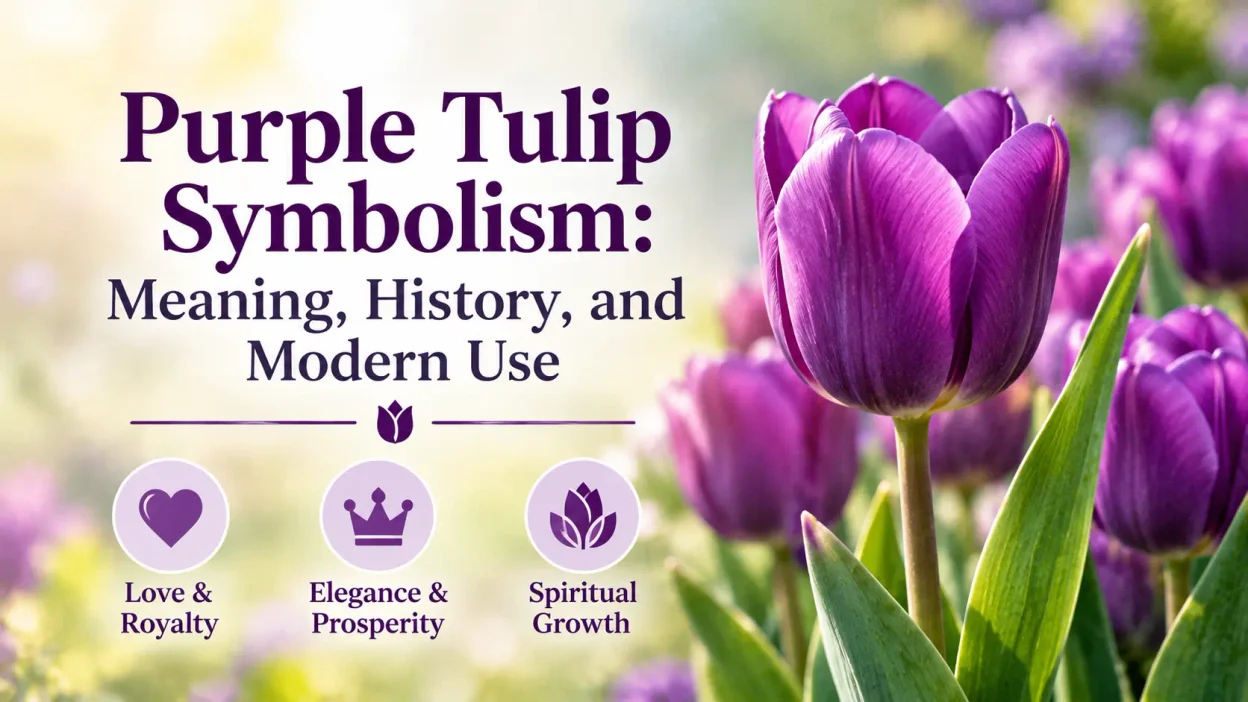
Purple tulip symbolism often centers on royalty, admiration, elegance, and personal achievement. With their rich colors and graceful, cup-shaped blooms, purple tulips stand out in gardens, floral arrangements, and gifts. In the United States, they can communicate appreciation, affection, congratulations, or a preference for flowers that feel distinctive without being overly romantic.
Unlike red roses, which have a well-established association with romantic love, purple tulips do not have one universally recognized meaning. Their symbolism comes from a combination of the cultural associations of purple, the history of tulip cultivation, and the personal circumstances in which people give or display the flowers.
Understanding these influences helps explain why purple tulips appear in everything from spring bouquets to wedding arrangements. Their meaning can shift with the shade, the occasion, and the relationship between the giver and recipient.
Quick Answer
Purple tulip symbolism commonly represents royalty, admiration, elegance, and respect in modern American culture, especially in gifts, celebrations, and decorative arrangements. The flower’s associations with status and refinement draw partly on the historical prestige of purple dye and the tulip’s celebrated role in European horticulture.
TL;DR
- Purple tulips commonly symbolize admiration, dignity, elegance, and achievement.
- Purple’s historical association with royalty helps explain the flower’s refined image.
- Tulip cultivation spread from Central Asia through Ottoman and European gardening traditions.
- In the United States, purple tulips suit spring gifts, celebrations, and sophisticated decor.
- Dark and light purple shades can communicate different moods and visual impressions.
- Personal context matters because purple tulips have no universal, fixed meaning.
What Purple Tulips Look Like and Why Their Color Matters
<escape>Purple tulips</escape> are spring-flowering plants with upright stems and smooth, cup-shaped blooms. Their petals range from pale lavender and lilac to vivid violet, plum, and nearly black-purple. Some varieties have solid-colored petals, while others display streaks, contrasting edges, or subtle variations in tone.
The color is central to their symbolic appeal. Purple often appears distinctive among familiar floral colors because it combines the visual warmth associated with red with the cooler character associated with blue. Depending on its shade, it can feel luxurious, gentle, dramatic, or contemplative.
A pale lavender tulip may suit a delicate spring arrangement, while a saturated violet variety can create a more formal appearance. Deep purple blooms may look particularly striking against white flowers or green foliage.
These differences influence how people interpret the flower. A bouquet of soft lavender tulips may communicate tenderness and thoughtful attention, whereas a formal arrangement of deep purple tulips may emphasize dignity or accomplishment.
The flower’s appearance does not determine its meaning by itself. Color, presentation, occasion, and personal preference all contribute to the message.
The Core Meaning of Purple Tulips
Purple tulips are commonly associated with four related ideas: royalty, admiration, elegance, and respect.
Royalty and distinction come largely from purple’s long association with status and authority. A purple flower can therefore feel more formal or prestigious than a simple arrangement of everyday blooms.
Admiration is another common interpretation. Purple tulips can make a thoughtful gift for someone whose creativity, judgment, talent, or accomplishments you value. They offer a way to express appreciation without relying on an overtly romantic message.
Elegance comes from the flower’s shape and color working together. Tulips have clean outlines and relatively simple blooms, while purple adds visual richness. The combination can look refined without requiring elaborate floral decoration.
Respect is especially relevant when the recipient is a colleague, mentor, teacher, or family member. A purple tulip bouquet can acknowledge someone’s importance while leaving the precise emotional message open.
These are common contemporary associations, not a universal floral code. Purple tulips do not automatically mean that someone is wealthy, powerful, admired, or romantically interested. Their significance depends on the intentions of the giver and the relationship between the people involved.
Why Purple Has Been Associated With Royalty
Purple’s connection with royalty predates the modern popularity of purple tulips. In parts of the ancient Mediterranean world, highly valued purple dyes were difficult and expensive to produce. Some celebrated dyes came from marine mollusks and required substantial labor and resources.
Because certain purple textiles were costly and socially restricted, purple became associated with rulers, elite households, and authority in several historical societies. The exact rules and meanings varied by place and period, so the color should not be treated as a universal royal emblem across every culture.
Over time, the association between purple and prestige became part of broader European visual culture. Purple clothing, ceremonial objects, and decorative materials could signal distinction, wealth, or rank.
Modern purple tulips inherit some of this cultural background through their color. A bouquet can look luxurious even when the flowers themselves are readily available. The association is symbolic rather than economic: the color recalls a history of prestige, not necessarily the price or rarity of the particular tulip variety.
This historical connection helps explain why purple tulips are often used to recognize achievement or create an elegant atmosphere. It does not, however, prove that the flower itself was an established royal symbol in every historical period.
The History of Tulips and Their Journey Into Europe
Tulips originated across parts of Central Asia, where wild species grew in varied mountain and steppe environments. Over centuries, people cultivated and selected tulips for their flowers, and the plants became especially prominent in Ottoman horticulture.
Tulips held an important place in Ottoman art, textiles, ceramics, and garden design. Their stylized forms appeared in decorative patterns, and the flower became associated with a period of notable artistic and horticultural development. The precise meaning of a tulip varied with its setting; it did not carry one fixed message in every Ottoman context.
Tulips later became highly fashionable in Europe, particularly in the Dutch Republic during the seventeenth century. Collectors and growers developed a strong interest in varieties with unusual shapes and colors. Some rare bulbs commanded extraordinary prices during the period known as Tulip Mania, although the episode involved particular market conditions and should not be confused with the ordinary modern flower trade.
As tulip cultivation expanded, the flowers became familiar garden plants and popular seasonal gifts. Breeding created a wider range of colors, including numerous purple shades.
Purple tulip symbolism therefore combines two histories: the broader cultural prestige of purple and the tulip’s changing place in gardening, art, and commerce. The modern meanings associated with the flower developed through these overlapping influences rather than from one ancient symbolic tradition.
What Purple Tulips Mean in American Culture
In the United States, purple tulips fit comfortably into a culture of seasonal flowers, personal gifting, home decoration, and celebration. They are especially useful when someone wants to express appreciation without choosing a flower strongly associated with romance or mourning.
A bouquet can congratulate a graduate, recognize a professional achievement, or thank a person who has offered meaningful support. Purple tulips can also make an attractive spring gift for a friend, parent, or host.
Their meaning changes with the occasion. At a graduation, the flowers may suggest pride and accomplishment. At a dinner party, they may simply express hospitality and good taste. In a romantic relationship, they can communicate admiration and affection, although the recipient may not interpret them as a specific declaration of love.
Purple tulips also suit American interior design because they work with several popular color palettes. Lavender complements soft neutrals and pastels, while deep violet can provide contrast in rooms decorated with white, gray, cream, or natural wood.
There is no official American meaning for the flower. Most people interpret it through familiar color associations, the occasion, and the giver’s intentions rather than through a formal language of flowers.
Purple Tulips as Gifts: Admiration Without Overstatement
One reason purple tulips make versatile gifts is that they can express positive feelings without defining the relationship too narrowly.
For a friend, they may communicate appreciation and affection. For a teacher or mentor, they can recognize patience, guidance, or achievement. For a coworker, a carefully arranged bouquet may celebrate a promotion or mark a professional milestone.
They can also suit romantic occasions. Purple tulips offer an alternative to red roses when the intended message emphasizes admiration, individuality, or understated affection rather than intense passion.
The presentation helps determine how the gift feels. Lavender tulips wrapped in simple paper may appear gentle and casual. Deep purple blooms arranged with white flowers can create a more formal, polished impression.
If the recipient enjoys gardening, a pot of purple tulips or a package of bulbs may be more meaningful than a cut bouquet. This choice gives the recipient an opportunity to watch the flowers grow and return to the garden under suitable growing conditions.
When the occasion is sensitive or the relationship is unfamiliar, a short personal note is more reliable than assuming the recipient knows a particular floral meaning. A clear message of thanks, congratulations, or appreciation gives the flowers a purpose that color alone cannot fully communicate.
How Different Shades of Purple Change the Message
Purple is not one uniform color. The difference between lavender and deep violet can change the emotional impression of a tulip arrangement.
<text weight=”medium”>Lavender and pale purple</text>
<AsyncImageGroup query={[“pale lavender purple tulips soft spring garden close up”,”light lilac tulips elegant white vase natural light”]} aspectRatio=”5:4″ layout=”bento” size=”lg”/>
Pale purple tulips often look delicate, fresh, and calm. They work well for spring celebrations, thoughtful gifts, and interiors that favor soft colors. Their visual character can support associations with gentleness, grace, and quiet admiration.
<text weight=”medium”>Violet and medium purple</text>
<AsyncImageGroup query={[“vivid violet purple tulips blooming garden close up”,”medium purple tulips arranged in elegant bouquet”]} aspectRatio=”5:4″ layout=”bento” size=”lg”/>
Medium purple shades create a more noticeable display without appearing as dark as plum-colored flowers. They suit gifts intended to express appreciation, confidence, or individuality and can stand out in a mixed spring bouquet.
<text weight=”medium”>Deep purple and plum</text>
<AsyncImageGroup query={[“deep dark purple tulips dramatic close up petals”,”dark plum purple tulips luxury floral arrangement”]} aspectRatio=”5:4″ layout=”bento” size=”lg”/>
Deep purple tulips often appear dramatic and formal. Their rich color can reinforce associations with prestige, dignity, and sophistication, especially when paired with white or restrained greenery.
These descriptions are visual interpretations, not fixed rules. A person’s experience with a particular shade, the surrounding flowers, and the setting can matter more than any general color association.
Purple Tulips for Weddings, Anniversaries, and Celebrations
Purple tulips can add color and structure to weddings, anniversary bouquets, engagement parties, and other celebrations. Their clean shape works with both contemporary and traditional floral arrangements.
At weddings, pale lavender tulips can complement white flowers, soft greenery, and pastel decorations. Deeper purple varieties can create contrast in arrangements with cream, blush, or burgundy accents. Depending on the design, the result may feel romantic, modern, or formal.
For anniversaries, purple tulips can express continuing admiration and appreciation. They are particularly suitable for couples who prefer a less conventional floral choice than red roses.
At graduations and career celebrations, the flower’s associations with distinction and accomplishment can make it a thoughtful option. Some schools and organizations use purple as an institutional color, which may provide an additional personal connection when the recipient shares that affiliation.
Still, purple does not have one universal meaning at weddings or celebrations. In some settings, it may represent a favorite color rather than a symbolic statement. If the arrangement needs to coordinate with a particular event, practical considerations such as color palette, season, and flower availability should guide the choice.
Purple Tulips in Gardens and Home Decor
In gardens, purple tulips bring contrast to spring planting schemes. They can be planted in groups for a concentrated display or mixed with white, yellow, pink, and red tulips for a more varied effect.
Their symbolic appeal often follows their visual role. A row of violet tulips may create a sense of order and formality, while a mixed bed of purple and pale pink blooms may feel softer and more informal.
Inside the home, purple tulips can become a seasonal focal point without requiring elaborate decoration. A simple glass vase highlights the stems, while a ceramic container can make the arrangement feel more traditional or substantial.
Purple also pairs well with different interior styles. Lavender suits airy, light-filled spaces, while dark violet can complement modern rooms with restrained colors and clean lines.
Some people choose flowers according to the mood they want to create. Color psychology offers possible explanations for these preferences, but it should not be treated as a precise science that predicts how everyone will respond. Cultural associations, personal memories, lighting, and individual taste all influence perception.
For gardeners, practical growing conditions matter as much as symbolism. Tulips generally perform best when their variety, planting depth, climate, drainage, and seasonal needs are suited to the location. In many U.S. regions, bulbs are planted in fall for spring blooms, though local conditions and variety can affect results.
Cross-Cultural Meanings of Purple Flowers
Purple flowers appear in many cultural settings, but their meanings are not identical everywhere.
In parts of European and North American culture, purple often suggests royalty, refinement, or distinction because of its historical association with costly dyes and elite clothing. Those associations can influence how purple tulips are used in contemporary bouquets.
In some East Asian cultural contexts, purple may be connected with status, dignity, or spiritual ideas, but meanings vary by country, period, and setting. It would be misleading to assign one interpretation to all East Asian traditions.
Purple flowers can also appear in mourning arrangements or memorial gardens in various communities. In these contexts, the meaning comes from the broader color palette, local customs, and the purpose of the gathering rather than from a universal rule about tulips.
Religious symbolism also varies. A purple flower may acquire significance through the color’s role in a particular ceremony or artistic tradition, but purple tulips themselves do not have one universally recognized religious meaning.
These comparisons show why context matters. The same bouquet may communicate celebration in one setting and quiet remembrance in another. The flower’s color contributes to the message, but cultural practice and personal intention shape its interpretation.
Emotional and Psychological Associations of Purple Tulips
Purple tulips can appeal to people who want to communicate appreciation while preserving a sense of individuality. Their color is less conventional than red in many romantic settings, and the flower’s simple shape keeps the arrangement from feeling overly elaborate.
For some people, purple suggests creativity or originality. For others, it evokes formality, nostalgia, or calm. These responses may come from personal memories, cultural experience, or repeated exposure to purple in clothing, art, and decoration.
Flowers can also serve as emotional reminders. A bouquet from a loved one may become associated with a particular celebration, while tulips planted in a garden may remind someone of a family member or a favorite season.
The psychological value of a flower often lies in the memory and relationship attached to it. No color can reliably reveal someone’s personality or emotional state, and choosing purple tulips does not prove that a person values status or sophistication.
A more grounded interpretation is that purple tulips provide a visual way to express an intention. The sender may want to celebrate, thank, encourage, or simply brighten someone’s day. The meaning becomes clearer when the flower is considered alongside the circumstances in which it is given.
Purple Tulips in Tattoos, Fashion, and Digital Culture
Purple tulips appear in contemporary art and personal design because their shape is easy to recognize and their color offers several stylistic possibilities.
A purple tulip tattoo may represent a personal milestone, a relationship, an appreciation for spring, or a preference for elegant floral imagery. Some people choose it as a reminder of someone they admire; others simply like the flower’s appearance.
In jewelry and fashion, tulip motifs can suggest nature, femininity, spring, or understated elegance. Purple accents may make the design feel more distinctive, but their significance depends on the wearer and the surrounding design.
On social media, purple tulips may appear in birthday posts, graduation messages, spring photography, wedding inspiration, or digital greetings. A photograph can communicate a mood even when the poster does not intend a traditional symbolic message.
These uses illustrate how floral meanings evolve. A modern design may combine ideas from color symbolism, gardening, personal memory, and contemporary aesthetics without claiming to represent an ancient tradition.
When someone uses purple tulips to express a particular feeling, the personal explanation matters more than assumptions about a universal code.
Common Misunderstandings About Purple Tulip Symbolism
Several popular claims about flower meanings are presented more confidently than the evidence supports.
One misconception is that purple tulips always mean royalty. Purple has a well-documented history of association with status in particular societies, but a modern bouquet may simply reflect the recipient’s favorite color or the season’s available flowers.
Another claim is that purple tulips always represent romantic love. They can be appropriate for romantic occasions, but they are also suitable for friends, family members, colleagues, and people being congratulated on an achievement.
Some interpretations assign a precise message to every shade of purple. Although color can influence the appearance and emotional impression of a bouquet, there is no universally accepted system that gives each shade a fixed meaning.
It is also inaccurate to assume that every flower carries an ancient spiritual message. Many modern floral associations developed through changing fashions, commercial flower traditions, art, and personal interpretation.
A useful distinction is between a documented historical association and a contemporary symbolic reading. Purple’s relationship with prestige has historical foundations, while a claim that a particular purple tulip variety guarantees luck or protection should be understood as a personal belief rather than an established fact.
Purple Tulip Symbolism at a Glance
| Context | Common meaning | Typical use |
|---|---|---|
| Gifts and bouquets | Admiration and appreciation | Thank-you gifts, birthdays, and congratulations |
| Weddings and anniversaries | Elegance and affection | Bridal flowers and anniversary arrangements |
| Deep purple blooms | Prestige and distinction | Formal displays and sophisticated decor |
| Lavender blooms | Grace and gentleness | Spring bouquets and thoughtful gifts |
| Gardens and home decor | Creativity and seasonal beauty | Spring planting and interior decoration |
The table summarizes common modern interpretations rather than a formal or universal language of flowers.
Frequently Asked Questions
What does a purple tulip symbolize?
A purple tulip commonly symbolizes admiration, elegance, respect, and royalty. Its meaning comes from the combination of purple’s cultural associations and the tulip’s place in modern floral traditions.
Are purple tulips romantic?
Yes, purple tulips can be romantic, especially when given to express admiration or affection. However, they are not exclusively romantic flowers and can also suit friendships, family celebrations, and professional congratulations.
What does a dark purple tulip mean?
Dark purple tulips often convey a formal, dramatic, or luxurious impression. These associations arise mainly from the visual character of the shade and purple’s broader connection with prestige, not from a universal historical rule.
Are purple tulips suitable for sympathy or memorial flowers?
They can be appropriate when the recipient or family appreciates purple flowers, but the choice depends on personal and cultural preferences. A simple arrangement with a thoughtful message is often more meaningful than relying on a presumed symbolic meaning.
What do purple tulips mean in a dream?
Some modern dream interpretations connect purple tulips with admiration, personal growth, or a desire for recognition. Dream meanings are subjective, however, and a flower in a dream does not have a scientifically established universal interpretation.
Do purple tulips symbolize good luck?
Some people may associate them with positive change, celebration, or success, but good luck is not a universally established meaning of purple tulips. Their more common modern associations are admiration, elegance, and distinction.
What is the difference between purple and lavender tulip symbolism?
Purple tulips generally suggest admiration, distinction, or elegance, while lavender varieties may look softer and more delicate. These differences are flexible visual associations rather than fixed rules governing what a bouquet must mean.
Conclusion
Purple tulip symbolism brings together admiration, elegance, respect, and the historical association between purple and prestige. The flower’s meaning also reflects the tulip’s journey through horticultural traditions, European garden culture, and modern American gifting and design.
Whether used in a spring bouquet, a wedding arrangement, a garden, or a personal artwork, purple tulips can communicate appreciation without relying on one rigid interpretation. Their most meaningful message comes from the combination of color, occasion, and intention, making them a thoughtful choice for celebrating people and moments that matter.