Meta Description: Silver commonly represents sophistication, clarity, achievement, and modernity. Explore its ancient lunar roots and uses in American culture today.
Silver sits between white, gray, and the visual shine of metal. Silver color symbolism is shaped largely by that reflective appearance: Americans often connect the color with sophistication, technology, achievement, elegance, and restrained luxury. Its cooler tone can also suggest calmness, distance, or an intentionally futuristic look.
Unlike a flat gray, silver seems to interact with light. That quality has helped connect it with mirrors, moonlight, polished metal, jewelry, machines, awards, and celebration. Many of these associations developed from the actual metal and were later transferred to silver-colored fabrics, paint, graphics, vehicles, accessories, and digital design.
The meaning is not universal, however. An ancient Egyptian silver object, an Olympic medal, a silver wedding decoration, and a metallic smartphone may share a color while communicating very different ideas.
Quick Answer
Silver color symbolism commonly represents sophistication, modernity, achievement, clarity, and refined value in American culture. Historically, silver has also carried associations with the moon, purity, precious metal, status, ceremonial objects, and wealth in several cultural traditions.
TL;DR
- Silver commonly suggests sophistication, modernity, achievement, and understated luxury.
- Its reflective surface encourages associations with light, clarity, and mirrors.
- Ancient cultures sometimes connected silver with the moon.
- Americans recognize silver in awards, anniversaries, technology, and entertainment.
- Metallic silver can feel futuristic, elegant, cool, or emotionally distant.
- Context determines whether silver appears prestigious, industrial, celebratory, or sterile.
What the Color Silver Actually Looks Like
Silver is not simply another name for gray. Gray can be completely matte, while silver is normally understood as a light gray or whitish tone with a metallic, reflective quality.
That shine matters symbolically. A silver surface changes as light moves across it. Highlights can appear almost white while shaded areas become charcoal gray. Because of this contrast, silver often looks more active and polished than ordinary neutral colors.
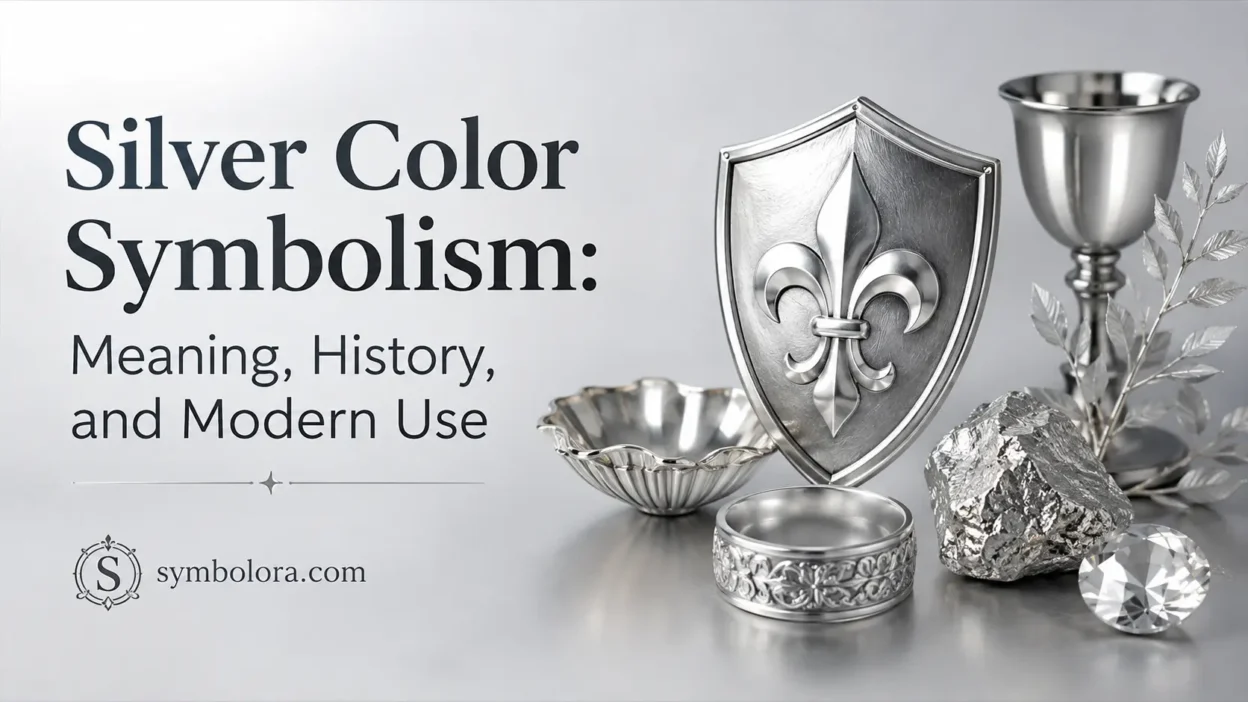
People encounter it in jewelry, stainless-steel appliances, cars, electronics, mirrors, metallic fabrics, holiday decorations, trophies, coins, watches, furniture hardware, cosmetics, and graphic design.
A printed or digital silver cannot reproduce actual metallic reflection perfectly, yet designers usually imitate the effect with gradients ranging from white through several shades of gray. The intention is still recognizable: the object should appear polished, metallic, and valuable.
The Core Meanings of Silver Today
In the United States, silver carries several meanings rather than one fixed definition. The setting usually tells a viewer which association matters most.
| Context | Common U.S. Meaning | Typical Associations | Important Note |
|---|---|---|---|
| Fashion and jewelry | Elegance and refinement | Polish, style, restraint | Often feels cooler than gold |
| Awards and competition | Achievement | Skill, recognition, second place | Success without the top-ranking status |
| Technology | Modernity and precision | Machines, innovation, engineering | Commonly paired with black or white |
| Weddings and anniversaries | Endurance | Commitment, celebration, maturity | Especially associated with 25 years |
| Interior design | Clean sophistication | Metal, minimalism, contemporary style | Too much can feel cold |
| Lunar imagery | Reflection and mystery | Moonlight, night, cycles | Historically important in some cultures |
Silver often occupies a middle position between showy luxury and complete neutrality. Gold tends to attract attention through warmth and richness. Gray can deliberately fade into the background. Silver combines neutrality with shine, allowing it to signal importance without necessarily appearing extravagant.
Why Reflection Shapes Silver’s Meaning
Much of silver’s symbolism begins with reflection.
Polished silver can return light and images to the viewer, so it naturally supports ideas such as clarity, perception, awareness, and self-examination. Mirrors have historically been made using different reflective materials and technologies, but their visual relationship with silvery surfaces strengthens this association.
Reflection also explains silver’s connection with moonlight. Unlike the sun’s direct brilliance, moonlight traditionally appears pale, cool, and indirect. Silver therefore became a useful visual counterpart to gold, which is more readily associated with sunlight.
This contrast should not be treated as a universal symbolic law. Cultures developed their own interpretations. Still, the opposition between warm gold and cool silver appears often enough in art and material culture to influence modern expectations.
Ancient Egyptian Associations With the Moon and Purity
One of the clearest historical examples comes from ancient Egypt. Silver was associated with the moon because of its pale appearance, while its soft luster could also carry ideas connected with ritual purity. Egyptian tradition even associated silver with the bones of the gods, in contrast with golden flesh.
Silver appeared in objects including jewelry, amulets, mirrors, vessels, and statuettes. Its importance therefore involved more than color alone. Material rarity, craftsmanship, ritual use, and access to precious resources all contributed to its significance.
Modern symbolism sometimes simplifies this history into the claim that silver always means spirituality or feminine lunar energy. That goes too far. Ancient Egyptian meanings developed within a particular religious and material culture and should not automatically be applied to every silver object today.
What survives most strongly in contemporary visual culture is the connection between pale metallic shine, the night sky, and the moon.
Silver, the Moon, and Duality in the Ancient Andes
A lunar connection also appeared independently in ancient Andean traditions.
In Inca belief, silver was associated with the moon, while gold was associated with the sun. Earlier Moche artists also used silver and gold together to express complementary relationships and visual dualism. Elite objects could combine the two metals within a single ceremonial ornament.
This use adds another symbolic possibility: silver can represent one half of a balanced pair rather than simply being a less expensive version of gold.
That distinction matters. Modern viewers often arrange precious metals as a hierarchy—gold first and silver second. Historical cultures did not always interpret them primarily through competitive ranking. Silver and gold could instead express contrasting celestial forces, colors, materials, or complementary principles.
Silver in European Heraldry and Visual Tradition
In European heraldry, silver developed a formal visual role through argent, the heraldic metal represented by silver or, commonly, white. Heraldic systems traditionally classify gold and silver as metals rather than ordinary colors.
Because actual metallic silver is difficult to reproduce consistently in painting, printing, or engraving, white frequently stands in for argent. That history helps explain why silver and white still overlap symbolically.
Both can suggest cleanliness, clarity, lightness, formality, and simplicity. Silver, however, adds the associations of metal, value, durability, and reflection.
Modern claims that heraldic silver has one universal meaning such as innocence, peace, or sincerity should be treated cautiously. Symbolic dictionaries often assign fixed virtues to heraldic colors, but actual heraldic practice is more complicated. A coat of arms must be understood through its specific design, history, and bearer.
Precious Metal, Money, and the Idea of Value
Silver’s connection with value comes directly from material history.
For long periods, silver was used for jewelry, ceremonial objects, household goods, trade, and coinage. In the Mediterranean world, coinage involving precious metals became an important part of economic life, and silver coins circulated widely in many later societies.
These uses left a lasting cultural association between silver and material worth.
That is why metallic silver can make packaging, lettering, clothing, or decorations appear more prestigious than ordinary gray. The surface implies a valuable material even when no real silver is present.
Yet silver generally communicates a different kind of luxury from gold. Gold is warmer and more conspicuous. Silver often appears cooler, cleaner, and more restrained. A silver watch, metallic car, or brushed-steel kitchen can therefore suggest expense without relying on ornate decoration.
What Silver Commonly Means in the United States
Modern American interpretations come from several overlapping traditions.
Silver frequently suggests achievement because of medal systems. It suggests long-lasting commitment through the silver wedding anniversary. It can imply Hollywood glamour through the familiar expression “silver screen.” It also evokes modern manufacturing through chrome, aluminum, stainless steel, and other bright metallic materials.
During twentieth-century American design, metallic surfaces became increasingly visible in furniture, transportation, appliances, architecture, textiles, and consumer products. Chrome-plated steel and stainless steel appeared prominently in modern design, while designers such as Dorothy Liebes used metallic fibers to add shine to fashion and interiors.
As a result, silver does not look purely traditional in the United States. It can refer backward to heirloom jewelry and formal tableware while simultaneously suggesting advanced technology.
Few colors move between heritage and futurism so easily.
Achievement, Competition, and the Silver Medal
Competition gives silver one of its most recognizable modern meanings: excellent performance that falls just short of first place.
Today, a silver medal normally indicates second place in major sporting competitions. Olympic history is somewhat more complicated. At the first modern Olympic Games in Athens in 1896, first-place competitors received silver medals, while the familiar gold-silver-bronze ranking system developed later.
Modern symbolism is therefore slightly paradoxical.
Silver represents genuine achievement, distinction, and elite performance, but it can also carry a sense of coming second. Someone described as a “silver medalist” is exceptionally accomplished, yet the medal exists within a hierarchy that places gold above it.
This explains why silver can symbolize both pride and incomplete victory. Context and personal experience determine which feeling dominates.
Silver in American Expressions and Popular Culture
Language has strengthened several American associations with the color.
The phrase “silver screen” became closely connected with movies and remains a familiar way of referring to cinema. American cultural institutions still use the expression when discussing film heritage.
A “silver lining” is the hopeful or beneficial aspect found within an otherwise difficult situation. That expression gives silver an optimistic association with light emerging around darkness.
A “silver spoon” can imply inherited privilege because expensive silver tableware historically signaled family wealth and social position.
These phrases do not create a single unified meaning. Instead, they demonstrate how broadly silver operates in American imagination: glamour in one expression, hope in another, and privilege in a third.
Emotional and Psychological Associations
Silver often creates an impression of composure.
Its low color saturation can make it feel less emotionally intense than red, orange, or bright yellow. At the same time, its shine prevents it from becoming visually passive. This combination can communicate control, precision, polish, and confidence.
People may therefore interpret silver as:
- sophisticated rather than playful,
- calm rather than energetic,
- polished rather than rustic,
- precise rather than spontaneous,
- modern rather than nostalgic.
These are cultural associations, not fixed psychological effects. There is no universal rule that seeing silver automatically produces a particular emotion.
Lighting and texture also matter. Soft satin silver can feel peaceful and elegant. Mirror-finish chrome may seem dramatic or futuristic. Dull, weathered metal can communicate age, toughness, or industrial use.
Silver in Fashion, Jewelry, and Personal Identity
Silver-colored accessories often communicate polished style without the warmth associated with yellow gold.
Minimalist necklaces, rings, watches, metallic shoes, handbags, and clothing can make an outfit look clean and contemporary. Highly reflective silver creates a stronger statement, especially in stage costumes, party clothing, and futuristic fashion.
Actual silver jewelry can carry additional cultural meanings beyond appearance. In some communities, jewelry marks family ties, identity, status, transition, or protection.
For example, historical Turkmen silver jewelry could accompany changes in a woman’s stage of life and was also connected with protective beliefs. Its symbolism belonged to the forms, materials, customs, and social practices of the community rather than to the silver color alone.
The same caution applies when interpreting Native American jewelry in the United States. Silverwork belongs to specific artistic traditions and communities. It should not be reduced to a generic online claim that “silver means protection” or “silver means spirituality.”
Why Silver Looks Technological and Futuristic
Silver became strongly associated with machines because modern technology has repeatedly exposed people to metallic surfaces.
Cars, aircraft, industrial equipment, household appliances, computer hardware, tools, and consumer electronics have all used visible metallic finishes. Twentieth-century modern design made materials such as chrome and stainless steel especially prominent.
Science fiction expanded the connection. Robots, spacecraft, futuristic buildings, suits, weapons, and interfaces have often been imagined with sleek metallic surfaces.
As a result, designers can use silver without depicting a specific machine and still suggest:
innovation, engineering, speed, precision, robotics, space exploration, or an imagined future.
This association changes with texture. Brushed silver feels technical and practical. Mirror silver feels more futuristic. Tarnished metal loses much of that sleek quality and begins to suggest age or wear instead.
Silver in Homes and Interior Design
In American interiors, silver usually works as an accent rather than a dominant color.
Stainless-steel appliances create a practical metallic presence in kitchens. Chrome fixtures appear in bathrooms and contemporary furniture. Silver picture frames, lamps, mirrors, trays, textiles, and decorative objects can add brightness without introducing a strong hue.
The effect depends heavily on surrounding colors.
Silver with white can appear clean and minimal. With black, it becomes sharper and more dramatic. With navy or deep green, it can look formal. Combined with glass and smooth surfaces, it may create a contemporary or high-tech impression.
Too much metallic gray can also make a space seem impersonal. This is one reason designers often balance silver with wood, fabric, warm lighting, plants, or warmer colors.
Weddings, Anniversaries, and Lasting Commitment
Silver has a well-established connection with the 25th wedding anniversary.
The custom of associating 25 years of marriage with silver has roots in Central European tradition, where a silver garland could mark the milestone. By the twentieth century, anniversary gift guides in the United States firmly included silver for the 25th year.
This gives silver a relationship meaning that differs from its technological image.
At an anniversary celebration, silver can represent endurance, accumulated value, maturity, and a partnership that has lasted through time. Silver-colored invitations, candles, table decorations, frames, or gifts can carry the association even when they contain no precious metal.
Silver also works well for weddings more generally because it pairs easily with white and can create a formal appearance without dominating floral colors or other decorations.
When Silver Has Negative Meanings
Silver is usually neutral or positive, but it can become emotionally cold.
A sterile metallic environment may suggest impersonality, isolation, machinery, or excessive control. In dystopian visual design, smooth silver interiors can make institutions or technologies look efficient but inhuman.
Its closeness to gray also creates associations with aging. “Silver hair,” for example, is commonly used as a more flattering description of gray or white hair. Depending on context, this can symbolize maturity, dignity, experience, or simply advancing age.
Silver can also suggest second-best because of medal rankings.
These meanings demonstrate why symbolism cannot be read from a color swatch alone. The same polished silver that communicates elegance on jewelry could feel clinical on an empty metal wall.
Common Misunderstandings About Silver Symbolism
One common mistake is treating modern symbolism charts as though every listed meaning comes from ancient tradition.
Claims that silver universally represents intuition, femininity, psychic ability, healing, protection, or a specific spiritual force usually combine selected historical associations with modern metaphysical interpretation. Some traditions genuinely connected silver with lunar or protective ideas, but those beliefs belonged to particular cultures.
Another mistake is assuming silver is simply “lesser gold.”
Competitive medals encourage that interpretation, but art history shows that silver and gold have also functioned as complementary materials rather than first- and second-place versions of the same idea.
Finally, silver color and actual silver metal are not interchangeable. A silver-painted phone can communicate technology without containing silver. A historical silver amulet may carry meanings connected with material, ritual, craftsmanship, and community that cannot be understood from its color alone.
How Silver’s Meaning Changed Over Time
Silver’s earliest meanings were closely tied to the physical metal.
Its appearance, scarcity, economic worth, religious uses, and suitability for jewelry and ceremonial objects created associations with status, wealth, ritual, reflection, and celestial imagery.
Later social traditions added new layers. Heraldry formalized silver as argent. Coinage reinforced its connection with money. Anniversary customs linked it with enduring marriage.
Modern industrial culture changed the picture again. Chrome, stainless steel, metallic textiles, cars, appliances, and electronics allowed the appearance of silver to represent modernity even when precious silver was absent.
Sports then made silver an international symbol of second-place excellence, while cinema and popular language gave it additional associations with glamour and optimism.
The result is a color whose meaning stretches from ancient moon imagery to twenty-first-century technology.
Frequently Asked Questions
What does the color silver symbolize spiritually?
There is no single spiritual meaning shared by all traditions. Silver has been linked with the moon and ritual purity in ancient Egypt, while other cultures developed their own associations around silver objects, jewelry, protection, ceremony, or celestial imagery.
Is silver a positive color?
Usually, yes. Silver commonly communicates elegance, achievement, value, clarity, or modernity, although it can appear cold, sterile, or distant when used in highly industrial surroundings.
What does silver symbolize in love?
Silver is especially associated with lasting commitment through the 25th wedding anniversary. In that setting, its value and durability make it an appropriate visual symbol for a relationship that has endured for decades.
What does silver mean in fashion?
Silver usually communicates polished, contemporary, or sophisticated style. Subtle metallic accessories can appear understated, while highly reflective silver clothing often creates a dramatic, glamorous, or futuristic effect.
Why is silver associated with the moon?
Its pale reflective appearance resembles moonlight, leading some historical cultures to connect the metal with the moon. Ancient Egyptian and Inca traditions provide notable examples, although the specific beliefs surrounding that relationship were different.
Does silver symbolize second place?
In modern competitions, it often does because silver medals commonly recognize second-place finishers. At the same time, a silver medal still represents exceptional achievement, so its meaning combines success with competitive rank.
Conclusion
Silver can communicate value without the warmth of gold and neutrality without the dullness of ordinary gray. Its reflective appearance connects naturally with light and clarity, while centuries of material culture have added associations with the moon, precious objects, money, celebration, craftsmanship, and social status.
In modern America, silver color symbolism most often centers on sophistication, achievement, modernity, precision, and restrained elegance. Depending on the setting, the same color can also represent enduring marriage, cinematic glamour, technology, maturity, second-place success, or emotional coolness.
Its meaning ultimately comes from context. Silver reflects more than light; it also reflects the cultural setting in which people choose to use it.