
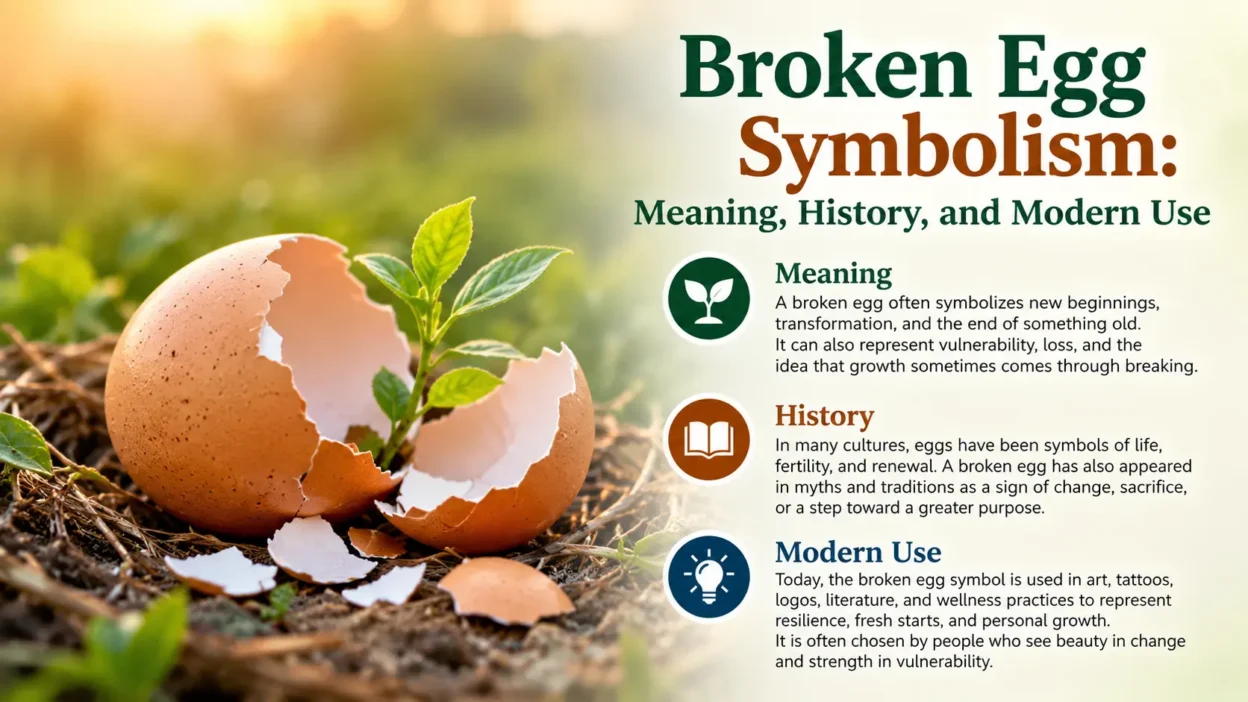
Broken egg symbolism often relates to vulnerability, change, disappointment, new beginnings, and the loss of something that once held promise. An egg has a natural protective shell, a delicate interior, and the potential for new life. When the shell breaks, that potential may be released, damaged, or transformed, depending on the circumstances.
In the United States, broken eggs appear in familiar settings, from Easter celebrations and breakfast tables to cooking mishaps, artwork, tattoos, and social media posts. Their meaning changes with the situation. A cracked egg in an Easter illustration might suggest birth and renewal, while an egg smashed on the kitchen floor may represent an accident, frustration, or an unexpected disruption.
People also look for symbolic meaning when a broken egg appears in a dream or during an emotionally important moment. Although no universal interpretation can explain every experience, the image offers a useful way to think about fragility, unrealized potential, and the difficult process of starting again.
Quick Answer
Broken egg symbolism commonly represents vulnerability, disappointment, interrupted plans, and change in modern American culture, although it can also suggest freedom from limitations and the beginning of something new. Historically, eggs have been associated with fertility, creation, and renewal, so a broken egg can represent either the release of life’s potential or the loss of something that was being protected.
TL;DR
- Core meaning: Fragility, disruption, disappointment, and transformation.
- Historical roots: Eggs have long represented fertility, creation, and new life.
- American culture: Easter traditions connect eggs with spring and renewal.
- Emotional meaning: A broken shell can reflect vulnerability or lost expectations.
- Positive interpretation: Breaking free can create room for change.
- Modern use: Art, tattoos, dreams, and digital culture give the image personal meaning.
1. What a Broken Egg Represents
An egg has two basic symbolic qualities: it protects something delicate, and it contains the possibility of life. A broken egg changes both qualities at once. Its shell no longer provides complete protection, and whatever was inside becomes exposed or released.
This physical change explains why the image can carry several meanings.
- Vulnerability: Something once protected is now exposed to the outside world.
- Disappointment: A promising situation may end before it reaches its intended outcome.
- Transformation: Breaking can mark a transition from one state to another.
- Freedom: A shell can represent a boundary that must be broken before something new can emerge.
- Lost potential: An egg damaged before development is complete can represent an opportunity that never reaches maturity.
The circumstances determine which interpretation fits best. A chick emerging from a shell suggests natural development, while an egg crushed before it can hatch suggests interrupted potential.
A broken egg therefore does not have one fixed meaning. It represents a change in the relationship between protection, possibility, and what happens next.
2. The Historical Roots of Egg Symbolism
Egg symbolism is much older than modern American Easter celebrations. Eggs appear in creation stories, fertility traditions, burial customs, and seasonal celebrations across different societies.
In some ancient Egyptian creation traditions, an egg was associated with the emergence of life or the sun. Hindu philosophical and mythological traditions also include the idea of a cosmic egg connected with the formation of the universe. Finnish epic tradition, recorded in the Kalevala, describes creation through the broken pieces of a bird’s eggs.
These stories are important because they show that breaking an egg has not always represented destruction. In some creation narratives, the breaking itself allows an ordered world to emerge.
The same distinction applies to ordinary life. A closed shell represents a contained possibility, but a broken shell can mark the moment that possibility becomes visible.
It would be inaccurate to claim that all ancient cultures interpreted broken eggs in the same way. Traditions differed, and many surviving stories concern eggs as symbols of life rather than broken eggs specifically. Still, creation narratives provide a historical foundation for interpreting a broken egg as the beginning of a new stage.
3. Broken Egg Symbolism in the United States
In American culture, a broken egg usually receives its meaning from its setting rather than from a single established tradition.
Consider an egg that falls from a carton onto a kitchen floor. Most Americans would first see a mess, a wasted ingredient, or an everyday accident. If the same image appeared in a painting about a failed business, a damaged egg might suggest a lost opportunity.
In a different context, an illustration of a chick emerging through a cracked shell could represent independence and growth.
The image also fits familiar American ideas about self-reliance and personal change. People often describe major life transitions as breaking out of a shell, leaving a comfort zone, or starting over after a setback. A broken egg can visually communicate a similar process without requiring a long explanation.
Its meaning depends on whether the break appears accidental, destructive, necessary, or liberating.
In the United States, there is no widely established national superstition that a broken egg automatically predicts bad luck. Individual families and communities may have their own beliefs, but a broken egg is usually understood through practical circumstances or personal interpretation.
4. The Connection Between Eggs, Birth, and Renewal
Eggs are closely associated with birth because they contain the early stages of life in many animal species. The chick’s emergence provides a natural image of development: a living creature moves from a protected enclosure into the outside world.
This connection makes a broken shell a useful symbol of transition.
Before hatching, the shell protects the developing chick. During hatching, the shell must open for the chick to emerge. The break is therefore part of a natural process rather than evidence of damage.
This distinction creates two different symbolic possibilities:
- A shell breaking at hatching: Growth, independence, and the beginning of life outside a protected environment.
- An egg breaking prematurely: Vulnerability, interruption, and the loss of an expected outcome.
In personal symbolism, the first interpretation may suit someone graduating, moving away from home, or beginning a new career. The second may suit someone grieving an opportunity that ended unexpectedly.
However, the comparison has limits. Human experiences do not follow a simple biological schedule, and a difficult ending does not guarantee a positive beginning. The image is most useful when it helps describe a particular experience rather than predict what will happen next.
5. Broken Eggs and Christian Easter Traditions
Eggs have an established place in Christian Easter customs, where they commonly represent new life and resurrection. Decorated eggs are exchanged, displayed, and used in family celebrations throughout the United States.
The connection between eggs and Easter developed over time. Medieval European Christians observed restrictions on eating eggs during Lent in some traditions, making eggs particularly associated with Easter feasting. Egg decoration also became part of seasonal customs, with practices varying by region and community.
Within Christian interpretation, the emergence of a chick from an egg can serve as an analogy for resurrection: life emerges from something that appears closed or lifeless.
A broken egg can consequently suggest the opening of a new stage or the release of life from confinement. Yet the distinction matters. Christianity does not have one universal doctrine declaring that every broken egg carries a specific spiritual message.
For some Christians, an egg breaking in an Easter scene may evoke resurrection and hope. For others, it may simply be a damaged egg with no religious significance.
American Easter celebrations also include secular activities such as egg hunts, decorating contests, and chocolate eggs. In these settings, the egg may communicate springtime, family traditions, childhood memories, or celebration rather than a strictly religious belief.
6. What Different Types of Broken Eggs Can Symbolize
The condition of the egg changes the impression it creates. A hairline crack looks different from an egg crushed into pieces, and a broken egg with a living chick inside communicates something different from an egg with a damaged interior.
| Type of broken egg | Possible symbolic meaning | Important distinction |
|---|---|---|
| Egg with a small crack | Vulnerability or an approaching change | The egg may still be intact inside |
| Egg split open during hatching | Birth, independence, and development | The break allows natural emergence |
| Egg smashed into pieces | Disruption, loss, or an irreversible ending | The image emphasizes damage |
| Egg with a leaking yolk | Exposure, wasted potential, or emotional release | The meaning depends on context |
| Empty eggshell | A completed transition, absence, or a stage left behind | An empty shell is not necessarily a sign of loss |
These interpretations are creative associations, not a standardized symbolic code. An artist, writer, or individual may give the same image a different meaning.
The most useful question is what the broken egg is doing in the scene. Is something emerging from it, spilling out of it, or missing from it? The answer helps clarify the intended message.
7. The Emotional Meaning of a Broken Egg
A broken egg can bring several emotions to mind because it combines delicacy with sudden change.
Disappointment is one common association. An egg can be damaged in an instant, even after being handled carefully. This makes it an effective image for plans that fail because of an unexpected event.
Exposure is another possible meaning. The shell conceals and protects the contents, so breaking it reveals what was previously hidden. In an artwork or personal story, this can suggest honesty, emotional openness, or the loss of privacy.
Grief may also be part of the image when the egg represents something valuable that cannot be restored to its original condition. A spilled egg cannot simply be put back into its shell. The comparison can express the reality that some experiences cannot be undone.
Yet the image does not need to be entirely negative. A person who has left a restrictive environment might interpret the broken shell as relief. Someone who has completed a difficult transition may see it as evidence of growth.
The emotion comes from the relationship between the object and the person’s experience. A broken egg is not inherently sad, hopeful, or frightening.
8. Broken Egg Symbolism in Dreams
Some people search for the meaning of a broken egg after seeing one in a dream. Possible interpretations include anxiety about a fragile plan, concern about a relationship, fear of losing an opportunity, or the anticipation of a major transition.
The details of the dream may help a person understand why the image stood out.
For example, dreaming about dropping an egg while trying to protect it might bring attention to a fear of making a mistake. Seeing a chick emerge from a cracked shell could reflect thoughts about independence or a new responsibility. Finding a broken egg without knowing how it happened might simply echo a recent frustration.
These are reflective possibilities, not proven interpretations. Dreams do not have a universal dictionary, and there is no reliable evidence that a broken egg in a dream predicts a death, breakup, financial loss, or other future event.
A useful approach is to consider three questions:
- What was happening in the dream when the egg broke?
- What emotion did the scene produce?
- Does that emotion resemble anything happening in waking life?
The answers may reveal a personal association without treating the dream as a supernatural warning.
9. Broken Eggs as Symbols of Bad Luck and Warning Signs
Because eggs are fragile, some people may interpret a sudden break as a warning of trouble. This reaction is understandable as a personal or folkloric association, but it should not be confused with an established universal belief.
Egg-related folklore includes beliefs about fertility, health, protection, harvests, and good fortune. Some historical customs assigned special meaning to when eggs were laid, how they were handled, or what happened to them. Such practices varied across communities.
However, there is no sound basis for claiming that breaking an ordinary egg predicts misfortune in every culture or religious tradition.
The difference between symbolism and prediction is important. A person may use a broken egg as a reminder to handle a delicate situation carefully. That is a personal interpretation. Claiming that the accident guarantees future trouble is a much stronger assertion without reliable evidence.
In everyday American life, a broken egg is usually explained by gravity, careless handling, a damaged shell, or an unstable container. If someone chooses to treat the incident as a symbolic reminder, the meaning can remain personal without becoming a claim about fate.
10. Broken Egg Symbolism in Different Cultural Traditions
Egg symbolism appears in many parts of the world, but the meaning of a broken egg must be understood within each tradition.
In some ancient Egyptian creation accounts, the egg is associated with the origin of life or the sun. Certain Hindu traditions describe a cosmic egg connected with creation. In the Finnish Kalevala, the broken pieces of a bird’s eggs contribute to the formation of the world.
These examples illustrate how an egg can represent the possibility of an entire world, not simply an individual birth. In such stories, the breaking of the egg can be part of creation rather than a sign of failure.
Christian Easter traditions use eggs to express new life and resurrection, while decorated eggs in Ukrainian and Polish traditions, including pysanky, carry designs associated with cultural, natural, and religious meanings.
These practices should not be collapsed into one general belief. A decorated egg has a particular cultural history, and its patterns may have meanings that a generic broken-egg image does not communicate.
The broader lesson is that an egg’s symbolic meaning depends on the story, ritual, and community surrounding it. A broken egg can be interpreted as loss in one situation and the opening of creation in another.
11. Modern Uses in Art, Tattoos, and Personal Design
In contemporary American design, a broken egg can communicate a personal story without relying on a formal religious or folkloric tradition.
Art and illustration
An artist might depict a cracked egg to explore uncertainty, the loss of innocence, the instability of a plan, or the beginning of change. A shell with light emerging from within can suggest discovery, while an egg shattered on a dark surface may communicate disappointment.
Tattoos and jewelry
Someone choosing a broken-egg tattoo might associate it with personal growth, recovery after hardship, freedom from expectations, or a life chapter that has ended. These meanings are individual choices rather than widely standardized tattoo conventions.
Home decor and gifts
A broken egg may appear in humorous kitchen artwork or in designs about new beginnings. Its meaning often comes from the accompanying words, colors, and imagery rather than from the egg alone.
Social media and digital culture
A photograph of a broken egg can serve as a visual joke about a ruined breakfast, a metaphor for a failed plan, or an image used in a personal reflection. The caption usually provides the context needed to understand it.
In all these uses, the broken egg works because its physical condition is immediately recognizable. People can connect the image to fragility, change, or an unexpected outcome without needing to know a specific historical legend.
12. The Psychology of a Shell Breaking
The shell is central to the image because it represents a boundary between the inside and the outside.
In ordinary life, boundaries can be protective. A home, a routine, a trusted relationship, or a familiar identity may provide stability. But protection can also become restrictive when a person needs more independence.
A broken shell can illustrate either side of this tension.
For someone leaving an unsatisfying job, the image might represent the end of a familiar structure. For someone facing an unexpected setback, it might express the feeling that a source of security has disappeared.
This is a useful metaphor, but it should not be treated as a formal psychological diagnosis. A broken egg does not reveal a person’s mental state by itself.
The image is valuable because it allows people to describe complicated experiences through something simple and concrete. Instead of explaining every detail of a transition, a person may use a cracked shell to communicate that an old structure has changed and that the next stage remains uncertain.
13. Positive and Negative Interpretations Compared
Broken egg symbolism can appear contradictory because breaking has different consequences in different circumstances.
When an egg breaks during hatching, the change supports development. When an egg breaks before it can fulfill its potential, the same physical event may represent loss.
The distinction is useful when deciding how to interpret the symbol in writing, art, or personal reflection.
| Interpretation | When it fits | Example |
|---|---|---|
| Positive | A break opens a path to something new | A chick emerges from its shell |
| Negative | The break destroys something valuable | An egg falls and spills before cooking |
| Transitional | An old state ends and another begins | An egg-shaped object splits in a painting |
| Reflective | The image draws attention to uncertainty | A person uses a cracked egg to represent a fragile plan |
Neither positive nor negative meaning is automatically correct. Context matters more than the image by itself.
A balanced interpretation also leaves room for mixed emotions. A major change can bring relief and sadness at the same time. The broken egg can express that combination without forcing the experience into a simple story about success or failure.
14. Common Misunderstandings About Broken Egg Symbolism
Several assumptions can make this symbol seem more definite than it really is.
Misunderstanding 1: A broken egg always means bad luck.
There is no universal rule establishing that meaning. The image can represent an accident, an ending, or a new beginning.
Misunderstanding 2: Every broken egg has a spiritual message.
Some people interpret ordinary events spiritually, while others do not. A broken egg can simply be an accident.
Misunderstanding 3: Ancient cultures all agreed on its meaning.
Historical traditions used eggs in different ways. Creation stories, fertility customs, burial practices, and Easter traditions should not be treated as interchangeable.
Misunderstanding 4: A broken egg predicts the future.
Symbolic interpretation is not a reliable forecasting method. A dream or household accident cannot establish what will happen next.
Misunderstanding 5: A broken egg is always a symbol of failure.
The breaking of a shell can also represent emergence, independence, and the end of a limiting condition.
Keeping these distinctions in mind makes the symbol more meaningful, not less. It allows interpretation to remain connected to actual circumstances instead of relying on rigid rules.
Frequently Asked Questions
What does a broken egg symbolize spiritually?
A broken egg may represent vulnerability, transformation, the release of potential, or the end of a previous stage. Spiritual interpretations vary, so the image does not carry one universally accepted religious meaning.
Is a broken egg a sign of bad luck?
No established universal rule says that breaking an egg causes or predicts bad luck. Some individuals may connect the event with local folklore or personal beliefs, but an ordinary broken egg is not evidence that something bad will happen.
What does a broken egg mean in a dream?
It may reflect concerns about a fragile plan, a missed opportunity, uncertainty, or a change in personal circumstances. The dream’s emotional tone and details matter more than any fixed interpretation.
What does a broken egg tattoo mean?
A broken-egg tattoo can represent personal transformation, vulnerability, freedom, or an experience that changed someone’s life. Its meaning is usually personal, and the surrounding design may communicate whether the emphasis is on loss or renewal.
Does a broken egg symbolize new beginnings?
It can, especially when the image suggests a chick emerging or a shell opening to release something new. However, an egg broken before hatching may instead represent interrupted development or disappointment.
What does a broken egg mean in Christianity?
Eggs are associated with new life and resurrection in Christian Easter traditions. A broken egg may serve as a personal reminder of those themes, but Christians do not universally recognize a broken egg as a separate religious sign.
What is the difference between a cracked egg and a broken egg symbolically?
A cracked egg often suggests vulnerability, tension, or a change that has begun but is not complete. A fully broken egg may suggest a more visible transition, a loss, or the release of something previously contained, depending on the context.
Conclusion
Broken egg symbolism brings together two ideas that can seem opposed: the fragility of something valuable and the possibility of change. In modern American culture, the image can suggest disappointment, vulnerability, disrupted plans, or the freedom that comes when a restrictive boundary opens. Its historical associations with fertility, creation, and renewal add another layer without establishing one universal interpretation.
The most useful reading depends on what the break makes possible or what it takes away. A shell that opens during hatching tells a different story from an egg smashed before it can be used. Neither meaning needs to be treated as a prediction or a supernatural warning.
Ultimately, broken egg symbolism offers a simple way to think about moments when protection gives way, expectations change, or a new stage begins. The meaning becomes clearest when the image is considered alongside the circumstances in which it appears.