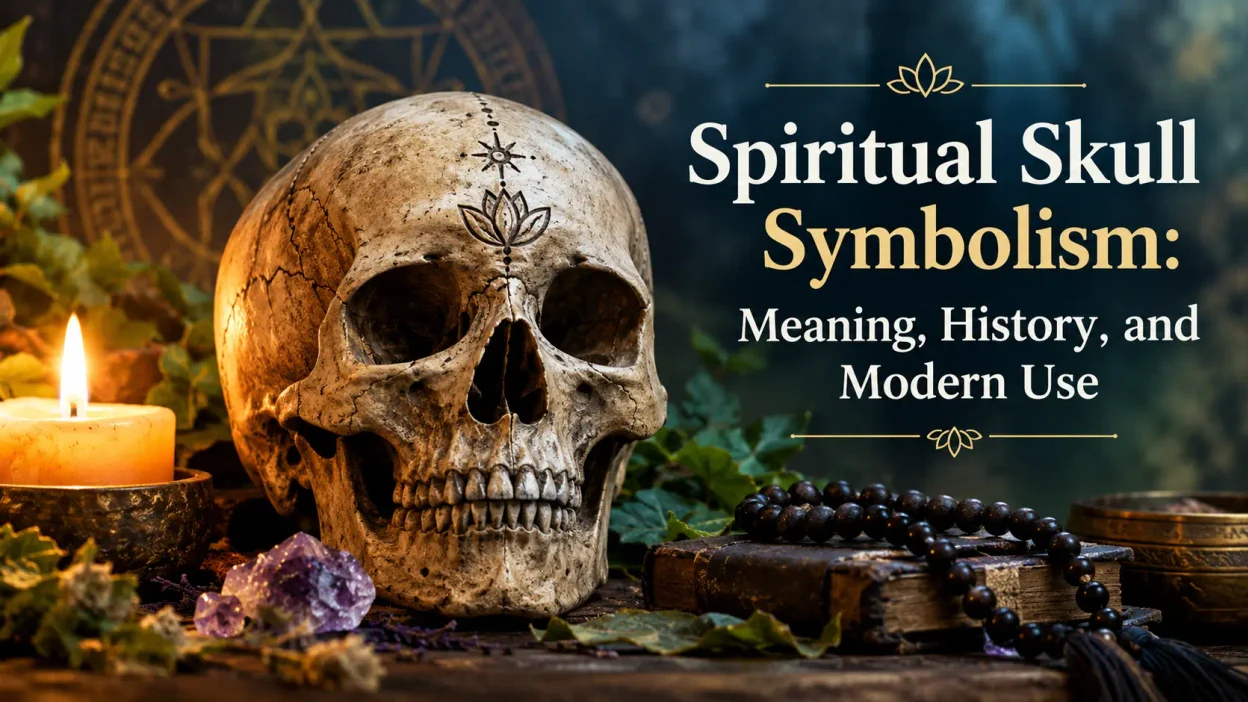
Skull symbolism spiritual traditions use often centers on mortality, transformation, wisdom, and the relationship between life and death. A human skull is instantly recognizable, yet its meaning changes with the setting. It can represent the end of life, a reminder to live intentionally, a spiritual teaching about impermanence, or an artistic expression of personal change.
In the United States, skulls appear in tattoo designs, jewelry, Halloween decorations, religious artwork, and memorial displays. Some people choose them to express independence or courage, while others use them to remember someone who has died or to reflect on life’s temporary nature.
Understanding these meanings requires more than assuming that every skull represents danger or darkness. Different cultures have used skull imagery for religious instruction, remembrance, meditation, and celebration. The most useful interpretation depends on the tradition, the surrounding symbols, and the intention behind the image.
Quick Answer
Spiritual skull symbolism commonly represents mortality, personal transformation, and awareness of life’s impermanence in modern American culture. Historically, skulls have also served as reminders of death in Christian art, objects of contemplation in Buddhist traditions, and symbols of remembrance in cultural practices such as Mexico’s Día de los Muertos.
TL;DR
- Skulls remind people that life is temporary and worth living intentionally.
- Spiritual traditions use skulls to explore death, impermanence, and detachment.
- Christian art often uses skulls to encourage reflection on mortality.
- Día de los Muertos connects skull imagery with remembrance and family bonds.
- Tattoos may express resilience, transformation, grief, or personal independence.
- A skull’s meaning depends on its cultural setting and accompanying imagery.
What a Skull Represents in Spiritual Symbolism
A skull represents the physical structure of the head after death, making it one of the clearest visual reminders of human mortality. Unlike many abstract symbols, it does not need much explanation to communicate the fact that life eventually ends.
That direct association has allowed skulls to serve several spiritual purposes. They can remind people to consider how they spend their time, encourage reflection on the temporary nature of possessions, or represent the transition from one stage of life to another.
A skull does not automatically symbolize evil, violence, or a desire for death. In some settings, it serves as a teaching object rather than a frightening image. In others, it honors ancestors or marks the memory of someone who has passed away.
Its meaning also changes with its design. A plain skull may emphasize mortality, while a skull surrounded by flowers can connect death with remembrance and renewal. A skull with a candle may suggest contemplation, and one paired with a serpent may communicate different ideas depending on the artistic or cultural tradition.
The central question is not simply what a skull means, but why it appears in a particular context.
The Spiritual Meaning of Death and Impermanence
One of the most widespread meanings associated with skull imagery is the recognition that life is temporary. This idea appears in many religious and philosophical traditions, although they explain its importance in different ways.
A skull can make an abstract truth concrete. People know that death is inevitable, but seeing a skull can turn that knowledge into a direct prompt to think about aging, priorities, relationships, and the limits of material success.
In Christian art, this reflection is often associated with memento mori, a Latin expression meaning “remember that you must die.” The phrase describes a tradition of reminders that human life is finite and that worldly achievements cannot last forever.
The spiritual purpose of such imagery is not necessarily to create fear. It may encourage humility, gratitude, ethical conduct, or a more deliberate approach to everyday decisions.
For example, someone might keep a small skull sculpture on a desk as a reminder to avoid wasting time on unnecessary conflict. Another person may wear a skull pendant to remember a loved one and acknowledge that loss is part of human experience.
In these cases, the skull functions as a reminder to live consciously rather than as a prediction or supernatural warning.
Skull Symbolism and Personal Transformation
Skulls can also represent transformation, especially when people associate them with the end of an old identity and the beginning of a new one.
This interpretation is common in modern spiritual writing and personal art. Someone who has recovered from a difficult period, left a destructive relationship, or changed their priorities may choose a skull as a reminder of what they have survived.
The symbolism works through the contrast between the skull as a remnant of a former life and the living person who continues to move forward. It can mark an ending without suggesting that the ending must be tragic.
However, transformation is not the only historical meaning of skulls, and it should not be presented as a universal belief shared by every spiritual tradition. In many historical settings, skull imagery primarily concerned death, religious devotion, ritual practice, or the treatment of human remains.
Modern interpretations can build on these associations while adding personal significance. A skull tattoo might represent leaving behind an earlier version of oneself, but that meaning comes from the wearer’s experience rather than from a fixed spiritual rule.
The distinction matters because symbols can help people tell their stories without requiring everyone to interpret them in the same way.
Skull Symbolism in Christianity and Christian Art
Christian skull imagery often encourages reflection on mortality, repentance, humility, and the relationship between earthly life and eternity.
In European Christian art, skulls frequently appeared in paintings, sculptures, devotional objects, and vanitas still lifes. These artworks reminded viewers that wealth, beauty, status, and physical strength eventually disappear.
A skull might appear beside a candle, an hourglass, a flower, or a book. The candle could suggest life’s limited duration, the hourglass could mark passing time, and the flower could represent beauty that fades. Together, the objects encouraged viewers to consider what remains important beyond worldly achievements.
Some Christian artworks also depict saints or religious figures alongside skulls. In such cases, the skull can indicate a life of contemplation, withdrawal from worldly distractions, or meditation on death.
Christian interpretations are not uniform. Some communities emphasize resurrection and eternal life, while others may avoid skull imagery in worship. The symbol’s meaning depends on the denomination, period, artwork, and intended message.
It is therefore inaccurate to assume that skulls are inherently anti-Christian or that every Christian skull image represents evil. Historically, skulls have also served as serious religious reminders about the limits of earthly existence.
Skull Symbolism in Buddhism and Meditation on Death
In some Buddhist traditions, contemplation of death and the body’s impermanence serves as a way to reduce attachment and develop insight. The aim is not to celebrate death for its own sake, but to understand that physical existence changes and cannot be permanently controlled.
Certain Buddhist artistic and ritual traditions also include skulls or skull-like imagery. In some Tibetan Buddhist contexts, skull cups and other ritual objects appear in practices connected with tantric symbolism. These objects belong to specific religious settings and should not be treated as generic decorations detached from their meanings.
In this context, skull imagery may challenge ordinary assumptions about beauty, purity, attachment, and the permanence of the self. The body is understood as subject to change, and contemplating this fact can become part of spiritual discipline.
These practices differ from modern interpretations that use a skull simply to represent independence or rebellion. A skull in a religious ritual may carry specialized meanings that cannot be reduced to a general statement about transformation.
Buddhist traditions are diverse, and not all Buddhists use skull imagery or engage in the same contemplative practices. The symbol must be understood within the specific school and ritual where it appears.
Skull Imagery in Día de los Muertos and Mexican Culture
One of the most recognizable forms of skull imagery in the United States comes from Día de los Muertos, or Day of the Dead, a Mexican tradition that honors deceased family members and loved ones.
Decorated sugar skulls, known as calaveras de azúcar, may appear on home altars, offerings, and seasonal displays. These skulls are often colorful and may include flowers, patterns, names, or other decorative details.
Their appearance differs sharply from the threatening skulls often found in horror films. In Día de los Muertos contexts, skull imagery can participate in remembrance, family continuity, and the recognition of death as part of life.
The tradition includes regional variations and combines Indigenous Mexican practices with Catholic influences and historical developments. It should not be reduced to a single universal belief about death or treated as merely a Mexican version of Halloween.
In the United States, Día de los Muertos events, art, and educational programs have introduced many people to these visual traditions. However, using sugar skull designs without understanding their cultural setting can strip them of the relationships and commemorative practices that give them meaning.
The distinction between decorative skull imagery and skulls used to honor the dead is important. Similar shapes can carry different meanings because the communities and occasions surrounding them differ.
Skull Symbolism in Ancient Cultures and Historical Rituals
Human skulls have held religious, funerary, and social significance in various societies. Archaeological evidence from different parts of the world shows that some communities treated human remains in ways that went beyond ordinary burial, although the meaning of each practice depends on its specific context.
In certain ancient societies, skulls were preserved, displayed, or incorporated into ritual settings. Such practices may have related to ancestors, social identity, warfare, religious beliefs, or relationships between the living and the dead. It is not accurate to assign one explanation to all of them.
Ancient Greek and Roman art also included reminders of mortality, while later European traditions developed more explicit forms of memento mori imagery. These examples illustrate how skulls could serve as visual prompts for reflection rather than simply as signs of danger.
Historical interpretation requires caution because the presence of a skull does not reveal its meaning by itself. Researchers must consider where an object was found, how it was used, and what other evidence survives from the community that produced it.
This approach avoids the common mistake of treating every ancient skull object as evidence of the same spiritual belief or ritual purpose.
What Skull Symbolism Means in Modern American Culture
In the United States, skull imagery has become part of several distinct cultural worlds. It appears in religious artwork, motorcycle culture, fashion, sports branding, memorial jewelry, Halloween decorations, and contemporary tattoo design.
For some Americans, a skull represents courage and independence. Its association with danger can communicate a willingness to challenge expectations or accept personal risks. For others, it serves as a reminder of mortality or a way to acknowledge a difficult experience.
Skulls also appear in public safety symbols. A skull and crossbones can warn people about poisonous or toxic substances, giving the image a practical meaning that differs from its spiritual uses. This association is so familiar that viewers may recognize the warning before considering any religious or philosophical interpretation.
American popular culture has expanded these meanings through music, film, gaming, and graphic design. A skull on a heavy metal album may communicate intensity or rebellion, while a small skull pendant may simply reflect the wearer’s fashion preferences.
The same design can therefore produce different reactions. One person may see a reminder to live courageously, while another sees death, danger, or a Halloween decoration. Context determines which interpretation is most likely.
Skull Symbolism in Tattoos, Jewelry, and Personal Style
Skull tattoos are popular partly because they communicate recognizable ideas without requiring words. Their meanings can range from remembrance and survival to independence, mortality, and an appreciation for gothic art.
A person who has survived a serious illness or difficult period may use a skull to acknowledge vulnerability and resilience. Someone else may choose one to remember a deceased friend or family member. Others simply enjoy the contrast between the skull’s stark shape and the decorative elements surrounding it.
Common design combinations influence interpretation:
- Skull with flowers: May connect mortality with beauty, remembrance, or the passing of time.
- Skull with a butterfly: Often suggests change, personal growth, or the relationship between endings and new beginnings.
- Skull with an hourglass: Emphasizes the passage of time and the limits of human life.
- Skull with a candle: Can suggest contemplation, remembrance, or spiritual reflection.
- Skull with a serpent: May draw on themes of knowledge, danger, renewal, or particular historical artistic traditions.
These meanings are not universal. A skull with roses does not automatically represent grief, and a serpent does not always indicate wisdom or rebirth. The artist’s choices and the wearer’s intentions matter.
In jewelry, smaller skull designs can communicate a similar message in a more understated form. Rings, pendants, and bracelets may function as memorial objects, personal reminders, or purely decorative accessories.
When a design claims a specific religious or cultural origin, it is worth checking whether its details genuinely belong to that tradition or represent a modern combination.
Skull Symbolism in Dreams and Personal Reflection
Dreams involving skulls can feel unsettling because the image is strongly associated with death and the human body. However, a skull in a dream does not establish that someone will die, that a negative event is approaching, or that a supernatural message has been delivered.
Personal circumstances often provide a more useful starting point for interpretation. Someone dealing with bereavement may dream about a skull while processing loss. A person facing a major life change might connect the image with the end of an earlier chapter.
The dreamer’s emotions also matter. A skull that produces fear may reflect anxiety about vulnerability, while one that appears calm or familiar may bring thoughts about acceptance or remembrance.
Psychology does not provide a single universally accepted interpretation for every skull dream. Dream imagery is influenced by memories, emotions, cultural expectations, and individual experience.
For personal reflection, consider three questions: What was happening in the dream? What emotions did the skull produce? Does its appearance connect with something currently changing in your life?
This approach allows the image to become a prompt for reflection without treating it as a prediction or a guaranteed spiritual sign.
Skull Symbolism, Color, and Surrounding Images
The color and visual treatment of a skull can change the impression it creates. Artists often use contrast, lighting, flowers, geometric patterns, and other elements to guide interpretation.
A white or ivory skull may resemble a bone specimen, a classical sculpture, or a simplified symbol of mortality. Black skull imagery is frequently used in gothic fashion and graphic design, where it can communicate seriousness, rebellion, or an interest in darker aesthetics.
Colorful skulls may suggest celebration, remembrance, or creative expression, particularly when they draw on the decorative traditions associated with Día de los Muertos. Their meaning depends on the cultural context rather than color alone.
A skull surrounded by green leaves may evoke nature and renewal. One paired with a red rose may create a contrast between love and mortality. Gold detailing can give a skull an ornamental or commemorative quality, although it does not carry one universal spiritual meaning.
Color psychology offers possible explanations for how viewers respond to visual designs, but these associations are influenced by personal experience and culture. There is no reliable rule that a particular skull color guarantees a specific spiritual message.
When interpreting skull artwork, examine the complete composition instead of assigning meaning to a single color or decorative feature.
Emotional and Psychological Meaning of the Skull
Skull imagery can bring people into contact with emotions they might otherwise avoid. Death, grief, uncertainty, aging, and the loss of control are difficult subjects, and the skull makes them visible in a direct form.
For some people, that directness is uncomfortable. They may associate skulls with violence, illness, or frightening experiences. Others find the image clarifying because it reminds them that time is limited and that relationships deserve attention.
A skull can also communicate a sense of control over how a difficult experience is remembered. Someone who chooses a skull tattoo after surviving a dangerous situation may be reclaiming an image that once represented fear. In this context, the symbol’s meaning comes from the person’s relationship with the experience.
There is no evidence that everyone who likes skull imagery shares the same personality traits or emotional state. A preference for skull designs does not automatically indicate aggression, sadness, or an unhealthy interest in death.
The image is best understood as a form of communication. It may express an individual’s values, memories, artistic tastes, or willingness to confront uncomfortable realities, but it cannot reveal those qualities with certainty on its own.
When Skull Symbolism Is Misunderstood or Misused
Skull imagery is frequently misunderstood because different traditions use the same basic form for different purposes.
One common misconception is that every skull represents evil or dark spiritual forces. Although skulls can appear in frightening imagery, they also serve as religious reminders, memorial objects, and symbols of mortality. Their presence alone does not establish a connection with harmful practices.
Another mistake is to assume that all skull traditions are interchangeable. A Christian memento mori, a Buddhist ritual object, a Mexican sugar skull, and a modern gothic tattoo may share a recognizable shape while carrying very different histories.
Cultural borrowing can create additional problems. Using imagery from Día de los Muertos solely as a frightening Halloween decoration, for example, may ignore its connection to honoring deceased loved ones. Similarly, labeling an invented design as an ancient religious symbol can spread inaccurate historical claims.
Commercial art sometimes combines elements from several cultures because they look visually striking together. Creative combinations are not necessarily wrong, but presenting them as authentic historical traditions requires evidence.
A respectful interpretation acknowledges the difference between personal meaning, artistic invention, and documented cultural practice. It also recognizes that people within the same tradition may interpret skull imagery differently.
How Skull Symbolism Has Changed Over Time
The meaning of skull imagery has developed through religious practices, funerary customs, philosophical reflection, artistic movements, and popular culture. No single tradition explains all the meanings associated with it today.
In some historical settings, skulls were connected with human remains and practices surrounding the dead. Later European Christian art used them as reminders of mortality and the limits of worldly success. Religious and philosophical traditions in other regions developed their own approaches to death, impermanence, and the body.
Modern American culture added new layers through gothic art, tattooing, entertainment, fashion, and public warning symbols. The skull became both a familiar everyday graphic and a vehicle for personal expression.
Digital culture has further broadened its use. Skull emojis and stylized skull graphics may communicate dark humor, exaggerated surprise, or the idea that something is extremely funny. In some online conversations, a skull emoji means that the sender is figuratively “dead” from laughter rather than thinking about mortality.
These modern meanings show why context matters. A skull in a memorial display, a religious painting, a video game, and a social media message cannot be interpreted in exactly the same way.
The symbol has not simply moved from sacred to secular use. Religious, commemorative, artistic, and humorous meanings continue to exist side by side.
Skull Symbolism at a Glance
| Context | Common meaning | Important distinction |
|---|---|---|
| Christian art | Mortality, humility, spiritual reflection | Often connected with memento mori traditions |
| Buddhist traditions | Impermanence and contemplation | Specific meanings depend on the school and ritual |
| Día de los Muertos | Remembrance and honoring the dead | Connected to particular Mexican cultural practices |
| Modern tattoos | Transformation, resilience, remembrance, or identity | Personal meaning varies by wearer |
| American popular culture | Rebellion, danger, humor, or gothic style | The setting determines the likely interpretation |
Frequently Asked Questions
What is the spiritual meaning of seeing a skull?
A skull may prompt reflection on mortality, change, remembrance, or the importance of living intentionally. Seeing one does not prove that a supernatural message or warning has been sent.
Is a skull a positive or negative spiritual symbol?
A skull can communicate either positive or negative ideas, depending on its context. It may represent fear or danger in one setting and remembrance, humility, or acceptance of life’s limits in another.
What does a skull tattoo mean spiritually?
A skull tattoo may represent personal transformation, resilience, grief, independence, or acceptance of mortality. Its spiritual meaning depends on the wearer’s intentions and any additional imagery included in the design.
What does a skull with flowers symbolize?
A skull with flowers often combines the themes of mortality and beauty. Depending on the flowers and cultural context, the design may suggest remembrance, the temporary nature of life, or the coexistence of loss and renewal.
Does a skull symbolize rebirth?
A skull can represent rebirth or transformation in modern personal symbolism, especially when it marks the end of one stage of life and the beginning of another. However, rebirth is not a universal historical meaning of skull imagery across cultures.
Why are skulls used in spiritual meditation?
Some religious and philosophical practices use contemplation of death to encourage awareness of impermanence and reduce attachment to temporary things. The methods and beliefs differ considerably between traditions, so skull imagery should be interpreted within its particular practice.
What does a skull symbolize in American culture today?
In the United States, skulls can represent mortality, independence, gothic style, remembrance, danger, or humor. Their meaning depends on whether they appear in religious artwork, tattoos, memorial objects, fashion, safety warnings, or online communication.
Conclusion
Spiritual skull symbolism centers on mortality, impermanence, remembrance, and the possibility of personal change. Historical traditions have used skulls for different purposes, from Christian reflections on death to specific Buddhist practices and Mexican traditions honoring deceased loved ones. These meanings overlap in some respects, but they should not be treated as interchangeable.
In modern American culture, a skull may communicate grief, resilience, independence, humor, or an interest in spiritual reflection. Its significance comes from the history surrounding the image, the context in which it appears, and the meaning a person chooses to give it. A skull does not have to represent fear; it can also serve as a reminder to recognize life’s limits and make thoughtful use of the time available.