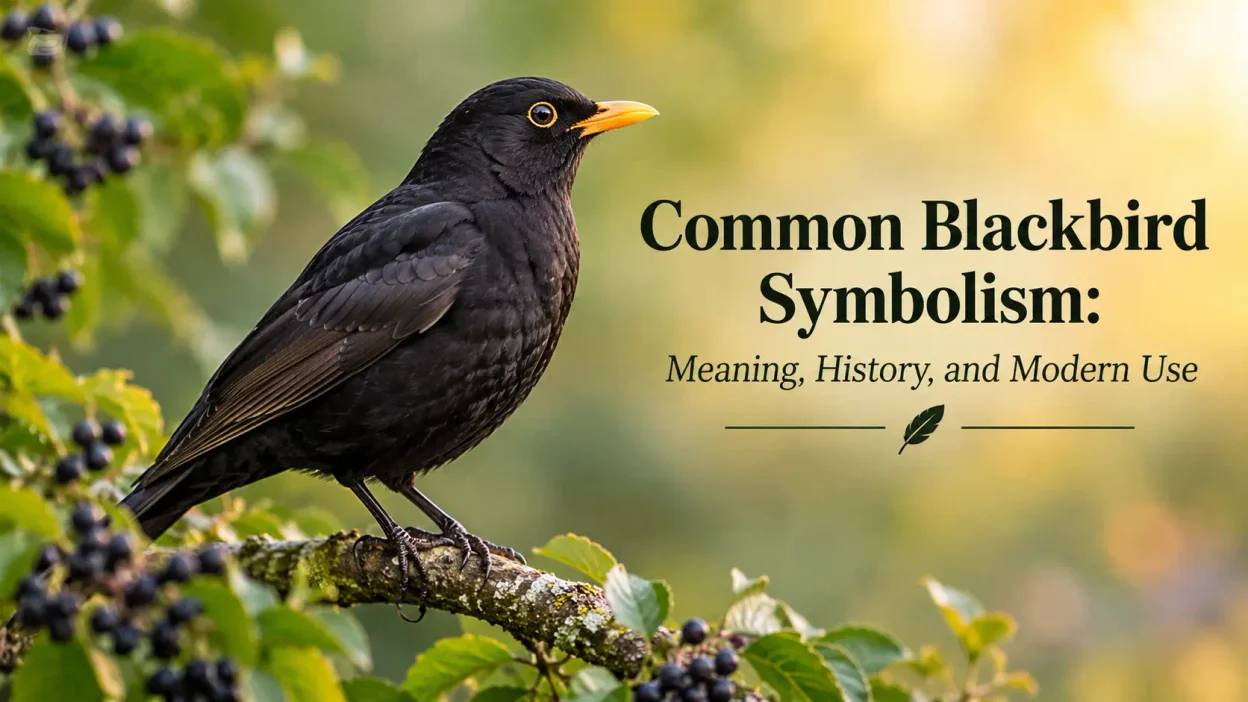
Blackbirds are familiar sights across much of the United States. You might notice one perched on a telephone wire, searching for food in a lawn, calling from a tree, or flying across an open field. Their dark feathers and distinctive songs make them easy to recognize, but their symbolic meaning depends on the setting, the bird’s behavior, and the observer’s cultural background.
Common blackbird symbolism often centers on mystery, intelligence, adaptability, change, and the relationship between darkness and the unknown. In some stories, a blackbird signals bad luck, death, or an approaching challenge. In others, it represents freedom, resilience, protection, or the ability to find opportunity in uncertain circumstances.
In American culture, blackbirds appear in literature, music, folklore, tattoos, art, and everyday observations of nature. Their meanings are not fixed rules or reliable predictions of the future. Instead, they offer a way to explore how people interpret animals, colors, sounds, and encounters with the natural world.
Understanding this symbolism begins with distinguishing established cultural traditions from personal interpretations and recognizing that different blackbird species do not share one universal meaning.
Quick Answer
Common blackbird symbolism usually represents mystery, transformation, intelligence, adaptability, and the unknown in modern American culture. Historically, blackbirds have appeared in folklore, poetry, and traditional beliefs associated with omens, spiritual messages, seasonal change, and the contrast between darkness and light.
TL;DR
- Blackbirds commonly symbolize mystery, change, intelligence, and adaptability.
- Dark plumage connects them symbolically with the unknown and hidden knowledge.
- European folklore sometimes portrays blackbirds as omens or supernatural messengers.
- American literature and music use blackbirds to explore freedom, grief, and hope.
- Seeing a blackbird does not reliably predict luck, death, or future events.
- Tattoos and artwork often express independence, resilience, or personal transformation.
1. What a Blackbird Represents in Symbolism
Blackbird symbolism depends on species, behavior, cultural background, and context.
The blackbird’s appearance provides the starting point for many symbolic interpretations. Dark feathers create an immediate visual connection with nighttime, shadows, secrecy, and things that remain outside ordinary understanding. At the same time, the bird’s alert movements and resourceful behavior suggest intelligence and awareness.
Blackbirds also live in changing environments. Depending on the species, they may forage in gardens, gather in flocks, defend nesting territories, or adapt to human neighborhoods. These characteristics make adaptability and survival natural themes for artistic and personal interpretations.
Several meanings recur in blackbird-related imagery:
- Mystery: The bird’s dark appearance can suggest secrets, hidden truths, or unanswered questions.
- Transformation: Its association with changing seasons, movement, and flight can represent a period of transition.
- Intelligence: Its alertness and problem-solving behavior can symbolize observation and practical wisdom.
- Freedom: Flight can represent independence, escape, and the desire to move beyond restrictions.
- Resilience: The ability of many blackbird species to thrive in different environments can suggest persistence.
- Omens: Traditional stories sometimes treat an unusual bird encounter or call as a sign of something approaching.
These interpretations are possibilities rather than universal definitions. A blackbird in a cheerful springtime illustration may communicate renewal, while one appearing in a dark, unsettling painting may contribute to a sense of danger or uncertainty.
2. Why Black Feathers Carry Symbolic Meaning
Color is one of the main reasons blackbirds have accumulated such varied interpretations. Across many artistic traditions, black can suggest night, mourning, authority, elegance, concealment, or the unknown. Its meaning changes with the surrounding imagery and cultural setting.
In Western visual traditions, darkness has often been used to represent uncertainty or danger. A blackbird can therefore become a convenient image for something that cannot yet be understood. Writers and artists may use its silhouette to introduce suspense without explaining exactly what threatens the characters.
However, black is not exclusively a negative color. It can also communicate dignity, strength, sophistication, and self-possession. A blackbird standing calmly against a bright sky may suggest confidence or independence rather than fear.
The contrast between dark feathers and a light background also gives the bird a useful artistic role. It can represent a hidden truth becoming visible, a difficult experience standing out against ordinary life, or the presence of something unusual in a familiar environment.
This is why blackbird symbolism should not be reduced to the idea that black means evil. The color establishes an emotional atmosphere, but the surrounding story determines what that atmosphere means.
3. Historical Roots of Blackbird Symbolism
Blackbirds have been part of human storytelling for centuries, especially in regions where people regularly encountered them in fields, gardens, and woodlands. Their calls, feeding habits, and seasonal appearances made them familiar subjects for observation and folklore.
In European traditions, birds were sometimes interpreted as signs connected with weather, harvests, travel, illness, or other uncertain events. Such beliefs developed in societies where the natural world played a direct role in everyday survival. An unusual animal encounter could become memorable because people wanted to understand events they could not control.
Blackbirds also entered songs, poems, fables, and local tales. Their dark appearance made them suitable characters for stories about secrecy, misfortune, or the supernatural, while their songs provided a contrasting image of beauty and life.
It is important to distinguish these documented cultural patterns from claims that all ancient societies assigned the same meaning to blackbirds. Interpretations varied by location, species, religion, and historical period. There is no single ancient blackbird code that explains every later tradition.
Modern symbolism draws on this mixture of folklore, literature, observation, and personal experience. Some people inherit an older superstition; others encounter the bird in a poem or song and develop their own interpretation.
4. Blackbird Symbolism in American Culture
In the United States, the word blackbird usually brings to mind species such as the Red-winged Blackbird, Brewer’s Blackbird, and Common Grackle. These birds differ from the Eurasian Blackbird often featured in British poetry and European folklore.
This distinction matters because American interpretations often grow from encounters with local wildlife rather than inherited European stories. A Red-winged Blackbird calling from a wetland, for example, has a different appearance and setting from a Eurasian Blackbird singing in a garden.
American culture also gives blackbirds meaning through music, literature, visual art, and popular storytelling. The bird’s dark outline works well in paintings and illustrations, while its song creates a contrast between appearance and sound.
In everyday American symbolism, a blackbird may represent independence, alertness, survival, or an individual’s willingness to face uncertainty. Someone might choose a blackbird image because it reflects their personality, reminds them of a particular place, or expresses a period of personal change.
There is no single national tradition that assigns one official symbolic meaning to the blackbird. Its significance is better understood as a combination of nature, inherited folklore, artistic expression, and individual experience.
5. Blackbirds in European Folklore and Mythology
European traditions provide some of the clearest historical examples of blackbird symbolism. In Britain and Ireland, the Eurasian Blackbird is a familiar garden bird known for its rich song. Its presence in everyday life helped it become part of seasonal sayings, poetry, children’s songs, and local stories.
The blackbird’s voice is especially important. A bird that sings from a rooftop or hedge can make a quiet landscape feel active and inhabited. In literature, this quality can suggest the return of spring, the persistence of life, or the beauty of an ordinary moment.
Blackbirds also appear in Welsh medieval storytelling. In the tale of Culhwch and Olwen, the Blackbird of Cilgwri is one of several ancient animals consulted during a search for knowledge about Mabon ap Modron. Its role connects the bird with memory, long experience, and the passing of knowledge across generations.
Other European stories treat dark birds more ominously, linking them with secrecy, temptation, or misfortune. However, these interpretations frequently overlap with traditions about ravens, crows, and other dark-feathered birds. It would be inaccurate to assign every belief about a black bird specifically to the blackbird.
The European record therefore presents several possibilities rather than one fixed meaning. The bird can be a sign of spring, a skilled singer, a witness to old knowledge, or a figure associated with uncertainty.
6. Spiritual Interpretations of Seeing a Blackbird
Some people interpret a blackbird encounter through a spiritual or reflective lens. They may see the bird as a reminder to pay attention, reconsider a decision, or remain open to change.
Within this personal approach, the blackbird’s dark appearance can represent something not yet understood, while its movement and song can suggest communication or the gradual discovery of a new direction.
These interpretations can be meaningful without being treated as supernatural facts. There is no reliable evidence that seeing a blackbird delivers a universal spiritual message or predicts a particular event.
A useful way to explore the experience is to consider three questions:
- What was happening in your life when you noticed the bird?
- What detail caught your attention: its song, appearance, behavior, or timing?
- Does the encounter remind you of a decision, relationship, memory, or change you are processing?
The answers may reveal why the encounter feels significant to you. For example, a person starting a new job might associate a blackbird’s flight with independence, while someone going through a difficult period might connect its survival with perseverance.
The meaning comes from the relationship between the experience and the observer’s life, not from a universal rule about what the bird must signify.
7. Does a Blackbird Represent Good Luck or Bad Luck?
Blackbirds can be interpreted as either favorable or unfavorable signs, depending on the story or belief system involved. Their dark feathers have sometimes encouraged ominous readings, while their songs and association with seasonal change can support more hopeful interpretations.
A blackbird singing outside a window might remind one person of peace and renewal. Another person, influenced by a frightening story, might feel uneasy about the same encounter.
| Context | Possible symbolic meaning | Why the association develops |
|---|---|---|
| A blackbird singing in spring | Renewal and hope | The song accompanies seasonal change |
| A blackbird in a dark illustration | Mystery or uncertainty | Dark imagery creates suspense |
| A blackbird in flight | Freedom and transition | Flight suggests movement and independence |
| A blackbird defending its nest | Courage and protection | The behavior suggests defending boundaries |
| A blackbird appearing during a difficult time | Resilience or reflection | The observer connects the encounter with personal circumstances |
These are interpretive possibilities, not established predictions. A blackbird landing on your porch does not prove that good fortune is coming, and hearing one at night does not mean that misfortune is approaching.
Bird behavior usually has ordinary explanations involving food, territory, nesting, movement, or communication. Recognizing those explanations allows people to appreciate symbolic meaning without confusing folklore with evidence.
8. Blackbird Symbolism and Death or Mourning
Dark birds often appear in stories and artwork about death because black is widely used in Western mourning traditions. This association can make a blackbird suitable for representing grief, remembrance, absence, or the uncertainty that follows a loss.
However, blackbirds do not have one universal connection with death. Some popular interpretations blend their symbolism with that of ravens and crows, which have their own prominent roles in folklore, mythology, and literary depictions of mortality.
In a poem or painting, a solitary blackbird may represent someone who is missing, a memory that remains, or the difficulty of accepting an ending. Its song can also create a contrast between sorrow and the continuation of life.
People sometimes choose bird imagery to remember a loved one. In such cases, the meaning may come from a shared memory of watching birds together or hearing a particular call in a meaningful place. The image becomes a personal memorial rather than evidence that the deceased is communicating through an animal.
For someone grieving, a blackbird encounter may provide a moment of comfort or reflection. That emotional experience deserves respect, even though it cannot establish a supernatural connection.
9. Blackbird Symbolism in Literature, Music, and Art
Blackbirds are effective artistic symbols because their appearance and behavior can support contrasting ideas. Their dark bodies stand out against the sky, while their songs introduce sound, movement, and emotional warmth.
In literature, a blackbird can establish a setting, signal a change in mood, or provide a natural image against which a character’s emotions become clearer. A writer may use the bird to suggest solitude without describing loneliness directly, or use its song to interrupt a scene dominated by grief.
Music provides a particularly recognizable American example of blackbird symbolism through the Beatles’ song “Blackbird.” Although the Beatles were British, the song’s imagery has been widely understood in connection with the American civil rights movement. Paul McCartney has discussed its inspiration in the struggle for racial equality, particularly the experiences of Black women seeking civil rights in the American South.
That context illustrates why symbolism cannot be interpreted from an animal’s appearance alone. In this song, the blackbird is not simply a dark bird associated with secrecy. Its flight becomes an image of freedom, endurance, and the possibility of overcoming restrictions.
Artists may also use blackbirds in paintings, photography, and graphic design to explore the relationship between darkness and beauty. A black silhouette against a sunrise can communicate hope, while the same silhouette against a stormy sky may suggest isolation.
The surrounding details determine which interpretation fits the work.
10. What a Blackbird Means in Dreams
Dream interpretations often connect blackbirds with hidden concerns, personal change, independence, or unanswered questions. These associations come from symbolic storytelling and personal reflection rather than a scientifically established dictionary of dream meanings.
The bird’s behavior can influence how a dream feels. A blackbird singing peacefully might remind the dreamer of relief or creative expression. A bird trapped in a room might reflect a personal feeling of restriction, although the dream alone cannot establish that interpretation.
Consider these possible readings:
- A flying blackbird: A personal association with freedom, distance, or a new direction.
- A singing blackbird: A reminder of communication, attention, or an emotion that needs expression.
- A blackbird inside a house: A possible reflection of a change affecting one’s private life.
- An injured blackbird: An image that may bring up vulnerability, concern, or a need for care.
- A flock of blackbirds: A possible connection with community, social pressure, or the feeling of being surrounded by competing demands.
None of these interpretations is definitive. Dreams are influenced by memories, emotions, recent experiences, and ordinary mental activity during sleep.
If a blackbird appears repeatedly in dreams, recording the circumstances and feelings surrounding each dream may be more useful than searching for a fixed prediction. The aim is to understand personal associations, not to assume the dream forecasts the future.
11. Blackbird Tattoos, Jewelry, and Personal Style
Blackbird imagery works well in tattoos and jewelry because it can be both visually simple and personally meaningful. A small silhouette requires few details, while a realistic design can highlight feathers, posture, and movement.
People may choose blackbird tattoos to represent independence, adaptability, or a willingness to move beyond a difficult chapter. Others may associate the bird with music, nature, a childhood memory, or a loved one.
The design changes the interpretation. A bird with outstretched wings can suggest freedom, while one perched on a branch may communicate patience, observation, or solitude. A blackbird accompanied by flowers can introduce associations with renewal, while one placed against a dark background may emphasize mystery.
Jewelry and clothing often use bird silhouettes for aesthetic reasons rather than to communicate a specific belief. A person wearing a blackbird pendant does not necessarily subscribe to spiritual symbolism.
For anyone choosing a permanent design, it helps to identify the intended meaning before selecting decorative details. The bird should represent something the wearer recognizes in their own experience rather than an interpretation presented online as universally true.
12. Emotional and Psychological Associations
Blackbird symbolism can help people express emotions that are difficult to describe directly. The bird’s dark appearance, distinctive call, and ability to move freely through the environment provide several images that writers and individuals can use to explore personal experiences.
Mystery is one common association. A blackbird can represent a question that has not yet been answered or a part of oneself that is still being understood.
Adaptability offers another interpretation. Many North American blackbird species use a range of habitats and food sources. As a metaphor, this flexibility can represent adjusting to unfamiliar circumstances without abandoning one’s identity.
The bird can also suggest the value of observation. Blackbirds forage, respond to their surroundings, communicate, and react to threats. An artistic portrayal may therefore evoke alertness or the importance of noticing details before acting.
These meanings are not psychological diagnoses. A preference for blackbird imagery does not reveal a person’s personality with certainty, and there is no established psychological test that assigns a fixed emotional meaning to the bird.
Instead, symbolism provides a vocabulary for reflection. It lets people communicate feelings through recognizable images rather than relying entirely on abstract descriptions.
13. Indigenous Traditions and the Importance of Cultural Context
Blackbird-related stories can carry specific meanings within Indigenous North American cultures, but those meanings should never be presented as one universal Native American belief.
Different nations have distinct oral traditions and relationships with the animals in their environments. In some documented stories about Red-winged Blackbirds, the bird is portrayed as a warning figure or a participant in protecting others. Such stories can support themes of courage, vigilance, and responsibility within their particular cultural settings.
The bird’s red shoulder markings may be important in a story involving danger or protective action. That detail differs from interpretations based mainly on plain black plumage.
It is also important to distinguish traditional teachings from contemporary commercial claims. Products advertised as carrying a universal Indigenous blackbird meaning, spirit-animal message, or sacred power may simplify or misrepresent specific cultural traditions.
When discussing an Indigenous story, identify its cultural source when that information is available and preserve the story’s original context. If the source is uncertain, it is better to acknowledge that limitation than to attribute a general spiritual interpretation to all Indigenous peoples.
Respectful symbolism recognizes that a cultural tradition belongs to the community that maintains it.
14. Common Misunderstandings About Blackbird Symbolism
Blackbird imagery is frequently grouped together with the symbolism of other dark birds. Although these animals can share visual associations, their biology and cultural histories are not identical.
Blackbirds are not the same as crows or ravens. In North America, blackbirds such as the Red-winged Blackbird belong to the family Icteridae. Crows and ravens belong to the family Corvidae. The Eurasian Blackbird is a thrush in the family Turdidae.
This distinction matters because stories about ravens as creators, tricksters, or figures associated with death cannot automatically be applied to blackbirds.
Another misunderstanding is the belief that every blackbird encounter carries a spiritual warning. A bird singing near a home, gathering with others, or defending its nest is usually displaying normal behavior.
It is also misleading to claim that all blackbirds represent darkness, evil, or death. Their songs, seasonal associations, and use in artistic expressions of freedom provide very different possibilities.
Finally, no single interpretation applies to every culture or individual. The most accurate reading considers the actual species, the historical or artistic setting, and the meaning the observer intends to communicate.
15. How Blackbird Symbolism Has Changed in Modern Life
Blackbird symbolism has shifted as people have moved between rural environments, cities, and digital culture. In older folklore, birds could become signs associated with seasonal changes, agricultural concerns, or uncertain events. Modern audiences still encounter these traditions, but they also interpret birds through music, environmental awareness, personal identity, and visual design.
In contemporary American life, the blackbird can be an emblem of independence, resilience, and self-expression. Its image appears in tattoos, prints, clothing, literary references, and discussions of nature. These uses often emphasize an individual’s connection with the bird rather than an inherited superstition.
Digital culture has also made symbolic interpretations easier to share. A photograph of a blackbird may prompt discussions about transformation or spiritual significance, even when the image shows an ordinary wildlife encounter. Such interpretations can be personally meaningful, but repetition online does not establish that a belief is ancient or universally accepted.
Environmental awareness adds another dimension. Many people value blackbirds as part of local ecosystems, recognizing their roles in consuming insects, dispersing seeds, and participating in food webs. For birdwatchers, the experience of noticing a species in its natural habitat may matter more than any symbolic explanation.
The modern blackbird therefore occupies several roles at once: a living animal, a subject of artistic expression, a figure in inherited stories, and a symbol that individuals can adapt to their own experiences.
Frequently Asked Questions
What does a blackbird symbolize spiritually?
Blackbirds are often interpreted spiritually as symbols of mystery, awareness, adaptability, and personal change. These meanings reflect contemporary spiritual interpretations and personal associations rather than a universal religious teaching.
Is seeing a blackbird a sign of good luck?
Some people interpret a blackbird encounter positively, associating it with hope, independence, or a new beginning. There is no reliable evidence that seeing one predicts good luck or changes your future.
Does a blackbird symbolize death?
A blackbird can represent mourning, absence, or uncertainty in a poem, artwork, or personal interpretation. However, blackbirds do not universally symbolize death, and their appearance is not evidence that someone will die.
What does a blackbird tattoo mean?
A blackbird tattoo can represent freedom, resilience, independence, or personal transformation. Its meaning depends on the wearer’s intentions and design choices, including whether the bird is flying, perched, singing, or paired with other imagery.
What does a blackbird symbolize in literature?
In literature, blackbirds can suggest mystery, solitude, seasonal change, memory, or freedom. Writers use the bird’s appearance and song to establish mood and communicate ideas that depend on the surrounding story.
Are blackbirds and crows symbols of the same things?
Not necessarily. Blackbirds, crows, and ravens belong to different bird groups, and their symbolic histories vary by culture and literary tradition. Similar dark coloring may create overlapping associations, but it does not make their meanings interchangeable.
What does hearing a blackbird sing mean?
In a symbolic interpretation, a blackbird’s song may suggest communication, hope, or renewed attention to everyday life. In nature, singing commonly serves biological purposes such as attracting mates and defending territory, so the sound does not automatically carry a spiritual message.
Conclusion
Common blackbird symbolism brings together mystery, adaptability, independence, and transformation. Its dark feathers can evoke the unknown, while its song and movement offer contrasting associations with expression, freedom, and the continuation of life.
In the United States, the bird’s meaning comes from a combination of local wildlife, European folklore, literature, music, and individual experience. Historical stories can provide useful context, but they should not be confused with universal beliefs or predictions about future events.
The most thoughtful interpretation begins with the actual bird and the circumstances in which it appears. Whether encountered in a garden, a song, a dream, or a piece of art, a blackbird can invite reflection without requiring a supernatural explanation.