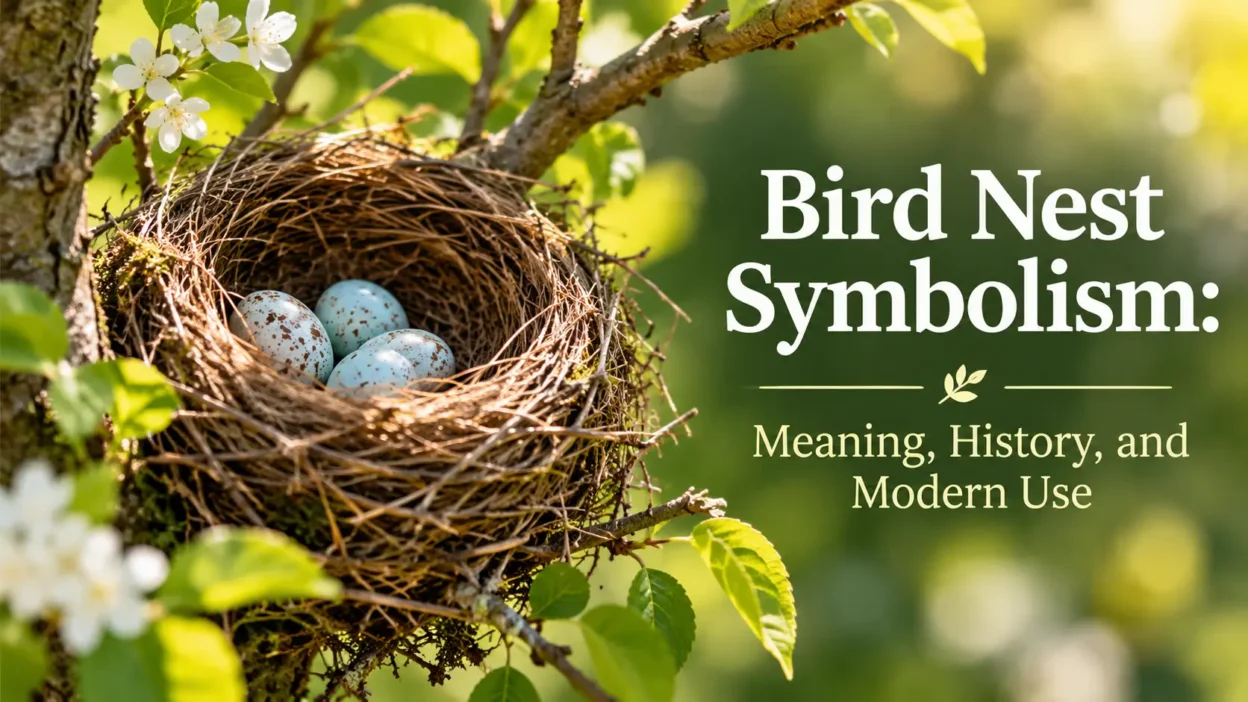
A bird’s nest is a familiar sight in nature, but its meaning often extends beyond twigs, grass, feathers, and other materials woven together to shelter eggs or young birds. Bird nest symbolism meaning commonly centers on home, family, protection, belonging, and new beginnings. Because a nest provides a place for life to develop, people often associate it with the care and security that help individuals grow.
In the United States, bird nests appear in home decor, wedding themes, spring decorations, jewelry, illustrations, and personal artwork. A nest holding eggs may suggest the anticipation of a new child, while an empty nest can represent independence, changing family relationships, or the next stage of adulthood.
The symbol also has a more complicated side. A nest can represent confinement when safety becomes restriction, or vulnerability when the shelter is threatened. Understanding these different interpretations helps explain why such a small feature of the natural world can communicate ideas about family, responsibility, loss, and personal change.
Quick Answer
Bird nest symbolism most commonly represents home, family, protection, belonging, and new beginnings in modern American culture. Historically, nests have also been associated with fertility, parental care, domestic life, and the relationship between human communities and the natural world.
TL;DR
- Bird nests symbolize home, security, family, and belonging.
- Eggs in a nest often represent fertility, potential, and fresh beginnings.
- An empty nest can signify independence, separation, or personal transition.
- American culture connects nests with parenting, weddings, spring, and homeownership.
- Folklore and religious interpretations vary across cultures and traditions.
- Modern nest imagery appears in jewelry, tattoos, artwork, and interior design.
1. What a Bird’s Nest Represents in Symbolism
A bird’s nest is a structure built by a bird to hold eggs, protect developing young, or provide a resting or breeding place. Depending on the species, it may consist of twigs, leaves, mud, moss, grass, feathers, or other available materials.
Not all birds build nests in the same way. Some make elaborate woven structures, others use cavities in trees, and some lay eggs in simple scrapes on the ground. This variety matters because the symbolism of a nest does not depend on one particular shape. Its central meaning comes from its function as a place of shelter and development.
The most common associations include:
- Home: A familiar place where life is sheltered and nurtured.
- Protection: A barrier between vulnerable young and outside dangers.
- Family: The relationship between parents and their offspring.
- Belonging: A place where an individual has a connection and a role.
- New beginnings: The promise represented by eggs and newly hatched birds.
- Care and responsibility: The effort required to maintain a safe environment.
These meanings are connected rather than interchangeable. A nest containing eggs may emphasize potential, while a nest with adult birds feeding their chicks highlights responsibility and care. A nest alone, without eggs or birds, may suggest the idea of home more generally.
2. Why Nests Symbolize Home and Security
The connection between nests and home begins with their practical purpose. Many birds build or select nesting sites that offer some protection from predators, weather, and disturbance. Their nests create conditions in which eggs can develop and young birds can receive care.
Human beings recognize a similar purpose in houses and family homes. A home is more than a physical structure; it can provide privacy, familiarity, emotional support, and a sense of stability. The nest therefore offers a natural image for the kind of environment people hope to create for themselves and those they love.
In American culture, this association often appears in expressions about making a home, raising a family, or building a secure future. A small nest ornament on a shelf can suggest warmth without requiring words. A painting of a bird returning to its nest may evoke the comfort of coming back to a familiar place.
However, a nest does not automatically represent a perfect or peaceful home. Its condition influences its meaning. A damaged nest may suggest insecurity, while a nest placed in an exposed location can symbolize the challenge of protecting something valuable under difficult circumstances.
3. Family, Parenting, and Parental Care
Bird nests are especially associated with parenting because they provide a setting for incubation, feeding, and early development in many bird species. Depending on the species, one or both parents may help build the nest, incubate eggs, defend the nesting area, or feed the young.
These behaviors have made the nest a recognizable symbol of parental commitment. In family-oriented illustrations, a parent bird sheltering chicks often represents attentive caregiving, patience, and the responsibility to protect children while they are vulnerable.
The image is common in greeting cards, nursery art, family gifts, and keepsakes celebrating pregnancy or a child’s birth. A nest containing several eggs may represent a growing family or the anticipation of welcoming a new member.
The symbolism does not have to be limited to biological parenthood. A nest can also represent foster families, adoptive families, close friendships, or any supportive environment in which someone receives care.
At the same time, the image can suggest the work involved in caregiving. Building and maintaining a nest requires effort, just as creating a stable family environment requires time, resources, and attention. In this sense, the nest represents not only the comfort of family life but also the responsibility that makes that comfort possible.
4. Eggs in a Nest: Fertility, Potential, and New Beginnings
Eggs add a distinct layer of meaning to nest symbolism. They contain developing life, making them natural images of potential, growth, and possibilities that have not yet fully emerged.
In American spring decorations, eggs and nests frequently appear together because they suggest renewal and the return of life after winter. The imagery also fits celebrations of pregnancy, childbirth, and the beginning of a new household.
An egg-filled nest may communicate several related ideas:
- Fertility: The possibility of new life or an expanding family.
- Potential: Something valuable that has not yet reached its full development.
- Hope: Anticipation of a favorable change or future event.
- Preparation: Creating the conditions necessary for growth.
- Renewal: The beginning of another stage after a period of waiting.
These meanings can apply to experiences beyond parenthood. An artist starting a project, a couple establishing a home, or a person beginning a new career might use a nest as a metaphor for nurturing an idea before it becomes visible to others.
Still, eggs do not mean fertility in every context. In a decorative arrangement, they may simply communicate springtime or natural beauty. The surrounding imagery and the intentions of the person using the symbol help determine its meaning.
5. Empty Nest Symbolism and Life Transitions
An empty nest has a different emotional character from a nest filled with eggs or young birds. It can represent departure, independence, change, or the end of a period of intensive caregiving.
In the United States, the phrase empty nest is widely used for the stage when adult children leave their parents’ home. Parents may experience pride, relief, sadness, uncertainty, or several of these feelings at once. The nest provides a useful metaphor for a home that once centered on raising children but must now serve a different purpose.
The symbolism also extends beyond family life. An empty nest can represent finishing a major responsibility, leaving a familiar community, or making room for a new direction. It may mark an ending, but that ending does not necessarily mean failure or loss.
In art, an empty nest on a branch can suggest absence or a quiet period after activity. In a more hopeful setting, it can represent successful growth: the young birds have developed enough to leave the place that sheltered them.
The distinction is important. An empty nest does not inherently mean loneliness. Its meaning depends on whether the emphasis falls on separation, freedom, completion, or the possibility of beginning again.
6. Bird Nest Symbolism in American Culture
In the United States, nest imagery is closely tied to domestic life, family identity, and the desire for stability. It appears in both everyday language and visual culture, often without requiring a formal explanation.
The idea of a nest can be seen in home decorating, real estate imagery, family photography, and gifts for new homeowners. A nest illustration may communicate the feeling of a welcoming home, while a bird carrying nesting material may suggest the work of establishing one.
The symbol also fits American ideas about personal independence. A person may spend years building a stable home before eventually leaving it to pursue education, work, or family life elsewhere. The nest then represents both the security that supports independence and the place a person may continue to remember.
Its meaning is not identical for everyone. For some people, home represents comfort and continuity. For others, leaving home is essential to freedom or personal growth. The nest can accommodate both perspectives because it represents a starting place rather than a permanent obligation to remain there.
This flexibility helps explain why nests appear in designs for family businesses, community organizations, childcare settings, and projects focused on housing or environmental protection.
7. Historical Roots of Nest Symbolism
The association between nests and family is rooted in direct observation of the natural world. Long before modern decorative trends, people could see birds constructing shelters, guarding eggs, and feeding their young.
These visible behaviors made nests useful metaphors for domestic life. Human communities have long relied on shelters to protect children, store essential belongings, and support daily living. Although the details of human housing and bird nesting are very different, the shared ideas of shelter and care are easy to recognize.
The nest also became associated with preparation. Birds frequently collect materials and select sites before laying eggs. For human observers, this process offers a natural image of getting ready for an important responsibility.
There is no single historical origin for nest symbolism. Different societies developed their own stories, images, and practices involving birds and their nesting behavior. Some traditions emphasized fertility and household continuity, while others used birds to communicate ideas about creation, the soul, or the relationship between earthly and spiritual life.
It is therefore more accurate to describe nest symbolism as a collection of related interpretations that developed in different contexts than as a single symbol with one universal meaning.
8. Nests in Folklore, Religion, and Cultural Traditions
Birds have important roles in the folklore and religious traditions of many societies, but the meaning of a nest depends on the particular story or belief system involved.
In some cultural settings, birds are associated with freedom, messages, the heavens, or the passage between different realms. A nest may extend those associations by representing the place where life is protected before entering the wider world. However, this interpretation should not be treated as a universal religious doctrine.
Christian readers may connect nest imagery with biblical passages that mention birds and their nests. In Psalm 84, for example, the nest appears in a passage expressing longing for the dwelling place of God. The image contributes to a reflection on shelter and the desire to be near the sacred. It does not establish that every bird’s nest has a fixed Christian meaning.
In folklore, particular birds may be connected with luck, household prosperity, or warnings, depending on the region and story. These beliefs should be understood within their cultural settings rather than combined into a single list of universal rules.
When interpreting a nest in a religious painting, traditional story, or cultural object, the species of bird, the surrounding symbols, and the specific tradition are more reliable guides than general symbolism alone.
9. Nest Symbolism in Love, Marriage, and Relationships
A bird’s nest can represent a relationship that provides security while allowing growth. This makes it a natural image for marriage, long-term partnership, and the creation of a shared home.
In American wedding and engagement designs, nest imagery sometimes appears alongside eggs, branches, flowers, or small birds. These elements may communicate the hope of building a life together rather than simply celebrating romantic attraction.
The nest can also suggest cooperation. Many birds invest time and energy in reproduction, and some species share nesting duties. As a human metaphor, this can represent the practical work of maintaining a relationship: communicating, dividing responsibilities, adapting to change, and caring for one another.
However, the symbol can become restrictive if home is understood as a place someone must never leave. Healthy relationships generally require both connection and individual development. A nest is most useful as a relationship symbol when it represents support rather than control.
For this reason, nest jewelry or artwork may suit someone who values commitment, family life, or the idea of creating a safe place with another person. Its meaning remains personal rather than guaranteed by the design itself.
10. The Emotional and Psychological Meaning of a Nest
Nest imagery can evoke comfort because it presents a small, enclosed place where vulnerable life receives protection. People may associate it with childhood memories, family traditions, familiar surroundings, or the relief of returning home after a demanding period.
The symbol can also evoke a desire for stability. During major changes, such as moving to another city, starting a family, or changing careers, a nest may represent the need for a reliable foundation from which to adapt.
Its emotional associations often depend on personal experience:
- Someone who remembers a supportive childhood home may associate a nest with trust and warmth.
- A new parent may see it as a reminder of responsibility and protection.
- A person leaving home may view it as a symbol of independence and separation.
- Someone rebuilding their life may interpret it as an image of starting over.
These responses are not fixed psychological rules. The same image can comfort one person and make another feel confined or nostalgic.
A nest can also represent a balance between safety and development. Young birds depend on protection, but eventually many leave the nest. As a metaphor, it suggests that support is valuable partly because it helps people become capable of living beyond the environment that first protected them.
11. Bird Nest Symbolism in Tattoos and Personal Jewelry
Nest tattoos and jewelry allow people to carry a personal reminder of home, family, or a meaningful period of life. The design can be small and understated or detailed enough to include birds, eggs, flowers, branches, or names.
Common design choices communicate different ideas:
- A nest with eggs: Hope, family growth, or a new chapter.
- A nest with baby birds: Parenting, caregiving, and family bonds.
- An empty nest: Independence, change, or children growing up.
- A nest with a flying bird nearby: The relationship between belonging and freedom.
- A nest on a branch: Stability, patience, and the work of building a life.
Some people choose a nest tattoo to honor their children or remember a childhood home. Others use it to represent a community they have built after a period of uncertainty.
The number of eggs or birds may carry a personal meaning, such as representing family members. However, there is no universal code that assigns a fixed meaning to each number.
Jewelry featuring a nest can also serve as a family keepsake, especially when it includes birthstones or small details representing loved ones. The meaning comes from the connection between the design and the wearer’s experience, not from a standardized symbolic rule.
12. Nest Imagery in Home Decor, Weddings, and Seasonal Design
Nest imagery works particularly well in decorative settings because it combines a recognizable natural form with associations of home and care.
In American interior design, nests appear in framed botanical prints, ceramic ornaments, wreaths, table arrangements, and rustic or farmhouse-inspired decor. Natural materials such as twigs, dried grasses, and wood can reinforce the connection to the outdoors.
Spring is a particularly common season for nest decorations. Designers may combine nests with flowers, pastel colors, eggs, or small birds to suggest renewal and the start of a new growing season. In Easter displays, nest imagery may appear alongside eggs, although the nest itself is not a universal religious symbol of Easter.
At weddings, a nest can represent the beginning of a shared household. It may appear in a centerpiece, invitation illustration, or small keepsake for guests. Its message is usually about creating a life together rather than predicting the future of a marriage.
The context matters. A nest decorated with flowers may feel celebratory, while a weathered nest displayed alone can suggest memory, simplicity, or the passage of time. These interpretations arise from the combination of the object, its surroundings, and the viewer’s associations.
13. Comparing Different Types of Nest Symbolism
The meaning of a nest changes according to what it contains, where it appears, and the story surrounding it.
| Nest image or context | Common symbolic meaning | Typical modern use |
|---|---|---|
| Nest with eggs | Potential, fertility, and anticipation | Baby gifts and spring decor |
| Nest with young birds | Family care and responsibility | Nursery art and family keepsakes |
| Empty nest | Independence, change, or completion | Personal art and life-transition gifts |
| Damaged nest | Vulnerability or disrupted security | Environmental artwork and storytelling |
| Nest with adult birds | Partnership and shared responsibility | Wedding designs and relationship jewelry |
| Nest in a tree | Shelter within the natural world | Botanical prints and nature-inspired decor |
These associations are interpretive rather than universal. A damaged nest may simply document an event in nature, while an empty nest may represent freedom to one person and sadness to another.
When reading nest symbolism, consider three details: the condition of the nest, the presence or absence of birds and eggs, and the setting in which the image appears. Together, these details usually provide a more accurate interpretation than the nest alone.
14. Environmental Symbolism and the Fragility of Nature
A bird’s nest can also represent the need to protect wildlife and the environments that sustain it. This interpretation becomes especially relevant when the nest appears in conservation posters, nature photography, environmental education, or artwork about habitat loss.
Many birds depend on suitable nesting locations, food sources, and relatively safe conditions to reproduce. When trees are removed, wetlands are altered, or nesting areas are disturbed, birds may lose access to places needed for breeding.
A nest in this context represents more than comfort. It becomes evidence of how much life depends on its surroundings. The image can remind viewers that protection is not only a private family concern but also an environmental responsibility.
This meaning is particularly relevant in American communities where people participate in backyard birdwatching, habitat restoration, and local wildlife conservation. A nest in a garden can encourage interest in the birds living nearby and the conditions they need.
There is an important practical distinction between appreciating a nest as a symbol and interacting with an actual wild nest. Active nests should generally be observed from a distance because disturbance can harm birds or cause adults to abandon a nesting site. In the United States, certain active nests and birds are also protected by federal or state laws.
The environmental interpretation therefore adds a broader dimension to the symbol: a safe home matters for people, but it also matters for other living creatures.
15. Common Misunderstandings About Bird Nest Symbolism
Nest symbolism is often simplified into a few positive ideas, but several common assumptions can lead to misleading interpretations.
Every nest represents motherhood. A nest can suggest parenting, but it may also represent home, partnership, community, preparation, or a place to grow. Its meaning does not depend on the viewer being a parent.
An empty nest is always negative. The phrase is associated with the emotional experience of children leaving home, but an empty nest can also represent successful development, independence, or a new stage of life.
Nest symbolism is identical across cultures. Different traditions interpret birds and their habitats in different ways. A specific religious or folkloric meaning should be understood within its own cultural setting.
A nest is always a sign of good luck. Some people may use nest imagery as a hopeful or protective symbol, but there is no universal rule that seeing a nest predicts good fortune. Such claims belong to personal belief or particular traditions rather than established fact.
A nest always means a person should stay close to family. The symbol can represent a supportive foundation, but it can also describe the place someone leaves when ready to become independent.
The most reliable approach is to interpret a nest in context. Its physical condition, accompanying symbols, cultural background, and personal significance all influence what it communicates.
16. How Bird Nest Symbolism Has Evolved in Modern Life
The basic association between nests and shelter remains recognizable, but modern life has expanded the ways people use the image.
Historically, people could interpret nests through direct observation of birds and through stories about domestic life, fertility, and the natural world. In modern American culture, these associations appear in a wider range of settings, including commercial design, personal tattoos, environmental campaigns, family photography, and discussions about independence.
The symbol also reflects changing ideas about what makes a home. For one person, a nest may represent a traditional family household. For another, it may symbolize a chosen family, a first apartment, a supportive community, or a place created after leaving an unsafe environment.
Digital culture has made nest imagery easy to share in photographs, illustrations, and short posts about parenting or starting over. Yet its meaning is still shaped by context. A nest beside a newborn may emphasize care, while an empty nest photographed after a move may communicate change.
The central idea has not disappeared: a nest provides a place where life can begin, develop, or find temporary shelter. What has changed is the range of human experiences people connect to that idea.
Frequently Asked Questions
What does a bird’s nest symbolize spiritually?
A bird’s nest may symbolize protection, belonging, renewal, and the care that supports life. In a particular religious tradition, its meaning may be shaped by scripture, folklore, or beliefs about birds, so it should not be treated as having one universal spiritual message.
Is seeing a bird’s nest a good sign?
Many people interpret a nest as a hopeful image associated with home, family, and new beginnings. However, seeing one does not reliably predict luck or a future event; its significance depends on personal beliefs and circumstances.
What does a bird nest tattoo mean?
A bird nest tattoo commonly represents family, security, personal growth, or the creation of a home. Adding eggs, chicks, or an empty nest can emphasize new beginnings, caregiving, or independence.
What does an empty bird nest symbolize?
An empty nest can represent separation, independence, completion, or the end of one stage of life. In the context of parenting, it often refers to adult children leaving home, but it can also symbolize readiness for a fresh start.
What does a bird’s nest symbolize in the Bible?
Psalm 84:3 describes a sparrow finding a home and a swallow finding a nest for its young near God’s altar. In context, the image contributes to the psalm’s expression of longing for God’s dwelling place and the blessing associated with being near it.
What do eggs in a nest symbolize?
Eggs in a nest often represent potential, fertility, hope, and the beginning of life. In decorative or personal artwork, they may also stand for a developing idea, a growing family, or a future that has not yet taken shape.
Why are bird nests associated with home and family?
Bird nests provide a place where many species lay eggs, shelter young, and carry out parental care. People use this familiar natural behavior as a metaphor for human homes, where protection, support, and preparation help family members grow.
Conclusion
Bird nest symbolism brings together several closely connected ideas: home, protection, family, belonging, and the possibility of new beginnings. Its meaning can shift with the details of the image, from the promise represented by eggs to the independence suggested by an empty nest.
In modern American culture, bird nest symbolism meaning extends beyond parenting and domestic life. It can represent a supportive community, a fresh start, a lasting relationship, or the responsibility to protect the natural world. The most meaningful interpretation depends on the setting and the person connecting with the symbol.
A nest reminds us that shelter is not simply a place to remain. It can also be the foundation that makes growth, change, and independence possible.