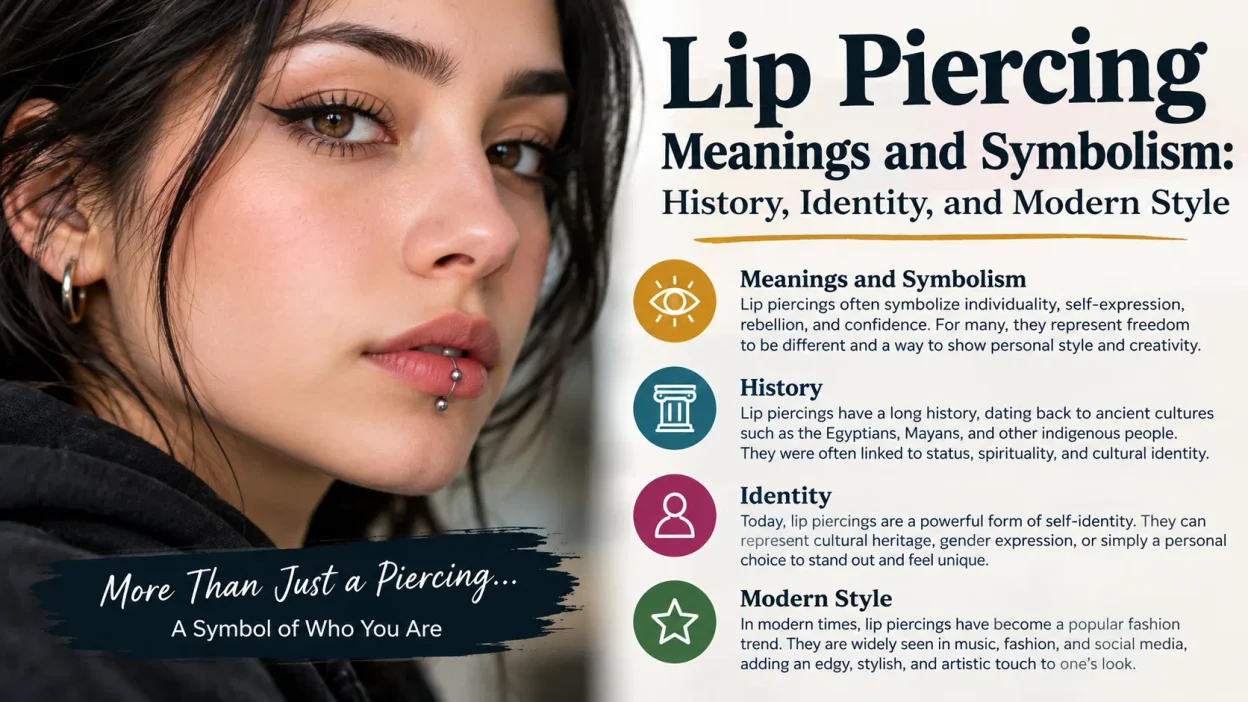
Lip piercing meanings and symbolism vary across cultures, generations, and individual experiences. In modern American culture, a lip piercing commonly represents personal style, independence, self-expression, or a willingness to challenge conventional beauty standards. For some people, it also reflects cultural identity, a personal milestone, or a meaningful change in how they present themselves.
A lip piercing is a form of body modification in which jewelry passes through the lip or the surrounding tissue. Popular styles include a labret piercing below the lower lip, a Monroe piercing above the upper lip, and paired piercings known as snake bites. Each placement creates a different appearance, but none has one universally accepted symbolic meaning.
The practice also has a longer history than its current association with fashion might suggest. Lip ornaments have served as markers of status, identity, and social belonging in several societies. Understanding these different uses helps explain why the same piece of jewelry can communicate confidence to one person, cultural heritage to another, and nothing more than an attractive style choice to someone else.
Quick Answer
Lip piercing meanings and symbolism commonly include self-expression, individuality, confidence, and personal style in modern American culture. Historically, lip ornaments have also marked social status, cultural identity, maturity, and ritual belonging in particular societies, although their meanings differ considerably across traditions.
TL;DR
- Lip piercings commonly express individuality, style, and personal identity.
- Historical lip ornaments sometimes marked status, maturity, or cultural belonging.
- Different piercing placements create distinct visual effects, not fixed symbolic meanings.
- American fashion has connected lip piercings with alternative culture and self-expression.
- Personal experiences often shape what a lip piercing means to its wearer.
- Oral piercings require careful consideration because dental and infection risks exist.
What a Lip Piercing Looks Like and Where It Is Placed
A lip piercing uses jewelry positioned through the lip itself or the surrounding tissue. Depending on the placement, the jewelry may appear as a small stud, a ring, a hoop, or a decorative bar.
The placement often influences the visual impression of the piercing, although it does not determine what the wearer believes it represents.
Common styles include:
- Labret: A piercing below the lower lip, usually centered but sometimes positioned to one side.
- Monroe: An upper-lip piercing placed to one side, inspired by the beauty mark associated with Marilyn Monroe.
- Medusa: A centered piercing through the philtrum, the groove between the nose and upper lip.
- Snake bites: Two piercings positioned on opposite sides of the lower lip.
- Angel bites: Two piercings above the upper lip, one on each side.
- Vertical labret: A piercing that passes through the lower lip so jewelry is visible on its outer surface.
These styles can create different impressions. A small stud may appear understated, while paired rings can create a more noticeable, symmetrical look.
In symbolism, appearance matters because people interpret visual details through their own cultural expectations. However, the style alone cannot reliably reveal a person’s beliefs, personality, or reasons for getting pierced.
What Lip Piercings Commonly Symbolize Today
In the United States, lip piercings are widely understood as a form of personal expression. People may choose them to distinguish their appearance, complement a fashion style, or communicate something about how they see themselves.
Individuality is one of the most common interpretations. Facial jewelry makes a visible change to a person’s appearance, allowing them to move away from conventional beauty standards or create a recognizable personal style.
Confidence is another possible association. Someone who enjoys drawing attention to their facial features may see a lip piercing as a way to feel more comfortable and self-assured. This does not mean everyone with a piercing is confident; the jewelry is a personal choice, not a personality test.
Independence can also be part of the meaning. A person may choose a piercing despite family expectations, workplace conventions, or social pressure to maintain a particular appearance.
For other wearers, the meaning is much simpler. They like the way the jewelry looks, enjoy changing accessories, or consider the piercing part of their everyday grooming routine.
These interpretations can overlap, but none should be assumed without asking the individual.
Historical Origins of Lip Piercing Symbolism
Lip piercing has been practiced in different parts of the world for centuries, with evidence of facial ornaments in ancient societies. The reasons for wearing these ornaments were not uniform, and historical examples should be understood within their specific social settings.
In parts of ancient Mesoamerica, including societies associated with the Maya and Mexica, lip ornaments could communicate social position, political authority, ritual identity, or other distinctions. Archaeological objects show that some labrets were elaborate works of craftsmanship rather than simple decorative accessories.
A particularly striking example is a Mexica gold labret shaped like a serpent. Its design demonstrates how lip jewelry could incorporate religious imagery and elite artistic traditions. The placement of such ornaments near the mouth could also draw attention to speech and public identity.
In other societies, lip ornaments and lip plates have been associated with cultural belonging, beauty ideals, maturity, or community traditions. Their meanings depend on the specific people, period, and circumstances.
Modern American lip piercings developed within a different context, especially the growth of contemporary body modification and alternative fashion. It would therefore be misleading to treat today’s small lip studs as direct equivalents of historically significant labrets worn by rulers or members of particular communities.
Lip Piercings in Ancient Mesoamerican Cultures
Ancient Mesoamerican societies provide some of the clearest examples of lip jewelry carrying meanings beyond personal decoration.
Among the Mexica, commonly known as the Aztecs, labrets could serve as visible markers of rank and elite identity. Some ornaments were made from precious materials and crafted into elaborate forms, including animals and supernatural figures.
Gold held religious and political associations in Mexica society, making a gold lip ornament more than a fashion accessory. Its material, shape, and placement could communicate distinctions that would not be conveyed by an ordinary piece of jewelry.
Maya communities also used facial ornaments in contexts connected with status, ritual practice, and social identity. However, Mesoamerica contained numerous societies across different periods, so a practice documented in one setting should not automatically be attributed to every Maya or Mexica community.
These examples reveal an important principle: body jewelry can communicate social information when a community shares an understanding of its materials, placement, and design. Without that cultural knowledge, an observer may see only the ornament rather than the distinctions it once represented.
For modern readers, these traditions provide historical context, not a universal definition for every contemporary lip piercing.
Lip Piercings and Cultural Identity Lip Piercing Meanings and Symbolism
A lip piercing can communicate cultural identity when it belongs to a tradition with established community meaning. In these situations, the ornament may connect a person with family history, shared customs, or a recognized stage of life.
Traditional lip plates worn by some Indigenous communities in Africa and the Amazon, for example, cannot be reduced to a single explanation. Their significance varies by community and may involve beauty, social identity, maturity, or customary expectations. These practices should be understood on their own terms rather than treated as interchangeable with modern Western piercing trends.
In the United States, cultural identity can influence how someone approaches body modification. A person might choose a piercing to honor family heritage, while another might use jewelry to express an individual identity that does not fit conventional expectations.
It is important not to assume that a modern lip piercing automatically represents a particular ethnicity, religion, or cultural affiliation. The meaning depends on the wearer and the context in which the ornament is used.
Respectful interpretation starts with recognizing that body modification can be both personal and communal. A style that is primarily aesthetic for one person may carry historical or social significance for another.
Lip Piercing Symbolism in American Fashion and Alternative Culture
Modern American lip piercing became more visible as body modification expanded beyond conventional ear piercing. Punk, alternative music, and other youth subcultures helped establish facial jewelry as a way to challenge mainstream expectations about appearance.
For some people, a lip ring or stud became a visual statement of nonconformity. It could distinguish someone from traditional fashion trends or signal an interest in music and communities that valued experimentation.
That association has changed over time. Facial piercings are now found across different age groups, occupations, and fashion styles. Some people wear subtle jewelry that blends with professional clothing, while others choose more prominent combinations as part of an alternative look.
This wider acceptance has made it harder to assign one cultural meaning to a lip piercing. A style that once attracted attention as unconventional may now be an ordinary accessory in some social settings.
American attitudes still vary. A piercing may be welcomed in a creative workplace but discouraged by a particular employer or institution. Those differences reflect changing expectations about professional appearance, not an objective measure of the wearer’s character.
What Different Lip Piercing Placements Can Symbolize
Placement can influence the visual message of a piercing, even though no reliable universal code assigns a fixed meaning to each location.
| Piercing style | Common visual impression | Possible personal meaning |
|---|---|---|
| Labret | Balanced, understated, or centered | Simplicity, individuality, personal style |
| Monroe | Beauty-mark-inspired and decorative | Glamour, vintage fashion, self-expression |
| Medusa | Symmetrical and prominent | Artistic style, facial symmetry |
| Snake bites | Bold and deliberately paired | Alternative fashion, experimentation |
| Angel bites | Symmetrical upper-lip jewelry | Distinctive style, visual balance |
| Vertical labret | Noticeable jewelry following the lip | A preference for distinctive facial adornment |
These descriptions concern visual impressions, not proven psychological meanings. Two people with identical piercings may have completely different reasons for choosing them.
The jewelry itself also affects the appearance. A small metal stud may create a subtle accent, while a larger ring or brightly colored piece may become the focal point of someone’s style.
If you are trying to understand another person’s piercing, their explanation matters more than a chart of symbolic associations.
Emotional and Psychological Meanings of Lip Piercings
Body modification can carry emotional significance because it changes how a person sees and presents themselves. For some people, getting a lip piercing marks a decision to take ownership of their appearance.
The experience may represent independence, especially when someone has spent years feeling pressure to meet other people’s expectations. Choosing a piercing can become a small but meaningful act of personal agency.
For another person, the piercing may mark a transition. It might follow a graduation, a move to a new city, the end of a relationship, or a period of personal growth. The jewelry then becomes a reminder of a particular time rather than a symbol with a universally recognized definition.
Some wearers also find that facial jewelry helps their external appearance feel more consistent with their internal sense of identity. Others simply enjoy the aesthetic result.
It is important not to confuse these possible meanings with psychological evidence about every wearer. A lip piercing does not prove rebellion, insecurity, courage, or emotional maturity. The same choice can arise from different motivations, and appearance alone does not reveal them.
Lip Piercings as Symbols of Confidence and Rebellion
Confidence and rebellion are frequently associated with facial piercings because they can visibly depart from traditional expectations about appearance.
For someone who has been discouraged from wearing facial jewelry, getting a piercing may feel like an assertion of independence. The choice can communicate that personal preferences matter more than fitting a particular image.
However, rebellion is only one possible interpretation. A person who wears a lip stud may have no interest in challenging authority or making a statement. They might prefer a minimalist look or consider the jewelry an ordinary part of their style.
Confidence is similarly subjective. Some people feel more comfortable with a piercing because it helps them express themselves. Others may feel nervous about how people will react, especially in unfamiliar social or professional settings.
In contemporary American culture, these meanings depend heavily on context. The same piercing can be interpreted as bold in one environment and unremarkable in another.
The most accurate approach is to understand confidence and rebellion as possible motivations, not automatic characteristics of people who wear lip jewelry.
Spiritual and Religious Interpretations of Lip Piercings
Lip piercings do not have one universal spiritual meaning. Their religious significance depends on the particular tradition, community, and historical period involved.
In some historical Mesoamerican contexts, facial ornaments appeared alongside religious imagery and ritual practices. Particular materials and designs could connect jewelry with political authority or sacred concepts.
Other cultural practices involving facial modification have been associated with rites of passage or community customs. These meanings cannot simply be transferred to a contemporary lip ring worn for fashion.
In modern American spirituality, an individual might interpret a piercing as a symbol of transformation, personal freedom, or a new chapter in life. Such interpretations can be meaningful to the person, but they should be identified as personal beliefs rather than established religious teachings.
Religious attitudes toward body modification also vary. Some individuals and communities accept piercings as ordinary adornment, while others discourage them for reasons involving modesty, tradition, or beliefs about the body.
A piercing alone does not establish someone’s religion or spiritual outlook. If religious meaning is important to the wearer, their own explanation is the most reliable guide.
Positive and Negative Meanings Associated With Lip Piercings
Lip piercing symbolism can be positive, negative, or neutral depending on the observer.
Positive interpretations often include individuality, creativity, independence, and confidence. Someone who values alternative fashion may see facial jewelry as an attractive expression of personal freedom.
Negative interpretations can emerge from conservative beauty standards or outdated assumptions about professionalism. Some observers may associate visible piercings with immaturity, defiance, or an unwillingness to follow rules. These are social judgments, not reliable evidence about an individual’s conduct or abilities.
Other people attach no particular symbolism to the piercing at all. They see jewelry as a personal style choice, similar to earrings, necklaces, or other accessories.
The following comparisons show how the same feature can be interpreted differently:
- Individuality: One observer sees originality; another sees a departure from convention.
- Confidence: A wearer may feel self-assured, while an observer may read the style as bold.
- Rebellion: Some people interpret facial jewelry as resistance to expectations, while others view it as ordinary fashion.
- Cultural identity: An ornament may have established significance within one community but carry no such meaning outside it.
These differences demonstrate why symbolic interpretations should remain flexible. The appearance of a piercing does not justify assumptions about a person’s morals, values, or personality.
Lip Piercings in Tattoos, Jewelry, and Social Media
Lip piercings appear frequently in contemporary style photography, beauty content, music imagery, and online discussions about body modification.
On social media, close-up portraits often highlight the relationship between facial jewelry, makeup, hairstyles, and clothing. A piercing can become part of a recognizable visual identity, particularly when a person consistently incorporates similar accessories into their appearance.
Some people combine lip jewelry with tattoos, ear piercings, or other modifications to create a coordinated aesthetic. Others prefer one small stud that adds contrast without dominating the face.
Lip piercings also appear in fictional characters, music performances, fashion photography, and digital art. In these settings, creators may use facial jewelry to suggest an alternative identity or distinguish a character’s appearance. Such visual shorthand reflects modern storytelling conventions rather than a universal rule about real people.
Online communities can also give a particular piercing personal significance. A person may associate a style with a favorite artist, a friendship group, or a period when they began exploring their identity.
The meaning is often created through repeated personal and cultural associations rather than inherited from one ancient symbolic system.
Common Misunderstandings About Lip Piercing Symbolism
One widespread misconception is that every lip piercing represents rebellion. Although some people choose facial jewelry to challenge social expectations, many do so for aesthetic reasons or personal comfort.
Another misconception is that a specific placement communicates a fixed personality trait. A Monroe piercing does not prove that someone values glamour, and snake bites do not establish that someone belongs to a particular subculture.
Historical claims also need care. Lip ornaments have existed in several societies, but their meanings were not identical. A labret associated with elite status in a historical Mesoamerican setting should not be treated as evidence that modern lip piercings carry the same status-related meaning.
It is also misleading to describe traditional lip plates as merely exaggerated fashion accessories. In some communities, these ornaments are connected with cultural practices and social identities that deserve specific historical and community-based explanations.
Finally, symbolic interpretation should not overshadow practical considerations. Lip and oral piercings can cause infection, swelling, gum injury, and damage to teeth. Anyone considering one should understand the risks, seek a qualified professional, and discuss oral-health concerns with a dental professional.
Respect for personal expression includes respecting the fact that a piercing has physical consequences as well as possible symbolic meanings.
How Lip Piercing Meanings Have Changed Over Time
The history of lip piercing is not a single progression from ancient ritual to modern fashion. Different societies developed their own practices, and similar-looking ornaments could serve different purposes.
In some historical settings, lip jewelry communicated status, ritual identity, or membership in a community. The material and craftsmanship of an ornament could matter as much as its placement.
Modern Western body-piercing culture developed through a different combination of experimentation, alternative subcultures, professional piercing practices, and changing attitudes toward body modification. From the late twentieth century onward, facial piercings became more visible in music, fashion, and everyday personal style.
By the 2020s, lip piercings could be found across a broader range of fashion preferences and social environments. Their meanings became increasingly individual rather than tied to one shared cultural code.
This change does not erase the historical importance of traditional lip ornaments. Instead, it shows that body modification can acquire new meanings as people adopt, adapt, or reinterpret existing practices.
The result is a symbol whose interpretation depends on time, place, community, and personal intention.
Frequently Asked Questions
What does a lip piercing mean on a woman?
A lip piercing on a woman may express individuality, fashion preferences, confidence, or personal identity. It does not have one universal gender-specific meaning, and the wearer may simply like the way it looks.
What does a lip piercing mean on a man?
A lip piercing on a man can communicate personal style, creativity, or an interest in alternative fashion. It does not reliably indicate sexuality, personality, beliefs, or membership in a particular social group.
Is a lip piercing a symbol of rebellion?
It can be, particularly when someone chooses facial jewelry to challenge expectations about appearance. However, many people wear lip piercings for aesthetic reasons without intending to make a rebellious statement.
What does a Monroe lip piercing symbolize?
A Monroe piercing is often associated visually with vintage glamour because its placement recalls Marilyn Monroe’s famous beauty mark. Today, it may represent personal style or an appreciation for that aesthetic, but its meaning depends on the wearer.
Do lip piercings have spiritual meanings?
Some people assign personal spiritual meanings to piercings, such as transformation or independence, while certain historical cultures used lip ornaments in ritual contexts. There is no single spiritual meaning shared by all lip-piercing traditions.
Do lip piercings have cultural significance?
Yes, in certain societies, lip ornaments have communicated social status, cultural identity, maturity, or ritual belonging. Those meanings vary by community and should not be assumed to apply to every modern piercing.
Can a lip piercing damage your teeth or gums?
Yes. Jewelry can rub against the gums, chip teeth, damage dental restorations, or contribute to infection and soft-tissue injury. Anyone considering a lip piercing should weigh these risks carefully and consult a dental professional about oral health.
Conclusion
Lip piercing meanings and symbolism reflect a combination of personal expression, cultural history, fashion, and social perception. In modern American culture, lip jewelry often communicates individuality, confidence, or a preference for distinctive style, while historical lip ornaments sometimes served more specific roles connected with status, identity, and ritual practice.
No single interpretation applies to everyone who wears one. The most useful way to understand a lip piercing is to consider its placement, cultural context, and the wearer’s own reasons for choosing it. A small piece of jewelry may carry a personal story, reflect a community tradition, or simply be an accessory someone enjoys wearing.