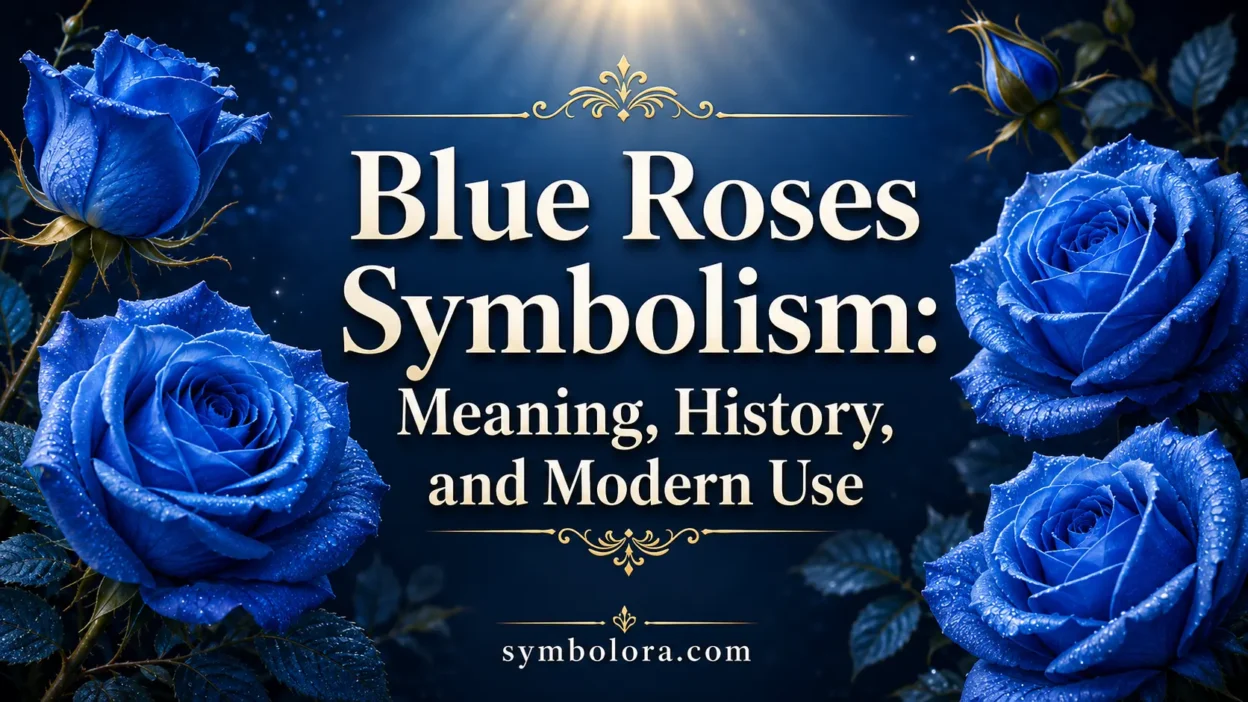
Blue roses look familiar and impossible at the same time. They have the layered petals and recognizable form of ordinary roses, yet their unusual color separates them from the reds, pinks, whites, and yellows people expect to see. That contrast is central to blue roses symbolism, which commonly connects the flower with rarity, unattainable desire, individuality, mystery, and the pursuit of something once thought impossible.
Unlike many flower meanings that developed mainly from religion or ancient mythology, the symbolic identity of the blue rose is closely tied to a botanical limitation: naturally occurring roses don’t produce the clear blue associated with flowers such as delphiniums or cornflowers. That absence gave artists, storytellers, breeders, and flower buyers room to imagine what a rose outside nature’s normal color range might represent. Today, Americans encounter blue roses in bouquets, tattoos, weddings, and artwork, and their meaning has shifted along with the science — what once represented the unreachable can now suggest ambition or the achievement of an unlikely goal.
Quick Answer
Blue roses symbolism most commonly represents mystery, rarity, individuality, and something difficult or impossible to attain in modern American culture. Historically, the flower’s unusual meaning developed largely because naturally blue roses did not exist, making them an effective image for longing, imagination, and the pursuit of the seemingly impossible.
At a glance:
- Blue roses commonly represent rarity, mystery, and individuality
- Their unattainable meaning comes from their absence in nature
- Modern versions can symbolize making the impossible possible
- Romantic associations include unusual, distant, or idealized love
- Tattoos often express uniqueness, ambition, or personal transformation
- Meanings vary with context rather than following one fixed flower code
What Blue Roses Actually Look Like
A true blue rose would display a noticeably blue hue rather than the lavender, lilac, or violet tones found in many rose cultivars marketed with names containing the word “blue.” Traditional rose breeding has produced flowers that approach cool purple and lavender shades, but conventional roses lack the biological pathway needed to produce delphinidin-based blue pigmentation the way some naturally blue flowers do.
As a result, vivid cobalt or sky-blue roses used in bouquets are often created through coloring techniques. Other blue-hued roses have resulted from biotechnology, though these flowers may still appear more lavender or violet than the pure blue people imagine. This gap between the imagined flower and the actual plant matters symbolically — the blue rose has long represented something that can be pictured clearly even when nature doesn’t readily provide it.
What Blue Roses Commonly Mean in the United States
In modern American use, there’s no official dictionary assigning one meaning to every blue rose — context determines the message. Still, several interpretations occur repeatedly because they grow naturally from the flower’s unusual color and history.
| Context | Common U.S. Meaning | Typical Association | Important Note |
|---|---|---|---|
| Romantic gift | Rare or extraordinary love | Attraction, fascination | Can also imply unreachable love |
| Tattoo | Individuality | Independence, uniqueness | Meaning is usually personal |
| Achievement | Making the impossible possible | Ambition, perseverance | A relatively modern interpretation |
| Art and fantasy | Mystery | Imagination, unknown worlds | Often intentionally surreal |
| Memorial | Uniqueness of the person remembered | Memory, absence | Not a standard funeral flower code |
| Wedding | Unconventional love | Originality, individuality | Often chosen mainly for aesthetics |
The most useful way to interpret the flower is to consider both its color and the situation in which it appears. A blue rose given to a romantic partner may communicate “you are unlike anyone else,” while the same rose in a surreal painting could represent an impossible world instead. In a tattoo, it might simply stand for refusing to conform.
Why the Impossible Became Its Defining Meaning
The association with impossibility is unusually easy to explain. For generations, gardeners could produce roses in many colors but not a naturally clear blue, so the flower became an ideal metaphor for something desired but unavailable — an impossible object, an unreachable ideal, an improbable romance. Its symbolism operates through contradiction: a rose is one of the world’s most recognizable flowers, while blue is one of the colors people historically couldn’t obtain naturally from it, and combining the two creates something familiar that nevertheless seems to violate expectation.
That’s why the blue rose can symbolize more than simple rarity. A rare red rose is still possible — the imagined true-blue rose represented something people wanted even though nature appeared to place it outside the normal range of possibility. In emotional terms, this may represent longing for a person, future, or ideal that remains just beyond reach.
From Impossible Flower to Scientific Achievement
The meaning became more complicated once researchers began trying to overcome the rose’s natural pigment limitations. Scientists working with Suntory and Florigene developed genetically engineered roses capable of accumulating delphinidin, a pigment associated with blue coloration in other flowers. The resulting blooms achieved hues unavailable through ordinary rose breeding, although their appearance remained closer to mauve or violet-blue than a saturated sky blue.
Commercial sales of Suntory’s APPLAUSE rose began in Japan in 2009, and the company associated the flower with the phrase “dreams come true,” directly turning the old idea of impossibility into one of accomplishment. That development created an interesting symbolic reversal — earlier, a blue rose could mean the impossible thing you cannot possess; in more recent contexts, it can mean the impossible thing someone finally achieved. Both interpretations remain valid, which is why the flower can represent longing in one setting and perseverance in another.
The Blue Flower Tradition and the Idea of Longing
The symbolic background of blue flowers extends beyond roses. During European Romanticism, the blue flower became associated with longing, imagination, and the search for something beyond ordinary experience. German writer Novalis made the blue flower a central image in his unfinished novel Heinrich von Ofterdingen, helping establish it as one of the recognizable motifs of Romantic literature.
The blue rose inherited some of that emotional vocabulary, though it shouldn’t be treated as identical to the Romantic blue flower. Both images combine beauty with distance, pointing toward something desired precisely because it can’t be easily reached or fully understood. This helps explain why modern blue roses may feel more wistful than roses in warmer colors — red commonly communicates direct passion, pink can suggest gentle affection, but blue creates greater emotional distance, encouraging associations with imagination or an ideal that exists partly in the mind.
Blue Roses in American Culture
American interpretations tend to be less formal than the elaborate flower-language systems sometimes associated with nineteenth-century Europe. Most people choosing blue roses today aren’t consulting a strict historical code — instead, meaning develops through recognizable contemporary associations: blue feels unusual on a rose, unusual things feel rare, and rarity can suggest individuality or something difficult to obtain.
The flower also fits comfortably into American ideas about self-expression, representing difference without necessarily being rebellious. Someone may choose a blue rose tattoo or wedding bouquet simply because conventional roses feel too predictable. At the same time, Americans familiar with fantasy and surreal imagery may read a blue rose as a signal that normal rules have changed — a single blue rose placed in an otherwise realistic scene can make the entire image feel dreamlike. Its modern American meaning sits between two broad ideas: exceptional rarity and deliberate difference.
What Blue Roses Mean in Love and Relationships
Romantic interpretations depend heavily on the relationship itself. A blue rose can communicate that someone seems rare or unlike anyone the giver has known, working as an unconventional alternative to the direct romantic message of a red rose. However, the older association with unattainability creates another possibility — blue roses can represent loving someone who remains emotionally or practically out of reach, including unrequited affection, a relationship that can’t continue, or longing for someone from a distance.
Because these meanings differ significantly, a blue bouquet isn’t automatically a declaration of unrequited love. Contemporary gifts often emphasize uniqueness rather than emotional distance, so context matters more than any supposed universal rule here.
Emotional and Psychological Meaning
Symbolically, blue roses often appeal to people who identify with difference. A familiar flower presented in an unexpected color can function as a visual statement of individuality: recognizable, but unwilling to fit the expected pattern. That makes the image useful for representing people who see themselves as unconventional, creative, or difficult to categorize.
The color blue also changes the emotional tone normally associated with roses. Warm-colored roses tend to feel immediate and expressive, while blue can appear cooler and more contemplative — combined with the rose, it can suggest emotion that’s present but restrained. For some people, that becomes a symbol of private affection; for others, it represents loneliness or the desire to understand something elusive. These are interpretations rather than psychological laws, of course — colors and flowers don’t produce identical emotional reactions in everyone.
Why Blue Rose Tattoos Are Popular
A blue rose tattoo can carry several meanings without requiring viewers to know a complicated symbolic tradition. Its most common personal interpretations include uniqueness, independence, an impossible goal, or surviving circumstances that once seemed impossible. Someone may also use the design to represent a person who felt irreplaceable, where rarity becomes emotional rather than botanical.
A tattoo featuring thorns can emphasize difficulty or the cost of pursuing something desirable, while a fading or damaged blue rose may suggest loss or an unreachable relationship instead. A highly stylized neon-blue rose can lean toward fantasy or visual experimentation. Because tattoos are personal symbols, no single meaning should be assigned automatically — the wearer’s own explanation matters more than generic flower symbolism.
Blue Roses at Weddings, Celebrations, and Memorials
Blue roses are often chosen for visual reasons first and symbolism second. At weddings, they can reinforce an unconventional color palette or represent a relationship the couple considers rare — especially suited to ceremonies built around navy, silver, or winter themes. As congratulatory flowers, their modern association with achieving the improbable can make them appropriate for unusual milestones or difficult accomplishments.
Memorial use is more delicate. A blue rose may represent someone remembered as unique, or it may express the distance created by death and the desire for something that can’t be recovered. None of these meanings constitutes a universal American ritual tradition — they’re contemporary symbolic uses shaped entirely by personal context.
Blue Roses in Art, Literature, and Pop Culture
Artists often use impossible colors to signal that an image shouldn’t be interpreted literally, and a blue rose works especially well because viewers recognize immediately that something is unusual. In literature, the image can suggest fragility, longing, or something that exists more fully in imagination than everyday life.
An important American example appears in Tennessee Williams’s The Glass Menagerie. Laura Wingfield acquires the nickname “Blue Roses” after Jim mishears her reference to pleurosis — the phrase fits a character presented as unusually delicate and isolated, though the nickname originates through wordplay rather than a formal flower code. The play itself is a major work of American theater centered on memory and vulnerability. Modern fantasy imagery uses the flower more broadly still, where blue roses may indicate enchanted gardens, supernatural characters, or a world where ordinary biological rules no longer apply.
Fashion, Jewelry, Decor, and Digital Culture
Modern design has expanded the flower far beyond actual bouquets. Blue rose patterns appear on clothing, jewelry, wall art, and digital illustrations, where symbolic meaning may be subtle — sometimes the rose simply offers familiar elegance without the predictable associations of red or pink. Online, intensely colored blue roses also work well because their unnatural appearance is visually striking, and digital art can push them toward electric blue or icy cyan shades that would be difficult to reproduce in living petals.
These variations change the mood considerably. Pale blue can feel quiet or dreamlike, dark navy roses can look solemn or dramatic, and bright electric blue often suggests fantasy or deliberate artificiality. Modern technology allows the symbolic blue rose to become even more visually impossible than the flower people originally imagined.
Cross-Cultural Meanings Require Context
It’s tempting to assign each culture a neat one-line definition of the blue rose, but that approach can create false certainty. Roses have accumulated meanings across Persian, Middle Eastern, European, and modern commercial traditions, and blue itself carries different religious and emotional associations depending on place and period. The specific blue rose, though, doesn’t have one ancient universal interpretation shared across civilizations — its strongest modern symbolic meanings come from rarity, artificial creation, and literary imagination. When a particular story or cultural community gives the flower a different meaning, that interpretation should be understood within that tradition rather than presented as a rule applying everywhere.
Common Misunderstandings About Blue Roses
One frequent misunderstanding is that blue roses have always carried a fixed meaning such as “true love” or “mystery” — flower symbolism is rarely that standardized. Another misconception is that modern biotechnology produced a perfectly pure blue rose. Researchers succeeded in introducing blue-associated pigmentation into roses, but the resulting flowers have generally appeared in violet or lavender-blue ranges rather than the intense blue seen in many edited photographs.
It’s also misleading to describe every blue rose as natural, since strongly saturated blue cut roses may owe their appearance to coloring rather than genetics. None of that reduces their symbolic value, though — artificiality can actually strengthen the meaning. A flower transformed into a color nature normally denies it becomes an especially clear image of invention and imagination.
How the Meaning Changed Over Time
The evolution of the blue rose can be summarized as a movement from absence to possibility. At first, its symbolic force depended on not existing naturally — the flower belonged to imagination, longing, and the unattainable. Later, plant breeding and biotechnology turned the quest for a blue rose into a scientific challenge, and the flower became associated not only with impossibility but with human determination to challenge biological limitations.
Modern culture added another layer still: individuality. People no longer need to know the botanical history to understand that a blue rose stands apart from ordinary roses. As a result, three meanings now coexist — the unreachable (something desired but beyond possession), the extraordinary (a person or experience perceived as rare), and the achieved impossible (a goal once considered unrealistic that finally became possible). That combination makes the flower more flexible than a simple symbol of mystery.
Frequently Asked Questions
What does a blue rose symbolize spiritually?
There is no single established spiritual meaning. In personal spiritual use, blue roses may represent searching for an ideal, reaching beyond ordinary limits, or pursuing something that seems impossible.
Does a blue rose mean true love?
It can represent an exceptional or rare love, but “true love” is not a universal definition. Depending on context, it can just as easily suggest unattainable or idealized love.
Are blue roses a positive or negative symbol?
They can be either. Positive interpretations include individuality, achievement, and rare beauty, while more melancholy interpretations include distance, loneliness, or unrequited affection.
What does a blue rose tattoo mean?
Blue rose tattoos commonly express uniqueness, independence, rare love, ambition, or overcoming something once thought impossible. Personal details such as thorns, names, or dates usually provide the more specific meaning.
Can you give blue roses to someone romantically?
Yes. In contemporary American gift giving, they can communicate that the recipient seems distinctive or rare, although they are less conventional than red roses for directly expressing romantic passion.
Do real blue roses exist naturally?
Roses do not naturally produce the clear delphinidin-based blue found in certain other flowers. Biotechnology has produced roses with blue-associated pigments, while vivid blue florist roses may also be created through artificial coloring.
What does a dark blue rose symbolize?
Dark blue roses often feel more solemn or dramatic than pale versions. In tattoos and artwork, they may suggest private emotions, independence, or fascination with something difficult to understand.
Conclusion
The meaning of the blue rose begins with a simple botanical contradiction: people could imagine the flower long before they could come close to producing one. That made it a natural metaphor for rarity, impossible desire, unusual love, and goals that seem beyond reach.
Modern blue roses symbolism has expanded beyond the unattainable. In American tattoos, gifts, art, and personal design, the flower can also represent individuality, exceptional relationships, and the satisfaction of achieving what once seemed impossible.
Its meaning works because the image still feels slightly unexpected. A blue rose asks us to notice the difference between what normally exists, what we wish existed, and what human imagination may eventually make possible.


