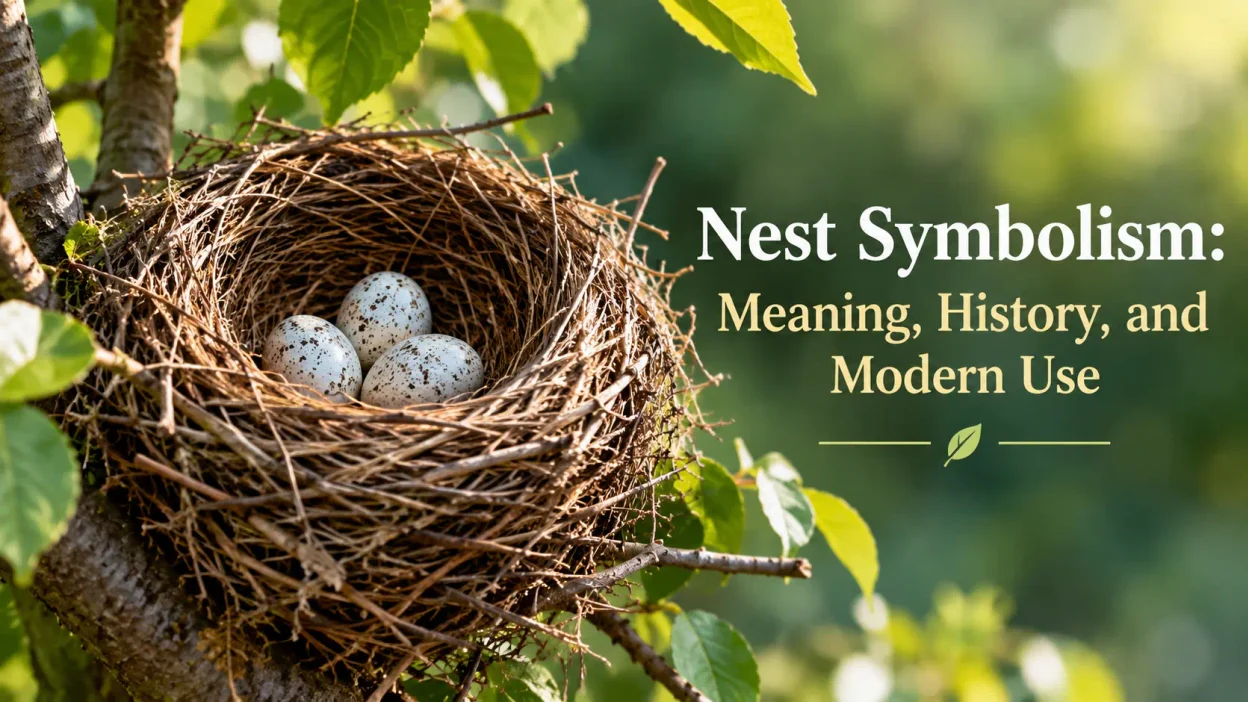
Nest symbolism often centers on home, family, safety, and the work of building a place where life can grow. In the United States, a bird’s nest commonly appears in spring decorations, wedding artwork, nursery designs, and nature photography because it offers a familiar image of shelter and new beginnings. Its meaning can also extend to belonging, patience, care, and the effort required to create a stable life.
A nest is more than a collection of twigs or grass. Birds build nests to protect eggs or young, using different materials and designs according to their species and surroundings. People recognize this practical purpose and connect it with experiences such as raising children, creating a home, starting a relationship, or preparing for a major change.
However, nests do not carry one universal meaning. Their symbolism varies across cultures, religions, literature, and personal experience. Understanding those differences helps explain why this ordinary feature of the natural world remains such a familiar symbol in modern American life.
Quick Answer
Nest symbolism commonly represents home, family, safety, nurturing, and new beginnings in modern American culture. Historically, nests have also appeared in stories, religious imagery, and literature as signs of shelter, care, vulnerability, and the conditions needed for life to develop.
TL;DR
- Nests commonly symbolize home, family, security, and belonging.
- Eggs and hatchlings connect nests with birth, potential, and new beginnings.
- Building a nest can represent patience, preparation, and shared responsibility.
- Empty nests often symbolize independence, transition, and changing family relationships.
- Religious and cultural interpretations vary according to the story and tradition.
- Modern art uses nest imagery to express care, resilience, and personal identity.
What a Nest Looks Like and Why It Matters
A nest is a structure built or adapted by an animal, usually to hold eggs, shelter offspring, or provide a protected place for reproduction. Bird nests vary widely: some are woven from grasses, others are made from twigs, mud, moss, feathers, or plant fibers. Certain species use tree cavities, while others nest on the ground, on cliffs, or on buildings.
This variety contributes to the nest’s symbolic flexibility. A woven nest may suggest careful construction, while a nest tucked inside a tree can evoke privacy and protection. A nest containing eggs suggests possibility, and one with newly hatched birds can represent the early stages of growth.
Not every bird builds a traditional nest, and not every nest resembles the familiar bowl of twigs shown in greeting cards. Still, that recognizable image has become a visual shorthand for care and shelter.
People encounter nest imagery in gardens, parks, children’s books, seasonal decorations, jewelry, and home design. Its familiarity allows a small natural object to communicate an idea that might otherwise require a longer explanation: someone or something is being given a place to belong.
The Core Meaning of Nest Symbolism
The central meaning of nest symbolism comes from the nest’s function as a place of shelter and development. A nest protects vulnerable eggs or young while providing a setting in which they can grow.
For people, this function translates naturally into ideas about family, emotional security, and the home. A nest may represent the place where someone feels accepted, where children receive care, or where a family establishes routines and traditions.
The symbol can also refer to something people create rather than inherit. Birds gather materials and construct their nests through species-specific behaviors. In human contexts, that process resembles the work of establishing a household, building a relationship, or developing a supportive community.
A nest therefore suggests both a place and an ongoing effort. It can stand for the comfort of being protected, but it can also represent the responsibility involved in protecting others.
These meanings are common rather than universal. Someone who associates home with conflict or instability may interpret a nest differently from someone whose strongest memories involve warmth and family support.
Home, Family, and a Sense of Belonging
In American culture, the nest is one of the clearest natural images of home and family. Its association with parental care makes it particularly common in artwork celebrating births, family milestones, and domestic life.
A nest containing several eggs may symbolize a growing family. A pair of adult birds tending their young can suggest cooperation and shared responsibility. In a home decoration, the same image may communicate a wish for comfort, stability, or a welcoming household.
The phrase “family nest” also connects the physical home with emotional belonging. People may describe a childhood home as the place where they first felt protected, even after moving away. The nest becomes a metaphor for those early experiences of care.
Belonging, however, does not depend only on biological family. A nest can also represent a chosen family, a close friendship group, or a community that gives people support during difficult periods.
This broader interpretation makes nest imagery useful beyond traditional family settings. It can express the idea that a home is defined not simply by its walls, but by the relationships and routines that make people feel accepted.
Safety, Protection, and Emotional Security
A nest is designed to serve a particular purpose during a vulnerable stage of life. Eggs cannot protect themselves, and young birds often depend on parental care until they become more independent.
That vulnerability explains why nests frequently symbolize safety and protection. In human life, the corresponding idea may be a stable home, a trustworthy relationship, or a place where someone can recover from stress without fear of judgment.
The symbol also reveals a limitation of protection: a nest offers shelter, but it cannot remove every danger. Weather, predators, and environmental changes can threaten even a well-built structure.
This detail gives the nest a more realistic meaning than the idea of perfect security. A supportive home can make growth possible, but it cannot guarantee that life will always be easy.
In art, a nest surrounded by strong branches may emphasize stability. One exposed on a narrow ledge may suggest vulnerability and the effort required to protect something precious. The setting changes the emotional message, even when the nest itself remains the same.
New Beginnings, Birth, and Potential
Eggs and hatchlings make the nest a natural symbol of beginnings. An egg contains the possibility of a new life, while a newly hatched bird represents a beginning that has already taken place.
This imagery appears frequently in American spring decorations, birth announcements, children’s illustrations, and designs celebrating fresh starts. A nest with eggs can express anticipation, while one with hatchlings can suggest growth, discovery, and the early stages of independence.
The same idea can apply to projects and personal changes. A new business, creative practice, educational goal, or relationship may be described as something still developing in its nest. The image suggests that early growth often needs time and protection before it can withstand outside pressure.
A nest does not necessarily symbolize success or guaranteed fulfillment. Eggs may fail to hatch, and young birds must eventually leave the nest. Its more grounded message is that new life and new ideas require suitable conditions to develop.
For this reason, nest imagery can express hope without promising a particular outcome.
Nest Building as a Symbol of Effort and Preparation
A nest may look simple when finished, but its construction requires behaviors suited to the bird’s species and environment. Birds collect or arrange materials, select a location, and create a structure that supports their reproductive needs.
People often interpret this process as a symbol of preparation and purposeful effort. Building a nest can represent saving for a home, preparing for a baby, establishing a new household, or making a space more comfortable for someone else.
The materials themselves can reinforce the idea. Individual twigs and strands of grass may appear insignificant, yet together they form a structure with a practical function. In human symbolism, this resembles the small decisions and repeated actions that gradually create stability.
The nest can also represent cooperation. In species where both parents participate in nesting or caring for young, the image may suggest shared work and responsibility. However, nesting behavior differs considerably among birds, so the symbolism should not be treated as a universal statement about animal relationships.
As a metaphor, nest building reminds us that a stable environment usually develops through practical effort rather than appearing fully formed.
What an Empty Nest Symbolizes
An empty nest can represent independence, change, and the end of one stage of family life. In American English, the phrase “empty nest” commonly describes a household after children have moved out, although the transition does not always happen permanently or at the same time for every family.
The image can bring mixed emotions. Parents may feel pride as their children become independent, sadness about daily routines that have ended, relief from certain responsibilities, or excitement about having more time for themselves. Several of these feelings can occur together.
An empty nest can also symbolize a broader transition. Someone leaving a familiar home, completing a long-term project, or changing careers may recognize the same pattern: a space that once served a clear purpose becomes available for something new.
The symbol is not necessarily negative. An empty nest may represent loss, but it can also suggest freedom, renewed relationships, and the opportunity to reconsider how a person wants to live.
Nest Symbolism in Religion and Spiritual Traditions
Nests appear in religious and spiritual interpretations because their natural function provides an accessible image of care, shelter, and vulnerability. However, their meaning depends on the particular tradition and passage rather than on a single religious rule.
In the Bible, nest imagery appears in several contexts. Job uses the idea of dying in one’s nest when expressing confidence in a stable future, while other biblical passages use nests to discuss safety, pride, or the limits of human security. These examples show that a nest can represent comfort without guaranteeing that comfort will last.
Christian readers may also interpret nest imagery through broader themes of divine care and the protection of vulnerable life. Such readings are interpretations of religious teachings, not evidence that every bird’s nest is a formal Christian emblem.
In other spiritual settings, a nest may be used as a contemporary metaphor for personal growth, a protected period of reflection, or the development of a new intention. These meanings can be meaningful to individuals, but they should not be attributed to an entire religion without specific evidence.
The key distinction is between a nest’s general associations with care and the particular meaning it receives in a religious story or practice.
Nest Symbolism Across Cultures
The nest is a familiar natural structure, but cultural interpretations differ according to local stories, beliefs, and experiences with birds.
In Slavic folklore, research into traditional beliefs has identified connections between the nest, family, marriage, fortune, protection, and the ancestral home. These associations illustrate how a bird’s dwelling can become a metaphor for household life and continuity between generations. They do not mean that every Slavic community shared the same customs.
In Persian literature and art, the nest of the mythical Simurgh has appeared in narratives connected with a remarkable bird and a significant mountain setting. The symbolism depends on the wider story and its literary or spiritual context rather than on nests in general.
In American Indigenous cultures, birds and their homes can have meanings shaped by particular nations, languages, stories, and relationships with the natural world. There is no single Native American interpretation of nest symbolism, so specific claims should be tied to a named community and documented tradition.
These examples demonstrate an important principle: similar natural images can acquire different meanings. A nest may represent family in one context, a mythological dwelling in another, or a practical feature of wildlife in everyday life.
Nest Symbolism in American Holidays and Home Decor
In the United States, nest imagery appears especially often during spring, Easter, baby showers, and celebrations connected with family life.
Spring decorations may feature nests filled with eggs, flowers, moss, or small artificial birds. These arrangements combine the visible signs of new life with the season’s association with growth. Easter displays may use nests and eggs as decorative reminders of renewal, although their religious significance varies and should not be assumed to be identical to the Christian meaning of the holiday.
For baby showers and birth announcements, a nest can represent the care surrounding a new child. Nursery prints often use birds, branches, and nests to create an image of a protected beginning without relying on explicitly religious imagery.
Home decor uses the nest in a similarly flexible way. A small nest-shaped ornament on a shelf may suggest a welcoming household, while a natural arrangement on a dining table may communicate an appreciation for seasonal materials.
These are cultural conventions rather than fixed rules. Some people choose nest decorations because of their associations with family, while others simply like their organic shapes and natural textures.
Nest Symbolism in Art, Literature, and Storytelling
Artists and writers can use nests to explore the relationship between shelter and freedom. A nest provides protection, but it also exists for a stage of life that will eventually change.
In children’s stories, nests often establish a setting for birth, discovery, or the first attempts at independence. A young bird leaving the nest offers a straightforward image of growing up, making it useful in stories about learning, courage, and separation.
In visual art, a nest can communicate vulnerability through its construction and location. A carefully woven structure tucked into a tree may suggest security, while one exposed to wind or balanced on a narrow branch may create tension.
Historical European prints sometimes used nest-related scenes in ways that were less sentimental. Depictions of people climbing trees to steal eggs or young birds could explore greed, mischief, or social behavior. This history shows that nest imagery has not always been limited to family affection and innocence.
The surrounding details determine the message. A nest in a peaceful landscape may evoke care, while a damaged nest in a dramatic scene can make loss or environmental harm the central theme.
Nest Symbolism in Tattoos, Jewelry, and Personal Style
Nest designs are popular choices for people who want a personal symbol connected with family, home, or new beginnings. Their meaning can be adjusted through the addition of eggs, birds, branches, flowers, or other visual elements.
A nest containing eggs may represent anticipation or the beginning of a new chapter. A nest with hatchlings can emphasize parenting and care, while a simple outline of a nest may express belonging without referring to a particular family event.
Some people choose nest jewelry to commemorate a birth, a relationship, or a home they associate with an important period in life. Others use the image as a reminder to create a supportive environment for themselves and the people they care about.
Personal meaning should not be confused with a universal cultural definition. A nest tattoo does not automatically indicate parenthood, marriage, or a particular spiritual belief. The wearer may have chosen it for a private reason that is not visible in the design.
For anyone seeking a historically grounded design, it is also worth distinguishing general nest imagery from a motif drawn from a specific myth, religious tradition, or cultural art form.
Emotional and Psychological Meaning of a Nest
Nest imagery often evokes comfort because people associate shelter with the ability to rest, recover, and develop without constant exposure to danger. This response can make a nest a useful metaphor for emotional security.
The symbol may also communicate attachment. A familiar room, a childhood home, or a place shared with close friends can function as an emotional nest because it carries memories and a sense of continuity.
At the same time, comfort can become restrictive when a person feels unable to leave a familiar environment. In that context, the nest can represent overprotection or reluctance to face uncertainty. The same image that suggests safety can therefore raise questions about independence.
These interpretations are not psychological diagnoses. A preference for nest imagery does not reveal someone’s personality or emotional history. It simply offers a visual language for experiences that many people recognize.
A balanced reading allows both sides to exist: people need supportive environments, but healthy growth often requires the freedom to move beyond them.
When Nest Symbolism Can Have a Negative Meaning
Although nests are usually associated with care and security, the symbol can take on less comforting meanings in particular contexts.
A destroyed nest may suggest loss, disrupted plans, environmental damage, or the sudden removal of a familiar source of support. An abandoned nest can evoke loneliness, but it may also represent a natural transition once young birds have left.
The metaphor of a “nest of vipers” illustrates a different use. Here, the nest becomes a place where danger or hostility is concentrated rather than a refuge for vulnerable life. The phrase demonstrates how the same word can communicate a threatening environment when the creatures and circumstances change.
An overly protected nest may also suggest confinement. In stories about growing up, a character who refuses to leave a secure home may struggle to develop independence. The nest itself is not necessarily harmful; the problem is the inability to move beyond it.
These less positive meanings make the symbol more realistic. A nest can represent the conditions that support life, but those conditions may be temporary, inadequate, or difficult to leave.
Common Misunderstandings About Nest Symbolism
One common misconception is that a nest always predicts good luck, marriage, pregnancy, or financial prosperity. People may interpret finding a nest as a positive personal sign, but there is no universal evidence that it forecasts a particular event.
Another misunderstanding is that every nest symbolizes motherhood. Nest imagery can represent fathers caring for young, shared parental duties in species where both parents participate, community, or a person’s desire for a secure home. Its meaning is broader than one family role.
A third mistake is treating every empty nest as a sign of sadness. In real life, the departure of children can produce a range of reactions, including pride, relief, renewed opportunities, and grief. The metaphor should leave room for those different experiences.
It is also important not to assume that all cultures or religions share one nest-related belief. Similar associations may arise independently, while specific traditions can assign very different meanings to the same image.
Finally, finding a real bird’s nest does not establish that the event carries a supernatural message. People can give such encounters personal significance without treating that interpretation as an objective prediction.
Nest Symbolism at a Glance
| Context | Common meaning | Typical association |
|---|---|---|
| Family and home | Security and belonging | A welcoming household |
| Eggs and hatchlings | Potential and new beginnings | Birth, growth, and fresh starts |
| Nest building | Preparation and effort | Creating stability over time |
| Empty nest | Transition and independence | Children leaving home or changing roles |
| Religious imagery | Care, security, or vulnerability | Meaning shaped by a specific passage |
| Damaged or exposed nest | Loss or insecurity | Disrupted plans or threatened shelter |
Frequently Asked Questions
What does a nest symbolize spiritually?
A nest can symbolize protection, nurturing, personal growth, and the preparation needed for a new stage of life. Its spiritual meaning depends on the individual’s beliefs and the tradition in which the image appears.
Is seeing a bird’s nest a good sign?
Many people interpret a nest as a positive reminder of family, growth, or new possibilities. However, seeing one is not a universally recognized prediction of good luck, pregnancy, marriage, or future success.
What does a nest with eggs symbolize?
A nest containing eggs commonly represents potential, anticipation, and the beginning of life. In modern decorative and personal symbolism, it may also express hope for a new project, relationship, or family chapter.
What does an empty nest mean symbolically?
An empty nest can represent independence, separation, or a transition after a period of care and responsibility. Its emotional meaning may be positive, negative, or mixed depending on the circumstances.
What does a nest tattoo represent?
A nest tattoo often represents family, belonging, protection, or the work of creating a stable life. Eggs, hatchlings, flowers, and other design details can give the tattoo a more personal meaning.
What does a nest symbolize in the Bible?
Biblical nest imagery can express security, comfort, and the desire for stability, but it can also illustrate the limits of human confidence. The specific meaning depends on the passage rather than on a single definition that applies throughout the Bible.
Can a nest symbolize feeling trapped?
Yes. In some stories and personal interpretations, a nest can represent excessive protection or the reluctance to leave a familiar environment. This reading emphasizes the tension between feeling safe and gaining the independence needed to grow.
Conclusion
Nest symbolism connects the natural act of sheltering young with familiar human experiences of home, family, protection, and change. Its meaning extends from the anticipation represented by eggs to the independence associated with an empty nest, showing how one image can describe several stages of life.
In modern American culture, nests appear in family celebrations, seasonal decor, personal art, and everyday expressions about home. Religious and cultural traditions add further interpretations, but those meanings should be understood within their specific contexts rather than treated as universal beliefs.
Ultimately, a nest represents more than a place to stay. It can remind us that growth requires support, that security takes effort to create, and that a healthy place of belonging should also leave room for life beyond its boundaries.