
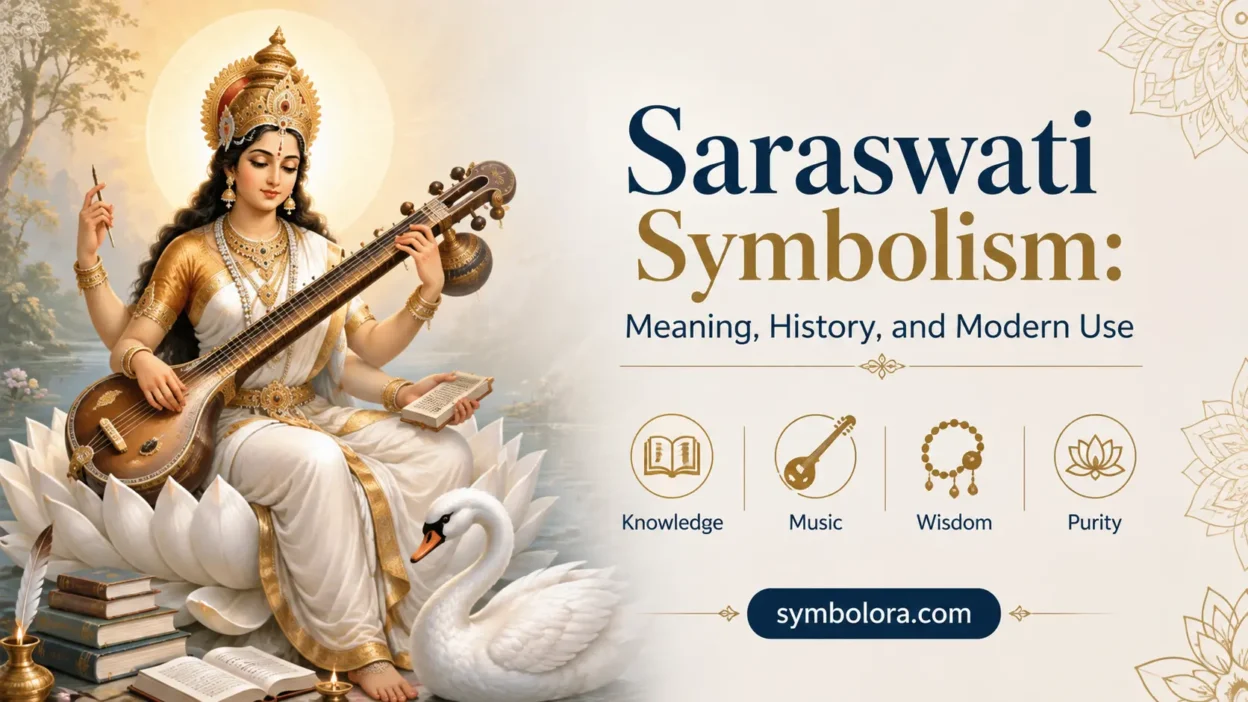
Saraswati is the Hindu goddess associated with knowledge, learning, speech, music, poetry, and the arts. Saraswati symbolism therefore centers on the disciplined pursuit of understanding and the ability to express knowledge clearly and creatively. Her familiar image—often dressed in white and shown with a veena, manuscript, prayer beads, lotus, and hamsa—turns abstract ideas such as wisdom, concentration, artistic skill, and discernment into visual form.
For Hindus, however, Saraswati is more than an artistic symbol. She is a living deity honored through prayer, festivals, temple worship, education, music, and family traditions. Her imagery should therefore be understood first within its religious setting rather than treated simply as a decorative representation of intelligence.
Her meaning has also changed over a very long period. Early Vedic traditions connect Saraswati with a sacred river and inspired speech, while later Hindu traditions increasingly identify her with education, language, music, and intellectual accomplishment. Today those meanings remain visible both in South Asia and in Hindu communities across the United States.
Quick Answer
Saraswati symbolism most commonly represents knowledge, education, clear speech, music, creativity, and disciplined learning. Historically, Saraswati developed from an ancient Vedic deity associated with a sacred river and inspired thought into the widely worshipped Hindu goddess of wisdom, language, and the arts.
TL;DR
- Saraswati primarily represents knowledge, learning, speech, music, and artistic skill.
- Her Vedic roots connect her with water, inspiration, and sacred expression.
- The veena represents music, creativity, discipline, and cultivated artistic knowledge.
- Books and manuscripts connect Saraswati with study, language, and scholarship.
- U.S. Hindu communities honor her through temples, schools, festivals, and universities.
- Sacred imagery deserves more care than ordinary decorative symbolism.
What Saraswati Commonly Symbolizes
The central idea behind Saraswati is knowledge that can be understood, practiced, and expressed. Her symbolism is not limited to intelligence in the narrow sense of memorizing facts. It includes learning, good judgment, eloquence, musical skill, artistic training, concentration, and the ability to communicate ideas.
This helps explain why students, teachers, writers, musicians, dancers, and scholars have particularly strong associations with her. A person may seek Saraswati’s blessings before an examination, lesson, performance, artistic project, or new stage of education.
Her symbolism also joins intellectual and creative life instead of treating them as opposites. The manuscript in her imagery points toward learning and study, while the veena points toward musical expression. Together they present knowledge as something that can become language, rhythm, art, and culture.
| Context | Main Meaning | Common Association | Practical Expression |
|---|---|---|---|
| Education | Knowledge and learning | Books, study, teachers | Prayers before classes or exams |
| Music | Skill and creative discipline | Veena, rhythm, melody | Musical study and performance |
| Speech | Eloquence and clarity | Language, poetry, communication | Writing, teaching, public speaking |
| Spiritual practice | Concentration and insight | Prayer beads, white clothing | Meditation and devotional study |
| Art | Creative intelligence | Music, poetry, performance | Dance, literature, visual culture |
From Sacred River to Goddess of Knowledge
Saraswati’s history reaches back to the Vedic religious world of ancient South Asia. In the Rigveda, Saraswati appears prominently in connection with a mighty river and is praised as both river and goddess. Early descriptions emphasize flowing water, vitality, abundance, and sacred power rather than the classroom-centered image familiar today.
Over time, the concept of flowing water became connected with other kinds of flow: inspired thought, sacred speech, poetry, and knowledge. Later Vedic traditions increasingly linked Saraswati with Vāc, the personification of speech.
That development is crucial to understanding her later symbolism. Knowledge does not remain silent or hidden; it becomes meaningful when it can be spoken, written, taught, sung, or transmitted. Saraswati gradually became associated less exclusively with the physical river and more strongly with the intellectual and linguistic capacities that allow culture and learning to continue from one generation to another.
Why Knowledge and Speech Belong Together
Saraswati’s connection with speech reflects the importance of spoken language in ancient Indian religious and intellectual life. Vedic teachings were transmitted orally with careful attention to pronunciation, rhythm, memory, and recitation. Speech was therefore not merely ordinary conversation; it was one of the main vehicles through which sacred knowledge survived.
Her association with eloquence developed naturally from this setting. Clear thinking and clear speaking become closely related qualities in Saraswati’s symbolism.
In modern terms, this can include writing, teaching, poetry, public speaking, academic work, storytelling, and responsible communication. Saraswati represents not simply having information but being able to organize and communicate it with skill.
This is one reason she remains especially meaningful in educational settings. Knowledge without expression cannot easily be shared, while speech without understanding can become empty. Her symbolism holds the two together.
What the Veena Symbolizes
The veena is one of Saraswati’s most recognizable attributes. It is a traditional Indian stringed instrument, and depictions of Saraswati playing it establish her connection with music and the performing arts. Museum collections describe the veena as an important sign of her role as goddess of music, learning, and artistic culture.
Its symbolism goes beyond entertainment. Learning an instrument requires repetition, listening, coordination, memory, patience, and sensitivity. For that reason, the veena fits Saraswati’s larger association with cultivated ability.
It also prevents her from becoming a symbol of purely academic intelligence. Knowledge includes aesthetic understanding: knowing how to create rhythm, shape language, interpret emotion, and produce beauty through disciplined practice.
For musicians and performers, Saraswati may therefore represent both inspiration and training. Creativity matters, but so does the work required to transform inspiration into skill.
What the Book or Manuscript Represents
A book, palm-leaf manuscript, or written text frequently appears in Saraswati’s hands. Its immediate meaning is learning, scripture, scholarship, and the preservation of knowledge. A nineteenth-century image in the Metropolitan Museum of Art, for example, explicitly uses the manuscript to identify Saraswati’s connection with learning.
The book also represents something broader: knowledge that can outlast one person’s memory. Writing allows teachings, discoveries, poems, philosophies, and histories to move across generations.
In contemporary imagery, viewers often interpret the book through modern education. It can suggest classrooms, libraries, examinations, research, reading, or academic achievement.
Within religious tradition, however, it should not be reduced to a generic school textbook. Saraswati’s association with written knowledge also points toward sacred learning, language, intellectual discipline, and the responsibility to preserve what is worth knowing.
Why Saraswati Is Often Shown in White
White is strongly associated with Saraswati’s traditional iconography. She is frequently depicted wearing white clothing, sometimes surrounded by a white lotus and a pale hamsa. Hindu interpretive traditions commonly connect this whiteness with purity, clarity, and sattva—a quality associated with balance, luminosity, and mental clarity.
In symbolic terms, white helps distinguish Saraswati’s domain from ideas such as wealth, physical power, or sensual display. Her emphasis is knowledge refined through attention.
That does not mean white has one universal meaning across all Hindu traditions. Iconography varies by region, period, artistic school, and devotional setting. Some images use bright colors or emphasize yellow, especially in connection with Vasant Panchami.
The safest interpretation is therefore not that every white element has a rigid code, but that Saraswati’s predominantly white visual tradition reinforces qualities such as clarity, disciplined thought, and spiritual or intellectual purity.
The Lotus and the Meaning of Unattached Learning
Saraswati is often seated or standing on a lotus. The lotus has a broad religious history in South Asian traditions, appearing in Hindu, Buddhist, and Jain art.
In Saraswati imagery, the white lotus is commonly interpreted as representing purity and knowledge. The plant grows from muddy water while its blossom remains above the surface, which has encouraged symbolic readings involving clarity despite confusing or imperfect surroundings.
Applied to learning, the idea is useful: education should improve discernment rather than simply increase information. A knowledgeable person still needs judgment about what deserves attention and how knowledge should be used.
The lotus therefore complements Saraswati’s other attributes. The book suggests learning, the veena cultivated creativity, and the lotus the quality of mind with which those abilities are developed.
The Hamsa and the Symbolism of Discernment
A white waterbird known as the hamsa often accompanies Saraswati. English descriptions frequently call it a swan, although scholars and translators have also identified the Sanskrit bird with a goose or other waterbird.
Later symbolic traditions associate the hamsa with discrimination—the ability to distinguish what is valuable from what is not. A well-known piece of Indian folklore attributes to the bird the ability to separate milk from water. The story functions metaphorically rather than zoologically.
That idea matches Saraswati especially well. Education is not only gathering facts. It also involves distinguishing strong arguments from weak ones, accurate information from error, and useful knowledge from distraction.
In a modern setting, the hamsa can therefore represent intellectual judgment and thoughtful selection: knowing not only more, but knowing what deserves to be believed or pursued.
Prayer Beads, Concentration, and Inner Discipline
Prayer beads, or a japa mala, sometimes appear among Saraswati’s attributes. They connect learning with concentration, repetition, contemplation, and religious discipline. Hindu explanations of her iconography commonly interpret the beads as representing meditation and focused practice.
This detail prevents Saraswati’s symbolism from becoming a celebration of cleverness alone. Knowledge requires attention.
The parallel with education is straightforward. Languages are learned through practice. Musicians repeat scales. Students revisit difficult material. Writers revise sentences. Religious practitioners repeat prayers and verses.
The beads therefore complement the book and veena. All three emphasize that meaningful achievement usually develops through sustained practice rather than instant inspiration.
Saraswati and Vasant Panchami
Saraswati is closely associated with Vasant Panchami, a festival marking the approach of spring and celebrated in many communities as Saraswati Puja. Students and families may honor books, educational materials, musical instruments, teachers, and the beginning of formal learning.
Yellow is especially visible during many celebrations, appearing in clothing, flowers, foods, and decorations because of the festival’s relationship with spring. Customs differ significantly between regions and communities, so there is no single way all Hindus observe the day.
For children, some traditions include a ceremonial introduction to writing or letters. Such rituals make Saraswati’s symbolism unusually concrete: learning itself becomes something worth marking publicly and treating with respect.
Rather than presenting education merely as a route to employment, the festival can frame study as an important cultural, family, and religious undertaking.
What Saraswati Represents in the United States
In the United States, Saraswati’s strongest meanings remain connected with living Hindu communities rather than with a separate mainstream American symbolic tradition.
Her images appear in Hindu temples, home shrines, cultural organizations, religious education programs, music and dance communities, and university Hindu life. Saraswati Puja events are held by Hindu and Bengali organizations in states including New York, New Jersey, California, Michigan, Texas, and elsewhere.
American universities also provide an important modern setting for her symbolism. Yale’s Hindu Life Program, for example, has identified Saraswati as a patron deity associated with knowledge, music, arts, and science and has held Saraswati worship around the academic year.
For many Hindu American families, these practices join religious devotion with education and cultural continuity. Children may encounter Saraswati simultaneously as a deity, a symbol of learning, and a connection to family heritage.
Saraswati in Music, Dance, Writing, and Creative Life
Saraswati’s artistic associations make her particularly relevant to performers. Classical Indian musicians and dancers may invoke or honor her because artistic practice is understood as a form of disciplined knowledge rather than spontaneous self-expression alone.
Writers and poets can interpret her through speech and language. Teachers see a connection with transmitting knowledge. Researchers and students may focus on inquiry and understanding.
This combination gives Saraswati unusual breadth. She does not create a sharp boundary between sciences and arts. Both depend on disciplined attention, memory, communication, creativity, and the development of skill.
Modern images therefore appear in music schools, dance programs, cultural performances, educational events, and digital artwork. The context matters: a devotional image in a shrine carries a different function from an illustration used to introduce students to Hindu art.
Emotional and Psychological Meaning
On a personal level, Saraswati can symbolize the desire for clarity.
Someone beginning college may associate her with confidence in learning. A musician may focus on patience and technical growth. A writer may connect her with finding the right words. A teacher may see her as representing the responsibility that comes with transmitting information.
These interpretations share a common psychological theme: turning confusion into understanding.
Saraswati can also represent quiet competence rather than dominance. Her familiar imagery emphasizes books, music, contemplation, and learning instead of weapons or conquest. That makes her especially suitable as a symbol of growth through knowledge rather than control through force.
For devotees, however, these psychological readings sit within a religious relationship. They should not replace the fact that Saraswati is worshipped as a goddess.
Saraswati Beyond Hindu Traditions
Saraswati’s history is not limited entirely to Hinduism. She also appears in Jain and Buddhist religious traditions, although her roles and forms vary.
Within Jain art and religious culture, Saraswati is recognized as a goddess of knowledge and learning. The Metropolitan Museum of Art places her among the important deities of the Jain pantheon associated with sacred knowledge.
Buddhist traditions carried related forms of Saraswati beyond India into other parts of Asia. Her associations with eloquence, music, knowledge, and learning developed differently as she entered new religious environments. In Japan, historically related traditions contributed to the figure known as Benzaiten.
These connections show how religious symbols travel and adapt. They do not mean Hindu, Jain, Buddhist, and Japanese forms are interchangeable. Each belongs to its own theological and cultural history.
How Saraswati’s Meaning Changed Over Time
The evolution of Saraswati is one of the most interesting features of her symbolism.
Early Vedic material emphasizes a river and sacred waters. Later associations with inspired thought and speech become increasingly prominent. Eventually Saraswati emerges as the recognizable goddess of knowledge, language, music, education, and the arts familiar in later Hindu traditions.
Her visual representation also developed through sculpture, manuscript painting, temple art, prints, and mass-produced devotional images. An influential nineteenth-century image by Raja Ravi Varma, for example, helped shape recognizable modern depictions of Saraswati through new forms of Indian print culture.
Yet the older meanings never disappeared completely. Water, flow, speech, knowledge, and creativity remain conceptually connected.
The result is not a symbol with one frozen definition but a religious figure whose meanings accumulated over centuries.
Modern Tattoos, Jewelry, Decor, and Digital Images
Saraswati imagery now circulates far beyond temple sculpture and traditional painting. People encounter her in posters, jewelry, prints, tattoos, digital illustrations, educational graphics, social-media posts, and home decor.
A tattoo of Saraswati may be chosen to represent devotion, education, music, creativity, or commitment to a lifelong craft. Someone studying classical music might emphasize the veena, while another person may focus on books or the lotus.
Context becomes especially important when sacred imagery enters fashion or commercial design. A deity represented respectfully on devotional jewelry is not equivalent to the same image placed on an object that will be stepped on, discarded, or used casually.
For people outside Hindu traditions, learning what the image represents before wearing or displaying it helps distinguish appreciation from careless use.
Common Misunderstandings and Disrespectful Use
One common mistake is describing Saraswati simply as the “Hindu goddess of intelligence.” That definition is too narrow. Her domain also includes speech, learning, music, poetry, artistic practice, concentration, and the transmission of knowledge.
Another misunderstanding is treating her as the direct Hindu equivalent of Athena or another Western goddess of wisdom. Comparisons can help beginners recognize broad themes, but they can erase major differences in theology, ritual, history, and iconography.
Commercial use raises another concern. Hindu organizations in the United States have repeatedly noted that many believers find sacred deity images inappropriate on items such as footwear, floor coverings, or products associated with disrespectful placement.
The practical distinction is simple: Saraswati may function symbolically, but she is not merely a symbol. For millions of people, she is part of active religious devotion.
Frequently Asked Questions
What is the main symbolism of Saraswati?
Saraswati primarily represents knowledge, education, wisdom, speech, music, creativity, and cultivated skill. Her imagery connects intellectual understanding with the ability to communicate and create.
Why does Saraswati hold a veena?
The veena represents music and the arts, two major areas associated with Saraswati. It can also suggest disciplined practice because mastery of music depends on training, concentration, memory, and sensitivity.
Why does Saraswati wear white?
Traditional explanations associate her white clothing with purity, clarity, and sattva, a quality connected with balance and illumination. White also visually reinforces her connection with knowledge and disciplined thought.
What does the swan beside Saraswati mean?
The bird is traditionally called a hamsa and is commonly rendered in English as a swan or goose. Later symbolism links it with discernment—the ability to distinguish what is valuable, true, or useful from what is not.
Is Saraswati only worshipped by students?
No. Students have an especially strong relationship with her, but Saraswati is also associated with teachers, musicians, writers, poets, artists, speakers, scholars, and others whose work depends on learning and expression.
Is Saraswati worshipped in the United States?
Yes. Hindu temples, cultural organizations, families, and university groups in the United States hold Saraswati Puja and other events associated with learning and the arts. Contemporary celebrations continue across multiple U.S. states and educational communities.
Is it respectful to use Saraswati as a tattoo or decoration?
Context matters. Some people use her image devotionally or to express respect for learning and art, but because Saraswati is a worshipped Hindu deity, sacred imagery should not be treated as disposable decoration or placed where many believers would consider it degrading.
Conclusion
Saraswati symbolism brings together knowledge, speech, education, music, creativity, concentration, and discernment. Her familiar veena, manuscript, prayer beads, lotus, white clothing, and hamsa each reinforce different parts of that larger idea: learning becomes most valuable when it is cultivated carefully and expressed with skill.
Her history also explains why the imagery contains more than a modern message about academic success. Saraswati developed from ancient Vedic associations with water and sacred expression into a goddess whose presence now reaches classrooms, temples, music, literature, family traditions, and university communities.
Understanding Saraswati therefore requires recognizing both sides of her image. She can represent qualities such as wisdom and creativity, but she remains, first and foremost, a revered deity within living religious traditions.


