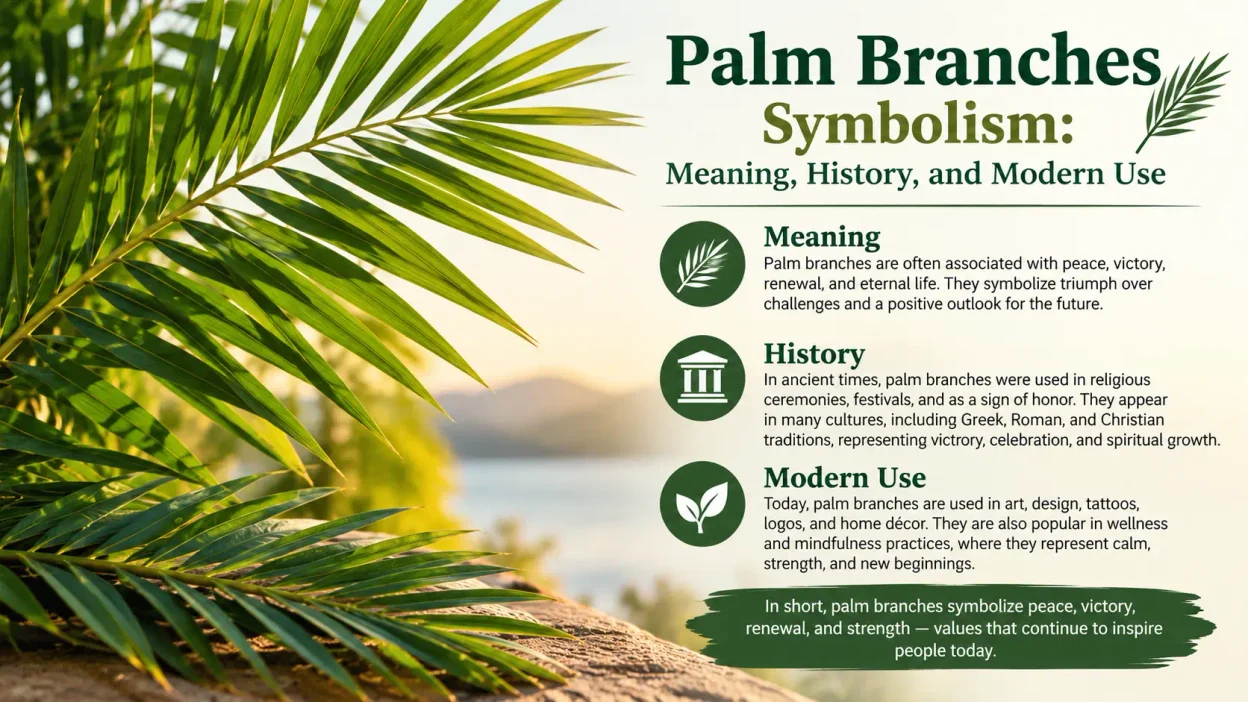
Palm branches symbolism centers on victory, peace, honor, and spiritual hope. For thousands of years, people have used palm leaves in religious ceremonies, public celebrations, and decorative art. Their long, arching fronds make them recognizable symbols of celebration, while their historical associations give them meanings that go beyond their appearance.
In the United States, palm branches are especially familiar during Palm Sunday, the Christian observance that recalls Jesus Christ’s entry into Jerusalem. Churches distribute palm fronds, arrange them into crosses, and use them in worship. Outside religious settings, palm imagery also appears in tropical decor, event decorations, architecture, and designs that suggest relaxation or achievement.
The meaning depends on where and how the branches appear. A palm carried in a religious procession communicates something different from a palm leaf used in a resort logo or a classical image of victory. Understanding these distinctions reveals how one natural object acquired several lasting cultural meanings.
Quick Answer
Palm branches symbolism most commonly represents victory, peace, celebration, and spiritual hope in modern American culture, especially in Christian worship and Palm Sunday traditions. Historically, palm branches also signified honor and triumph in ancient Mediterranean societies, where people used them in public ceremonies and images of achievement.
TL;DR
- Palm branches have long represented victory, honor, and public celebration.
- Palm Sunday connects palm fronds with Jesus’ entry into Jerusalem.
- Ancient Mediterranean cultures used palms in ceremonies honoring achievement.
- Christian traditions associate palms with faith, hope, and martyrdom.
- Modern American designs use palm leaves to suggest tropical relaxation.
- The meaning changes with religious, historical, and decorative context.
What Palm Branches Look Like and Why They Matter
Palm branches are the large leaves, or fronds, of palm trees. Depending on the species, a frond may have a featherlike shape with leaflets extending along a central stem or a fanlike structure spreading outward from a common point.
Their distinctive form makes them easy to recognize in paintings, carvings, religious objects, and decorative designs. A single frond can create a graceful curved line, while several branches arranged together can form a wreath, procession ornament, or ceremonial display.
Palm trees also grow in many warm regions, including parts of the Mediterranean, North Africa, the Middle East, Asia, and the Americas. Their presence in everyday life helped make their leaves available for practical and ceremonial uses in different societies.
The branch itself does not carry one universal meaning. Its significance comes from the action surrounding it, the culture using it, and the story associated with its display. A palm held above a crowd, for example, can communicate public honor, while a palm displayed in a church may refer to a specific religious event.
The Core Symbolism of Palm Branches
Palm branches are associated with several related ideas, but each has a distinct emphasis.
Victory is one of the best-known historical meanings. Palm leaves appeared in ancient images and celebrations connected with triumph, making them recognizable signs of achievement and recognition.
Peace is another common association. A branch held or displayed during a public gathering can suggest goodwill, welcome, or the desire for peaceful relations. In Christian contexts, palm branches may also evoke the hope of salvation and reconciliation.
Honor and celebration explain why palms have appeared in ceremonial settings. Presenting a branch can mark a person’s arrival, achievement, or elevated status within a particular tradition.
Spiritual hope is especially important in Christianity. Palm Sunday connects the branches with Jesus’ entry into Jerusalem, while some Christian traditions also use palm imagery to represent martyrdom and faithfulness.
These meanings overlap, but they are not interchangeable. Victory focuses on achievement, peace emphasizes harmony, honor recognizes a person or event, and spiritual hope relates the branch to religious belief.
Palm Branches in Ancient Mediterranean Civilizations
The use of palm branches as signs of honor and triumph predates Christianity. Palms were familiar plants in parts of the ancient Mediterranean and Near East, where they supplied food, shade, building materials, and ceremonial objects.
In ancient Greek settings, palm branches could be associated with athletic success and public recognition. Palm imagery also appeared in artistic representations of victory and achievement. Such uses helped establish the palm as a visual sign of distinction.
In the Roman world, palms appeared in artistic and ceremonial contexts connected with triumph. Their meaning varied according to the event and the image in which they appeared, but the association with success and public honor was well established.
Palm imagery also held importance in ancient Egypt and other societies of the region. In Egyptian art and religious contexts, the palm could be connected with life, regeneration, and time. These associations developed within distinct religious and cultural systems rather than from one shared interpretation.
This historical background matters because Christian palm symbolism did not emerge in isolation. Early Christian communities adopted familiar plants and images while giving them meaning within the story of Jesus and the beliefs of the church.
Why Palm Branches Represent Victory and Triumph
The association between palms and victory developed partly through their use in public recognition. A branch could be carried, presented, or shown in art to mark a successful person or an important achievement.
Unlike a weapon, a palm frond could function as a ceremonial object. It signaled that a victory had been recognized rather than simply depicting the physical act of fighting. In this way, the palm became a visual shorthand for honor and accomplishment.
This association continued through later European art and literature. Artists used palm branches in images of victorious figures, while religious paintings incorporated them into scenes involving spiritual triumph.
In modern American culture, palm imagery can still communicate success, although it is less standardized than symbols such as medals or trophies. A palm may appear in an award design, a commemorative illustration, or a classical-style emblem to suggest achievement.
The meaning depends on context. A palm in an ancient victory scene refers to public recognition, while a palm carried on Palm Sunday points to a religious narrative with a different purpose.
Palm Sunday: The Christian Meaning of Palm Branches
Palm Sunday is the most recognizable religious context for palm branches in the United States. It falls on the Sunday before Easter and begins Holy Week in many Christian traditions.
The observance recalls the Gospel accounts of Jesus entering Jerusalem before his crucifixion. In these accounts, people welcome him with branches and other gestures of public celebration. The Gospel of John specifically identifies palm branches, while the other Gospel accounts describe related details using different wording.
For Christians, the scene can express welcome, recognition, hope, and the acknowledgment of Jesus’ identity. The crowd’s celebration also creates a contrast with the suffering and death associated with the events that follow during Holy Week.
Palm Sunday is therefore not simply a celebration of victory in the ordinary sense. It connects public honor with the Christian understanding of Jesus’ mission, including the movement from his entry into Jerusalem toward the crucifixion and resurrection.
In American churches, palm fronds may be distributed during worship services, carried in processions, or displayed around the sanctuary. Congregations may sing hymns, read the biblical account, and allow worshippers to take branches home as reminders of the observance.
Practices differ among denominations and individual congregations. Some churches use fresh palm leaves, while others use prepared or woven fronds designed for handling and display.
Palm Branches and the Symbolism of Christian Martyrdom
Palm branches have another important meaning in Christian art: victory over death through faith. This association developed as Christians used the palm to represent spiritual triumph rather than military or athletic success.
In traditional paintings, mosaics, and sculptures, saints who died for their faith are often shown holding a palm frond. The branch identifies them as martyrs and communicates the belief that death did not defeat their spiritual commitment.
This imagery draws on the biblical Book of Revelation, which describes a multitude standing before God’s throne with palm branches in their hands. Christian interpreters have connected this scene with salvation, perseverance, and the final victory of the faithful.
The symbolism also explains why palms appear in funerary art and religious memorials. A palm held by a saint does not necessarily suggest that the person achieved worldly success. Instead, it points toward a religious understanding of endurance, sacrifice, and eternal life.
For modern viewers, the distinction is important. A palm in a sports-themed design may represent winning a competition, while the same branch in a painting of a saint communicates a specific Christian belief about faith and death.
Palm Branches in Jewish Tradition and Sukkot
Palm branches also have an established place in Judaism, where their significance is separate from the Christian observance of Palm Sunday.
During Sukkot, the Jewish Festival of Booths, observant Jews use the lulav, a ritual bundle containing a palm frond together with branches of myrtle and willow. The bundle is used alongside an etrog, a citron fruit, during the festival’s prescribed rituals.
Sukkot recalls the Israelites’ wilderness journey and celebrates themes connected with harvest, gratitude, and dependence on God. The palm frond is one part of a larger ritual arrangement rather than an independent symbol with exactly the same meaning as a Christian palm branch.
Palm imagery also appears in Jewish historical and artistic contexts, including ancient objects and religious decoration. These uses reflect the importance of palms in the region and their place in Jewish communal life.
The shared use of palm branches in Jewish and Christian traditions reflects overlapping geographical and historical settings, but the practices should not be treated as interchangeable. Sukkot and Palm Sunday have different religious foundations, ritual purposes, and narratives.
Recognizing this distinction makes comparisons more accurate and helps avoid reducing a meaningful Jewish practice to a precursor of a Christian ceremony.
Palm Branches in American Churches and Family Traditions
In the United States, Palm Sunday provides the most visible setting for palm branches. Many churches distribute fresh or dried fronds during services, allowing congregants to hold them during prayers, hymns, and processions.
Some congregations weave the leaves into small crosses. Others encourage worshippers to take the branches home and display them in a suitable place. These practices extend the observance beyond the church building and give the palm a continuing role in family religious life.
In churches that follow the practice, old palm branches may be collected before the next Ash Wednesday and burned to produce ashes for the following year’s observance. This custom creates a connection between two points in the Christian calendar: the celebration at the beginning of Holy Week and the penitential season that leads toward Easter.
American practices vary according to denomination, local resources, and community traditions. In areas where fresh palms are difficult to obtain, churches may use other suitable branches or substitute greenery. The religious meaning comes from the observance and its connection with the biblical story, not simply from possessing a particular plant.
For children and families, carrying a palm can make the biblical narrative tangible. Rather than hearing only about the crowd that welcomed Jesus, worshippers participate in a ceremony that recalls the event through a physical object.
Palm Branches in Modern American Design and Decoration
Outside religious settings, palm branches often communicate tropical scenery, leisure, and warmth. In the United States, palm leaves appear on resort branding, beach-themed invitations, summer clothing, restaurant decor, and travel advertisements.
These uses draw on the familiar association between palm trees and warm coastal environments. A palm frond on a greeting card may suggest a vacation, while a palm-patterned fabric can create a relaxed, summery atmosphere.
Palm imagery also appears in formal design. Classical illustrations may use the branch to suggest achievement, honor, or a traditional sense of ceremony. In this setting, the image draws more heavily on the palm’s historical association with victory than on its modern connection with beaches.
The distinction can be seen in the surrounding design elements. A palm paired with ocean waves, a sunset, and sand-colored backgrounds usually communicates leisure. A palm paired with a laurel wreath, an inscription, or a commemorative portrait may suggest honor or accomplishment.
Although these uses share the same basic shape, the intended message changes with the visual context. Designers rely on familiar associations to make the image understandable without explaining its history.
Palm Branch Tattoos, Jewelry, and Personal Expression
Palm branches can also serve as personal symbols in tattoos, jewelry, and other forms of self-expression. Their slender stems and spreading leaves make them adaptable to small, simple designs as well as larger illustrations.
A person might choose a palm branch tattoo to represent a religious commitment, particularly if the design references Palm Sunday or Christian martyrdom. Another person may use it as a reminder of a personal achievement, a meaningful journey, or a connection with a tropical place.
Jewelry featuring palm leaves can carry similar associations. A small pendant may communicate faith, while a palm motif incorporated into a bracelet or ring may simply reflect an interest in botanical design.
The surrounding imagery can make the intended meaning more specific. A palm paired with a cross often signals a Christian connection. A palm beside a date or name may commemorate an important event. A palm incorporated into a beach scene may recall travel or a favorite destination.
There is no universal rule that every palm branch tattoo means victory or peace. Personal symbolism develops through memory, belief, and individual choice. When a design is intended to represent a historical tradition, however, it is useful to distinguish documented symbolism from a modern meaning chosen by the wearer.
Emotional and Psychological Meaning of Palm Branches
Palm branches can communicate different emotions because they are associated with both celebration and reflection.
In a celebratory setting, the branch can suggest welcome, recognition, or shared joy. Its movement in a procession makes it a visible gesture, helping a group express a feeling together rather than leaving the response to individual words.
In Christian worship, the same object can prompt hope, gratitude, and reflection on sacrifice. Palm Sunday combines celebration with the knowledge that Holy Week also recalls suffering and death. This contrast gives the branch an emotional meaning that is more complex than simple happiness.
In decorative settings, palm leaves often evoke warmth and escape. People may associate them with childhood vacations, family trips, tropical destinations, or a desired change of pace. These responses arise from personal experience and repeated exposure to images of palms in travel and leisure advertising.
Psychological interpretations should not be treated as fixed rules. A palm branch cannot reveal a person’s emotional state, and the symbol does not carry the same associations for every viewer. Its effect depends on memory, cultural familiarity, and the context in which it appears.
Misunderstandings and Misuse of Palm Branch Symbolism
Several common misunderstandings arise when people treat palm branches as though they have one universal meaning.
One mistake is assuming that palms are exclusively Christian symbols. Their association with victory and public honor existed before Christianity, and palm imagery appears in multiple religious and cultural traditions.
Another is treating Palm Sunday as a celebration of uncomplicated political or military triumph. The Christian narrative involves a public welcome, but the wider story of Holy Week moves toward Jesus’ suffering and crucifixion. Christian interpretations of the palms therefore include spiritual hope and salvation, not merely worldly power.
A further misunderstanding occurs when blessed palm branches are treated as objects that automatically guarantee protection or bring good luck. Some communities have developed folk customs involving palms kept in homes or fields, but these practices should be distinguished from the central religious meaning of the observance. In Catholic teaching, for example, keeping a blessed palm is intended as a sign of faith, not a magical guarantee against harm.
Palm imagery can also be used in political or commercial settings. In such cases, it may draw on associations with victory, authority, or a tropical lifestyle without carrying a religious message. Its appearance alone does not establish the beliefs or intentions of the person displaying it.
The most reliable interpretation begins with the setting. Ask whether the branch appears in a religious ceremony, a historical image, a memorial, or a commercial design before deciding what it represents.
How the Meaning of Palm Branches Has Changed Over Time
Palm branches acquired their symbolism through repeated use in different settings. In ancient societies, they were associated with public ceremonies, recognition, and ideas connected with life and renewal. Their physical availability and distinctive appearance made them useful for both practical purposes and symbolic display.
Christian communities incorporated palm imagery into the story of Jesus’ entry into Jerusalem and developed further associations with martyrdom and spiritual victory. Over time, Palm Sunday processions became established features of Christian worship, and the distribution of branches helped preserve the tradition across generations.
Jewish ritual traditions maintained their own uses of palm fronds, especially through the lulav associated with Sukkot. Meanwhile, European art and later decorative traditions continued to use palm imagery for honor, achievement, and classical elegance.
Modern American culture added other associations, particularly through travel advertising, resort design, and tropical fashion. A palm leaf can now appear in a context with no religious or historical intention at all.
This evolution does not mean earlier meanings disappeared. Instead, several layers of symbolism remain available, and context determines which one becomes most visible. The same branch can represent religious devotion, public recognition, or a relaxing summer destination without those meanings becoming identical.
Palm Branch Symbolism at a Glance
| Context | Main meaning | Common example |
|---|---|---|
| Palm Sunday | Welcome, faith, and spiritual hope | Palm fronds distributed in church |
| Ancient public ceremonies | Victory and honor | Branches in triumphal imagery |
| Christian martyrdom | Faithfulness and victory over death | Saints depicted holding palms |
| Jewish Sukkot | Ritual observance and gratitude | Palm frond used in the lulav |
| Modern American decor | Tropical leisure and relaxation | Beach-themed art and resort designs |
| Tattoos and jewelry | Personal faith, achievement, or memory | A palm paired with a cross or meaningful date |
The context, accompanying symbols, and intended audience help determine which interpretation fits best.
Frequently Asked Questions
What do palm branches symbolize in the Bible?
In the Bible, palm branches are particularly associated with Jesus’ entry into Jerusalem, as described in the Gospel of John. They also appear in Revelation in a vision of a multitude standing before God’s throne, where Christian interpretations connect them with salvation and victory.
Why do Christians carry palm branches on Palm Sunday?
Christians carry palm branches to remember the crowd that welcomed Jesus into Jerusalem before his crucifixion. The practice turns the biblical account into a shared act of worship and marks the beginning of Holy Week.
Do palm branches symbolize peace or victory?
They can symbolize both, although victory and honor have especially strong historical associations. Peace is a common interpretation in some modern settings, but the intended meaning depends on the culture, ceremony, and surrounding imagery.
What does a palm branch tattoo mean?
A palm branch tattoo may represent Christian faith, personal achievement, remembrance, or a connection with tropical places. Designs that include a cross or other religious imagery usually provide more context than a palm branch alone.
Why are palm branches associated with martyrs?
In Christian art, the palm became a sign of spiritual victory, particularly for people who died rather than abandon their faith. Saints depicted holding palms are therefore often identified as martyrs, although the meaning of a particular image depends on its broader context.
What happens to palm branches after Palm Sunday?
Some churches encourage congregants to keep their branches at home, while others collect them for later use. In traditions that follow this custom, old palms are burned and their ashes are used on Ash Wednesday the following year.
Are palm branches considered lucky?
Some folk traditions associate palm branches with protection or good fortune, but these beliefs are not universal. In Christian worship, a blessed palm is primarily a reminder of faith and the events commemorated during Holy Week.
Conclusion
Palm branches symbolism brings together victory, honor, peace, and spiritual hope, with different traditions emphasizing different aspects of the plant. Ancient ceremonies connected palms with recognition and triumph, Christianity associated them with Jesus’ entry into Jerusalem and the victory of faith, and Jewish tradition incorporated the palm frond into the rituals of Sukkot.
In modern American culture, palm branches appear in churches, homes, tattoos, jewelry, and tropical designs. Their meaning depends on the story and setting surrounding them. Understanding that context allows the palm branch to be appreciated not as a symbol with one fixed definition, but as a familiar natural form carrying distinct historical, religious, and personal meanings.