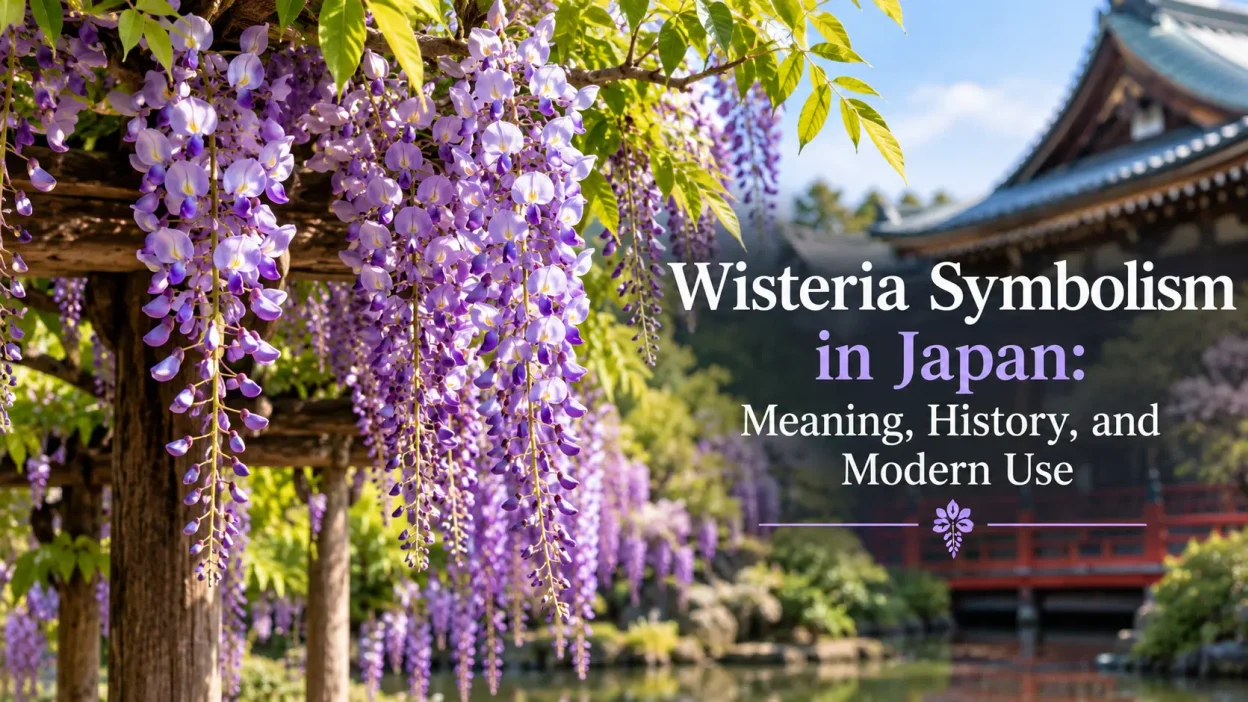
Wisteria symbolism in Japan is closely associated with elegance, graceful beauty, romance, and the passing nature of life. Known as fuji (藤) in Japanese, wisteria is a flowering vine whose long, cascading clusters appear in traditional gardens, paintings, poetry, and seasonal celebrations. Its appearance each spring has helped make it a recognizable part of Japanese visual culture.
The flower’s meaning comes from several connected qualities. Its hanging blossoms create an impression of movement and refinement, while its seasonal flowering offers a reminder that beauty does not last forever. Wisteria also has historical connections with aristocratic culture, family identity, and traditional Japanese design.
For American readers, wisteria often suggests romance, serenity, or an enchanting garden. Japanese interpretations can be more specific, particularly when the flower appears in historical artwork, literary settings, or family crests. Understanding these contexts helps distinguish traditional associations from meanings that have become popular through modern floral symbolism.
Quick Answer
Wisteria symbolism in Japan commonly represents elegance, grace, romance, and the fleeting beauty of life. Historically, the flower has also been associated with aristocratic culture, traditional Japanese art, family crests, and the seasonal appreciation of nature.
TL;DR
- Wisteria, called fuji, is associated with grace and refined beauty.
- Its spring blossoms can evoke the temporary nature of life.
- The flower has connections with Japanese aristocratic culture and traditional design.
- Wisteria appears in poetry, gardens, textiles, and family crests.
- Purple and white varieties can create different visual impressions.
- Modern Japanese and American designs use wisteria to express romance and tranquility.
What Wisteria Looks Like in Japanese Culture
<AsyncImage query=”Japanese wisteria fuji flowers cascading purple clusters traditional garden” aspectRatio=”16:9″ width=”100%”/>
Wisteria is a woody climbing vine known for its hanging clusters of flowers. Depending on the variety, the blossoms may be purple, violet, pale lavender, pink, or white. The clusters can hang like curtains from branches, pergolas, and specially constructed garden supports.
In Japan, wisteria is commonly called fuji. Its flowering season generally falls in spring, although the exact timing depends on the region, weather, and cultivar. The sight of long flower clusters hanging above a path or pond has made wisteria a popular feature of traditional Japanese gardens.
Its physical form contributes to its symbolism. Unlike a single upright flower, wisteria creates a flowing display that can soften buildings, fences, and garden structures. The hanging blossoms suggest delicacy and movement, while the established vine itself can become a substantial, long-lived plant.
These contrasting qualities help explain its appeal. Wisteria looks delicate when it blooms, yet the vine can be durable and structurally strong. In visual interpretation, that combination can suggest beauty supported by endurance, although this is an interpretive association rather than a fixed traditional definition.
Elegance, Grace, and Refined Beauty
One of the most recognizable associations of wisteria in Japanese culture is elegance. The flower’s long clusters, soft colors, and flowing shape lend themselves to images of refinement rather than boldness or aggression.
This quality fits well with traditional Japanese aesthetics that pay close attention to seasonal changes, careful composition, and the relationship between natural forms and designed spaces. Wisteria can frame a garden walkway, soften the edge of a roof, or appear in a textile pattern without overwhelming the larger design.
Its appearance also makes it suitable for formal and decorative settings. Wisteria motifs can be found in traditional arts and crafts, where curved stems and hanging blossoms provide graceful lines. The motif may be stylized rather than botanically realistic, allowing the plant’s shape to become part of a repeating pattern.
In modern settings, people may choose wisteria imagery to communicate sophistication, femininity, or understated beauty. These associations are not exclusive to Japan, but they fit naturally with the flower’s established place in Japanese visual culture.
The important distinction is that elegance is a broad interpretation supported by the flower’s appearance and artistic use, not a single official meaning that applies to every Japanese representation of wisteria.
Romance, Affection, and Emotional Attachment
Wisteria can also suggest romance and affection. Its hanging blossoms create a soft, intimate atmosphere, especially when they form a canopy over a path or gathering space. In contemporary floral design, that appearance makes wisteria suitable for wedding decorations, romantic photography, and garden ceremonies.
Japanese cultural interpretations of flowers often depend on the setting, the artwork, and the season in which a flower appears. Wisteria can contribute to a romantic mood without functioning as a universal declaration of love.
This distinction matters when comparing Japanese symbolism with Western floral traditions. In the United States, people often associate roses with romantic love because of their established role in gifts and courtship. Wisteria usually communicates romance more indirectly through its setting, color, and appearance.
Purple wisteria may evoke affection, admiration, or enchantment for a modern viewer, while white wisteria may suggest purity or quiet sophistication. Such color associations vary, however, and should not be treated as a fixed Japanese code.
When wisteria appears in a poem, painting, or personal gift, the surrounding details help determine its emotional meaning. The flower may express affection, longing, nostalgia, or an appreciation of beauty rather than one narrowly defined romantic message.
The Fleeting Beauty of Spring
<AsyncImage query=”Japanese wisteria garden spring flowers falling light serene seasonal atmosphere” aspectRatio=”16:9″ width=”100%”/>
Wisteria blooms for a limited period each year. Its dramatic display arrives in spring, reaches its peak, and eventually fades. This seasonal pattern makes the plant a natural subject for reflection on impermanence.
A major concept in Japanese aesthetics is mono no aware, a sensitivity to the passing nature of things and the emotions that arise from recognizing their impermanence. The idea is often associated with the beauty of seasonal experiences, including blossoms that cannot remain at their peak indefinitely.
Wisteria can be understood through this perspective, particularly when it appears in poetry or art that emphasizes changing seasons. Its beauty becomes meaningful partly because the display is temporary.
However, mono no aware is not a meaning exclusive to wisteria. It is a broader aesthetic concept that can be applied to many natural and human experiences. Nor should every image of wisteria be interpreted as a reference to impermanence.
In a garden, the fading flowers may simply mark the transition from one stage of spring to the next. In a poem, the same change may evoke memory, longing, or the passage of time. The symbolism depends on how the flower is presented and what the creator wants the audience to notice.
Wisteria and Japan’s Aristocratic Past Wisteria Symbolism in Japan
Wisteria has historical associations with Japan’s aristocratic culture, particularly through the prominence of the Fujiwara clan. The Fujiwara were an influential family whose members held important political positions during much of the Heian period (794–1185).
The name Fujiwara contains the character fuji (藤), meaning wisteria, along with wara (原), meaning field or plain. The association between the clan and the plant gives wisteria particular historical interest, especially when examining the relationship between natural imagery, family identity, and political status.
During the Heian period, court culture placed considerable value on poetry, seasonal awareness, clothing, and refined artistic expression. Flowers and plants could function as more than decorative details: they helped communicate taste, literary knowledge, and familiarity with established cultural conventions.
Wisteria’s association with the Fujiwara family does not mean that every wisteria motif was an official sign of aristocratic rank. The historical relationship is more specific than that. The plant’s name and its later use in family insignia helped connect it with a prominent lineage.
For modern audiences, this history adds a social dimension to the flower. Wisteria can evoke not only natural beauty but also the traditions of Japan’s courtly past and the ways families used visual motifs to express identity.
The Fujiwara Clan and the Wisteria Crest
<AsyncImage query=”Japanese traditional fuji wisteria mon family crest kamon circular stylized wisteria motif” aspectRatio=”16:9″ width=”100%”/>
Japanese family crests, known as kamon (家紋), are stylized designs associated with families and lineages. Wisteria motifs became particularly recognizable through their historical connection with the Fujiwara family and its branches.
A crest simplifies a natural form into a design that can be recognized at a glance. Wisteria clusters, leaves, and stems may be arranged symmetrically or reduced to a compact pattern. This transformation allows the plant to function as a sign of family association rather than simply an illustration of a flower.
The connection between wisteria and the Fujiwara clan is historically meaningful, but it should not be generalized to all Japanese families or all uses of the flower. Different lineages have different crests, and wisteria designs can appear as decorative motifs without implying descent from the Fujiwara.
In contemporary Japanese culture, family crests may appear on formal clothing, ceremonial objects, historical buildings, and heritage displays. A wisteria crest can therefore connect a natural image with family history, social identity, and continuity across generations.
For someone choosing wisteria imagery today, the distinction is useful. A botanical illustration emphasizes the plant’s beauty, while a traditional crest may carry a more specific historical or genealogical association.
Wisteria in Japanese Poetry and Literature
Japanese poetry has long treated seasonal plants as ways to communicate emotion, memory, and changes in human relationships. Wisteria is well suited to this tradition because its blossoms provide a clear visual impression and appear during a recognizable part of the year.
The flower can be described through its color, movement, shape, or relationship to a garden. A poet might draw attention to blossoms hanging above water or to a flowering vine that brings an earlier memory to mind. Such images can make an emotional experience concrete without explaining it directly.
Wisteria appears in classical Japanese poetic and literary traditions, including the broader world of court poetry, where plants and seasonal references often carry associations beyond their physical appearance. The meaning of a particular passage depends on its wording, historical context, and literary conventions.
It would be inaccurate to assume that every classical mention of wisteria refers to romance or aristocracy. Sometimes a plant serves as a seasonal marker or a visual detail. In other contexts, its associations with a family name, a place, or a personal memory may become more important.
Modern Japanese writers and artists can use wisteria in similar ways. A flowering vine may suggest nostalgia, a relationship that has changed, or the beauty of a moment that cannot be repeated. The plant gives these themes a recognizable seasonal form.
What Purple, White, and Pink Wisteria Can Suggest
<AsyncImage query=”Japanese wisteria flowers purple white pale pink varieties hanging clusters close up” aspectRatio=”16:9″ width=”100%”/>
Wisteria’s colors influence the mood of an image, although they do not create a universal system of Japanese symbolism. The species and cultivar, the surrounding landscape, and the purpose of the design all affect how viewers interpret the flowers.
| Color or form | Common modern association | Typical visual effect | Important distinction |
|---|---|---|---|
| Purple wisteria | Elegance, romance, admiration | Rich, graceful, and dramatic | Associations vary by context |
| White wisteria | Purity, calm, simplicity | Light, restrained, and formal | Not an exclusive symbol of purity in Japan |
| Pink wisteria | Tenderness and affection | Soft, gentle, and romantic | Often reflects modern floral design |
| Cascading clusters | Flow, delicacy, seasonal beauty | Creates movement and a canopy effect | Shape is not a fixed historical code |
Purple wisteria is especially recognizable in photographs of Japanese gardens. Its rich color contrasts with green foliage and wooden structures, creating a visual impression that many modern viewers associate with refinement or romance.
White blossoms can produce a quieter effect. In contemporary wedding or garden design, they may be chosen to create a restrained palette, but that choice does not necessarily reflect a specific traditional Japanese belief.
Pink wisteria is also used in decorative settings, although its availability depends on the cultivar. Modern floral symbolism may connect pink with affection or tenderness, but those associations should be separated from claims about established historical Japanese meanings.
The shape of the flowers matters as much as the color. A long cascade of blossoms can suggest movement and abundance even when the palette is simple.
Wisteria in Japanese Gardens and Seasonal Festivals
<AsyncImage query=”Ashikaga Flower Park Japan wisteria tunnel flowering pergola visitors spring” aspectRatio=”16:9″ width=”100%”/>
Wisteria is one of the plants that can transform a garden into a seasonal destination. Its vines are often trained over pergolas and trellises, allowing the flower clusters to hang above visitors and create shaded passages.
In Japanese garden design, the experience of a plant changes with its placement. Wisteria growing beside a pond may be reflected in the water, while a vine over a path can frame the movement of visitors. Its appearance can guide attention through a space without the need for elaborate decoration.
The flowering season also draws public interest. Ashikaga Flower Park in Tochigi Prefecture, for example, is widely known for its wisteria displays, including large trained vines and flowering tunnels. Such attractions bring together horticulture, tourism, photography, and seasonal appreciation.
These visits are not necessarily religious or symbolic ceremonies. Many people come because the flowers are beautiful and because the blooming period is limited. The experience can nevertheless encourage reflection on seasonal change and the relationship between cultivated landscapes and natural growth.
In the United States, Japanese-inspired gardens sometimes use wisteria to create a similar sense of enclosure and calm. Gardeners should remember that Japanese wisteria can become vigorous and invasive in parts of North America. American landscapes may require carefully selected species, cultivars, or alternatives suited to local conditions.
Wisteria in Japanese Art, Textiles, and Traditional Design
Wisteria’s hanging clusters and curling stems lend themselves to decorative composition. In Japanese art, the plant can appear in paintings, printed imagery, ceramics, kimono patterns, and other forms of design.
Textile patterns are especially well suited to wisteria because the vine’s shape can be arranged into flowing lines or repeating motifs. The blossoms can be rendered realistically or simplified into recognizable clusters. Either approach can bring movement to a garment or decorative surface.
In traditional clothing, floral patterns may relate to the season, the occasion, and the overall design. Wisteria can contribute a springtime impression or an elegant visual theme. The exact interpretation depends on the garment and the conventions surrounding its use.
Artists also use wisteria to create contrasts between built structures and the natural world. A flowering vine draped over a wooden gate, for instance, brings softness to a rigid architectural form. The image can suggest harmony between human design and plant growth without requiring a specific spiritual explanation.
Today, wisteria motifs appear in contemporary illustration, stationery, home decor, and fashion. These designs may draw on Japanese aesthetics, but not every product featuring wisteria has a direct historical connection to traditional Japanese art.
Wisteria Symbolism in Modern American Culture
For American audiences, wisteria often combines the appeal of Japanese garden imagery with familiar associations of romance, beauty, and tranquility. Photographs of flowering pergolas are common in garden inspiration, wedding design, travel photography, and home decor.
The flower’s Japanese background adds another layer. People who appreciate Japanese gardens, traditional textiles, or seasonal aesthetics may choose wisteria because it suggests a connection to Japanese art and landscape design.
That interest can be meaningful when it includes an understanding of the plant’s cultural context. Learning about fuji, the Fujiwara connection, and the role of wisteria in Japanese gardens gives the image more substance than treating it as a generic sign of spirituality.
In American weddings, wisteria may be used for floral arches, ceremony backdrops, and romantic photography. In home decor, it can create a soft botanical theme. In tattoos, it may represent affection, personal growth, or an interest in Japanese culture.
These uses reflect contemporary American choices rather than a single Japanese tradition. The flower can carry different meanings for different people, and its cultural background does not require every modern use to reproduce historical symbolism.
Wisteria in Tattoos, Jewelry, and Personal Expression
Wisteria is a popular visual choice for people who want a floral design with flowing lines and a recognizable seasonal association. Its hanging clusters can follow the shape of an arm, shoulder, back, or leg, making it adaptable to different tattoo compositions.
A wisteria tattoo may express elegance, affection, memory, or appreciation for nature. Someone may choose it to remember a visit to Japan, celebrate a relationship, or mark a personal connection with spring. The flower’s temporary bloom can also inspire a reminder to appreciate experiences while they last.
In jewelry, wisteria may appear as a pendant, an engraved motif, or a floral arrangement in metalwork. Such pieces can be selected for their appearance alone or for a personal connection to Japanese culture.
Design context matters. A wisteria branch rendered in a traditional Japanese artistic style communicates something different from a minimal botanical outline. A crest-inspired design may also suggest family heritage, although the wearer should not assume a historical lineage merely because a wisteria motif is present.
For a culturally informed design, it helps to know whether the intended reference is botanical, literary, historical, or simply aesthetic. That clarity makes personal symbolism more deliberate and avoids presenting a modern invention as an ancient tradition.
Emotional and Psychological Meaning of Wisteria
Wisteria can create a feeling of calm because its hanging blossoms soften visual boundaries and form a gentle canopy. The effect is partly environmental: filtered light, greenery, and flowers can make a garden feel sheltered and removed from busy surroundings.
Its seasonal nature can also prompt reflection. Knowing that the flowers will fade may encourage people to pay closer attention to the present moment. This response connects naturally with the broader Japanese aesthetic appreciation of changing seasons, though individual reactions vary.
Wisteria can communicate romance without the directness of a rose. Its clusters may suggest an atmosphere, a memory, or a place shared with another person. For someone who associates the flower with a particular garden or journey, the personal memory may be more important than any general symbolic definition.
Psychological interpretations should remain flexible. Choosing wisteria does not establish that someone is refined, romantic, or emotionally sensitive. It shows only that the person finds something meaningful or appealing in the image.
The flower’s value as a symbol comes from the relationship between its physical qualities, cultural history, and the meaning a viewer brings to it.
<WritingBlock id=”62742″ variant=”document”>## Common Misunderstandings About Japanese Wisteria Symbolism
Wisteria has accumulated many interpretations, and some modern explanations present them as if they were universal Japanese beliefs. A careful reading separates established historical connections from broader symbolic possibilities.
One misconception is that wisteria has a single, fixed meaning in Japan. The flower can appear in a family crest, a seasonal poem, a garden, or a modern wedding arrangement, and each setting changes how it is understood.
Another mistake is to assume that every wisteria motif represents romantic love. Romance is a common modern interpretation, but the flower can also serve decorative, seasonal, historical, or family-related purposes.
The association with the Fujiwara clan also requires precision. The connection is historically significant, but a wisteria image alone does not establish that a person or family belongs to that lineage. Traditional crests have specific histories, and similar floral designs can be used for different reasons.
Finally, Japanese concepts such as mono no aware should not be treated as exclusive explanations for every seasonal flower. The concept offers a useful way to understand the emotional response to fading blossoms, but it does not define every wisteria image or every Japanese person’s interpretation.
Respectful symbolism does not require assigning an ancient meaning to every detail. It is more accurate to identify the documented context and allow room for modern personal expression.
How Wisteria’s Meaning Has Changed Over Time
Wisteria’s cultural role developed through several overlapping traditions rather than one fixed symbolic system. Its association with the Fujiwara clan gave the plant a historical connection with family identity and elite culture. Its seasonal flowering also made it suitable for poetry, garden design, and artistic representations of nature.
Over time, the flower continued to appear in Japanese decorative arts and landscape design. Its recognizable form made it adaptable to changing styles while retaining its connection to spring and traditional visual culture.
In contemporary Japan, wisteria is appreciated through gardens, public flower displays, photography, and design. Some people approach it through historical interest, while others simply enjoy the seasonal spectacle. These motivations can exist side by side.
International exposure has added further interpretations. In the United States and elsewhere, wisteria may be used to represent romance, femininity, tranquility, or spiritual growth. Some of these associations overlap with Japanese aesthetic traditions, while others come from modern Western floral symbolism.
This evolution illustrates how symbols remain useful without retaining one exclusive meaning. Wisteria can preserve historical associations while also becoming part of new artistic and personal expressions.
Frequently Asked Questions
What does wisteria symbolize in Japanese culture?
Wisteria is commonly associated with elegance, grace, and the beauty of the spring season. Its historical connection with the Fujiwara clan also gives it associations with family identity and Japan’s aristocratic past.
Does wisteria symbolize love in Japan?
Wisteria can express romance and affection, particularly in contemporary art and floral arrangements. However, it is not a universal or exclusive Japanese symbol of romantic love, and its meaning depends on the context.
Why is wisteria important in Japanese history?
Wisteria is historically connected with the Fujiwara clan, an influential aristocratic family whose members played major roles in Japanese politics during the Heian period. The plant also became an established motif in Japanese artistic and decorative traditions.
What does a wisteria tattoo mean?
A wisteria tattoo may represent elegance, affection, seasonal change, or a personal connection to Japan. Its meaning can also reflect a specific memory, relationship, or appreciation of Japanese garden and floral art.
Does wisteria symbolize impermanence in Japanese aesthetics?
Wisteria can evoke impermanence because its blossoms appear for a limited time and then fade. This interpretation relates to the broader Japanese aesthetic concept of mono no aware, which concerns sensitivity to the passing nature of things.
What do purple and white wisteria mean in Japan?
Purple wisteria is often interpreted in modern floral design as elegant or romantic, while white varieties may suggest simplicity and calm. These are flexible associations rather than a universally established traditional Japanese color code.
Is wisteria a traditional Japanese symbol of good luck?
Wisteria has historical and decorative importance in Japan, but it is not universally recognized as a symbol of good luck in every traditional context. Claims about luck should be evaluated according to the specific artwork, custom, or historical setting involved.
Conclusion
Wisteria symbolism in Japan brings together graceful beauty, seasonal change, historical identity, and artistic expression. Its connection with the Fujiwara clan gives it a distinctive place in Japanese cultural history, while its flowering season and flowing clusters make it a natural subject for poetry, gardens, and decorative art.
In modern American culture, wisteria often represents romance, elegance, and tranquility, sometimes alongside an appreciation of Japanese aesthetics. These interpretations can be meaningful without being treated as universal ancient beliefs. Understanding the flower’s history allows its beauty to be appreciated with greater cultural awareness, whether it appears in a garden, a painting, or a personal design.