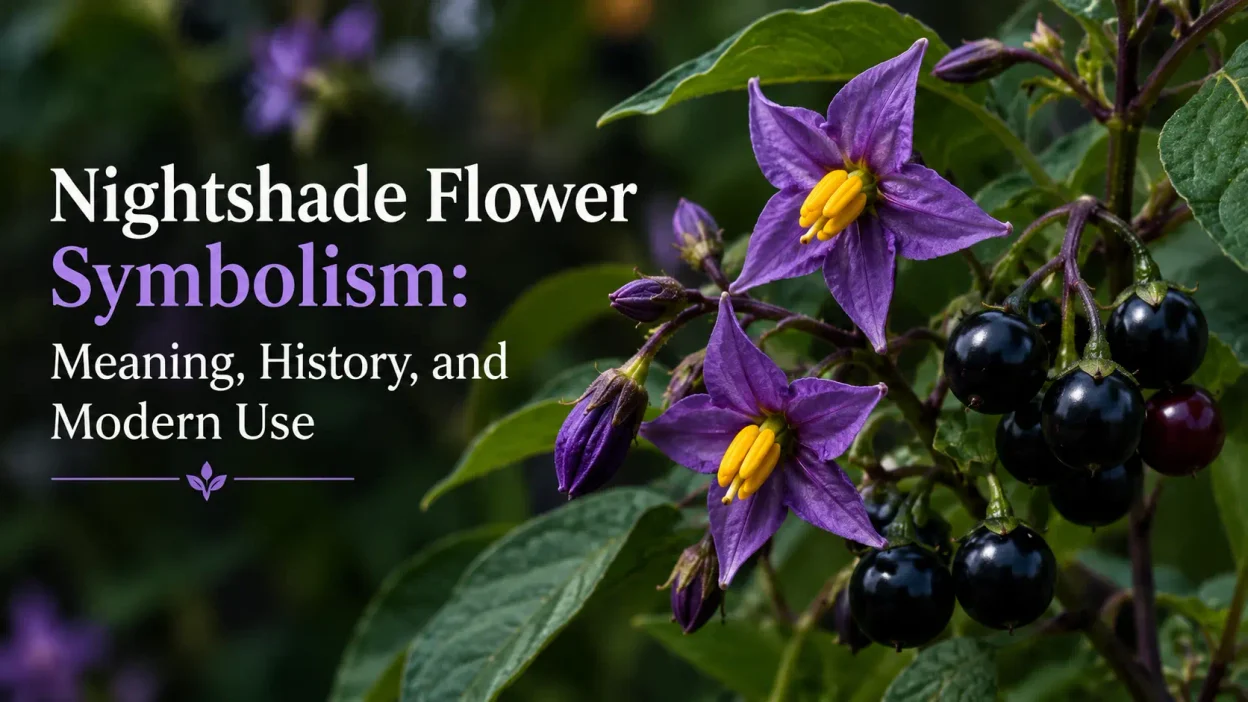
Nightshade flower symbolism often centers on beauty, danger, secrecy, and transformation. Nightshade plants produce delicate flowers and, in some species, striking berries, creating a contrast between an attractive appearance and potentially toxic parts. In the United States, this contrast makes nightshade a compelling image in gothic art, botanical illustration, literature, and personal jewelry.
The word nightshade refers to plants in the nightshade family, Solanaceae, rather than one single flower. This family includes familiar food plants such as tomatoes, potatoes, and peppers, as well as poisonous species such as deadly nightshade. Their flowers differ in shape and color, so the symbolism depends partly on which plant someone has in mind.
Understanding the flower’s meaning requires separating botanical facts from folklore and modern creative interpretations. Nightshade has a genuine historical association with poisonous plants and medicinal preparations, but ideas about secrecy, forbidden knowledge, and hidden beauty often emerge from how writers and artists use it rather than from one universal ancient tradition.
Quick Answer
Nightshade flower symbolism commonly represents danger hidden behind beauty, mystery, and transformation in modern American culture, especially in gothic art, tattoos, and dark botanical designs. Historically, certain nightshade plants were associated with poison, medicinal use, folklore, and witchcraft, while their precise meanings varied across cultures and periods.
TL;DR
- Nightshade often represents beauty that conceals danger or uncertainty.
- Deadly nightshade has historical associations with poison and medicinal knowledge.
- Purple and white blossoms create different visual moods in modern art.
- Gothic literature uses nightshade to suggest secrecy and forbidden subjects.
- Tattoos and jewelry turn the flower into a symbol of individuality.
- Botanical identification matters because nightshade species differ in toxicity.
What Is the Nightshade Flower?
Nightshade is a common name applied to several plants, especially those in the genus Solanum and the species Atropa belladonna, commonly known as deadly nightshade. These plants belong to the broader nightshade family, which contains thousands of species with different appearances and uses.
The flowers vary considerably. Some Solanum species have small, star-shaped blossoms, often white, purple, or bluish, with a distinctive cluster of yellow anthers at the center. Deadly nightshade produces bell-shaped flowers that are typically dull purple or brownish-purple, followed by glossy, dark berries.
These visual differences affect how people interpret the plant. A delicate purple blossom may suggest elegance and secrecy, while a dark berry beside a flower can emphasize the contrast between an inviting appearance and a potentially dangerous substance.
Nightshade appears in botanical gardens, old herbals, fantasy illustrations, decorative prints, and contemporary alternative fashion. Its recognizable name and varied appearance allow it to work as both a real botanical subject and a literary symbol.
However, not every plant called nightshade is equally poisonous, and not every member of the nightshade family is dangerous to eat. The symbolism of the plant should never replace accurate botanical identification.
The Core Meaning of Nightshade Flower Symbolism
The most recognizable modern interpretation of nightshade is beauty combined with danger. The plant can appear delicate or attractive, yet certain species contain compounds that can cause severe poisoning. This contrast gives writers and artists a concrete reason to use nightshade as an image of something appealing but risky.
A second association is mystery. The name itself evokes darkness, while the plant’s historical reputation connects it with substances that were not always understood or safely handled. In fiction, a nightshade flower may therefore signal concealed motives, secret knowledge, or an unsettling discovery.
Transformation is another possible meaning. Some nightshade plants have been used in medicinal and cultural contexts, while others have served as food crops. The same botanical family can be connected with nourishment, treatment, toxicity, and danger, depending on the species and circumstances.
These meanings are related, but they are not interchangeable. Beauty and danger arise from the plant’s appearance and toxicity; mystery often comes from its cultural reputation; transformation is a broader interpretation used in contemporary symbolism. None is a fixed meaning shared by every culture.
Historical Roots: Poison, Medicine, and Botanical Knowledge
Nightshade’s historical symbolism developed partly from the practical importance of plants that could both affect the human body and cause harm. Before modern toxicology, identifying a plant’s properties depended on accumulated observation, traditional knowledge, and the written records of herbalists and physicians.
Deadly nightshade, or Atropa belladonna, contains tropane alkaloids, including atropine and scopolamine. These substances affect the nervous system, and exposure can cause serious poisoning. The plant’s toxicity contributed to its place in historical discussions of poisons and medicinal preparations.
The name belladonna comes from Italian words meaning “beautiful woman.” The name is associated with historical cosmetic practices in which preparations made from the plant were used to dilate women’s pupils. Such use could cause dangerous side effects and is not a safe cosmetic practice.
The plant’s history illustrates why nightshade can symbolize beauty at a cost. Its attractive appearance and historical cosmetic associations exist alongside the real dangers of its chemistry.
Still, the history should not be simplified into the claim that all nightshade plants were feared or avoided. Tomatoes, potatoes, peppers, and eggplants belong to the same botanical family, and many have become important foods. The family name covers plants with very different relationships to human life.
Why Nightshade Became Associated With Witchcraft and Folklore
Nightshade’s association with witchcraft grew from a mixture of plant toxicity, traditional medicine, folklore, and later literary storytelling. Plants that altered perception or caused severe physical effects could become surrounded by fear, secrecy, and speculation, particularly when their properties were poorly understood.
Deadly nightshade is often mentioned in discussions of European folklore involving witches and supposed magical preparations. Other plants in the broader nightshade family, including henbane and mandrake, also appear in historical accounts of magic, medicine, and superstition. These are related botanical subjects, but they are not interchangeable species.
During periods when accusations of witchcraft shaped European communities, knowledge of unusual plants could be interpreted through religious beliefs and fears about harmful magic. Yet it would be inaccurate to claim that every herbalist who handled a poisonous plant was a witch or that all nightshade species held the same place in magical traditions.
Modern fantasy and gothic fiction have expanded these associations. A nightshade flower in a story may suggest a forbidden garden, a secret potion, a dangerous bargain, or knowledge that carries consequences. These images draw on historical reputations but often belong to the author’s fictional world rather than to a documented historical ritual.
The flower’s connection with witchcraft is therefore best understood as a layered tradition, combining real botanical risks with folklore and imaginative reinterpretation.
Nightshade Symbolism in Gothic Literature and Dark Art
Nightshade fits naturally into gothic art because it combines delicate botanical features with associations of toxicity, secrecy, and death. Gothic storytelling often places beauty beside decay or danger, and the nightshade plant provides a recognizable visual way to express that tension.
An illustrator might place purple nightshade flowers against a nearly black background, using the pale petals and dark shadows to create an unsettling atmosphere. A novelist might describe the plant growing near an abandoned house to suggest that the setting conceals a troubling history.
The flower can also represent forbidden knowledge. In a fictional garden, a poisonous plant may mark the boundary between ordinary curiosity and a choice with serious consequences. Its presence can imply that something valuable or beautiful carries a risk the characters do not fully understand.
These associations are especially common in contemporary dark botanical aesthetics, which combine flowers, thorny stems, deep colors, antique illustrations, and references to death or transformation. Nightshade works well in this style because its real botanical history gives the image more substance than a purely invented plant would have.
However, nightshade is not inherently gothic. A scientific illustration may focus on its flower structure, while a garden photograph may simply document a plant. The mood comes from the way the plant is presented and the cultural associations viewers bring to it.
What Nightshade Means in Modern American Culture
In the United States, nightshade flower symbolism is largely shaped by popular culture, botanical interest, gothic design, and the modern fascination with plants that appear beautiful but can be dangerous.
Unlike roses, which have widely recognized associations with romance, nightshade does not have one established public meaning. Someone encountering it in a botanical garden may think about plant identification, while someone seeing it in a fantasy illustration may associate it with magic or hidden danger.
American alternative fashion and dark floral design have helped make poisonous plants appealing subjects for jewelry, clothing, tattoos, and decorative artwork. Nightshade can communicate an interest in the unusual, an appreciation for darker aesthetics, or a preference for symbols that resist conventional ideas of sweetness and innocence.
Its meaning can also depend on the setting. A nightshade illustration on a vintage-style label may evoke historical herbalism. The same flower printed on a black T-shirt may communicate gothic style, while a botanical drawing in a classroom may emphasize scientific classification.
These interpretations are not contradictory. They demonstrate how a plant can function as a cultural symbol without having a single fixed meaning.
Purple, White, and Dark Nightshade Flowers: Do Colors Change the Meaning?
Color influences how people interpret flowers, although there is no universal color code for nightshade symbolism. The colors associated with the flower often reflect general conventions in American floral design rather than a specific historical nightshade tradition.
<box gap={3}> <row align=start gap={3}> <AsyncImage query=”purple deadly nightshade Atropa belladonna flowers botanical close up” aspectRatio=”3:4″ width=”112px”/> <box flex=”1″ gap={1}> **Purple nightshade**
  Purple flowers often suggest mystery, imagination, individuality, or a connection with gothic aesthetics. When used in nightshade artwork, the color can reinforce the plant's association with secrecy and unusual beauty.
</box>
</row> <divider color=”subtle”/> <row align=start gap={3}> <AsyncImage query=”white Solanum nightshade flowers yellow anthers botanical macro photography” aspectRatio=”3:4″ width=”112px”/> <box flex=”1″ gap={1}> **White nightshade**
  White blossoms can create an impression of simplicity, delicacy, or contrast against darker surroundings. In contemporary designs, this contrast may suggest innocence alongside danger, but that is an artistic interpretation rather than an established botanical meaning.
</box>
</row> <divider color=”subtle”/> <row align=start gap={3}> <AsyncImage query=”Atropa belladonna dark glossy berries purple bell flowers botanical illustration” aspectRatio=”3:4″ width=”112px”/> <box flex=”1″ gap={1}> **Dark berries and deep tones**
  Dark berries, shadows, and muted colors can emphasize the plant's association with toxicity, secrecy, and mortality. This visual approach is common in dark botanical illustration, although the berries themselves are not flowers.
</box>
</row> </box>
A flower’s actual color depends on the species and its growing conditions. When interpreting an image, it helps to identify the plant before assigning symbolic meaning based on its appearance.
Nightshade as a Symbol of Hidden Danger
The contrast between appearance and risk is one of the clearest reasons nightshade works as a modern symbol. A flower may look delicate, while the plant’s chemistry presents a hazard that is not obvious from its appearance alone.
In literature, this contrast can represent a person who seems trustworthy but conceals harmful intentions. It can also represent a tempting opportunity whose consequences have not been fully considered.
The symbolism is not limited to deception. Nightshade can suggest that people and situations are more complicated than they first appear. Something may be attractive without being safe, and something dangerous may still deserve careful study rather than automatic fear.
This interpretation makes nightshade useful in stories about secrets, manipulation, risky decisions, and the cost of pursuing forbidden knowledge. The plant provides a visual metaphor without requiring the writer to explain the entire idea directly.
In real life, however, a plant’s appearance cannot reliably indicate its toxicity. Nightshade symbolism may invite reflection, but botanical safety depends on accurate identification and evidence, not on whether a plant looks threatening.
Beauty, Femininity, and the Belladonna Connection
Deadly nightshade has a particular historical association with beauty through its name, belladonna. The connection with cosmetic practices gives the plant a complicated place in discussions of appearance, femininity, and the risks people have taken to meet cultural beauty standards.
Historical accounts describe the use of belladonna preparations to dilate pupils. Although this practice has become part of the plant’s cultural reputation, it carried significant risks because the substances involved can affect vision, heart rate, body temperature, and the nervous system.
Modern writers may use belladonna as a symbol of beauty that demands a price, or of a person who refuses to separate attractiveness from danger. In a character’s portrait, the flower might suggest self-invention, social pressure, vanity, or the tension between outward appearance and physical well-being.
These interpretations are particularly relevant to contemporary discussions of beauty culture, where people consider the relationship between appearance, identity, and risk. However, they should not be treated as the plant’s only meaning or as evidence that women historically shared one attitude toward beauty.
The historical association gives the symbol a specific context, while modern artists decide which aspects of that history they want to emphasize.
Emotional and Psychological Meaning of Nightshade
Nightshade can communicate several emotions at once because its visual appeal contrasts with its reputation. Depending on the artwork, it may feel elegant, unsettling, secretive, or quietly defiant.
For some people, the flower represents comfort with complexity. They may appreciate symbols that acknowledge that attractive things can carry risks and that people can have qualities that do not fit neatly into categories such as good or bad.
Others may choose nightshade because it expresses individuality. A less familiar flower can distinguish a personal style from conventional floral imagery, especially when paired with dark colors, antique botanical drawings, or unusual jewelry.
The plant may also remind viewers of boundaries and informed choices. Its toxicity provides a concrete basis for a metaphor about recognizing risks, questioning appearances, and respecting what one does not fully understand.
These psychological associations are possibilities, not personality tests. Choosing nightshade jewelry or a tattoo does not reveal whether someone is secretive, rebellious, or emotionally guarded. The wearer’s personal explanation is more reliable than assumptions based on the symbol alone.
Nightshade Tattoos, Jewelry, and Personal Style
Nightshade appears in modern body art and accessories because it combines attractive botanical forms with associations that are less conventional than those of many familiar flowers.
<AsyncImageGroup query={[“nightshade flower botanical tattoo blackwork forearm design”,”purple belladonna flower fine line botanical tattoo”,”dark botanical nightshade flower silver pendant jewelry”]} aspectRatio=”4:5″ layout=”bento” size=”lg”/>
A nightshade tattoo may represent an interest in gothic literature, poisonous plants, personal transformation, or the relationship between beauty and risk. Some designs feature a single flower, while others include berries, leaves, botanical labels, or a dark woodland setting.
Jewelry often simplifies the plant into a recognizable flower or branch. A small pendant can serve as a personal reference to nature, while a more elaborate design may reflect an interest in botanical history or dark romantic aesthetics.
Before choosing a design described as belladonna or deadly nightshade, it is worth checking the botanical reference. Artists sometimes combine features from different species or use the word nightshade for a fictional flower.
There is no requirement for a tattoo or piece of jewelry to follow a historical interpretation. A contemporary design can have personal significance even if its meaning was created by the wearer. The important distinction is between expressing an individual idea and claiming that the design reproduces a documented ancient symbol.
Nightshade in Gardens, Home Decor, and Botanical Illustration
Nightshade imagery can be used in home decor without necessarily communicating danger or witchcraft. Botanical prints, vintage-style illustrations, notebooks, textiles, and framed plant studies often feature unusual flowers because of their distinctive shapes and colors.
In a dark botanical interior, nightshade may complement antique furniture, black frames, muted purple accents, or illustrations of other woodland plants. The result can feel dramatic without relying on supernatural imagery.
Scientific botanical illustration uses a different approach. It may show flowers, leaves, stems, and fruit together so viewers can distinguish the species. In this context, accuracy and observation matter more than symbolic associations.
Gardeners should also distinguish between using a nightshade image for decoration and growing an actual plant. Some species are toxic, and their berries can pose risks to children and pets. A plant’s ornamental appeal does not make it safe to handle or consume.
For most decorative purposes, printed illustrations or artificial botanical arrangements can provide the visual effect without introducing the risks associated with a poisonous plant.
Nightshade Across Cultures: Similar Images, Different Traditions
Plants associated with toxicity, medicine, or altered perception appear in many cultural traditions. Their meanings, however, depend on the specific species and historical context.
European herbal traditions contributed significantly to the modern reputation of deadly nightshade, especially through medicinal writing, poison lore, and stories about witchcraft. These histories helped shape the plant’s place in contemporary gothic imagery.
In other settings, plants from the nightshade family have been valued as food crops. Tomatoes, potatoes, eggplants, and peppers are important in cuisines around the world, showing that the family’s broader identity cannot be reduced to poison or darkness.
The term nightshade can also create confusion when different plants are grouped together in popular writing. A poisonous species discussed in European folklore should not automatically be treated as culturally or medicinally equivalent to a food plant or another member of the family.
Cross-cultural interpretation is most reliable when it begins with the exact species and tradition. General themes such as danger or healing may appear in different places, but similar themes do not prove that cultures share the same beliefs about a particular flower.
Common Misunderstandings About Nightshade Flower Symbolism
One frequent misunderstanding is that all nightshade plants are poisonous in the same way. The nightshade family includes many species, and their toxicity varies considerably. Deadly nightshade is not interchangeable with tomatoes, potatoes, or every wild plant commonly called nightshade.
Another mistake is to assume that nightshade has one established spiritual meaning. There is no universal historical system in which the flower always represents witchcraft, death, protection, or transformation. Such meanings depend on particular stories, artistic traditions, and personal interpretations.
It is also misleading to describe every use of nightshade in historical medicine as evidence of witchcraft. Herbal knowledge existed in many settings, and poisonous plants could be studied or used for medicinal purposes without necessarily being associated with magic.
Finally, modern online symbolism lists sometimes present invented meanings as ancient facts. A claim that nightshade represents a specific spiritual power, relationship outcome, or universal omen should be treated cautiously unless its historical basis can be demonstrated.
A symbol does not need an ancient origin to be meaningful. Clear distinctions between documented history, folklore, and modern creativity make its interpretation more useful and credible.
How Nightshade Symbolism Has Changed Over Time
Nightshade’s modern meaning reflects several layers of cultural history. Its botanical properties contributed to its reputation as a plant requiring knowledge and caution, while historical cosmetic and medicinal practices added associations with beauty and risk.
Folklore and witchcraft narratives introduced another layer, connecting certain poisonous plants with secrecy, fear, and supposed supernatural practices. Later literature and visual art used these associations to create atmospheres of danger, temptation, and forbidden knowledge.
Contemporary American culture has expanded the flower’s role through gothic fashion, fantasy fiction, tattoos, social media imagery, and botanical decor. People now use nightshade to express personal identity or aesthetic preferences, even when they have little knowledge of its historical background.
This change does not mean the earlier associations have disappeared. Instead, different meanings operate together. A nightshade illustration can be botanically accurate, historically suggestive, and personally meaningful at the same time.
The plant’s symbolism remains flexible because its physical appearance, toxicity, and cultural history provide several distinct starting points for interpretation.
Nightshade Flower Symbolism at a Glance
| Context | Common symbolic meaning | Basis of interpretation |
|---|---|---|
| Gothic art and literature | Secrecy, danger, forbidden knowledge | Literary use and historical poison associations |
| Purple flower designs | Mystery and individuality | Modern color conventions and visual style |
| Belladonna imagery | Beauty with potential risks | Historical cosmetic use and toxicity |
| Tattoos and jewelry | Personal identity and unconventional beauty | Individual meaning and contemporary design |
| Botanical illustration | Natural complexity and scientific interest | Plant structure and species identification |
| Folklore-inspired artwork | Witchcraft and hidden knowledge | European folklore and later fictional retellings |
These meanings are common interpretations rather than a universal symbolic code. The plant species, surrounding imagery, and creator’s intention all influence how a particular design should be understood.
Frequently Asked Questions
What does the nightshade flower symbolize spiritually?
In contemporary spiritual interpretations, nightshade may represent transformation, hidden truths, boundaries, or the need to look beyond appearances. These meanings vary among individuals and should not be presented as a single established belief shared by all spiritual traditions.
Is nightshade a symbol of death?
Nightshade can symbolize death or danger in gothic art because certain species are poisonous and have historical associations with toxic substances. However, death is not its only meaning, and many modern designs emphasize beauty, mystery, or individuality instead.
What does a nightshade flower tattoo mean?
A nightshade tattoo may express an appreciation for dark botanical art, personal independence, or the contrast between beauty and risk. Its meaning depends on the wearer’s intention and the design’s details, including whether it depicts deadly nightshade or another species.
Is nightshade associated with witches?
Certain nightshade plants, especially deadly nightshade, have associations with European folklore and stories about witchcraft. These connections developed through a combination of plant toxicity, historical beliefs, and later literature, rather than through one universal tradition involving every nightshade species.
Does the color of a nightshade flower change its symbolism?
Purple nightshade flowers may be used to suggest mystery or individuality, while white blossoms can create an impression of delicacy or contrast. These are modern artistic interpretations, not fixed historical meanings assigned to each flower color.
Is nightshade a positive or negative symbol?
Nightshade can carry either positive or negative associations depending on the context. It may represent individuality, beauty, and transformation in one design, while suggesting deception, toxicity, or danger in another.
Are all nightshade flowers poisonous?
No. The nightshade family contains many species with different properties, including familiar food plants and highly toxic plants such as deadly nightshade. Never eat an unidentified plant or assume that its flowers or berries are safe because they look attractive.
Conclusion
Nightshade flower symbolism brings together beauty, danger, secrecy, and transformation. Its history is connected with the real properties of certain poisonous plants, traditional herbal knowledge, and folklore, while modern American interpretations draw heavily on gothic literature, botanical art, fashion, and personal expression.
The flower’s most useful meaning comes from the contrast between its appearance and what it represents in a particular setting. Whether it appears in a tattoo, a botanical print, or a fictional garden, nightshade reminds viewers that an attractive image can carry more than one interpretation. Understanding its botanical identity and cultural history makes that symbolism more precise, without limiting the personal meaning people choose to give it.