
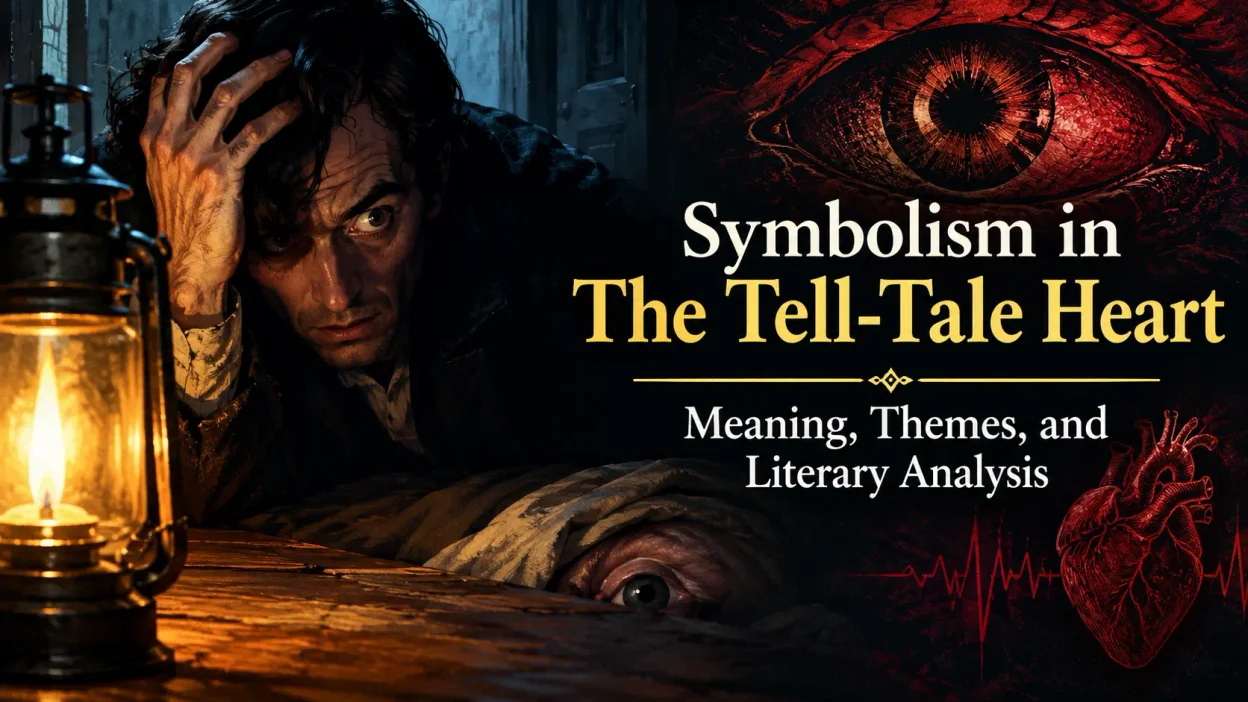
The symbolism in The Tell-Tale Heart reveals how guilt, fear, and an unstable sense of reality can shape a person’s actions. Written by Edgar Allan Poe and published in 1843, this short story follows an unnamed narrator who insists that he is sane while describing how he murders an old man and attempts to conceal the crime.
At first, the story appears to be a tale about murder and a mysterious beating sound. However, Poe uses ordinary objects, repeated images, and the narrator’s increasingly desperate behavior to explore psychological conflict. The old man’s pale blue eye, the sound beneath the floorboards, and the narrator’s careful handling of the body all carry meanings beyond their literal roles.
For American readers, the story remains a familiar example of Gothic fiction and psychological horror. Its symbols also connect with modern discussions of guilt, unreliable narration, paranoia, and the difference between what people believe and what they can prove.
Quick Answer
Symbolism in The Tell-Tale Heart commonly represents guilt, psychological instability, fear, and the consequences of trying to hide wrongdoing. Poe uses the old man’s eye, the imagined beating heart, and the concealed body to show how the narrator’s obsession and growing guilt undermine his attempt to appear sane.
TL;DR
- The old man’s eye symbolizes the narrator’s obsession and perceived threat.
- The beating heart represents guilt, fear, and the narrator’s psychological unraveling.
- The floorboards symbolize concealment and the fragile control the narrator tries to maintain.
- Darkness and nighttime create secrecy, suspense, and psychological unease.
- The narrator’s repeated claims of sanity make his reliability increasingly doubtful.
- Poe’s Gothic symbols continue to influence American horror and psychological storytelling.
1. The Old Man’s Eye as a Symbol of Obsession
The old man’s eye is the story’s most recognizable symbol. The narrator describes it as a pale blue eye with a film over it, comparing it to the eye of a vulture. He claims that the eye, rather than the old man himself, drives him to commit murder.
This distinction is essential. The narrator provides no reasonable evidence that the old man has harmed him or intends to do so. Instead, he turns one physical feature into the center of an overwhelming fixation.
The eye can therefore symbolize obsession: a person becomes so focused on one detail that it distorts everything else. The narrator treats the eye as if it were a threat that must be eliminated, even though the story gives readers no objective reason to accept that interpretation.
The eye also suggests the fear of being watched or judged. Although Poe never confirms that the eye possesses supernatural powers, the narrator behaves as if its presence makes him uncomfortable and exposed.
For readers, the eye demonstrates how an ordinary feature can acquire an exaggerated meaning inside a troubled mind. The horror comes not from the eye itself but from the narrator’s inability to separate his perception from reality.
2. The Beating Heart and the Symbolism of Guilt
The beating heart is the story’s central symbol of guilt and psychological collapse. After murdering the old man and hiding his body beneath the floorboards, the narrator hears what he believes is a steady, increasingly loud heartbeat.
At first, he tries to maintain control. He speaks confidently with the police officers who arrive to investigate a reported scream. As the sound seems to grow louder, however, his composure breaks down.
The heart can be read as the narrator’s conscience, the part of him that cannot accept the crime as successfully concealed. Even though he has hidden the physical evidence, he cannot escape the mental consequences of what he has done.
Poe leaves the sound open to interpretation. It may represent an imagined noise produced by the narrator’s disturbed mental state, an exaggerated perception of an ordinary sound, or a Gothic device that makes internal guilt seem physically present. The story does not establish that the dead man’s heart literally continues beating beneath the floor.
That uncertainty makes the symbol effective. Readers experience the narrator’s growing distress without receiving independent confirmation of what he hears.
3. The Floorboards as a Symbol of Concealment
The narrator carefully dismantles the old man’s body and places the remains beneath the floorboards. He then restores the room so that it appears undisturbed.
The floorboards represent the boundary between what the narrator wants others to see and what he desperately wants to keep hidden. On the surface, the room looks normal. Beneath it lies the evidence of a violent crime.
This arrangement also reflects the narrator’s belief that careful planning can eliminate consequences. He assumes that hiding the body means he has regained control of the situation. The beating sound eventually destroys that confidence.
The floorboards also create a physical image of buried guilt. The narrator attempts to push the crime out of public view, but the story suggests that concealment does not guarantee psychological relief.
In this sense, the floorboards are more than a hiding place. They represent the fragile barrier between outward respectability and an unbearable private reality.
4. The Narrator’s Claims of Sanity and Self-DeceptionSymbolism in The Tell-Tale Heart
The narrator repeatedly insists that he is not mad. He points to his careful planning, patience, and attention to detail as evidence of his intelligence and self-control.
These claims create an important contrast between what he says and what his behavior reveals. His elaborate explanation of the murder becomes increasingly difficult to reconcile with his insistence that he is perfectly rational.
His language itself becomes symbolic. Each attempt to prove his sanity draws attention to the possibility that his judgment is unreliable. Instead of persuading readers, his defensive tone makes his account more disturbing.
The narrator’s claims also reveal self-deception. He appears to believe that being methodical is the same as being mentally sound. He treats the ability to plan an act as proof that the act and his reasoning are reasonable.
Poe uses this contradiction to question the narrator’s authority over his own story. Readers must evaluate the events through a voice that may misunderstand its own motives and experiences.
The result is an unsettling reading experience: the person telling the story is also the person whose account readers have the strongest reason to question.
5. The Nighttime Setting and the Symbolism of Darkness
The story’s nighttime setting supports its themes of secrecy, fear, and psychological uncertainty. The narrator enters the old man’s room during the night, when ordinary surroundings become harder to interpret and the household is quiet.
Darkness gives the narrator a sense of privacy. He believes that moving carefully in the absence of light and activity allows him to control what happens without being discovered.
Yet the darkness also creates tension. Readers know that the narrator is hiding his intentions, while his slow movements and repeated visits to the old man’s room turn an ordinary bedroom into a place of danger.
Darkness in this story does not need to represent evil in every possible sense. Its more specific function is to support secrecy and make the narrator’s obsessive behavior feel threatening.
Poe’s use of the nighttime setting is characteristic of Gothic fiction, where isolated spaces, limited visibility, and suspense often reveal fears that characters struggle to confront directly.
6. The Lantern as a Symbol of Control and Selective Attention
The narrator uses a lantern with a narrow opening to direct a small beam of light toward the old man’s eye. He takes pride in opening the lantern slowly and carefully, believing that his precision proves his control.
The lantern therefore represents the narrator’s attempt to manage perception. He does not illuminate the whole room or consider the situation broadly. Instead, he directs a small amount of light toward the single detail that dominates his attention.
This limited beam mirrors his thinking. He concentrates on the eye while ignoring the moral reality of his intended actions and the humanity of the old man.
The lantern also increases suspense because the narrator’s slow movements force readers to wait for the moment when the eye becomes visible. A simple household object becomes part of the story’s psychological tension.
Its symbolism is not that light always represents truth or darkness always represents evil. Here, the lantern illuminates a narrow target while leaving the narrator’s broader judgment in darkness.
7. The Old Man as a Symbol of Vulnerability
The old man is important not only because of his eye but also because he becomes the victim of the narrator’s irrational fixation. Poe provides little information about his personality, relationships, or history, leaving him largely defined by the narrator’s account.
That limited characterization serves the story’s psychological focus. Readers learn far more about the narrator’s obsessions than about the man he kills.
The old man’s vulnerability becomes especially clear during the nighttime visits. He is sleeping, unaware of the danger approaching him, while the narrator interprets his movements and reactions through a distorted perspective.
The old man can be understood as a symbol of innocence in the limited sense that the story gives no evidence of wrongdoing on his part. However, it would be too strong to claim that Poe explicitly establishes him as a universal symbol of innocence.
His role highlights the gap between the narrator’s perceived threat and the actual evidence available to readers. That gap is central to the story’s moral and psychological tension.
8. The Police Officers and the Pressure of Public Judgment
When the police officers arrive, they initially appear to be ordinary representatives of public authority. They investigate a reported scream, ask questions, and accept the narrator’s invitation to sit in the room.
The narrator believes he has outsmarted them because they do not immediately discover the concealed body. Their calm behavior briefly allows him to imagine that he has escaped the consequences of his crime.
As the narrator becomes increasingly distressed, however, the officers take on another symbolic role. They represent the external world that he cannot fully control. Their presence forces him to maintain a performance of normality while his internal state deteriorates.
The officers do not need to accuse him or uncover the body directly to create pressure. His own interpretation of their behavior becomes part of the problem.
This contrast between their apparent composure and his growing panic helps Poe show how fear can intensify when a person believes that hidden wrongdoing is about to be exposed.
9. The Beating Sound as a Conflict Between Appearance and Reality
The beating sound becomes especially important because it disrupts the narrator’s carefully constructed version of events. He believes the murder is hidden and that the police have no reason to suspect him, yet he experiences the sound as increasingly unbearable.
The contrast between external calm and internal distress shapes the story’s climax. The officers remain seated while the narrator struggles to maintain control. To him, the sound becomes proof that something is terribly wrong, even though the officers’ reactions do not confirm his interpretation.
The sound therefore symbolizes the conflict between appearance and reality. The room appears peaceful, the body is concealed, and the narrator’s words suggest confidence. His behavior, however, reveals a growing inability to sustain that appearance.
The beating heart also shows how the story turns an internal conflict into an apparent external event. Readers cannot directly observe the narrator’s conscience, but they can witness his response to the sound he describes.
This technique makes the psychological conflict dramatic without resolving whether the noise exists outside his perception.
10. The Eye and Heart as Contrasting Symbols
The eye and the heart work together to express two different parts of the narrator’s psychological conflict. The eye represents the fixation that motivates his actions, while the heart represents the distress that follows the crime.
The eye is associated with watching, perception, and the narrator’s feeling of being threatened. The heart is associated with the sound that he cannot tolerate and the guilt that appears to overwhelm him.
Their relationship creates a movement from obsession to collapse. The narrator initially believes that destroying the source of his discomfort will solve his problem. After the murder, however, he experiences a new form of distress that he cannot control through physical action.
This contrast also separates the narrator’s imagined problem from its consequences. He focuses on an external feature of another person but cannot manage his own response to the crime.
Poe does not present a simple formula in which the eye always represents evil and the heart always represents goodness. Instead, the two images reveal how the narrator’s fixation and emotional response interact throughout the story.
11. Repetition as a Symbol of an Unstable Mind
Repetition shapes both the narrator’s language and the story’s atmosphere. He repeatedly emphasizes his intelligence, his careful movements, and his belief that he has acted rationally.
These repetitions sound less convincing as the story progresses. Rather than settling the question of his sanity, they suggest that he needs constant reassurance and cannot maintain confidence in his own explanation.
The repeated references to the beating sound have a similar effect. As the narrator becomes more agitated, the sound seems to dominate his attention and drown out his ability to think calmly.
Repetition also creates suspense for readers. The return of familiar words and ideas makes the narrator’s thoughts feel trapped in a narrow loop. He cannot move beyond his obsession or return to a stable understanding of events.
Poe uses this technique to make the narrator’s mental state part of the story’s form. The writing itself begins to reflect the pressure that the narrator experiences.
12. Time, Patience, and the Illusion of Mastery
The narrator takes pride in the time he spends preparing for the murder. He describes his nighttime visits as careful, controlled actions and treats patience as evidence of exceptional intelligence.
Time initially appears to work in his favor. His slow movements allow him to observe the old man without immediately being discovered, and his preparation creates the impression that he has considered every detail.
Yet the story eventually reverses that sense of mastery. The narrator cannot control the sound he hears or the speed at which his distress increases.
Time therefore becomes associated with the difference between procedural control and genuine self-command. A person may plan an action carefully without understanding its consequences or controlling the emotions that follow.
This interpretation helps explain why the narrator’s apparent patience does not make him a reliable judge of his own behavior. His careful method serves the crime, but it does not protect him from its psychological consequences.
13. Gothic Horror and the Symbolism of the Unseen
The Tell-Tale Heart belongs to the Gothic tradition, which often creates fear through confined spaces, disturbing images, uncertainty, and the possibility that ordinary experiences conceal something threatening.
Poe does not depend on a visible monster or a supernatural explanation to create horror. Instead, the story centers on an unnamed narrator whose perception becomes increasingly difficult to trust.
The concealed body, the narrow beam of the lantern, the darkness of the bedroom, and the unexplained beating sound all contribute to this effect. Each image leaves readers with a gap between what appears to be happening and what can actually be established.
The unseen is especially important because the narrator’s greatest fear seems to emerge from within his own experience. The police officers do not react to the sound as he does, and the story never independently confirms that they can hear it.
This uncertainty allows the reader to experience the atmosphere of supernatural horror while considering a psychological explanation. Poe’s technique is effective precisely because he does not settle every question.
14. How American Readers Interpret the Story Today
In American classrooms, The Tell-Tale Heart is frequently studied as an example of symbolism, Gothic literature, suspense, and unreliable narration. Students often examine how Poe turns a small number of objects into recurring signs of the narrator’s psychological conflict.
The story also remains relevant to contemporary discussions of accountability. Its narrator believes that hiding the evidence will allow him to avoid the consequences of his actions, but his own behavior eventually undermines that goal.
Modern readers may connect the story with anxiety, obsessive thinking, self-deception, or the discomfort of concealing wrongdoing. These connections can make the narrative feel familiar even though its language and setting belong to the nineteenth century.
However, the narrator should not be treated as a clinical case study. Poe wrote a work of fiction, and the story does not provide enough information to establish a modern psychiatric diagnosis. Terms such as paranoia or psychological instability can describe aspects of his behavior, but they should not be used as definitive diagnoses.
The story’s continuing appeal comes partly from its ability to support several interpretations at once. Readers can study its literary techniques, consider its moral implications, or examine the relationship between perception and reality without reducing it to a single explanation.
15. Symbolism in The Tell-Tale Heart at a Glance
| Symbol | Meaning | Role in the story |
|---|---|---|
| The old man’s eye | Obsession and perceived threat | Motivates the narrator’s fixation |
| The beating heart | Guilt and psychological distress | Drives the narrator toward confession |
| The floorboards | Concealment and suppressed wrongdoing | Hide the physical evidence of murder |
| The lantern | Selective attention and attempted control | Focuses attention on the eye |
| Darkness and nighttime | Secrecy and uncertainty | Create suspense around the narrator’s actions |
| The police officers | Public scrutiny and external reality | Challenge the narrator’s sense of security |
These interpretations describe the symbols’ functions within the story rather than assigning them universal meanings that apply to every literary work.
Frequently Asked Questions
What is the main symbol in The Tell-Tale Heart?
The beating heart is often considered the story’s central symbol because it represents the narrator’s growing guilt and psychological distress. The old man’s eye is equally important because it reveals the obsession that leads to the murder.
What does the old man’s eye symbolize?
The eye symbolizes the narrator’s irrational fixation and his perception of the old man as a threat. Its importance comes from the narrator’s reaction to it, not from any evidence that the eye has supernatural powers.
What does the beating heart represent in the story?
The beating heart commonly represents guilt, fear, and the narrator’s inability to feel secure after committing murder. Whether the sound is real or imagined remains uncertain, which strengthens the story’s psychological tension.
How does Poe use symbolism to develop the theme of madness?
Poe connects recurring images with the narrator’s increasingly unreliable account of events. His obsession with the eye, his reaction to the beating sound, and his repeated claims of sanity reveal a growing conflict between his self-image and his behavior.
What does the floor represent in The Tell-Tale Heart?
The floorboards represent the narrator’s attempt to hide evidence and keep his crime beyond public view. The concealed body also creates a contrast between the room’s orderly appearance and the violence hidden beneath it.
Is the beating heart real or imaginary?
Poe never provides independent confirmation that the officers hear the sound. Readers can interpret it as an imagined noise, a distorted perception, or a Gothic device that makes the narrator’s guilt seem physically audible.
What is the main message of The Tell-Tale Heart?
One central message is that concealing wrongdoing does not necessarily eliminate its psychological consequences. The story also warns readers to question a narrator’s claims when those claims conflict with the behavior and events described.
Conclusion
The symbolism in The Tell-Tale Heart transforms an eye, a heart, a lantern, and a set of floorboards into expressions of obsession, guilt, concealment, and psychological instability. Each object contributes to the conflict between the narrator’s belief that he has everything under control and the distress that eventually overwhelms him.
Poe’s story remains relevant because it leaves readers questioning what is real, how people justify their actions, and whether outward appearances can conceal an unresolved internal conflict. Its symbols are most effective when understood in the context of the narrator’s behavior rather than as isolated objects with fixed meanings.
Ultimately, the story’s horror comes from the failure of concealment: the narrator hides the evidence of his crime, yet he cannot maintain the sense of control he believes he has earned.


