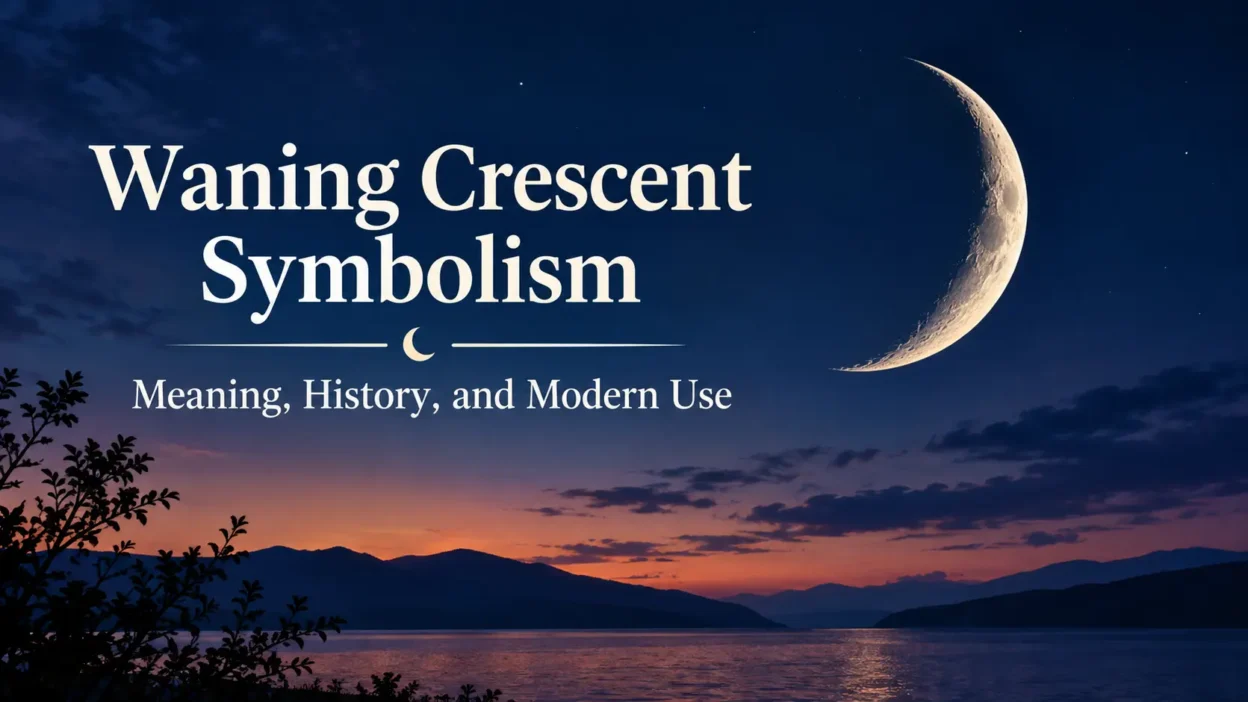
The waning crescent symbolism is often connected with release, reflection, rest, and preparation for a new beginning. As one of the final visible phases of the lunar cycle, the waning crescent appears as a thin curve of light just before the new moon.
People have attached meaning to this moon phase for thousands of years. Farmers watched it to guide seasonal activities, religious traditions linked it to prayer and contemplation, and many cultures saw it as a symbol of endings that naturally lead to renewal.
Today, Americans encounter the waning crescent in art, jewelry, tattoos, astrology, wellness practices, and digital culture. Its appeal comes from a simple idea that many people recognize in their own lives: sometimes growth requires letting go before starting something new.
Quick Answer
The waning crescent commonly symbolizes release, reflection, rest, and preparation for a fresh start in modern American culture. Historically, it has also represented the closing stage of cycles, spiritual contemplation, and the transition between endings and new beginnings in many traditions.
TL;DR
- Represents endings before a new beginning.
- Often linked to reflection and self-evaluation.
- Appears near the end of the lunar cycle.
- Associated with rest rather than action.
- Used in tattoos, jewelry, and wellness culture.
- Symbolizes natural life transitions.
What the Waning Crescent Looks Like
The waning crescent is the final lunar phase before the new moon. During this stage, only a narrow sliver of the moon remains illuminated, while most of the lunar disk appears dark.
In the Northern Hemisphere, including the United States, the illuminated portion appears on the left side of the moon. It is often visible shortly before sunrise, creating a quiet and subtle presence in the early morning sky.
Because so little light remains visible, many people naturally associate the waning crescent with completion, closure, and the fading of something that has nearly reached its end.
The Core Meaning of the Waning Crescent
The most common symbolic meaning of the waning crescent centers on letting go.
Unlike the waxing phases, which are associated with growth and expansion, the waning crescent represents reduction and release. Symbolically, it suggests clearing away what is no longer useful, whether that means habits, beliefs, relationships, or responsibilities.
Many people also view it as a reminder that endings are not failures. Instead, they are natural parts of larger cycles that eventually create room for new opportunities.
This interpretation has made the waning crescent especially popular in modern self-development and mindfulness communities.
Why Endings Are Central to Its Symbolism
The moon’s cycle naturally encourages people to think about beginnings and endings. Since the waning crescent appears immediately before the moon disappears from view, it has become associated with the final stage of a journey.
In symbolic terms, it often represents:
- Finishing a chapter
- Completing a project
- Releasing emotional burdens
- Accepting change
- Preparing for renewal
Rather than suggesting loss alone, the symbol emphasizes transition. The darkness ahead is temporary because another lunar cycle is about to begin.
Ancient Roots and Early Symbolism
Ancient civilizations closely observed the moon because it influenced calendars, agriculture, navigation, and religious observances.
In many early societies, lunar phases marked the passage of time more visibly than solar measurements. The waning crescent became associated with completion because it signaled the final days of the lunar month.
Some ancient cultures viewed the fading moon as a period for settling affairs, concluding rituals, and preparing for upcoming cycles. The symbolic connection between the shrinking moon and gradual release likely emerged from these practical observations.
Although meanings varied across regions, the general theme of closure appeared repeatedly throughout history.
Symbolism in Ancient Religious Traditions
Several religious traditions attached special significance to the later phases of the moon.
In some ancient Near Eastern cultures, lunar decline symbolized withdrawal and transition. Certain rituals were timed according to the moon’s changing appearance.
Within Islamic tradition, lunar observation plays an important role in determining months and religious observances. While specific symbolic interpretations differ among individuals, the lunar cycle itself remains culturally and spiritually significant.
Various mystical and contemplative traditions also connected the waning moon with introspection, prayer, and spiritual preparation.
The common thread was not fear of darkness but recognition of cyclical change.
What the Waning Crescent Means in Modern American Culture
In the United States, the waning crescent is usually interpreted through a personal growth lens.
Many Americans see it as a symbol of:
- Self-reflection
- Emotional healing
- Simplification
- Recovery
- New beginnings after closure
The symbol frequently appears in journals, wellness products, meditation spaces, and inspirational artwork.
Unlike some historical interpretations that focused on ritual calendars, contemporary American meanings often emphasize personal transformation and mental well-being.
For many people, the waning crescent serves as a reminder to pause before moving forward.
Emotional and Psychological Symbolism
Psychologically, the waning crescent often reflects a need for quiet and recovery.
Human beings naturally move through periods of activity and rest. Because the moon appears diminished during this phase, it has become a visual metaphor for stepping back and conserving energy.
People frequently associate it with feelings such as:
- Calm
- Acceptance
- Relief
- Reflection
- Closure
- Readiness for change
The image can be reassuring because it suggests that periods of uncertainty or stillness are temporary rather than permanent.
The Waning Crescent and Personal Transformation
Many people interpret the waning crescent as a symbol of personal evolution.
Major life changes often require releasing old identities before embracing new ones. Someone leaving a career, ending a relationship, moving to a new city, or recovering from hardship may find meaning in the symbol.
The waning crescent reflects a stage that is neither the past nor the future. It represents the space between them.
This transitional quality helps explain why the image resonates with individuals experiencing significant life changes.
Cross-Cultural Meanings Around the World
Although interpretations differ, several themes appear across cultures.
| Culture or Context | Common Meaning | Associated Ideas | Notes |
|---|---|---|---|
| Ancient agricultural societies | End of a cycle | Harvest completion, preparation | Linked to lunar calendars |
| Spiritual traditions | Reflection | Prayer, contemplation | Often connected to inward focus |
| Modern Western culture | Letting go | Healing, renewal | Popular in wellness communities |
| Astrology communities | Release | Closure, evaluation | Used symbolically rather than scientifically |
| Artistic traditions | Transition | Change, impermanence | Common visual metaphor |
The details vary, but many cultures connect the waning crescent with movement from one stage to another.
Why It Appears in Tattoos and Body Art
Moon tattoos remain among the most popular symbolic designs in the United States.
People choose the waning crescent to represent:
- Personal growth
- Recovery from hardship
- Acceptance of change
- Emotional healing
- New beginnings after endings
Unlike symbols associated with victory or achievement, the waning crescent often reflects a quieter kind of strength.
Its understated appearance appeals to individuals who want meaningful imagery without an obvious or aggressive message.
The Symbol in Jewelry, Fashion, and Home Decor
The waning crescent appears frequently in contemporary design.
Jewelry makers often use crescent moons to symbolize life transitions, intuition, or personal reflection. Home decor featuring moon phases has become common in bedrooms, meditation spaces, and wellness-focused environments.
In fashion, crescent imagery can communicate creativity, individuality, or a connection to nature.
Many people are drawn to the design simply because it is visually elegant, even when they are not actively thinking about symbolism.
Connections to Astrology and Lunar Practices Waning Crescent Symbolism
Astrology and lunar wellness communities often assign special meaning to the waning crescent.
In these circles, the phase is frequently viewed as a time for:
- Reviewing recent experiences
- Releasing unwanted habits
- Simplifying commitments
- Preparing for future goals
Not everyone accepts astrological interpretations, but the symbolic framework remains influential in modern culture.
The popularity of moon journals, lunar planners, and reflection practices has helped keep these associations visible.
Common Misunderstandings About the Waning Crescent
One common misconception is that the waning crescent symbolizes negativity or bad luck.
Historically, some individuals associated decreasing light with decline. However, most modern interpretations focus on healthy closure rather than misfortune.
Another misunderstanding is that the symbol always carries a religious meaning. While some spiritual traditions use lunar symbolism, many people view the waning crescent in entirely secular ways.
It is also often confused with a generic crescent moon, even though specific lunar phases can carry different symbolic associations.
How the Meaning Has Evolved Over Time
The symbolism of the waning crescent has shifted alongside cultural priorities.
In earlier societies, practical concerns such as agriculture, seasonal planning, and religious observance shaped lunar meanings. The phase marked a measurable point within a recurring cycle.
Modern interpretations tend to focus more on psychology and personal development. Instead of emphasizing calendars or rituals, people often use the symbol to think about emotional growth and life transitions.
Despite these changes, one idea has remained remarkably consistent: endings create the conditions for beginnings.
The Waning Crescent in Digital Culture and Social Media
Moon imagery has become increasingly common online.
The waning crescent appears in digital art, wellness content, mood boards, aesthetic photography, and self-reflection posts. Social media users often pair the image with messages about growth, healing, and moving forward.
Because the symbol is visually simple and widely recognizable, it communicates complex emotions without requiring lengthy explanations.
Its popularity reflects a broader cultural interest in cycles, mindfulness, and intentional living.
FAQ
Is the waning crescent a positive symbol?
Generally, yes. Most modern interpretations view it as a symbol of release, reflection, and preparation for a new beginning rather than something negative.
What does a waning crescent tattoo mean?
A waning crescent tattoo often represents personal growth, healing, closure, or the completion of an important chapter in life. Meanings vary based on individual experiences.
Does the waning crescent have religious meaning?
It can. Some religious and spiritual traditions incorporate lunar symbolism, but many people use the waning crescent as a cultural or personal symbol without religious connections.
What is the difference between a waning crescent and a waxing crescent?
A waxing crescent symbolizes growth, expansion, and beginnings, while a waning crescent is usually associated with release, reflection, and preparation for renewal.
Why do people associate the waning crescent with letting go?
Because it appears as the moon’s visible light decreases before the new moon. The fading appearance naturally became connected with completion and release.
Is the waning crescent connected to astrology?
Yes. Many astrological traditions interpret it as a period for review, reflection, and clearing away what no longer serves a purpose. These meanings are symbolic rather than scientific.
What does the waning crescent symbolize emotionally?
Emotionally, it often symbolizes acceptance, healing, rest, closure, and readiness for change. Many people see it as a reminder that transitions are normal parts of life.
Conclusion
The waning crescent represents one of the most recognizable symbols of transition within the lunar cycle. Its most common meanings include release, reflection, closure, and preparation for a fresh beginning.
Across ancient traditions, religious practices, artistic expression, and modern American culture, the symbol has consistently been linked to the final stage of a cycle. While interpretations differ, the central message remains remarkably similar.
Today, waning crescent symbolism continues to resonate because it reflects a universal experience: some endings are not conclusions at all, but the first step toward something new.