Belladonna flower symbolism brings together beauty, danger, mystery, and human fascination with the natural world. Also known as deadly nightshade, Atropa belladonna is a poisonous plant with small, bell-shaped flowers and dark berries. Its striking appearance and long history in medicine, folklore, cosmetics, and literature have made it an enduring symbol of beauty with a dangerous side.
Unlike flowers commonly associated with affection or celebration, belladonna carries a more complicated meaning. Its name is connected with historical beauty practices, while its toxicity has made it a recognizable image in stories about poison, temptation, and forbidden knowledge.
In the United States, belladonna appears most often in gothic art, dark botanical illustrations, fantasy fiction, and discussions of historical herbalism. Understanding its symbolism requires separating documented history from later legends and recognizing that the plant’s attractive appearance does not make it safe to handle or consume.
Quick Answer
Belladonna flower symbolism commonly represents dangerous beauty, mystery, temptation, and hidden risks in modern American culture. Historically, the plant was associated with beauty practices, traditional herbal medicine, and poison, giving it a complex reputation that continues to influence gothic art, literature, and contemporary botanical imagery.
TL;DR
- Belladonna symbolizes beauty that conceals danger.
- Its historical name connects it with beauty practices in Europe.
- Folklore and literature associate the plant with poison and forbidden knowledge.
- Gothic art uses belladonna to create an atmosphere of mystery and risk.
- Its poisonous berries and leaves make it a symbol of nature’s double edge.
- Modern interpretations often emphasize caution, independence, and dangerous attraction.
What Is the Belladonna Flower?
Belladonna, commonly called deadly nightshade, is a perennial plant native to parts of Europe, North Africa, and western Asia. It belongs to the nightshade family, Solanaceae, which also includes familiar plants such as tomatoes, potatoes, and eggplants.
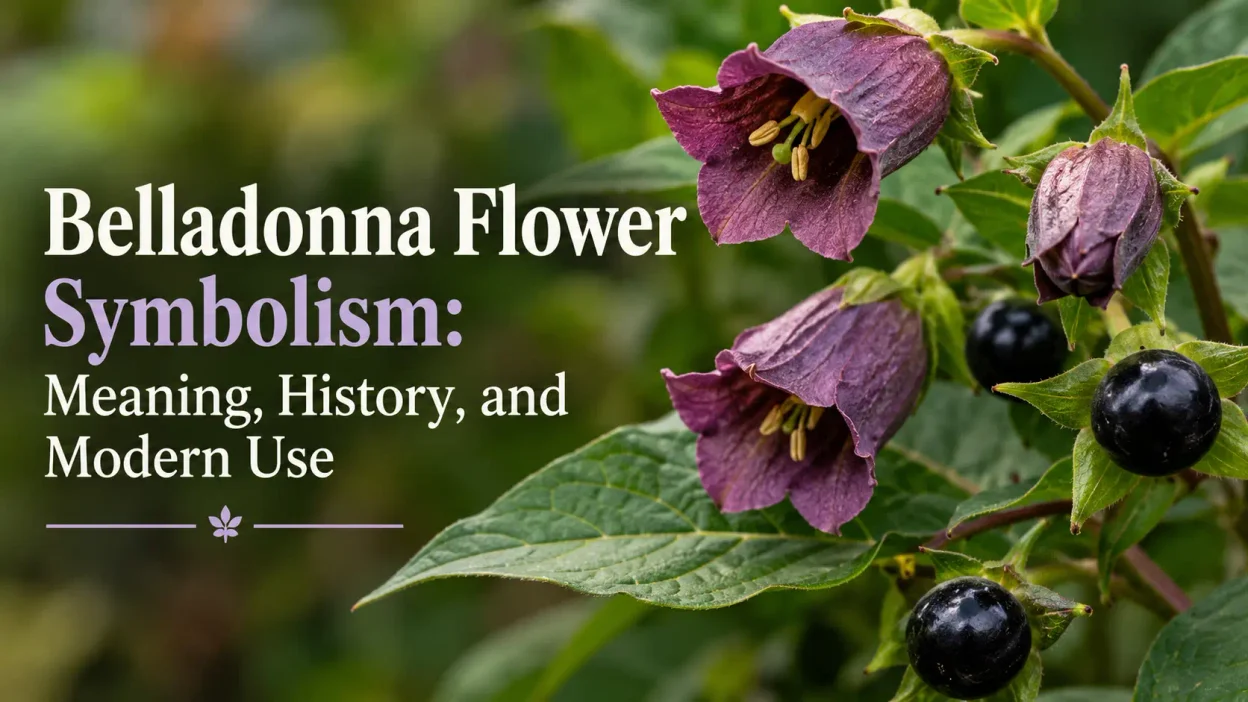
Its flowers are usually dull purple or brownish-purple, with a bell-like shape and five partially fused petals. The plant later produces shiny, dark purple-black berries that can resemble small cherries. Despite their appealing appearance, the berries, leaves, roots, and other parts contain dangerous tropane alkaloids.
The contrast between the plant’s appearance and its toxicity explains much of its symbolic appeal. Belladonna does not look like an obvious threat. Its flowers can appear delicate, and its berries may look inviting, even though ingestion can cause severe poisoning or death.
This contrast makes the plant especially suitable for visual storytelling. An artist can use belladonna to suggest that appearances are not always reliable, while a writer can introduce it as a sign of concealed danger.
The Core Meaning of Belladonna Flower Symbolism
The central theme of belladonna symbolism is the coexistence of attraction and risk. The plant’s beauty draws attention, while its toxicity gives that beauty an unsettling dimension.
Several related meanings emerge from this contrast:
- Dangerous beauty: Something can be visually appealing while carrying serious risks.
- Mystery: Belladonna’s dark reputation makes it a natural fit for hidden motives and unexplained events.
- Temptation: Its attractive appearance can represent the urge to pursue something despite warnings.
- Hidden knowledge: Its history in medicine and poison lore connects it with knowledge that can help or harm.
- Transformation: Its role in historical medicine and modern fiction can suggest a change in perception, identity, or circumstances.
These meanings are related, but they are not interchangeable. A gothic illustration may use belladonna to create suspense, while a literary character may associate it with manipulation or a dangerous secret.
The context determines which interpretation makes the most sense. Belladonna is not inherently a symbol of evil; it can represent the difficult relationship between human desire, natural power, and responsibility.
Why Belladonna Is Associated With Beauty
The word belladonna comes from Italian and is commonly translated as “beautiful woman” or “fair lady.” The name is frequently connected with historical accounts of European women using preparations made from the plant to enlarge their pupils for cosmetic effect.
Atropine, a compound found in belladonna, can dilate the pupils by affecting the muscles that control them. Historically, this effect was exploited for cosmetic purposes, although it could also cause blurred vision, light sensitivity, and other harmful effects.
The precise extent and prevalence of these beauty practices are difficult to establish from popular accounts alone. Nevertheless, the association between the plant’s name, enlarged pupils, and feminine beauty became an enduring part of its reputation.
Symbolically, this history creates an unusual tension. Belladonna can represent the desire to become more attractive, but it can also suggest the risks people take to meet social standards of beauty.
In modern interpretations, the plant may therefore stand for beauty that comes at a cost. It can also raise questions about appearance, vanity, and the pressure to change one’s body for the approval of others.
Historical Roots: Medicine, Poison, and Human Curiosity
Belladonna has a long history of use in European herbal traditions, although its effects make it particularly dangerous when used without medical expertise. Its compounds have influenced medicine, but the plant itself is not a safe home remedy.
Historically, preparations containing belladonna were used for various purposes, and some applications relied on its effects on bodily functions. The same compounds that produce medically useful effects can also cause severe toxicity when the dose is inappropriate.
This narrow margin between effect and harm helped establish belladonna’s reputation as a plant that demands caution. In historical narratives, it became associated with the boundary between healing and poisoning.
The plant’s history also reflects a broader pattern in human relationships with poisonous botanicals. People have long investigated plants that alter perception, affect the body, or produce serious illness. Such knowledge could be valuable, but it could also be misused.
Belladonna’s symbolism developed around this uncertainty. It represents the possibility that the same natural substance can be treated as a source of knowledge, a medical resource, or a threat, depending on how it is understood and used.
The Connection Between Belladonna and Greek Mythology
Belladonna’s scientific name adds another layer to its symbolism. Its genus name, Atropa, refers to Atropos, one of the three Fates in Greek mythology.
The Fates were associated with the course of human life. Clotho spun the thread of life, Lachesis measured it, and Atropos cut it. Atropos therefore became associated with the moment when life ends.
This connection is especially relevant to belladonna because of the plant’s toxicity. Its name links a real botanical danger with a mythological figure whose role involved mortality.
The association does not mean that ancient Greeks universally worshiped belladonna as a sacred flower or used it as a standard emblem of Atropos. Rather, the botanical name draws on an established mythological figure to reflect the plant’s deadly properties.
For modern artists and writers, this connection makes belladonna a fitting symbol of fate, mortality, and the thin boundary between life and death. A dark botanical illustration featuring the plant may evoke these themes without requiring a literal depiction of the Greek goddess.
Belladonna in Witchcraft, Folklore, and Dark Legends
Belladonna frequently appears in accounts of European folklore involving witches, magical ointments, and poisonous plants. Its toxic effects, including delirium and hallucinations in cases of poisoning, contributed to stories that connected nightshade plants with altered perception and supernatural experiences.
Some historical accounts describe belladonna as an ingredient in preparations associated with witchcraft. Researchers have examined these traditions to understand how knowledge of poisonous plants, religious beliefs, accusations of witchcraft, and ideas about extraordinary experiences became intertwined.
However, stories about witches using belladonna should not be treated as proof that every accused person practiced such rituals or that every traditional account describes a verified event. Folklore often blends observed effects, rumor, symbolic storytelling, and later reinterpretation.
In contemporary gothic culture, these associations have become part of belladonna’s visual identity. The plant may appear beside candles, old books, moonlit gardens, or other imagery intended to suggest forbidden knowledge.
The symbolism is usually atmospheric rather than historical. A modern illustration of belladonna in a witch’s garden can express a fascination with folklore and the darker side of botanical history, but it does not automatically reproduce a specific historical practice.
What Belladonna Represents in Modern American Culture
In the United States, belladonna is more commonly recognized through the name deadly nightshade, its reputation as a poisonous plant, and its appearances in popular culture than through a shared traditional flower language.
Its symbolism fits several modern cultural interests. Gothic fashion uses dark botanical imagery to explore beauty, mortality, and individuality. Fantasy stories may use belladonna to suggest danger or a secret that characters should not uncover. Botanical art can highlight the unusual contrast between the plant’s delicate flowers and its toxic berries.
The plant also fits contemporary discussions about the limits of natural remedies. Many Americans encounter herbal products through wellness culture, but belladonna demonstrates why natural origin should never be confused with safety.
Unlike a rose used to communicate affection or a sunflower associated with cheerfulness, belladonna rarely serves as an uncomplicated celebratory flower. Its associations tend to be more specific and intentionally unsettling.
The American interpretation is not uniform, however. A botanist may see a distinctive species with a complicated chemical history, while an artist may see an image of dangerous beauty. Both interpretations can be valid within their own contexts.
Emotional and Psychological Meaning: Attraction, Fear, and Control
Belladonna can represent the tension between wanting something and recognizing its risks. Its beauty invites attention, while its toxicity introduces a reason to pause. This combination can make the plant a useful symbol for stories about temptation, obsession, ambition, or relationships that appear attractive but prove harmful.
It may also represent control over appearance. The historical association with cosmetic practices invites reflection on how people change their bodies to meet cultural expectations and what they may risk in pursuit of those expectations.
For some people, belladonna’s dark reputation communicates independence from conventional ideas of beauty. Instead of representing sweetness or innocence, it offers an image that is elegant, unsettling, and difficult to categorize.
These psychological associations describe possible interpretations, not universal reactions. Someone who enjoys belladonna imagery is not necessarily attracted to danger or interested in poison. The plant may simply appeal to that person’s aesthetic preferences or interest in botanical history.
Its strongest emotional effect often comes from contrast: the flower looks delicate, but the plant can be lethal. That contradiction gives the image its distinctive character.
Belladonna Tattoos, Jewelry, and Personal Style
<WritingBlock id=”61483″ variant=”document”>Belladonna appears in contemporary tattoos and accessories for people drawn to gothic botanical imagery, poisonous plants, and unconventional floral designs. Its flowers and dark berries create a recognizable composition that differs from the more familiar rose, lily, or cherry blossom.
A belladonna tattoo may express several ideas:
- Dangerous beauty: An outwardly attractive appearance can conceal serious risks.
- Personal independence: A dark floral design can challenge conventional expectations of femininity or beauty.
- Mortality: The plant’s botanical name and poisonous reputation can evoke the limits of human life.
- Transformation: Its history in medicine and folklore can suggest change, uncertainty, or a complicated relationship with knowledge.
- Interest in nature: The design may reflect an appreciation for unusual plants and botanical illustration.
Placement and accompanying imagery influence the interpretation. A small flower design may emphasize elegance, while a full botanical composition with berries, stems, and leaves may focus on the plant itself. Pairing belladonna with a skull, a moon, or a gothic frame can make mortality or mystery more prominent.
Jewelry and fashion prints use similar visual contrasts. Dark floral patterns can communicate a dramatic personal style without requiring the wearer to endorse every legend associated with the plant.
As with any tattoo or decorative motif, the meaning ultimately depends on the person using it. Belladonna’s historical associations provide context, but they do not dictate a single personal message.
Belladonna Compared With Other Symbolic Flowers
Flower symbolism often depends on the relationship between appearance, cultural history, and the situations in which a plant is used. Belladonna stands apart from many familiar flowers because its poisonous nature is central to its reputation.
| Flower | Common modern association | Symbolic contrast |
|---|---|---|
| Belladonna | Dangerous beauty, mystery, temptation | Attractive appearance conceals risk |
| Rose | Love, passion, devotion | Beauty may express affection or desire |
| Lily | Mourning, purity, remembrance | Often appears in ceremonies and memorials |
| Poppy | Sleep, remembrance, consolation | Meaning varies by species and cultural setting |
| Foxglove | Beauty, caution, danger | Ornamental appearance contrasts with toxicity |
These comparisons are interpretive rather than universal definitions. A rose can symbolize grief, and a lily can appear in contexts unrelated to mourning. Likewise, belladonna can serve as a botanical subject without implying danger or temptation.
The comparison helps explain why belladonna works particularly well in gothic design. Its symbolism depends less on a conventional message of affection or celebration and more on the tension between an appealing appearance and a hazardous reality.
Common Misunderstandings About Belladonna Symbolism
Popular descriptions of belladonna sometimes combine genuine historical details with exaggerated legends. Separating them helps readers understand the plant without treating every dramatic story as fact.
One misconception is that belladonna has always been a universal symbol of witchcraft. The plant has appeared in European folklore associated with witches and poisonous preparations, but its historical uses and cultural meanings were more varied.
Another is that the name belladonna proves the plant was widely used as an eye cosmetic by European women. The name is historically connected with beauty practices, but the precise details and prevalence of particular pupil-dilating practices are debated. The broader connection with cosmetic use is better supported than every popular retelling of how it happened.
A third misconception is that poisonous plants are inherently evil. Toxicity is a biological property, not evidence of moral character or supernatural intent. Belladonna compounds have also had legitimate medical applications under controlled conditions.
Finally, belladonna should not be confused with every plant called nightshade. Several different species belong to the nightshade family, and they do not all have the same appearance, chemical composition, or toxicity.
Accurate symbolism begins with accurate identification. The more carefully the plant is understood, the more meaningful its historical and artistic associations become.
Belladonna in Contemporary Art, Literature, and Digital Culture
Belladonna’s visual identity makes it useful in contemporary creative work. Its dark berries, muted flowers, and historical associations give artists a way to communicate tension without relying on graphic images of violence.
In fiction, the plant may appear as a clue, a symbol of a dangerous character, or a reminder that something attractive can conceal a threat. Such uses draw on its real poisonous properties while adapting them to an invented story.
In botanical illustration, the emphasis can be quite different. An artist may highlight the flower’s structure, the arrangement of its leaves, or the contrast between its flowers and berries. Here, the plant can represent scientific curiosity and the beauty of botanical diversity.
Online, belladonna imagery fits gothic aesthetics, dark academia, fantasy-inspired art, and alternative fashion. These styles frequently combine historical references with modern visual choices, so their meanings should not automatically be attributed to an older tradition.
The plant’s continued use shows how symbolism evolves. A real botanical characteristic becomes a cultural association, and that association becomes a creative tool for people who may know little about the plant’s original history.
Safety, Poisoning, and the Limits of Symbolic Interpretation
Belladonna’s symbolic appeal should never obscure its real-world danger. All parts of Atropa belladonna contain toxic compounds, including atropine and scopolamine. Ingestion can cause serious poisoning, including confusion, delirium, abnormal heart rhythms, seizures, and potentially death.
Its berries are particularly concerning because their dark, glossy appearance can make them look edible. The plant should not be tasted or used for homemade remedies, cosmetics, or experiments.
Belladonna also illustrates an important distinction between historical medical use and safe modern practice. Some compounds derived from the plant have legitimate medical applications, but these rely on controlled preparations, appropriate dosing, and professional oversight. That does not make the plant itself safe for home use.
If someone may have swallowed belladonna or been exposed to it in a potentially dangerous way, contact emergency services or a poison control center immediately rather than waiting for symptoms.
Symbolically, these facts reinforce the plant’s association with hidden risks. Historically, its toxicity helped shape its reputation; today, botanical knowledge allows people to appreciate its appearance and cultural history without romanticizing unsafe contact.
Frequently Asked Questions
What does the belladonna flower symbolize spiritually?
In contemporary spiritual interpretations, belladonna may represent transformation, protection, mystery, or the need to recognize hidden dangers. These meanings are modern interpretive choices rather than a single established spiritual doctrine shared across cultures.
Is belladonna a symbol of love or beauty?
Belladonna is associated with beauty partly because its Italian name means “beautiful woman” and is linked to historical cosmetic practices. Unlike a traditional romantic flower, however, it often represents attraction complicated by risk, vanity, or temptation.
Why is belladonna associated with witches?
Belladonna appears in European folklore and historical accounts involving poisonous plants and preparations associated with witchcraft. Its toxic effects and reputation contributed to these associations, although popular stories sometimes exaggerate what can be established historically.
What does a belladonna tattoo mean?
A belladonna tattoo may represent dangerous beauty, individuality, mortality, or an interest in gothic botanical art. The meaning depends on the wearer and the surrounding design rather than on a fixed historical rule.
Is belladonna considered a negative symbol?
Belladonna often carries unsettling associations because it is poisonous and has a long history connected with poison lore. It can also symbolize knowledge, caution, independence, or the complexity of beauty, so its meaning is not exclusively negative.
What is the connection between belladonna and Atropos?
The botanical genus name Atropa refers to Atropos, the Greek Fate associated with cutting the thread of human life. This connection reinforces the plant’s association with mortality, although it does not establish that belladonna was universally worshiped as a sacred flower in ancient Greece.
Is belladonna safe to use in natural beauty products?
No. The plant contains toxic compounds and should not be used in homemade cosmetics or beauty preparations. Historical cosmetic practices do not establish safety, and medically useful compounds derived from belladonna require appropriate professional control.
Conclusion
Belladonna flower symbolism centers on dangerous beauty, temptation, mystery, and the risks hidden beneath an attractive appearance. Its history connects European beauty practices, poisonous plants, medical knowledge, Greek mythology, and folklore, while its modern image has become especially recognizable in gothic art and alternative fashion.
For American readers, belladonna offers more than a dark floral aesthetic. It provides a way to explore the complicated relationship between appearance and reality, natural beauty and toxicity, and historical tradition and modern interpretation. Understanding those contrasts makes the plant’s symbolism more meaningful without losing sight of the real dangers behind its beautiful appearance.