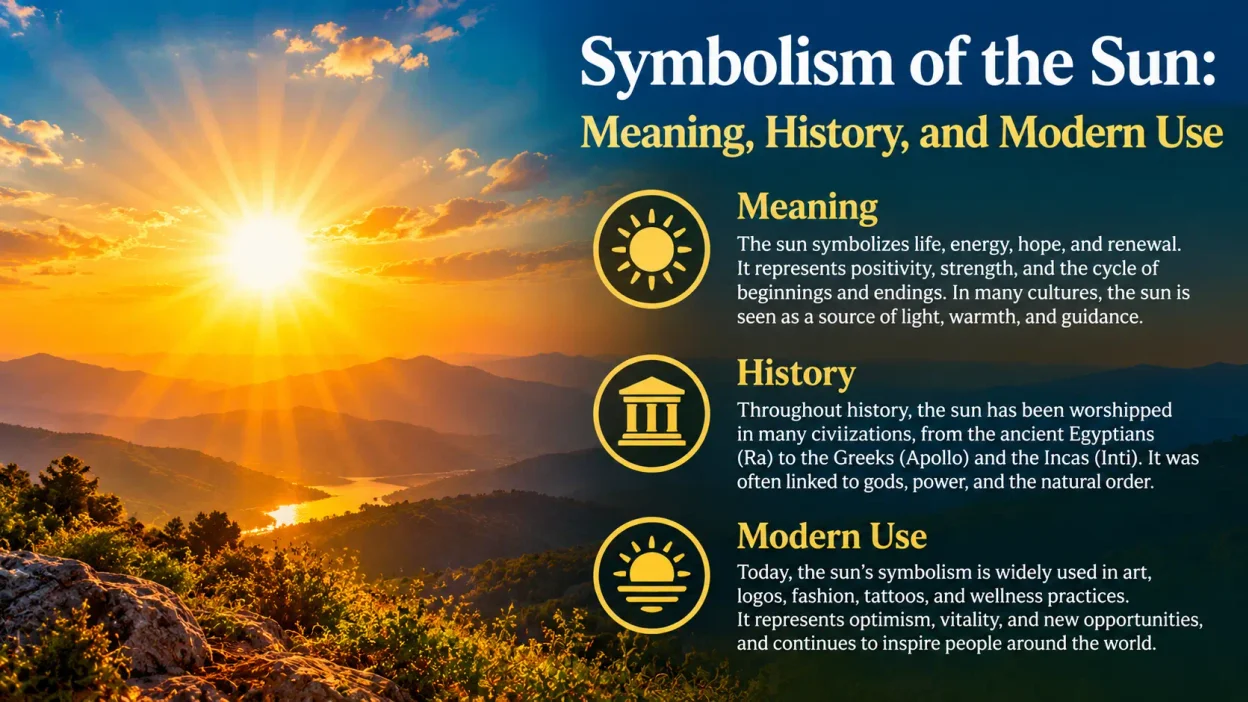
The symbolism of the sun centers on life, light, warmth, hope, and renewal. As the most visible source of natural light during the day, the sun has shaped human beliefs, calendars, religious traditions, and artistic expression across many cultures. In the United States, it commonly represents optimism, personal growth, freedom, and the promise of a fresh start.
The sun is more than a bright circle in the sky. Its daily appearance and disappearance provide a natural pattern that people have used to understand time, change, and the relationship between human life and the wider world. Its warmth supports agriculture, while its light makes work, travel, and ordinary activities possible.
These practical experiences help explain why the sun appears in religious imagery, national emblems, literature, jewelry, tattoos, and home decor. However, its meaning is not identical everywhere. Depending on the tradition and context, the sun can represent a creator, a ruler, truth, spiritual understanding, destruction, or the passage of time.
Understanding the symbolism of the sun means looking beyond its familiar association with happiness and examining how different societies have interpreted its light, heat, movement, and influence.
Quick Answer
The sun commonly symbolizes life, hope, warmth, energy, and new beginnings in modern American culture, especially in art, personal expression, and everyday imagery. Historically, it has also represented deities, royal authority, divine order, spiritual insight, and the cycles of time across different civilizations.
TL;DR
- The sun represents life, light, hope, vitality, and renewal.
- Ancient civilizations connected the sun with deities, rulers, and cosmic order.
- American culture often uses sunlight to express optimism and freedom.
- Religious traditions interpret the sun through distinct beliefs and teachings.
- Sun tattoos and jewelry commonly represent growth, strength, and fresh starts.
- Excessive heat and harsh sunlight can also symbolize danger and destruction.
What the Sun Looks Like as a Symbol
The sun is usually represented as a circle, sometimes with rays extending outward from its edge. Some designs show a plain golden disk, while others include a human face, flames, geometric patterns, or a rising horizon.
Each visual choice can affect the meaning. A simple circle may suggest wholeness or continuity. A sun with long, sharp rays can communicate strength, authority, or intensity. A sunrise often represents a beginning, while a sunset may suggest completion, reflection, or the end of a period in life.
Color also matters. Yellow and gold commonly communicate warmth, energy, prosperity, or celebration. Orange can suggest creativity and enthusiasm, while red may emphasize heat, urgency, or intensity. These associations are influenced by artistic conventions and personal experience rather than fixed universal rules.
In the United States, sun imagery appears on clothing, greeting cards, children’s illustrations, logos, flags, jewelry, and outdoor decor. Its simple shape makes it recognizable even when artists reduce it to a few lines or a small icon.
The Core Meanings of Sun Symbolism
Several major ideas recur in sun imagery, although their importance varies by culture and setting.
Life and vitality: Sunlight provides the energy that supports nearly all food chains on Earth. It is therefore an understandable symbol of growth, health, fertility, and the conditions needed for life.
Hope and optimism: The return of daylight after darkness offers a familiar image of relief. A sunrise can represent the belief that a difficult period will end or that another opportunity is possible.
Knowledge and clarity: Light makes things visible, so the sun can represent understanding, truth, awareness, or the discovery of something previously hidden.
Strength and authority: The sun’s brightness and central place in the sky have made it an image of rulers, gods, leadership, and power in various historical traditions.
Time and renewal: The sun’s daily movement and its changing position across the seasons help mark the passage of time. Its recurring appearance can symbolize continuity, while a sunrise can suggest a new phase.
These meanings overlap, but they are not interchangeable. A sun used in a graduation illustration may emphasize achievement and future possibilities, while a sun carved into an ancient royal monument may communicate political authority or religious legitimacy.
Ancient Civilizations and the Origins of Sun Symbolism
People observed the sun long before written records documented their beliefs. Its predictable movement helped communities organize daily activities, recognize seasonal changes, and develop calendars. As agricultural societies grew, understanding the sun’s seasonal patterns became especially important for planting and harvesting.
In ancient Egypt, the sun was central to religious life. Ra, a major solar deity, was associated with the sun and with the maintenance of cosmic order. The sun’s daily journey across the sky and its return after night became part of broader religious ideas about creation, continuity, and renewal.
In ancient Mesopotamia, Shamash was a sun deity associated with light and justice. The connection between sunlight and judgment made sense within a worldview in which the sun’s visibility could serve as an image of truth and the exposure of wrongdoing.
Ancient Greek traditions connected the sun with Helios, who personified the sun and was depicted traveling across the sky. Apollo became strongly associated with solar imagery in later Greek and Roman traditions, although the relationship between these deities changed over time and should not be reduced to a single unchanging belief.
These examples demonstrate that sun symbolism developed through a combination of observation, religion, political life, and storytelling. There was no single ancient interpretation shared by every civilization.
The Sun as a Symbol of Power and Leadership
The sun’s prominence made it a natural image for political authority. It appears bright above the landscape, follows a regular path, and influences the conditions under which people live. Rulers in several societies used solar imagery to associate their position with divine favor, stability, or the proper order of the world.
In ancient Egypt, royal and religious imagery sometimes connected pharaohs with solar divinity. The Aten, represented as the solar disk with rays extending toward the earth, became especially important during the reign of Akhenaten in the 14th century BCE. This religious development illustrates how a familiar celestial object could become central to a particular ruler’s religious program.
Solar imagery also appeared in imperial traditions beyond Egypt. In ancient Rome, the sun became associated with imperial representation and the cult of Sol, especially in the later empire. Such uses could communicate endurance, authority, and the ruler’s relationship with a larger cosmic order.
Modern interpretations of the sun as a leadership symbol draw on similar visual qualities: visibility, centrality, and the ability to illuminate a wider space. A sun in a logo may suggest confidence or ambition, but that does not automatically connect it to an ancient royal tradition.
What the Sun Means in American Culture
In the United States, the sun most often appears as a positive, accessible symbol. It is linked with outdoor recreation, warm weather, vacations, summer, and the relief that comes with a clear day after prolonged rain or cold.
American visual culture frequently uses a smiling sun to communicate friendliness and comfort. Children’s books, school artwork, weather illustrations, and greeting cards use this image because it is easy to recognize and rarely requires explanation.
The sun also carries associations with personal freedom and independence. Sunlight over an open road, a bright horizon, or a beach can suggest escape from routine and the chance to experience something new. In advertising, these images are often used to sell travel, outdoor products, wellness experiences, and summer activities.
National imagery adds another dimension. The sun appears in some state flags, municipal emblems, and historical designs, although its meaning varies with each emblem’s origin. It should not be assumed that every American sun symbol represents the same national ideal.
For many Americans, the sun’s meaning is shaped less by ancient mythology than by everyday experience. A sunny morning may improve someone’s mood, a sunrise may mark the beginning of a hiking trip, and sunlight through a window may make a home feel welcoming.
Sun Symbolism in Religion and Spiritual Traditions
The sun has a place in numerous religious traditions, but these traditions do not all treat it in the same way. In some, it is a deity or a divine manifestation; in others, it serves as a sign of divine creation, order, or spiritual understanding.
In Hindu traditions, Surya is a solar deity associated with light, vitality, and the sustaining conditions of life. Surya appears in religious art and devotional practice, and solar imagery can also be found in traditions involving prayer, ritual, and the observance of time.
In ancient Egyptian religion, solar deities were associated with creation, kingship, and the recurring movement between day and night. The sun’s journey could be understood within a larger account of the cosmos and its continued renewal.
In Christianity, light frequently serves as a metaphor for divine truth, guidance, and goodness. However, the sun itself is not generally worshiped as God in mainstream Christian teaching. Christian artwork may use sunlight or rays of light to communicate divine presence, but this is different from treating the sun as a deity.
Buddhist art sometimes uses solar imagery, although the meaning depends on the specific work and tradition. A sun can be part of a broader visual vocabulary involving illumination, wisdom, and the natural world, but it should not be assigned one universal Buddhist meaning.
The distinction matters: a religious tradition may honor a solar deity, use the sun as a metaphor, or include it as a decorative celestial feature. Those are different relationships with the same natural object.
The Sun in Indigenous Cultures and Traditional Beliefs
The sun holds important roles in the traditions of various Indigenous peoples, including communities across North America. However, there is no single Indigenous American interpretation of the sun. Nations have distinct histories, languages, ceremonial practices, and teachings.
In some Indigenous traditions, the sun is connected with life, seasonal cycles, relationships between human communities and the natural world, or sacred narratives. The precise meaning depends on the people and the context in which the symbol appears.
The sun also features in cultural artwork, ceremonial objects, stories, and designs, but a visual resemblance does not prove that two communities share the same beliefs. A circular motif with rays might have a specific meaning in one cultural setting and a different role in another.
When discussing Indigenous sun symbolism, it is important to identify the particular nation or tradition whenever reliable information is available. Generalized claims that all Native American cultures view the sun as a symbol of healing, protection, or universal harmony overlook meaningful cultural differences.
For contemporary American audiences, this is especially relevant when choosing Indigenous-inspired jewelry, artwork, or tattoos. Respectful interpretation requires understanding the design’s cultural context rather than treating it as a generic spiritual decoration.
Sunrise and Sunset: Two Different Symbolic Meanings
Although both involve the sun, sunrise and sunset often communicate different ideas.
A sunrise is commonly associated with beginnings, opportunity, awakening, and renewed motivation. Its gradual movement from darkness into daylight makes it an effective image for starting over after a difficult experience.
This symbolism appears in American photography, inspirational artwork, graduation gifts, and personal milestones. Someone beginning a new career might choose a sunrise image because it expresses possibility without suggesting that success is guaranteed.
Sunset, by contrast, often represents completion, reflection, transition, or the peaceful ending of a chapter. In literature and photography, it may signal the close of a journey or a moment to consider what has happened.
Neither interpretation is fixed. A sunrise can represent the start of a demanding day, and a sunset can suggest beauty, romance, or the anticipation of an evening ahead. The surrounding scene and the viewer’s experience influence the meaning.
The distinction is useful when selecting sun imagery for a personal project. A sunrise is generally suited to themes of fresh starts, while a sunset often fits themes of reflection and transition.
Emotional and Psychological Meaning of the Sun
The sun can produce strong emotional associations because people experience its effects directly. Natural daylight influences visibility, daily routines, and the way a landscape looks and feels.
For many people, sunlight is associated with comfort, activity, and a sense of openness. A bright outdoor scene can appear welcoming, while a dim landscape may feel quieter or more uncertain. Artists often use these contrasts to influence the emotional tone of a painting, film, or photograph.
Sun imagery can also communicate resilience. A person may choose a sunrise design after a major life change because it represents their decision to move forward. Another may associate the sun with a parent, a childhood home, or a favorite season.
These personal meanings are genuine, but they are not universal psychological rules. A person who dislikes intense heat may associate the sun with discomfort, while someone who spends time outdoors may connect it with freedom and relaxation.
It is also important not to confuse symbolic meaning with medical claims. Sun imagery may represent vitality, but a picture of the sun does not itself produce health benefits, and sunlight exposure requires sensible protection against ultraviolet radiation.
When the Sun Symbolizes Danger or Destruction
The sun is not always a positive symbol. Its heat can dry out soil, intensify drought, damage crops, and create dangerous conditions for people and animals. In regions affected by extreme heat, the sun may represent hardship rather than comfort.
This double meaning appears in literature and visual art. A bright, empty landscape can suggest isolation, while an oversized sun may create a feeling of oppression or impending disaster. Artists may use harsh light to expose a character’s vulnerability rather than to express hope.
Solar imagery can also be connected with endings and destruction in myths and apocalyptic narratives. Some stories imagine the sun being obscured, extinguished, or disrupted as part of a larger crisis in the natural order.
These negative meanings do not cancel out the sun’s associations with life. They show that the same source of energy can sustain living systems under one set of conditions and threaten them under another.
In modern American design, this contrast can be useful when a creator wants to communicate climate anxiety, environmental vulnerability, exhaustion, or the limits of human control over nature.
The Sun in Art, Literature, and Popular Culture
Artists use the sun to establish mood, suggest the passage of time, and communicate ideas that would take longer to explain in words. Its appearance can change the meaning of an entire scene.
In landscape painting, a rising sun may emphasize possibility, while a low sun can create a feeling of nostalgia or closure. In literature, sunlight can reveal something that a character has avoided, mark a change in circumstances, or contrast with the uncertainty of nighttime.
Film and television use similar techniques. Warm sunlight can make a scene feel welcoming, while harsh overhead light can create tension or expose uncomfortable details. The meaning comes from the way light interacts with the setting and characters, not simply from the presence of the sun.
Popular culture also uses stylized suns in album artwork, clothing, animation, and graphic design. A retro sun with orange rays may evoke the visual style of the 1960s and 1970s, while a minimalist golden circle may suit a contemporary wellness brand.
In these settings, the sun works because viewers already recognize its basic qualities. Creators can build on that familiarity to express freedom, nostalgia, hope, danger, or the passing of time.
Why People Choose Sun Tattoos and Jewelry
Sun tattoos and jewelry are popular ways to express personal beliefs without relying on written words. The design can be simple enough for a small pendant or detailed enough to include a landscape, celestial elements, or geometric patterns.
Common interpretations include:
- New beginnings: A sunrise can mark a fresh start after a major life change.
- Personal strength: A bright sun may represent persistence during difficult circumstances.
- Family and connection: Some people use sun imagery to honor a loved one who brought warmth or stability to their lives.
- Creativity and confidence: Radiating lines can suggest energy, ambition, or a desire to stand out.
- Connection to nature: A sun combined with mountains, plants, or the moon can express an appreciation for the natural world.
The design can also reflect a particular cultural or spiritual tradition. Someone interested in ancient Egyptian religion may choose a solar motif for its historical associations, while another person may prefer an abstract sun with no specific religious meaning.
Before choosing a culturally specific design, it is worth understanding its origin. Not every sun tattoo is an ancient symbol, and similar designs can carry different meanings across cultures.
Sun Symbolism in Home Decor, Fashion, and Digital Culture
Sun imagery is common in American homes because it can make a space feel warm, bright, and welcoming. Wall art, mirrors, ceramics, embroidered fabrics, and decorative metalwork often use the sun’s circular shape as a focal point.
A golden sun above a bed may suggest comfort or optimism, while a simple sun print in a home office can create a cheerful visual accent. In outdoor spaces, sun motifs often complement plants, gardens, and natural materials.
Fashion uses the symbol in a similarly flexible way. A sun pendant may communicate a personal connection with nature, while a printed shirt can simply reflect a summer aesthetic. The same image may be spiritual for one wearer and decorative for another.
On social media, the sun often appears in posts about morning routines, vacations, outdoor activities, and personal milestones. Sunrise photographs can accompany messages about starting over, while sunshine emojis commonly communicate warmth, happiness, or friendly enthusiasm.
These contemporary uses are not necessarily connected to ancient religious beliefs. They demonstrate how a familiar natural image continues to acquire meaning through ordinary choices, design trends, and personal experience.
Common Misunderstandings About Sun Symbolism
The sun’s familiarity can make its symbolism seem more straightforward than it really is. Several common assumptions deserve closer examination.
The sun always represents positivity. In many modern American contexts, it does communicate hope and happiness. However, it can also represent heat, drought, exposure, exhaustion, or destructive power.
Every sun symbol comes from an ancient religion. Circular sun designs appear in many cultures and periods. Some have specific historical origins, while others are modern decorative creations. Visual similarity alone does not establish a shared source.
All religions interpret the sun in the same way. Some traditions include solar deities, while others use light as a metaphor for divine truth or understanding. These differences should not be erased by assigning every sun image the same spiritual meaning.
A sun tattoo has one universal interpretation. Personal symbols depend on the wearer, the design, and the context. A sunrise chosen to mark recovery from a difficult period may mean something very different from a historical solar emblem.
The sun is universally associated with masculine energy. Some historical traditions connected solar deities with male figures, but other cultures developed different relationships between celestial bodies, gender, and divinity. Modern claims about masculine and feminine solar energy are interpretations, not universal historical facts.
Recognizing these distinctions makes sun symbolism more useful. Rather than searching for one secret meaning, consider the setting, cultural background, visual style, and intended message.
How the Meaning of the Sun Has Changed Over Time
The sun’s symbolic history reflects changes in human society as well as continuity in human experience. Early communities observed its relationship with seasons, food production, and daily activity. Religious traditions incorporated those observations into accounts of creation, divine authority, and cosmic order.
As civilizations developed, solar imagery became part of architecture, royal representation, religious art, calendars, and public ceremonies. The symbol could express the authority of a ruler or the continuing order of the universe, depending on the society using it.
Later artistic and religious traditions preserved some older associations while creating new ones. The sun continued to serve as an image of light and truth, but its visual forms and cultural meanings varied across periods.
In contemporary American life, the symbol often carries a more personal and everyday meaning. It may represent a new beginning, a family connection, a vacation memory, or a commitment to outdoor living. Digital communication has made simplified sun icons familiar even to people who have little interest in mythology.
The result is not one continuous belief shared by all generations. It is a changing collection of meanings shaped by physical experience, cultural traditions, and individual interpretation.
Sun Symbolism at a Glance
| Context | Common meaning | Typical example | Important distinction |
|---|---|---|---|
| Modern American culture | Hope, warmth, and optimism | Sunrise artwork or greeting cards | Often personal rather than religious |
| Ancient Egypt | Divine power and cosmic order | Solar imagery associated with Ra | Specific meanings changed across periods |
| Religious traditions | Divinity, light, or spiritual insight | Solar deities or sacred light imagery | Beliefs differ between religions |
| Tattoos and jewelry | Renewal, strength, or identity | A sun pendant or sunrise tattoo | Meaning depends on the wearer |
| Environmental imagery | Life, heat, and natural forces | Sun over a field or dry landscape | Can communicate both growth and danger |
Frequently Asked Questions
What is the main symbolism of the sun?
The sun most commonly symbolizes life, light, hope, energy, and renewal. Depending on its cultural or artistic setting, it can also represent authority, truth, divine presence, or destructive heat.
Is the sun a symbol of good luck?
Some people use sun imagery as a sign of optimism, prosperity, or favorable beginnings. However, there is no single worldwide tradition that establishes the sun as a universal guarantee of good luck.
What does a sun tattoo mean spiritually?
A sun tattoo may represent personal growth, spiritual awareness, vitality, or a connection with a religious tradition. Its spiritual meaning depends on the wearer’s beliefs and the specific design rather than on one universal interpretation.
What does a rising sun symbolize?
A rising sun commonly represents fresh starts, renewed motivation, and opportunities ahead. In personal artwork, it may mark recovery, a new relationship, a career change, or the beginning of a different stage of life.
What does the sun symbolize in Christianity?
In Christian contexts, sunlight can represent divine truth, guidance, goodness, and the presence of God. This symbolic use of light is distinct from worshiping the sun as a deity, which is not part of mainstream Christian teaching.
Why did ancient civilizations worship the sun?
The sun provided light and warmth, influenced agricultural seasons, and helped people measure time. Some ancient civilizations developed solar deities and religious practices around these observations, although the beliefs and rituals differed significantly between cultures.
Can the sun symbolize death or endings?
Yes. Sunset imagery can represent the end of a life stage, while harsh sunlight may communicate danger, drought, or destruction. In literature and art, these interpretations depend on the surrounding imagery and the story being told.
Conclusion
The symbolism of the sun brings together life, hope, knowledge, authority, renewal, and the forces of nature. Ancient civilizations incorporated the sun into religious and political traditions, while modern Americans often use it to express optimism, personal growth, freedom, and connection with the natural world. Its meaning changes with the cultural setting, visual design, and experiences of the people interpreting it.
The sun is not exclusively a symbol of happiness or spiritual power. It can also represent hardship, exposure, and the limits of human control over nature. Understanding both sides makes its symbolism more historically accurate and personally meaningful. A sunrise, a golden pendant, or an ancient solar emblem can communicate different ideas, but each begins with the same familiar sight: the light that shapes our days.