
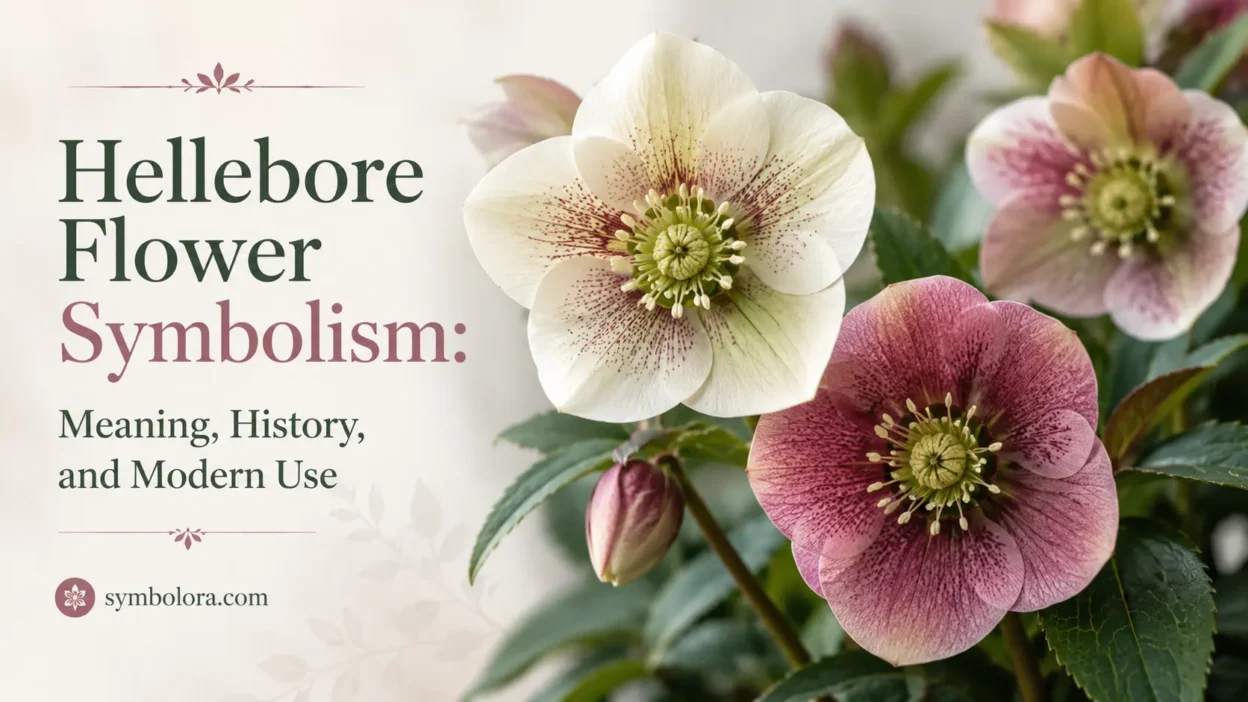
Hellebores bloom at a time when many gardens still look dormant. That unusual timing gives hellebore flower symbolism much of its modern character: resilience, quiet hope, endurance, renewal, and the ability to remain composed during difficult periods.
Yet the flower has never carried only cheerful meanings. Its poisonous chemistry, ancient medicinal reputation, Christian legends, and place in nineteenth-century flower language created a more complicated symbolic history. Depending on the period, hellebore could suggest healing, anxiety, scandal, protection, or survival.
Today, especially in the United States, its most natural interpretation comes from what gardeners actually see. Hellebores push flowers through the cold months and often remain attractive when little else is blooming. That makes them especially suitable symbols of persistence without showiness.
Quick Answer
Hellebore flower symbolism most commonly represents resilience, hope, calm, and renewal in modern American interpretation because the plant flowers during winter or very early spring. Historically, hellebore has also been connected with healing, anxiety, protection, religious legend, and darker ideas such as scandal because of its medicinal past and toxicity.
TL;DR
- Hellebores commonly represent resilience, hope, and endurance through hardship.
- Winter flowering connects them with renewal before spring fully arrives.
- Ancient medicine linked hellebore with purging, melancholy, and mental illness.
- Christian legend gave the Christmas rose associations with humble devotion.
- Victorian flower books gave hellebore surprisingly anxious and negative meanings.
- Modern Americans mainly encounter hellebores in gardens, decor, and floral design.
What a Hellebore Actually Looks Like
Hellebore is the common name for plants in the genus Helleborus, members of the buttercup family rather than the rose family. Their flowers often resemble simple roses, which explains familiar names such as Christmas rose and Lenten rose.
Most garden hellebores are low-growing perennials with leathery, deeply divided leaves. Their flowers may be white, cream, pale green, pink, burgundy, purple, spotted, or so dark that they appear almost black.
Many blossoms tilt downward rather than facing straight upward. This nodding habit can make the flowers appear restrained or contemplative, although that emotional reading is a modern interpretation rather than a fixed historical meaning.
The most important physical feature for symbolism is their flowering season. Depending on species, climate, and cultivar, hellebores can bloom from winter into early spring, sometimes while snow is still present.
The Core Meanings of Hellebore Today
In contemporary symbolic use, several ideas fit the flower particularly well.
| Context | Meaning in the USA | Common Association | Why It Fits |
|---|---|---|---|
| Winter bloom | Resilience | Enduring hardship | Flowers appear during cold months |
| Early-season garden | Hope | Better days approaching | Bloom precedes many spring flowers |
| Personal symbolism | Quiet strength | Perseverance | The plant survives without dramatic display |
| Reflective occasions | Calm | Emotional steadiness | Muted colors and nodding flowers feel restrained |
| Historical interpretation | Anxiety or scandal | Victorian flower language | Older floral dictionaries assigned darker meanings |
| Christmas rose tradition | Humility and devotion | Christian folklore | Legend links the flower with a humble gift |
These meanings are not universal rules. Floral symbolism rarely has one official definition. Instead, meaning develops from physical characteristics, stories, social customs, literature, and personal interpretation.
For modern hellebore, the strongest positive theme is endurance during an unfavorable season.
Why Winter Blooming Became a Symbol of Resilience
A flower opening in winter creates an immediate visual contrast. The surrounding landscape may be brown, frozen, wet, or dormant, while the hellebore is producing fresh growth.
That contrast explains why resilience is such an intuitive contemporary interpretation.
Unlike a sunflower, which often symbolizes brightness and outward confidence, the hellebore suggests a quieter form of persistence. It does not metaphorically conquer winter through dramatic height or color. It simply continues growing in conditions associated with dormancy.
For someone using flowers to represent recovery, grief, a difficult transition, or persistence through a demanding period, that distinction matters. The hellebore can communicate:
- I continued even when conditions were difficult.
- Hope can appear before circumstances fully improve.
- Strength does not always need to be visible or loud.
- Renewal can begin gradually.
This interpretation comes more from the plant’s seasonal behavior than from a single ancient legend.
Ancient Medicine Gave Hellebore a Darker Reputation
Hellebore’s older associations are inseparable from medicine.
In ancient Greek and later medical traditions, plants called hellebore were used as strong purgatives and were associated with treatments for conditions described as madness or melancholy. Ancient terminology can be confusing because historical writers distinguished black and white hellebore, and the plants identified under those names do not always correspond neatly to the modern botanical genus Helleborus.
This medical history helped connect hellebore with several symbolic themes that seem contradictory today:
Healing. It was treated as a medicinal plant, so it could represent an attempt to restore order or health.
Mental disturbance. Because it appeared in treatments for conditions once described as madness or melancholy, later folklore connected it with unstable mental states.
Danger. Hellebores contain compounds that can be harmful if consumed, making the plant a reminder that medicine and poison were historically separated by uncertain knowledge and dosage.
The modern symbolic connection with recovery therefore has historical echoes, but it should not be interpreted as evidence that hellebore is a safe herbal remedy.
Greek Tradition Connected Hellebore With Madness and Restoration
Stories associated with ancient Greece strengthened the relationship between hellebore and mental disturbance.
One tradition connects the seer and healer Melampus with curing a group of women suffering from madness using hellebore or a hellebore-like medicinal preparation. Variations of the story differ in important details, and later retellings often simplify what ancient texts actually say.
Still, the broader cultural connection is clear: hellebore became associated with purging something harmful from the mind or body.
That gives the flower an older symbolic contrast between disorder and restoration.
Modern readers sometimes reinterpret this as emotional healing, but the historical idea was more literal and medically framed. Ancient physicians worked within theories of bodily humors and purgation that differ sharply from modern medicine.
As symbolism, the surviving idea is not that the flower “cures madness.” It is that hellebore once stood near the boundary between illness, treatment, danger, and hoped-for recovery.
The Christmas Rose and Christian Symbolism
Helleborus niger is commonly known as the Christmas rose, although it is not a true rose. In suitable climates it can flower during winter, which helped connect it with the Christmas season.
A later Christian legend tells of a poor girl who wanted to offer a gift to the infant Jesus but had nothing to bring. After she cried in the snow, flowers appeared, allowing her to present them as her gift.
The story has made the Christmas rose a symbol of several ideas:
Humility: the meaningful gift is modest rather than expensive.
Sincere devotion: intention matters more than material value.
Hope appearing in hardship: a flower emerges from a cold landscape.
Grace after sorrow: tears are followed by something beautiful.
The legend belongs to Christian folklore rather than the biblical Nativity narratives themselves. That distinction matters. Hellebore should not be presented as a flower specifically identified in the Bible.
In Christmas arrangements today, however, its winter flowering and traditional name make themes of hope and renewal understandable even when the religious legend is not known.
Victorian Flower Language Made the Meaning More Complicated
Anyone expecting Victorian flower symbolism to make hellebore purely romantic may be surprised.
Nineteenth-century flower dictionaries did not always agree with one another. Floral meanings varied by publication, species name, and compiler.
Kate Greenaway’s well-known Language of Flowers gives Christmas Rose the message “Relieve my anxiety.” The same floral vocabulary associates hellebore with “scandal” and “calumny.”
Those meanings create an unusually broad emotional range.
“Relieve my anxiety” treats the winter flower almost as a request for reassurance. Scandal and calumny move in the opposite direction, suggesting damaged reputation, accusation, or social unease.
This is a useful reminder that Victorian floriography was never a perfectly standardized secret code. Different flower books sometimes assigned different sentiments to the same plant.
For modern interpretation, Victorian meanings are best treated as historical curiosities rather than rules that determine what a hellebore bouquet means today.
What Hellebore Commonly Means in the United States
Americans are most likely to encounter hellebores as ornamental perennials in shade gardens, woodland-style landscapes, containers, botanical gardens, and winter floral arrangements.
Because the genus is Eurasian rather than native to most of the United States, its symbolism here is largely imported or newly interpreted rather than rooted in Indigenous North American traditions. Helleborus niger, for example, is native to parts of mountainous Europe.
Modern American meanings tend to follow visible plant behavior more than old European folklore.
The most relevant associations are:
Resilience because the plants tolerate winter conditions.
Hope because flowering begins before the main spring season.
Renewal because fresh blossoms appear as the garden moves out of dormancy.
Self-possession because the flowers are visually restrained rather than flamboyant.
Individuality because blooming outside the expected season makes the plant feel independent of the normal floral calendar.
These meanings work especially well in personal gifts, memorial plantings, tattoos, and gardens designed around emotional themes.
Hellebore as a Symbol of Quiet Strength
“Strength” is used so frequently in flower symbolism that it can become meaningless. Hellebore offers a more specific version: quiet strength.
The plant does not visually resemble conventional symbols of dominance. It is relatively low, its flowers often nod, and many cultivars use muted rather than brilliant colors.
Its strength comes from timing.
Symbolically, that can fit a person who keeps functioning during a difficult period without seeking recognition. It can also suit someone who values patience, privacy, and emotional control.
This is why the flower may feel more appropriate for understated resilience than flowers traditionally associated with victory or bold confidence.
Its message is closer to endurance than conquest.
Emotional Meaning: Hope Before the Hardship Is Over
Hellebore differs from many spring symbols because it often blooms before winter has truly ended.
That gives it a useful emotional distinction.
A daffodil or cherry blossom can represent the arrival of spring. Hellebore can represent the first evidence that change has begun even though difficult conditions remain.
Psychologically, that makes it a fitting emblem for transitional moments:
- beginning recovery while challenges continue
- rebuilding life after grief
- maintaining hope during uncertainty
- staying emotionally steady through a demanding season
- starting again without pretending the past was easy
This interpretation avoids turning the flower into a promise that hardship disappears quickly.
The symbolism is more realistic: improvement can begin before circumstances become comfortable.
What Different Hellebore Colors Can Suggest
Hellebore colors do not have a universally recognized historical code. Modern color interpretations should therefore be treated as personal symbolism rather than fixed definitions.
White Hellebore
White varieties can suggest sincerity, peace, remembrance, winter stillness, or spiritual reflection.
The white Christmas rose is particularly compatible with themes of humility and hope because of its seasonal and folkloric associations.
Pink Hellebore
Pink can soften the plant’s serious character. It works well for affection, emotional recovery, tenderness, gratitude, or compassionate support.
Purple and Burgundy Hellebore
Deep purple and burgundy flowers can suggest dignity, introspection, maturity, individuality, or emotional complexity.
They are often well suited to designs intended to feel dramatic without using bright colors.
Green Hellebore
Green-flowered varieties naturally evoke regeneration, endurance, growth, and the continuity of nature through winter.
Very Dark Hellebore
Flowers that appear deep purple, maroon, or nearly black can emphasize mystery, mourning, independence, or survival after hardship.
These darker meanings come primarily from contemporary color symbolism and aesthetics, not from an ancient standardized code.
Hellebore Tattoos and Personal Symbolism
Hellebore is not as common in tattoo culture as roses, lotuses, or lilies, which can make it appealing to people who want a less conventional botanical design.
A hellebore tattoo can reasonably represent:
Surviving a difficult period. Winter flowering creates a direct metaphor for remaining alive or hopeful in harsh circumstances.
Recovery. Its historical relationship with medicine can add another layer, although the plant’s toxic nature makes the idea complicated rather than purely positive.
Calm under pressure. The nodding flowers and subdued colors suggest restraint.
A new beginning. Hellebores can mark the stage before complete renewal rather than a clean break from the past.
Duality. Beauty combined with toxicity can symbolize a personality, relationship, or experience that cannot be described as simply good or bad.
Someone choosing a tattoo primarily for historical accuracy may also incorporate the Christmas rose legend or Victorian anxiety symbolism rather than relying only on resilience.
Hellebore in Weddings, Gifts, and Home Decor
Hellebores appear naturally in winter and early-spring aesthetics, so their symbolic value changes depending on the occasion.
In a winter wedding, they can represent love or commitment that remains steady during difficult seasons. That meaning is contemporary rather than an established wedding tradition.
As a supportive gift, a hellebore plant can communicate encouragement to someone moving through grief, recovery, stress, or major life change.
In holiday decor, white Christmas roses can suggest winter hope and understated celebration without relying on the brighter visual language of poinsettias.
In a memorial garden, perennial hellebores can express remembrance combined with continuity. Their yearly return gives the symbolism a seasonal rhythm.
Because the plant is toxic if eaten, placement matters in households with young children or pets. Hellebores should be appreciated as ornamentals rather than edible or medicinal plants.
Beauty and Poison Create a Symbolic Duality
One reason hellebore feels more complex than many conventional floral symbols is the contrast between appearance and chemistry.
The flowers can look delicate, peaceful, and elegant. Yet hellebores contain substances that make ingestion unsafe, and contact with damaged plant tissue may irritate sensitive skin.
Symbolically, that contrast can represent:
- beauty with boundaries
- attraction combined with danger
- strength hidden beneath delicacy
- a complicated personality
- caution beneath an inviting appearance
- healing traditions that also carried genuine risk
This duality should not be exaggerated into claims that hellebore traditionally represented deception. That is a modern interpretive possibility, not a universal historical meaning.
The better-established darker associations come from toxicity, old medical use, and nineteenth-century floral meanings involving anxiety, scandal, and calumny.
Common Misunderstandings About Hellebore Symbolism
Several claims about hellebore are repeated so often that they deserve clarification.
Hellebore is not a true rose
Christmas rose and Lenten rose are common names. Botanically, Helleborus belongs to Ranunculaceae, the buttercup family, not Rosaceae.
It does not have one official meaning
Resilience and hope are especially logical modern interpretations, but hellebore has carried different meanings in medicine, folklore, religion, and floriography.
“Black hellebore” does not mean the flowers are black
The name Helleborus niger is generally associated with the plant’s dark roots, while its natural flowers are typically white and can age toward pink.
Hellebore is not a biblical flower
The Christmas rose legend is Christian folklore. It should not be described as an event recorded in Scripture.
Historical medicinal use does not make hellebore a home remedy
Older physicians used plants identified as hellebore under medical systems very different from today’s practice. Toxicity makes self-treatment unsafe.
How the Meaning Changed Over Time
Hellebore’s symbolic history can be understood as a series of layers rather than one meaning replacing another.
In antiquity, its identity centered heavily on medicine, purgation, danger, melancholy, and attempts to treat mental disturbance.
Later European folklore added supernatural and protective associations to an already unusual plant.
The Christmas rose tradition softened its image by connecting winter flowering with humility, devotion, and unexpected grace.
During the nineteenth century, flower-language books assigned sentiments including anxiety, scandal, and calumny, showing that floral meanings could be uncomfortable as well as romantic.
In modern gardening culture, the plant’s actual behavior has become more important than many older stories. People see a perennial flowering during winter and naturally read it as endurance, renewal, and hope.
That modern shift explains why today’s positive symbolism can coexist with a surprisingly dark historical background.
Why Hellebore Still Feels Relevant Today
Hellebore fits a modern preference for symbols that acknowledge difficulty rather than pretending life is always optimistic.
Its symbolism does not require hardship to become beautiful or desirable. Instead, the plant offers a simpler observation: difficult conditions and new growth can exist at the same time.
That makes it useful for occasions where a bright celebratory flower may feel wrong.
Someone grieving a loss may connect with its return each winter. A person recovering from a difficult year may see the early bloom as evidence of persistence. A gardener may simply appreciate the contrast between a cold landscape and an unexpected flower.
Its emotional range is one reason hellebore can carry both comforting and darker meanings without contradiction.
Frequently Asked Questions
Is hellebore a positive or negative symbol?
It can be either, depending on context. Modern interpretations usually emphasize resilience, hope, renewal, and calm, while older associations include toxicity, mental disturbance, anxiety, scandal, and calumny.
What does a hellebore tattoo symbolize?
A hellebore tattoo commonly works as a personal symbol of endurance, surviving hardship, quiet strength, or renewal during difficult circumstances. Darker designs can also emphasize duality, danger, grief, or the contrast between beauty and toxicity.
What does the Christmas rose symbolize?
The Christmas rose is often associated with winter hope, humility, sincere devotion, and renewal. A Christian folk legend links it with a poor girl whose tears in the snow were followed by flowers that she could offer to the infant Jesus.
Does hellebore symbolize protection?
Protection appears in some later folklore surrounding hellebore, particularly traditions that treated unusual or medicinal plants as defenses against harmful supernatural forces. It is better considered one historical association rather than the flower’s main modern meaning.
Why is hellebore associated with anxiety?
Part of the connection comes from nineteenth-century flower language. Kate Greenaway’s floral vocabulary assigned the Christmas rose the message “Relieve my anxiety,” while hellebore itself also received darker associations involving scandal and calumny.
Does hellebore symbolize death?
Death is not its primary traditional meaning, although poisonous chemistry, dark-colored varieties, winter flowering, and historical medicinal dangers can make it appropriate in designs involving mortality or mourning. In memorial contexts, renewal and continuing remembrance are usually more natural interpretations.
What does hellebore mean as a gift?
As a modern gift, a hellebore plant can communicate encouragement, persistence, calm, or hope during a challenging period. Its winter blooming makes it especially appropriate when the intended message is “keep going” rather than simple celebration.
Conclusion
Hellebore carries an unusually layered set of meanings because its appearance, flowering season, toxicity, medicinal history, religious folklore, and Victorian associations all point in different directions.
Today, hellebore flower symbolism is most naturally understood as resilience, hope, quiet strength, and renewal during difficult circumstances. Older traditions add anxiety, healing, scandal, protection, and danger, giving the flower a history that is more complicated than its peaceful appearance suggests.
Its clearest modern message comes from the garden itself: new growth does not always wait for the difficult season to end.


