
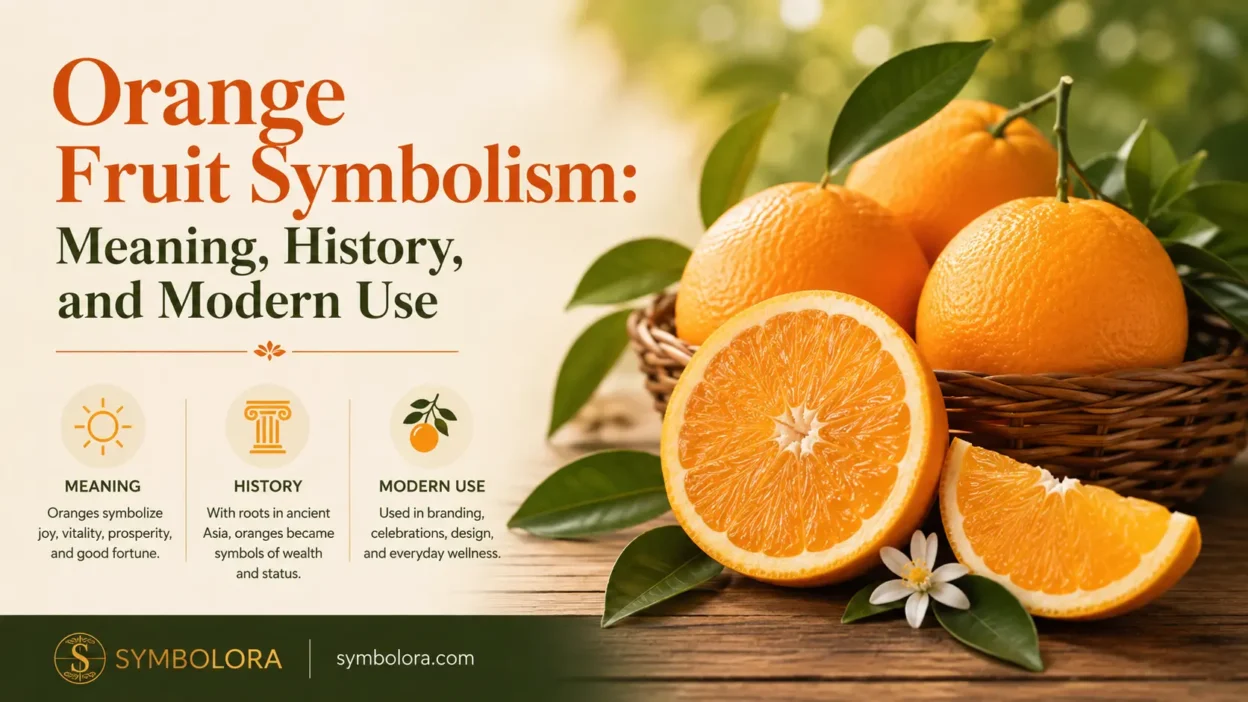
A familiar orange can carry more meaning than its everyday place in a fruit bowl suggests. Orange fruit symbolism is most often connected with prosperity, abundance, vitality, generosity, and good fortune, though those associations depend heavily on cultural setting. The fruit’s bright appearance, sweetness, seasonality, and history as a valued gift all contributed to those meanings over time.
In the United States, oranges are especially associated with sunshine, freshness, winter holidays, Florida, California citrus culture, and simple hospitality. In Chinese and other East and Southeast Asian traditions, particular citrus fruits carry more explicitly auspicious associations, especially during Lunar New Year. It’s worth separating genuine cultural traditions from generalized claims here, too — the orange fruit, orange blossom, and orange color overlap symbolically in some settings, but they aren’t interchangeable symbols.
Quick Answer
Orange fruit symbolism commonly represents prosperity, abundance, vitality, happiness, and generosity in modern American interpretation. Historically, oranges also became associated with good fortune, valuable gifts, marriage traditions, seasonal celebration, and prosperity in several cultures.
At a glance:
- Oranges commonly suggest prosperity, abundance, happiness, and vitality
- Lunar New Year citrus traditions emphasize luck and good fortune
- Christmas oranges once represented an unusually valuable seasonal treat
- American imagery connects oranges strongly with sunshine and warm climates
- Orange blossoms, more than the fruit, traditionally symbolize marriage and fertility
- Modern symbolism often focuses on optimism, hospitality, and healthy living
What an Orange Commonly Symbolizes
An orange isn’t a universal symbol with one fixed definition — its meaning changes according to the culture, occasion, and way it’s shown. Still, several associations occur repeatedly:
| Context | Common Meaning | Why the Association Developed | Modern Example |
|---|---|---|---|
| Gifts | Generosity and abundance | Fruit was historically valuable in some regions | Holiday fruit baskets |
| Lunar New Year | Luck and prosperity | Language, color, shape, and custom | Giving mandarins or oranges |
| American culture | Sunshine and vitality | Citrus-growing regions and advertising | Florida-themed design |
| Christmas | Treat, generosity, nostalgia | Fresh citrus was once a prized winter gift | Orange in a stocking |
| Weddings | Love and fertility | Mainly inherited from orange-blossom traditions | Floral bridal imagery |
| Personal symbolism | Optimism and growth | Bright fruit and productive trees | Tattoos, art, home decor |
The common thread is usually something desirable being produced and shared. A fruiting orange tree offers many bright fruits at once, making abundance an easy visual association to draw on.
Why the Fruit Naturally Suggests Abundance
Many symbolic meanings begin with physical characteristics rather than mythology. An orange tree can carry numerous round fruits against dark green foliage, and that contrast gives the tree an appearance of fullness — an impression that only strengthens when fruit is shown in clusters or piled in a bowl. The fruit also contains many juice-filled segments inside a single peel, and in modern personal symbolism, that structure can suggest completeness or different parts contributing to a whole, though those readings are mostly contemporary rather than ancient doctrine.
Sweetness adds another layer, since sweet foods are commonly used at celebrations to communicate pleasure and hopes for enjoyable experiences ahead. As a result, an orange can visually communicate a simple message: there’s enough to enjoy, and enough to share.
How Orange Fruit Symbolism Developed Historically
The symbolism of oranges developed alongside the fruit’s movement between regions. Modern genetic research shows cultivated sweet orange has a complex citrus ancestry involving mandarin and related orange lineages, and citrus cultivation developed in Asia before different varieties traveled westward through trade. As citrus reached the Middle East and Mediterranean world, orange trees became valued for more than food — their evergreen leaves, fragrant white flowers, and colorful fruit made them attractive status plants in their own right.
Sweet oranges later became highly desirable in Europe, where maintaining citrus trees in colder climates could require protected gardens or specialized buildings, helping connect oranges with wealth and access to distant goods. That history matters because symbolism often follows scarcity — a fruit available at every supermarket doesn’t carry the same emotional weight as one that once had to travel great distances or be carefully cultivated by wealthy households. Over time, expanding trade and commercial agriculture made oranges far more accessible, and their symbolic identity gradually shifted from luxury toward hospitality and everyday pleasure instead.
Luck and Prosperity in Lunar New Year Traditions
Some of the clearest traditional symbolism involving oranges and related citrus fruits appears during Lunar New Year celebrations. Mandarins, tangerines, oranges, kumquats, and other citrus varieties can be displayed, eaten, or exchanged as auspicious foods, though the exact customs and meanings differ by region and language — it would be misleading to reduce every tradition to a single rule.
Wordplay is especially important here. In some Chinese languages and dialects, names for particular citrus fruits resemble words associated with luck or gold, and their golden-orange appearance further supports associations with prosperity. Roundness can suggest completeness, while displaying plentiful fruit reinforces hopes for abundance — in some traditions, fruit is exchanged in pairs or presented to hosts as a courteous expression of good wishes. These customs remain visible in Asian American households and community celebrations across the United States. The important distinction is that this symbolism belongs to specific living traditions — it shouldn’t be flattened into a generic idea that “all Asian cultures believe oranges attract money.”
Prosperity, Wealth, and the Idea of “Golden” Fruit
An orange’s appearance naturally encourages comparisons with gold, though that connection doesn’t mean orange fruits universally represented literal wealth throughout history. Rather, bright golden citrus became useful for expressing ideas already associated with prosperity, particularly in cultures where linguistic traditions reinforced that connection directly. A bowl overflowing with citrus can therefore communicate financial well-being without showing coins or money at all.
In modern decor and celebratory imagery, oranges are often combined with warm lighting or red accents to strengthen impressions of richness. For personal symbolism, the fruit can represent a broader definition of prosperity: having enough food, supportive relationships, and opportunities to share with others.
Generosity, Hospitality, and Gift-Giving
Fruit has long been one of the simplest gifts people can offer, and an orange is especially suited to that role — individually wrapped by its own peel, easy to transport, and generally associated with refreshment. When citrus fruit was rarer or more expensive in northern climates, receiving an orange could feel significantly more special than it does today, and that history helped strengthen its connection with generosity.
Even now, baskets of oranges are given for holidays, housewarmings, recovery wishes, and family visits. In that setting, the meaning is less about formal religious symbolism and more about simple care — I brought something good for you to enjoy — which makes the orange an effective symbol of practical generosity rather than extravagant display.
Love, Marriage, and Fertility: An Important Distinction
Oranges are sometimes described online as ancient universal symbols of marriage and fertility, but that claim needs qualification. Much of the strong wedding symbolism belongs specifically to the orange blossom, not automatically to the mature fruit. Fragrant white orange blossoms became associated with bridal dress, love, and fertility in European wedding traditions, and Queen Victoria helped popularize orange-blossom bridal fashion during the nineteenth century, strengthening its influence in Britain and later American wedding culture.
The fruit can inherit some of those associations since blossom and fruit belong to the same tree, and a flowering, fruiting tree provides an intuitive image of continuation. Still, an orange tattoo shouldn’t automatically be described as a historical fertility symbol — the meaning depends heavily on the person and context.
Orange Fruit Symbolism in the United States
American interpretations of oranges developed through several overlapping influences rather than one ancient tradition. For many Americans, an orange first suggests Florida or California, warm weather, breakfast and orange juice, freshness, and Christmas stockings — associations that give American orange symbolism a particularly optimistic tone overall.
Unlike symbolic objects primarily encountered in religious buildings or folklore, oranges are ordinary foods, and their meaning often comes straight from memory: drinking juice at breakfast, receiving citrus during the holidays, or seeing roadside fruit stands on vacation. That familiarity explains why modern American orange imagery tends to feel approachable rather than ceremonial.
Why Oranges Became Symbols of Florida and Sunshine
Few American regional identities are as strongly connected to a fruit as Florida is to the orange. Orange trees were introduced to Florida centuries ago, and commercial citrus cultivation later became a major part of the state’s economy and public image — today, the orange is officially designated Florida’s state fruit, while the orange blossom has served as the state flower since 1909. Tourism advertising, roadside stands, and juice branding further reinforced the connection over the decades.
Consequently, an orange in American graphic design can communicate more than food — it may suggest Florida, warmth, vacation, and outdoor life all at once, an example of symbolism created partly through geography and commerce rather than mythology. Recent challenges facing citrus agriculture also add a new dimension here — disease and damaging weather have made the orange a symbol of agricultural heritage that can’t necessarily be taken for granted anymore.
The Christmas Orange and Holiday Nostalgia
Oranges also have a distinctive place in American Christmas tradition. Putting an orange in the toe of a Christmas stocking became familiar during a period when fresh citrus could be a prized winter treat, especially for families living far from citrus-growing regions. Several explanations developed around the tradition — one connects round golden oranges with the legendary gifts of gold associated with Saint Nicholas, while a more practical explanation is that a fresh orange was once unusual and valuable enough to function as a genuine holiday present. The American citrus industry later promoted oranges heavily as Christmas gifts on top of that.
Today, an orange in a stocking may seem modest, and that’s precisely why its current symbolism has become nostalgic — it represents an older idea of holiday abundance in which a rare piece of fresh fruit counted as something genuinely memorable.
Emotional and Psychological Meaning
Symbolism also works through emotional association rather than inherited tradition. The visual character of an orange is difficult to ignore — round, bright, fragrant when peeled, usually sweet or pleasantly tart — and those sensory qualities support emotional associations with alertness and comfort. An intact orange can suggest stored potential, since its bright interior stays concealed until the peel is opened, while a peeled orange creates a different impression entirely, its separated segments evoking sharing or community instead.
A fruiting tree can suggest patience and results: growth eventually producing something tangible. These interpretations should be understood as symbolic readings rather than scientific rules about human psychology, though — someone who associates oranges with a grandparent’s kitchen may experience completely different emotions than someone who associates them with a childhood holiday. Personal memory often matters more than any symbolic dictionary.
Spiritual and Religious Interpretations
There’s no single religious meaning of the orange fruit. In Chinese cultural and religious environments, auspicious citrus displays may accompany New Year practices or family observances concerned with fortune and renewal, shaped by local custom rather than a universal doctrine. In Christianity, the orange itself doesn’t have a standardized biblical meaning comparable to bread, wine, or the dove — modern claims that the Bible assigns oranges a specific spiritual message are usually interpretations created after the fact rather than anything textually grounded.
Christian associations are more likely to arise indirectly through Christmas customs or orange blossoms used in weddings. People may still choose an orange personally to represent gratitude or blessing, and those meanings can be sincere without being described as ancient religious teaching.
Orange Fruit in Art and Decorative Symbolism
Fruit has long given artists a convenient way to communicate prosperity, season, and sensory pleasure. A single orange in a still life can draw attention through its saturated color, while several oranges overflowing from a container create a stronger impression of abundance. Context changes the interpretation considerably — fresh fruit beside flowers may suggest life and beauty, cut or overripe fruit can introduce ideas about passing time, and citrus arranged on an elegant table can imply hospitality or wealth.
Modern illustrators often use oranges differently, though. Minimalist orange prints tend to evoke Mediterranean interiors or cheerful domestic spaces rather than historical allegory — a shift that shows how symbols evolve when objects become part of lifestyle design instead of formal art.
What an Orange Tattoo Can Mean
Orange fruit tattoos don’t have one established meaning. A person might choose one to represent optimism, prosperity, family heritage, Florida or California roots, Chinese cultural traditions, or simply a favorite memory. A whole orange often emphasizes completeness or abundance, orange branches can suggest growth and harvest, and blossoms may introduce associations with love or marriage instead.
A sliced orange focuses attention on the patterned interior and can suggest openness or revealing what lies beneath the surface. For someone choosing a tattoo, personal context is more reliable than claiming any universal interpretation.
Oranges in Home Decor, Fashion, and Digital Culture
Orange imagery has become increasingly common in contemporary decorative design. Printed table linens, ceramics, dresses, and social posts frequently use citrus patterns to communicate Mediterranean leisure or cheerful domestic life. Restaurants and food brands use the fruit differently, where an orange signals flavor, freshness, or natural ingredients instead. Wellness-oriented imagery may use citrus to suggest healthy routines and morning energy on top of that.
On social media, bowls of citrus function as lifestyle objects rather than explicit symbols — an arrangement of oranges on a sunlit table communicates a mood (bright, relaxed, abundant) even when nobody consciously calls it symbolism at all.
Common Misunderstandings About Orange Symbolism
Several popular claims require some caution. First, the fruit and the color aren’t identical symbols — orange color symbolism can include enthusiasm, autumn, or warning signals, and those meanings don’t automatically transfer to the fruit itself. Second, orange blossoms and oranges shouldn’t be treated as interchangeable, since historical wedding symbolism is much more strongly documented for the blossom specifically.
Third, not every citrus custom is the same — mandarins, tangerines, pomelos, and sweet oranges may have different names and associations within Chinese-speaking and Southeast Asian communities. Fourth, an orange isn’t universally a money-attracting charm; prosperity symbolism is culturally meaningful in particular traditions, but turning it into a generic promise of wealth strips away the cultural context that gives the practice its real meaning. Finally, symbolic meaning shouldn’t be confused with botanical history — a story about what a fruit represents isn’t automatically evidence about where that fruit originated.
How the Meaning of Oranges Has Changed
The orange demonstrates how symbolism changes when an object’s economic role changes. When citrus was difficult to obtain in certain regions, the fruit could signify privilege or generosity. As commercial agriculture expanded, oranges became far more accessible, and in the United States, large-scale cultivation and marketing tied them to breakfast, Florida sunshine, and everyday health instead.
Christmas traditions preserved some memory of that earlier scarcity, while Asian American communities continue traditions in which citrus conveys explicit wishes for luck and prosperity, particularly around Lunar New Year. In contemporary design, oranges have gained another identity still: cheerful lifestyle symbols associated with warm climates and leisurely Mediterranean-inspired aesthetics. The fruit didn’t lose its older meanings — new associations simply accumulated around them over time.
Frequently Asked Questions
Is orange fruit symbolism positive or negative?
Orange fruit symbolism is predominantly positive, especially when associated with prosperity, hospitality, abundance, vitality, and celebration. Negative meanings are uncommon and usually depend on a specific artwork or personal memory rather than the fruit itself.
What does an orange symbolize spiritually?
There’s no universal spiritual definition. Depending on the tradition or personal interpretation, oranges may represent blessing, prosperity, generosity, renewal, or the results of patient growth.
What do oranges symbolize during Lunar New Year?
Oranges and related citrus fruits can symbolize good fortune, prosperity, and auspicious beginnings in Chinese Lunar New Year traditions. Their meaning may come from wordplay in particular Chinese languages, their golden appearance, round shape, and customary use as gifts or displays.
What does an orange tattoo symbolize?
An orange tattoo may represent optimism, abundance, warmth, growth, family heritage, or a personal connection to citrus-growing regions. Its exact meaning depends on details such as blossoms, branches, sliced fruit, or accompanying imagery.
Why are oranges associated with Christmas?
Fresh oranges were once valuable winter treats in many colder areas, making them suitable Christmas gifts and stocking fillers. Their round golden appearance was also connected in later tradition with stories about Saint Nicholas giving gifts of gold.
Do oranges symbolize fertility?
They can, but the distinction matters. Historical European wedding traditions more clearly associate orange blossoms with love, marriage, and fertility, while the mature fruit may inherit those ideas indirectly through its connection to the flowering tree.
What does giving someone an orange symbolize?
The meaning depends on the situation. In everyday American life it may simply express hospitality or generosity, while in certain Lunar New Year traditions, giving auspicious citrus can communicate wishes for luck and a favorable year ahead.
Conclusion
The orange is an everyday fruit whose symbolism grew from several very different histories. Scarcity once made citrus an impressive gift. Productive trees encouraged associations with abundance. Lunar New Year traditions gave particular citrus fruits strong connections with luck and prosperity, while American agriculture linked oranges with Florida, sunshine, and warm-weather living.
Modern orange fruit symbolism therefore centers most reliably on abundance, prosperity, vitality, generosity, and celebration. Marriage and fertility associations also exist, though they belong more specifically to the orange blossom tradition.
What makes the orange especially effective as a modern symbol is its familiarity. It doesn’t need to be rare or ceremonial to communicate plenty and warmth — just the simple pleasure of having something good enough to share.


