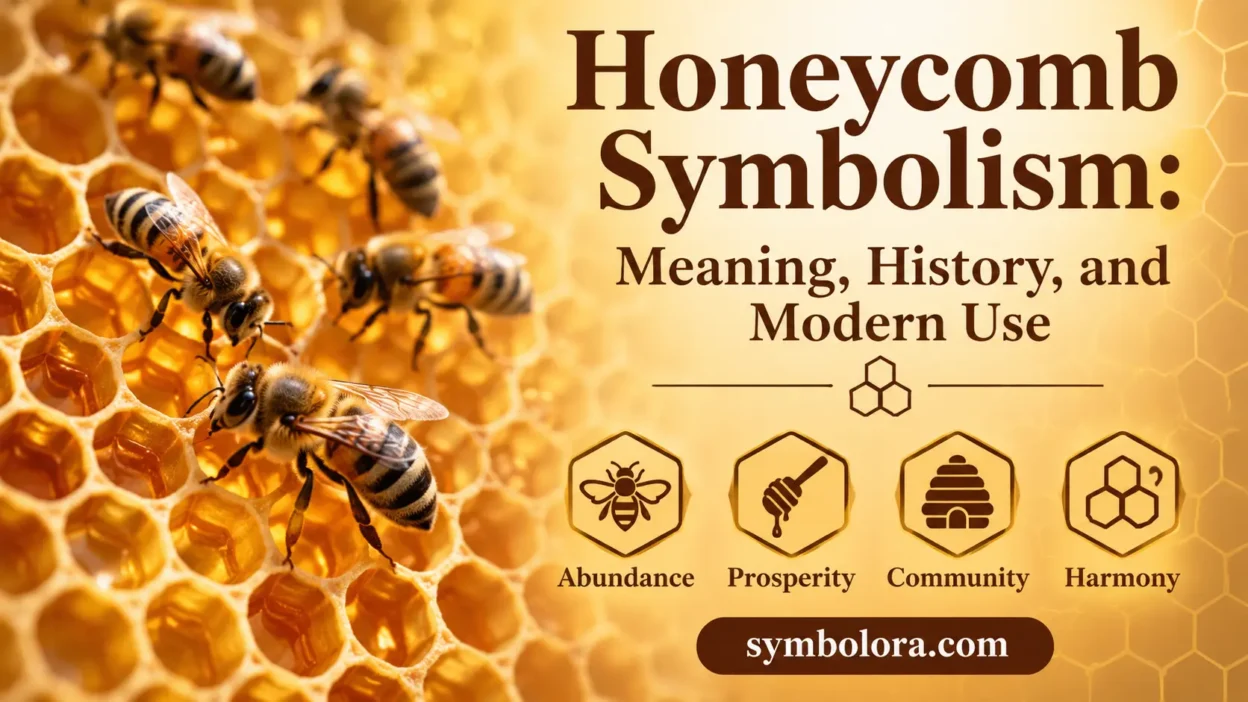
Nature often creates patterns that humans recognize as meaningful, and the honeycomb is one of the most familiar examples. Built by bees with remarkable precision, the honeycomb represents cooperation, structure, patience, and the value of working together. The meaning behind honeycomb symbolism comes from both its natural design and the important role bees have played in human cultures.
In the United States, the honeycomb appears in art, architecture, branding, jewelry, tattoos, and home décor because its geometric shape communicates ideas of organization and community. The hexagonal pattern feels modern and scientific, while its connection to bees gives it a warmer association with teamwork, nourishment, and shared effort.
Understanding this symbol means looking beyond the shape itself. The honeycomb carries meanings connected to nature, human relationships, productivity, and the balance between individual contribution and collective success.
Quick Answer
Honeycomb symbolism commonly represents teamwork, harmony, productivity, and organized growth in modern American culture. Historically, it has also been associated with community, nourishment, prosperity, and the relationship between humans and the natural world.
TL;DR
- Honeycombs symbolize cooperation and collective effort.
- Bees connect the symbol with productivity and community.
- Hexagonal patterns represent balance and efficiency.
- Americans use honeycombs in design and personal expression.
- Ancient traditions linked honey with prosperity and healing.
- Modern meanings focus on connection and sustainability.
What the Honeycomb Looks Like and Why It Matters
A honeycomb is a structure made by honeybees from beeswax. It consists of tightly packed hexagonal cells where bees store honey, pollen, and raise young bees. The repeating six-sided pattern is one of nature’s most recognizable examples of efficient design.
The shape itself contributes to the symbol’s meaning. Hexagons fit together without leaving empty spaces, allowing bees to create a strong structure while using limited material. Because of this, humans often connect the honeycomb pattern with organization, intelligence, and careful planning.
People encounter honeycomb imagery in many places today, including scientific illustrations, decorative patterns, product packaging, tattoos, and architectural designs. Its appearance combines natural beauty with mathematical order.
What Honeycomb Commonly Means in the United States
In American culture, the honeycomb is most often associated with cooperation and community. A single bee cannot create a hive alone, so the honeycomb represents how individual efforts can contribute to a larger purpose.
The symbol also represents productivity. Bees are commonly viewed as hardworking creatures, and the honeycomb reflects the results of consistent effort over time. This connection appears frequently in business branding, educational materials, and motivational designs.
Another common meaning is abundance. Since honey is stored inside the honeycomb, the image often suggests nourishment, rewards, and the positive results of dedication.
| Context | Meaning in the USA | Common Associations | Notes |
|---|---|---|---|
| Nature | Balance and efficiency | Bees, ecosystems, growth | Reflects natural design |
| Business | Teamwork and productivity | Collaboration, success | Common in branding |
| Tattoos | Connection and personal values | Community, resilience | Often paired with bees |
| Home Design | Order and harmony | Modern patterns, warmth | Popular geometric style |
| Environmental Causes | Protection of nature | Pollinators, sustainability | Highlights bee conservation |
Ancient Roots and Early Symbolism of Honeycombs
The symbolic importance of honey and bees goes back thousands of years. Ancient societies valued honey as a food source, medicine, and trade product. Because honey was difficult to obtain and required organized bee colonies, it became associated with prosperity and natural abundance.
In ancient Egypt, bees and honey held religious and cultural importance. Honey was used in offerings and daily life, while bees were connected with ideas of royalty and divine order. The honeycomb itself reflected the organized society of the hive.
Ancient Greek culture also respected bees. Bees were connected with agriculture, fertility, and wisdom in mythology. Honey was considered a valuable substance, and bees represented disciplined cooperation.
Although interpretations varied between cultures, many traditions recognized the same basic idea: the hive showed how cooperation could create something valuable.
The Honeycomb as a Symbol of Teamwork and Community
One of the strongest meanings of the honeycomb comes from the relationship between individual bees and the colony. Each bee performs a role that supports the survival of the entire hive.
This makes the honeycomb a symbol of shared responsibility. It suggests that communities become stronger when people contribute their skills and support one another.
In modern America, this meaning appears in workplace culture, nonprofit organizations, schools, and community projects. A honeycomb image may communicate that success comes from cooperation rather than individual achievement alone.
The symbol does not erase individuality. Instead, it highlights how personal contributions can become part of something larger.
Why Hexagonal Shapes Represent Balance and Efficiency
The hexagon is a major reason the honeycomb became such a recognizable symbol. Unlike many shapes, hexagons can connect closely together without leaving gaps, creating a stable and efficient structure.
Because of this, the honeycomb pattern is often connected with balance, planning, and smart use of resources. Designers and architects frequently use hexagonal patterns because they combine visual appeal with practical structure.
In symbolism, this geometric quality adds another layer of meaning. The honeycomb is not only about bees; it also represents thoughtful organization and harmony between form and function.
Honeycomb Symbolism in American Design and Architecture
Honeycomb patterns appear widely in American design because they fit both natural and modern styles. Interior designers use hexagonal tiles, wall patterns, and decorative elements to create spaces that feel organized yet organic.
The pattern is also common in logos and product designs. Companies connected with food, nature, technology, and sustainability often use honeycomb imagery because it communicates reliability and connection.
Architecture sometimes incorporates honeycomb structures because the pattern suggests strength and efficient use of space. Modern designers often view the shape as a bridge between biology and engineering.
The Meaning of Honeycomb Tattoos
Honeycomb tattoos have become popular because the symbol combines personal meaning with attractive visual design. Many people choose the pattern to represent family bonds, teamwork, personal growth, or appreciation for nature.
When combined with a bee, the tattoo often emphasizes hard work, loyalty, and dedication. When paired with flowers or plants, it may represent environmental awareness or a connection to natural cycles.
Some people choose honeycomb tattoos after personal experiences involving community, recovery, or building a new life structure. The meaning depends on the individual, but the central themes usually involve connection and progress.
Religious and Spiritual Interpretations
Honey and bees appear in several religious traditions, although meanings differ depending on the belief system.
In some Christian traditions, honey represents sweetness, blessing, and abundance. Biblical references to honey often connect it with nourishment and the rewards of a fruitful life.
Jewish traditions also recognize honey as an important symbol, especially during celebrations connected with hopes for a sweet and positive future.
In broader spiritual practices, honeycomb imagery may represent natural order, cooperation, and the relationship between living things. These interpretations are usually symbolic rather than based on a single universal meaning.
Emotional and Psychological Meaning of the Honeycomb
People often respond positively to honeycomb patterns because they combine familiarity from nature with visual order. The repeating structure can create feelings of stability and calm.
Psychologically, the symbol may communicate belonging. The hive represents a place where individuals are connected while still serving a purpose.
The honeycomb can also represent personal development. Just as bees gradually build their structure, people often create meaningful lives through repeated small actions rather than sudden changes.
Honeycomb Symbolism in Sustainability and Environmental Awareness
In recent years, honeycomb imagery has become closely connected with environmental conversations, especially those involving bees and pollinators.
Bees play an important role in ecosystems because they help many plants reproduce. As awareness of declining pollinator populations has increased, the honeycomb has become a symbol of protecting nature.
In American environmental movements, honeycomb designs may appear in educational campaigns, gardens, and conservation projects. The symbol reminds people that small creatures can have a major impact on the planet.
Modern Uses in Fashion, Media, and Pop Culture
Today, honeycomb imagery appears in clothing, accessories, artwork, and digital designs. Its popularity comes from its ability to represent both natural themes and modern aesthetics.
Fashion often uses honeycomb patterns because they look clean and geometric. Jewelry designers may combine honeycomb shapes with bee details to create pieces associated with nature and craftsmanship.
In digital culture, the symbol can represent networks and connection. The repeated pattern visually suggests linked communities and shared systems.
Common Misunderstandings About Honeycomb Symbolism
Because honeycomb imagery is widely used, some meanings have become exaggerated or simplified. It does not automatically represent success, wealth, or perfection in every situation.
The symbol also does not have one fixed meaning across all cultures. Its interpretation depends on context, personal experience, and the way it is presented.
Another misunderstanding is confusing the honeycomb with only the bee itself. While related, the honeycomb focuses more on structure, community, and the results of collective work.
How Honeycomb Symbolism Has Changed Over Time
The meaning of the honeycomb has evolved alongside human relationships with nature. Earlier societies often viewed it through agriculture, survival, and religious traditions.
Modern interpretations place more emphasis on teamwork, sustainability, design, and personal identity. The symbol has moved from representing a valuable natural resource to representing ideas about how people organize their lives and communities.
Its continued popularity comes from its ability to connect ancient observations of nature with modern values.
Honeycomb Symbolism in Personal Identity and Self-Expression
Many people use honeycomb imagery because it reflects personal beliefs about connection and purpose. Someone who values family, teamwork, or environmental responsibility may choose the symbol as a visual reminder.
Unlike symbols with narrow meanings, honeycomb imagery allows different interpretations. A person may see it as a reminder of hard work, a connection to nature, or appreciation for the people around them.
This flexibility helps explain why the symbol remains popular in personal art and design.
Frequently Asked Questions
What does honeycomb symbolism represent?
Honeycomb symbolism usually represents teamwork, organization, productivity, and community. It reflects how individual contributions can create something stronger when combined.
What does a honeycomb tattoo mean?
A honeycomb tattoo often symbolizes connection, dedication, personal growth, or appreciation for nature. Its exact meaning depends on the person wearing it and the elements included in the design.
Is honeycomb symbolism positive?
Yes, honeycomb imagery is generally viewed positively. It is commonly connected with cooperation, abundance, balance, and environmental awareness.
What does a honeycomb symbolize spiritually?
Spiritually, a honeycomb may represent harmony, natural order, and the relationship between individual actions and a larger purpose. Different traditions interpret it in their own ways.
Why is the honeycomb shape important?
The hexagonal structure represents efficiency and balance because the cells fit together with minimal wasted space. This natural design has influenced both symbolism and human architecture.
Does honeycomb symbolism relate to bees?
Yes, honeycomb symbolism is closely connected with bees because bees create and depend on the structure. However, the honeycomb emphasizes organization and community more than the bee alone.
Why do companies use honeycomb designs?
Companies often use honeycomb patterns because they suggest teamwork, reliability, innovation, and natural efficiency. The design works well for brands connected with technology, nature, food, and sustainability.
Conclusion
The honeycomb represents more than a pattern created by bees. It reflects ideas about cooperation, careful construction, balance, and the value of shared effort. From ancient connections with honey and prosperity to modern uses in design and environmental awareness, the symbol continues to adapt to changing cultures.
Honeycomb symbolism remains meaningful because it connects natural intelligence with human experiences. Whether used in tattoos, artwork, architecture, or personal expression, it reminds people that strong communities are built through many small contributions working together.


