Methodist symbolism centers on Christian faith, the work of the Holy Spirit, spiritual growth, and service to others. The best-known example is the United Methodist Church’s cross and flame, a design that connects the Christian cross with the movement’s historical emphasis on the Holy Spirit and a living faith. Understanding Methodist symbolism helps Americans recognize the beliefs, history, and community values expressed through church emblems, worship spaces, and religious artwork.
Methodism developed from an eighteenth-century renewal movement within the Church of England associated with John Wesley and Charles Wesley. As Methodist churches grew in the United States and other countries, they developed distinctive traditions, visual identities, and ways of expressing Christian teachings.
Unlike traditions built around elaborate systems of religious icons, Methodist churches generally place greater emphasis on Scripture, preaching, congregational worship, and practical Christian living than on a large collection of required sacred images. Their symbols often work as visual reminders of beliefs rather than objects of devotion in themselves.
Quick Answer
Methodist symbolism commonly represents Christian faith, the Holy Spirit, spiritual renewal, and service to others in American church life. Historically, these meanings developed from the Methodist movement’s Protestant roots and emphasis on personal faith, holy living, and sharing God’s love, with the United Methodist cross and flame becoming a widely recognized denominational emblem.
TL;DR
- The cross and flame is the best-known emblem of the United Methodist Church.
- The cross represents Jesus Christ and the foundation of Christian faith.
- The flame recalls the Holy Spirit and Methodist spiritual renewal.
- Methodist worship emphasizes Scripture, prayer, preaching, and congregational participation.
- Communion, baptism, and church architecture express important Christian beliefs.
- Methodist symbols often connect personal faith with compassion and public service.
What Methodist Symbols Look Like and Where They Appear
Methodist symbols appear on church signs, denominational websites, worship bulletins, clergy materials, educational resources, and community outreach publications. The exact imagery varies among Methodist denominations and individual congregations.
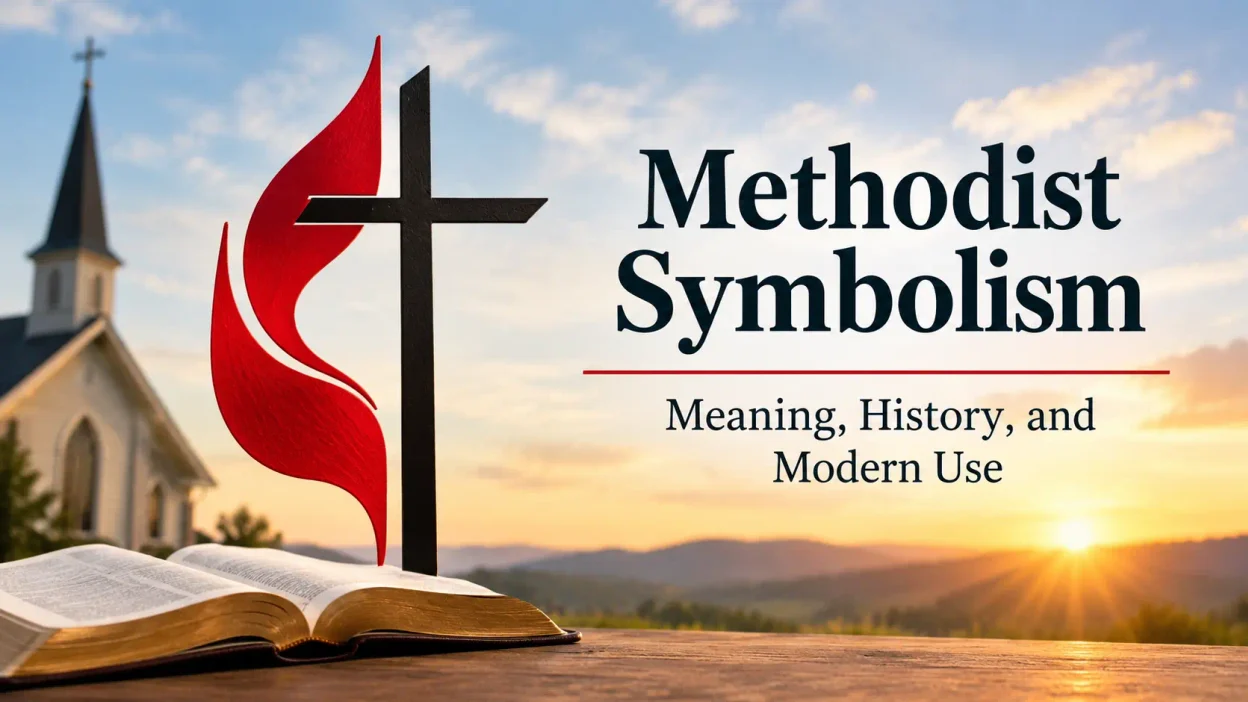
The most recognizable design in American Methodism is the United Methodist cross and flame. It combines a cross with a flowing flame, usually presented in a simple, recognizable arrangement. Its clean lines make it suitable for everything from a church building sign to a small printed emblem.
Other symbols commonly encountered in Methodist churches include the Christian cross, the Bible, water associated with baptism, bread and the cup used in Communion, and the flame or dove associated with the Holy Spirit. Some churches also use images of open hands, hearts, doves, or people serving their communities.
These images do not all have the same official status. The cross and flame identifies a particular denomination, while the cross, Bible, and Communion elements belong to the wider Christian tradition. Understanding that distinction helps prevent a general Christian symbol from being mistaken for an exclusively Methodist one.
The Cross and Flame: The Most Recognizable Methodist Emblem
The cross and flame is the signature emblem of The United Methodist Church, formed in 1968 through the union of the Methodist Church and the Evangelical United Brethren Church.
The cross represents Jesus Christ, particularly his crucifixion and the Christian understanding of salvation. It connects Methodists with the central belief shared across mainstream Christianity that Jesus’ life, death, and resurrection are fundamental to Christian faith.
The flame represents the Holy Spirit. It also recalls the spiritual renewal associated with the Methodist movement and the work of God’s Spirit in the lives of believers and the church.
Together, the two elements express a relationship between Christ and the continuing work of the Holy Spirit. The cross points to the foundation of Christian faith, while the flame suggests spiritual life, transformation, and active faith.
The emblem is particularly useful because it communicates these ideas without relying on words. A person unfamiliar with Methodist history may recognize the cross as Christian imagery, while someone familiar with United Methodism may identify the complete design as a denominational mark.
The emblem belongs specifically to The United Methodist Church. Other Methodist denominations may use different logos or church identities, so the cross and flame should not automatically be treated as the official symbol of every Methodist body.
Why the Flame Represents the Holy Spirit and Spiritual Renewal
The flame in the United Methodist emblem carries several connected meanings. Its primary religious association is the Holy Spirit, whose presence Christians understand as a source of guidance, renewal, and transformation.
The imagery recalls the biblical account of Pentecost in Acts 2, when the Holy Spirit comes upon Jesus’ followers and is described through the image of tongues resembling fire. This connection makes the flame more than a decorative element: it points to a specific event in Christian Scripture.
The flame also recalls John Wesley’s spiritual experience at a meeting on Aldersgate Street in London in 1738. Wesley described feeling that his heart was “strangely warmed,” a phrase closely associated with his developing understanding of faith and assurance in God’s grace.
These connections help explain why fire became appropriate imagery for a movement known for preaching, spiritual discipline, and renewed Christian commitment. In modern Methodist settings, a flame may consequently suggest a faith that remains active rather than merely inherited.
However, the flame is not an exclusive Methodist symbol. Fire also appears in Pentecostal, Catholic, Orthodox, and other Christian traditions. Its specific meaning depends on the image and the context in which it appears.
The Two Tongues of Flame and the Church’s History
An important detail in the United Methodist emblem is the flame’s two tongues. They represent the two denominations that united to form The United Methodist Church in 1968: The Methodist Church and The Evangelical United Brethren Church.
This historical meaning gives the design a second purpose beyond expressing Christian doctrine. It commemorates the joining of two church traditions into one denomination.
The emblem was developed during the preparations for church union and adopted at the 1968 Uniting Conference. Its designers aimed for a mark that was simple, recognizably Christian, and distinctive to the new denomination.
This detail is easy to miss when the flame is interpreted only as a symbol of enthusiasm or spiritual energy. The design also records a particular event in American religious history.
The distinction matters because not every Methodist denomination emerged from the same merger, and the emblem does not represent all Methodist churches worldwide. Its two tongues have a specific institutional meaning within United Methodist history.
Methodist Roots: John Wesley and the Meaning of the Heart
Methodist symbolism cannot be understood fully without considering John Wesley, whose teaching helped shape the movement’s spiritual identity. Wesley and his brother Charles were Anglican clergymen who became central figures in an eighteenth-century movement focused on disciplined Christian living, spiritual renewal, and outreach.
The term Methodist developed from the structured habits of a group of students at Oxford. They met for prayer, Bible study, Communion, and practical service, including visiting prisoners and helping people in need.
Their approach linked faith with regular practice. Christianity was not meant to remain an abstract set of beliefs; it was to shape a person’s habits, relationships, and conduct.
The heart became a useful image for this emphasis on inward transformation. Wesley’s Aldersgate experience is frequently remembered through the phrase “strangely warmed,” although its significance should not be reduced to a claim that every Methodist must experience the same emotion.
In modern Methodist art, a heart may represent love of God, compassion for neighbors, or a renewed commitment to Christian living. Unlike the cross and flame, however, a heart is not a universal official emblem of Methodism.
The Cross, Bible, and Other Christian Symbols in Methodist Churches
Methodist congregations use many symbols shared with other Christian communities. These images communicate beliefs through familiar objects, gestures, and scenes.
The cross is the clearest example. It recalls Jesus’ crucifixion and the Christian understanding of salvation. Some churches display a plain cross, while others use a crucifix depicting Jesus’ body.
The Bible represents Scripture as a foundation for Christian teaching, preaching, and personal study. It may appear on a lectern, a church seal, or educational materials. Its presence reflects the importance of Scripture in Methodist worship and theological reflection.
A dove is another familiar Christian image, often associated with the Holy Spirit because of biblical descriptions of the Spirit in dove-like form. When a Methodist church uses a dove, the symbol is Christian rather than exclusively Methodist.
The empty tomb, an Easter lily, or a crown may also appear in church artwork. These images can communicate resurrection, hope, or Christ’s kingship, depending on their setting.
Such symbols help congregations explain Christian beliefs visually, but they do not all carry the same official standing. A church may select particular images for its building or worship materials without making them required symbols for every Methodist congregation.
Baptism: Water as a Sign of Grace and New Life
Water has an important place in Methodist symbolism because baptism is one of the two sacraments recognized by The United Methodist Church. The other is Holy Communion.
In baptism, water is used as a visible sign connected with God’s grace, the beginning of Christian discipleship, and incorporation into the church. Methodist congregations baptize infants, children, and adults, although practices and individual circumstances vary.
Water can suggest cleansing and new life, but its significance in baptism is more specific than a general metaphor for starting over. The ritual places the person within the Christian community and connects the act with God’s promises.
In American Methodist churches, baptismal fonts and bowls are often placed near the front of the sanctuary or in another visible location. Some congregations use larger baptismal pools or other arrangements suited to their worship practices.
For families, baptism may also become a lasting memory of belonging, commitment, and support from the congregation. Photographs, baptismal certificates, and family traditions can preserve that meaning beyond the service itself.
The symbolism is shared across Christianity, though the theology and practice of baptism differ between denominations.
Bread and the Cup: The Meaning of Holy Communion
Holy Communion, also called the Lord’s Supper, is another central Methodist sacrament. Bread and the cup are visible elements that connect the worship service with Jesus’ final meal with his disciples and the Christian understanding of his death and saving work.
United Methodists generally understand Communion as a means through which God’s grace is offered and received. It is not simply a reminder of a historical event; it is a communal act of worship and spiritual nourishment.
The table also expresses fellowship. Participants gather as a congregation rather than treating faith as an entirely private experience. United Methodist practice is known for an open Communion table, with an invitation that extends beyond formal membership in the denomination.
Bread and the cup therefore combine remembrance, grace, and community. Their meaning comes from Christian Scripture and worship, not from a unique Methodist invention.
In contemporary American churches, the elements may be presented on a communion table, distributed by clergy or lay servers, or shared through different arrangements. The physical details can vary, but the central Christian meaning remains.
The Bible, Hymns, and Music as Expressions of Methodist Identity
Methodist symbolism is not limited to objects or logos. Words, melodies, and repeated practices can also express the movement’s identity.
Charles Wesley, John Wesley’s brother, wrote a large body of hymns that helped communicate Christian teachings through music. Hymns about grace, repentance, holiness, love, and the life of Christ became important to Methodist worship and influenced Protestant hymnody more broadly.
Music gives theological ideas an emotional and communal form. A congregation singing together can express grief, gratitude, hope, or commitment in ways that a printed statement may not achieve.
The Bible also has a visible and practical role. Public readings, sermons, study groups, and personal devotion make Scripture part of the congregation’s shared vocabulary. A Bible pictured alongside a cross may therefore represent both Christian authority and the practice of learning and living out the faith.
Not every Methodist congregation uses the same music or worship style. Some favor traditional hymns and organs, while others use contemporary worship bands or a mixture of musical forms. These differences reflect the variety within modern Methodism rather than a single universal aesthetic.
Service, Compassion, and the Symbolism of Helping Others
Methodist tradition strongly connects Christian faith with practical service. This emphasis grew from Wesleyan teaching that love of God should be reflected in how people treat their neighbors.
Early Methodist groups combined religious discipline with acts such as visiting prisoners, assisting the poor, and teaching children. Over time, Methodist communities became involved in education, health care, charitable work, and campaigns addressing social problems.
This history helps explain why service-related imagery appears frequently in Methodist church materials. Open hands may suggest generosity, a heart may communicate compassion, and images of people working together may represent community ministry.
These are usually interpretive or locally chosen symbols rather than official denominational emblems. Their significance comes from the values they express and the activities of the congregation using them.
In the United States, Methodist congregations may organize food pantries, disaster relief, clothing drives, neighborhood programs, or support for people facing hardship. A church’s visual identity can connect these activities with its understanding of Christian discipleship.
Service symbolism also creates an important distinction between professed belief and practical action. The image is not meant to replace the work itself; it points toward the responsibilities that members associate with their faith.
Methodist Symbolism in American Churches and Public Life
American Methodism developed through preaching, local societies, camp meetings, congregational growth, and the establishment of churches in towns and cities. As the movement expanded, its symbols became part of the country’s religious landscape.
The cross and flame is particularly visible on United Methodist church signs, denominational publications, educational materials, and community ministry resources. For people who regularly pass a local church, the emblem can signal the congregation’s denominational identity before they know anything about its members.
Church architecture also communicates religious identity. Crosses on steeples, stained-glass windows, baptismal fonts, pulpits, and communion tables make Christian beliefs visible in physical spaces.
Methodist congregations vary in architectural style. Some worship in historic brick churches with traditional stained glass, while others meet in modern buildings with simpler interiors. The absence of elaborate religious decoration does not indicate a lack of symbolism; it may reflect a preference for simplicity and attention to preaching and congregational worship.
Methodist symbols also appear in public service settings, including hospitals, schools, charities, and disaster-response organizations with Methodist histories or affiliations. Their meaning may extend beyond the sanctuary, connecting religious identity with education, care, and community involvement.
The United States has multiple Methodist denominations, so the exact emblem or organizational identity depends on the church. Recognizing the United Methodist cross and flame is useful, but it should not be used as the sole test of whether a congregation belongs to the broader Methodist tradition.
Colors and Visual Design in Methodist Symbolism
Color can reinforce the meaning of a religious emblem, but its interpretation should begin with the actual design rather than assumptions about universal color psychology.
The United Methodist cross and flame is commonly displayed with a black cross and a red flame. The cross remains visually distinct, while the flame draws attention to the Holy Spirit and the emblem’s connection with Pentecost.
Red is often associated in Christian art with fire, the Holy Spirit, sacrifice, or passionate commitment. In this particular emblem, the connection between the flame and the Holy Spirit provides the strongest contextual explanation for the color.
Black helps the cross remain clear and legible across different backgrounds and print formats. It should not automatically be interpreted as mourning or sin simply because those meanings sometimes appear in other religious settings.
Methodist churches may also use white, purple, green, and other colors during the Christian year. In many churches, white is associated with celebrations such as Easter and Christmas, purple with seasons of preparation such as Advent and Lent, and green with periods of ordinary growth in the church calendar. Practices differ by congregation and tradition.
These seasonal colors belong to the wider Christian liturgical tradition. They can appear in Methodist worship without being unique Methodist symbols or carrying exactly the same emphasis in every church.
How Methodist Symbols Compare With Other Christian Traditions
Methodist symbols overlap substantially with those used by other Protestant churches, the Catholic Church, and Eastern Orthodox Christians. This shared imagery reflects common Christian beliefs rather than a lack of Methodist identity.
The cross, Bible, baptismal water, bread, and cup all have meanings that extend across denominational boundaries. Their theological interpretation can vary, especially around the sacraments, but their Christian origins are widely shared.
Methodism’s distinctive identity is more visible when these symbols are considered alongside its Wesleyan emphasis on grace, holiness, spiritual discipline, and service. The cross and flame is especially recognizable because it combines Christian imagery with the history of a specific denomination.
Other Protestant traditions may emphasize different visual marks. Presbyterian churches, for example, may use symbols related to their denominational identity, while Lutheran congregations often use a variety of crosses and historic Christian imagery. None of these visual differences should be mistaken for a complete summary of each tradition’s theology.
The important question is not simply whether a symbol appears in one church or another. It is how the congregation understands that symbol within its own beliefs, history, and worship.
Emotional and Personal Meaning in Methodist Symbolism
Religious symbols often become meaningful through repeated experiences. A cross above a family church may remind someone of childhood worship, a funeral, a wedding, or a period of personal change. The same object can carry different memories for different people.
The cross and flame may remind a United Methodist of confirmation, youth ministry, mission trips, or a congregation that supported the family during a difficult time. For someone outside the church, it may simply identify a nearby religious community.
Water from a baptism, bread shared at Communion, or a familiar hymn can also connect faith with personal and family history. These experiences give the symbols emotional meaning without changing their underlying religious significance.
Symbols should not be treated as reliable measures of an individual’s beliefs or character. A person may value Methodist imagery because of family heritage, artistic interest, community relationships, or personal faith. Another person may belong to a Methodist congregation without feeling strongly attached to any particular emblem.
The most accurate interpretation leaves room for this variety. Religious symbols communicate shared beliefs, but their personal meaning develops through individual experience.
Misunderstandings About Methodist Symbols
A frequent misunderstanding is that the cross and flame represents every Methodist denomination. It is the official emblem of The United Methodist Church, but other Methodist bodies may have their own logos and institutional histories.
Another mistake is to treat every cross, dove, flame, or heart displayed in a Methodist church as an exclusively Methodist symbol. Most of these images belong to the wider Christian tradition, and their meaning depends on how they are used.
The red flame is sometimes interpreted only as enthusiasm or emotional intensity. Although the image can suggest spiritual renewal, its established meaning also includes the Holy Spirit, Pentecost, and the union of two denominations.
Likewise, a church’s use of stained glass, seasonal colors, or traditional architecture does not necessarily indicate a particular theological position. Congregations differ in their worship preferences, budgets, histories, and local cultures.
Finally, symbolism should not be separated from practice. A church may display a symbol of compassion, for example, but the image alone cannot establish how effectively the congregation serves its neighbors. Understanding Methodist identity requires attention to both its visual language and its lived commitments.
Methodist Symbols and Their Meanings at a Glance
| Symbol | Common meaning | Where it appears | Important distinction |
|---|---|---|---|
| Cross and flame | Christ, the Holy Spirit, and United Methodist identity | Church signs, publications, and ministry materials | Official emblem of The United Methodist Church |
| Christian cross | Jesus’ crucifixion and salvation | Sanctuaries, jewelry, and church buildings | Shared across Christianity |
| Bible | Scripture, teaching, and spiritual guidance | Pulpits, study groups, and worship materials | Not exclusive to Methodism |
| Baptismal water | Grace, baptism, and Christian discipleship | Baptismal fonts and worship services | One of two United Methodist sacraments |
| Bread and cup | Holy Communion, grace, and fellowship | Communion tables and services | Shared Christian practice with denominational differences |
| Heart or open hands | Love, compassion, and service | Outreach materials and local church designs | Common illustrative imagery, not a universal official emblem |
Frequently Asked Questions
What is the main symbol of Methodism?
The best-known symbol of The United Methodist Church is the cross and flame, adopted when the denomination formed in 1968. The cross represents Christ, while the flame represents the Holy Spirit and recalls the two denominations that united.
What does the red flame mean in Methodist symbolism?
The red flame represents the Holy Spirit and recalls the biblical event of Pentecost. Its two tongues also reflect the union of The Methodist Church and The Evangelical United Brethren Church in forming The United Methodist Church.
Is the cross and flame used by all Methodist churches?
No. The cross and flame is the official emblem of The United Methodist Church, not a universal logo for every Methodist denomination. Other Methodist churches may use different emblems while sharing many of the same Christian beliefs and symbols.
What do water and bread symbolize in Methodist worship?
Water is used in baptism, which marks the beginning of a person’s lifelong journey of Christian discipleship. Bread and the cup are used in Holy Communion, a sacrament associated with Christ, God’s grace, remembrance, and fellowship.
Why is the heart important in Methodist tradition?
The heart is often used to express love, inward spiritual change, and devotion to God and neighbor. It is especially associated with John Wesley’s account of feeling his heart “strangely warmed,” but it is not the denomination’s official emblem.
What colors are associated with Methodist churches?
The United Methodist cross and flame commonly uses a black cross and a red flame. Individual congregations may also use seasonal Christian colors such as white, purple, and green, depending on the worship calendar and local tradition.
What does Methodist symbolism teach about everyday life?
Methodist symbolism often connects Christian belief with practical discipleship, including prayer, compassion, and service to others. The emphasis is not merely on recognizing religious images but on living out the values those images represent.
Conclusion
Methodist symbolism brings together Christian faith, the Holy Spirit, spiritual renewal, and service. The United Methodist cross and flame is its most recognizable denominational emblem, while the cross, Bible, baptismal water, and Communion elements express beliefs shared with the wider Christian tradition. Each symbol has a particular context, and understanding that context makes its meaning clearer.
For Americans, these symbols can identify a congregation, preserve family memories, and communicate a commitment to faith and community life. Methodist symbolism is best understood not as a fixed collection of images but as a visual expression of beliefs that congregations seek to practice in worship and everyday relationships.


