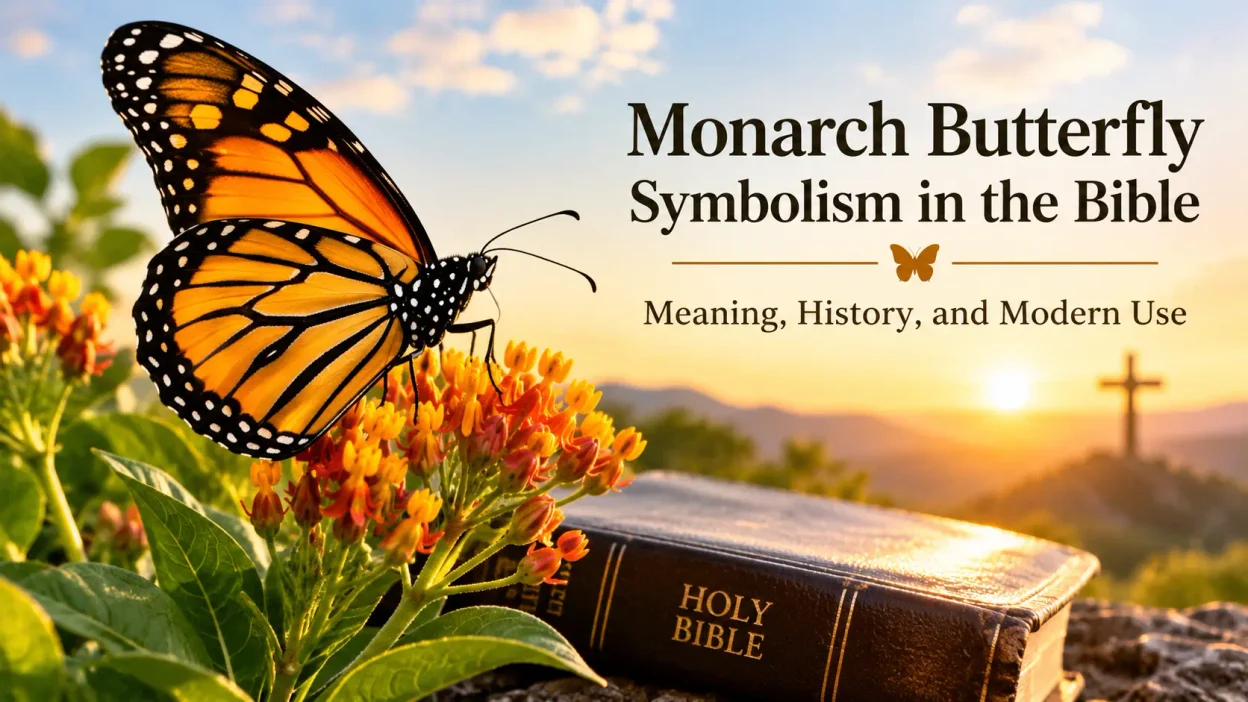
Monarch butterfly symbolism in the Bible often centers on transformation, new life, hope, and spiritual renewal. In modern American Christian culture, the monarch’s journey from caterpillar to butterfly can serve as a visual reminder of personal growth and the promise of resurrection. However, the Bible does not specifically mention monarch butterflies, so it is important to distinguish biblical teachings from symbolic interpretations inspired by nature.
Monarch butterflies are recognizable for their orange-and-black wings, delicate bodies, and remarkable seasonal migrations. Their life cycle provides an accessible example of change: a caterpillar forms a chrysalis, and an adult butterfly emerges with a completely different appearance and way of moving through the world.
For Christians, this process can prompt reflection on spiritual growth, God’s creation, and the hope of life beyond death. These associations can be meaningful without claiming that every detail of a butterfly’s biology has a direct biblical meaning.
Understanding the distinction helps readers appreciate the monarch as a modern Christian symbol while remaining accurate about what Scripture actually teaches.
Quick Answer
Monarch butterfly symbolism in the Bible is commonly associated with transformation, new life, hope, and spiritual renewal in modern American Christian culture. Although monarch butterflies are not specifically mentioned in Scripture, their life cycle can illustrate biblical themes of becoming a new creation, resurrection, and trust in God’s work.
TL;DR
- Monarch butterflies can symbolize spiritual transformation and new beginnings.
- The Bible does not specifically mention monarch butterflies.
- Metamorphosis offers a modern illustration of Christian renewal.
- Butterfly imagery can remind Christians of resurrection and eternal hope.
- Monarch migration may inspire reflection on faith, perseverance, and God’s creation.
- Christian interpretations are symbolic applications, not direct biblical definitions.
What Does a Monarch Butterfly Represent in Christian Symbolism?
The monarch butterfly commonly represents transformation, hope, renewal, and the possibility of new beginnings in contemporary Christian symbolism. These meanings arise largely from its life cycle and the way Christians connect natural change with spiritual teachings.
A caterpillar looks and behaves very differently from an adult butterfly. During metamorphosis, it develops inside a chrysalis before emerging with wings. This visible change provides a useful illustration of how a person might leave old habits behind, grow in faith, and develop a new way of living.
Christians may connect this image with the idea of becoming a new creation in Christ. In this interpretation, the butterfly does not possess a special spiritual power. Instead, it serves as a reminder of a change that Christians believe God can bring about in a person’s life.
The monarch’s bright wings may also draw attention to beauty, fragility, and the variety of life in creation. Its symbolic meaning depends on the setting: a butterfly in a church illustration may communicate renewal, while one on a memorial card may represent hope after loss.
There is no single official Christian meaning for the monarch butterfly. Its significance comes from the relationship between the natural world, biblical themes, and the beliefs of the person interpreting it.
Does the Bible Mention Monarch Butterflies?
No. The Bible does not specifically mention monarch butterflies, and it does not assign them a formal religious meaning.
The biblical texts were written long before modern scientific classification established the monarch butterfly as a distinct species in the way it is recognized today. Scripture contains references to many animals, plants, birds, and insects, but the monarch’s familiar orange-and-black appearance is not described as a biblical sign.
This distinction matters because some popular spiritual interpretations are presented as though they came directly from a verse. A statement such as “the monarch butterfly is God’s biblical symbol of resurrection” goes beyond what Scripture explicitly says.
A more accurate explanation is that Christians use the butterfly as an illustration of ideas already present in the Bible. Transformation, renewed life, and resurrection are biblical themes, while the monarch provides a natural image through which people can reflect on them.
The absence of a direct reference does not make the symbol meaningless. It simply means that its religious significance belongs to interpretation and devotional practice rather than to an explicit biblical identification.
Transformation and the Biblical Idea of Becoming New
Transformation is one of the clearest connections between the monarch butterfly and Christian teaching. The butterfly’s life cycle offers a visible example of a major change in form, making it an accessible metaphor for a changed heart and a renewed life.
Second Corinthians 5:17 teaches that anyone who is in Christ is a new creation. The passage describes a change in a person’s relationship with God and the passing away of an old way of life. Christians often connect this teaching with repentance, forgiveness, and a new direction.
Romans 12:2 also encourages believers to be transformed through the renewing of their minds. Its focus is on spiritual discernment and a changed pattern of thinking, not on physical metamorphosis.
A monarch butterfly can help communicate these ideas in a sermon, children’s lesson, devotional journal, or church display. The chrysalis becomes an illustration of transition, while the emerging butterfly represents the visible result of change.
The comparison has limits. A butterfly’s metamorphosis is a biological process, while Christian spiritual transformation involves faith, choices, relationships, and growth over time. The butterfly illustrates the idea; it does not explain every aspect of it.
Monarch Butterfly Symbolism and Resurrection
Resurrection is another common association in Christian butterfly imagery. The butterfly’s emergence from a chrysalis can remind believers of the Christian teaching that death does not have the final word.
In 1 Corinthians 15, Paul discusses resurrection and the transformation of the body. The chapter presents resurrection as a central part of Christian hope, grounded in Christ’s resurrection rather than in the life cycle of an insect.
The butterfly can make this teaching easier to visualize. Before emergence, the chrysalis appears still and inactive from the outside. Later, a butterfly comes out and begins a different stage of life. For Christians, that change can serve as a picture of hope beyond what is immediately visible.
However, a chrysalis is not literally a dead body, and metamorphosis is not biological proof of life after death. The analogy works as an illustration of faith, not as scientific evidence for a religious claim.
This distinction is particularly important in funerals and memorial services. A butterfly image can express a family’s belief in resurrection, but its meaning should not be imposed on people whose beliefs or grieving experiences differ.
New Life, Hope, and Spiritual Renewal
A monarch butterfly may symbolize a fresh start after a difficult season. Its development can prompt people to think about recovery, forgiveness, and the possibility of moving forward without pretending that earlier hardships never happened.
Christian hope is more than optimism that circumstances will improve. It is connected with trust in God, the promises of Scripture, and the belief that suffering does not have to define the whole of a person’s life.
Romans 6:4 describes walking in newness of life in connection with Christ. This provides a stronger biblical foundation for the idea of spiritual renewal than any claim that monarch butterflies have a specific scriptural meaning.
In practical Christian settings, a butterfly may appear on a baptism card, a journal cover, or a church program about personal growth. In each case, the image can encourage reflection on a new chapter of life.
Hope does not require a person to feel happy all the time. A butterfly can be a reminder that growth may happen gradually and that uncertainty can coexist with faith.
What the Monarch’s Life Cycle Can Teach About Faith
The monarch’s development includes four main stages: egg, caterpillar, chrysalis, and adult butterfly. Each stage has a distinct biological role, and together they offer a natural sequence that people can use to illustrate different experiences of growth.
The egg represents the beginning of the life cycle. The caterpillar feeds and grows, the chrysalis provides the setting for metamorphosis, and the adult butterfly emerges to reproduce and continue the species.
Christians sometimes adapt this sequence into a lesson about spiritual development. The beginning can suggest the start of faith, the caterpillar can represent learning and preparation, and the adult butterfly can illustrate visible growth or a new way of living.
These comparisons are teaching tools rather than fixed meanings assigned to each stage by the Bible. There is no biblical rule that the egg must represent salvation or that the chrysalis must represent suffering.
The life cycle also offers an important reminder that development takes time. A person may experience progress, uncertainty, setbacks, and further learning rather than one dramatic moment of change. That gradual process can be a useful theme in Christian teaching about patience and perseverance.
What the Monarch’s Migration Can Symbolize in Christian Life
The monarch butterfly’s migration adds another layer to its modern symbolism. Many monarchs in eastern North America travel thousands of miles toward overwintering areas in Mexico, while western populations generally migrate to coastal California. This journey is one of the most recognizable examples of insect migration.
For Christians, the migration can serve as an illustration of perseverance, direction, and continuing through uncertainty. A butterfly that travels across changing landscapes provides a natural image for a person navigating a difficult period while holding on to faith.
Some believers connect this journey with the biblical idea of trusting God without knowing every detail of the future. Proverbs 3:5–6 encourages trust in the Lord and acknowledges the importance of seeking divine guidance. The passage does not refer to butterfly migration, but its message can inform a personal reflection on the journey.
It is important not to treat the monarch’s navigation as evidence of supernatural guidance. Scientists study the biological and environmental mechanisms that help these butterflies migrate. Christians may appreciate those mechanisms as part of creation while finding personal spiritual meaning in the journey.
Monarch Butterfly Colors and Their Christian Associations
The monarch’s orange-and-black wings make it easy to recognize. Although the Bible does not assign these colors specific meanings for monarch butterflies, their appearance can influence the way people interpret them in religious art.
Orange may suggest warmth, vitality, light, or celebration in contemporary visual design. Black can communicate contrast, seriousness, or mourning, depending on the surrounding imagery. These are general cultural associations rather than fixed biblical definitions.
In a Christian illustration, an orange monarch against a dark background might represent hope during a difficult season. A butterfly surrounded by flowers and sunlight might emphasize gratitude for creation and the possibility of renewal.
The context determines the message. A butterfly displayed at a funeral may communicate remembrance, while the same image on a baptism invitation may suggest a new chapter of faith.
Christians should be cautious about claims that orange monarchs carry a special divine message because of their color. The natural colors help identify the species, but their religious significance comes from the meaning people give the image.
What Does It Mean When a Monarch Butterfly Visits You?
A monarch butterfly landing nearby or repeatedly appearing in a garden can feel significant, especially during a period of grief, uncertainty, or personal change. Some Christians interpret the encounter as an invitation to reflect on hope, God’s creation, or the possibility of renewal.
However, the Bible does not establish a monarch butterfly sighting as a specific message from God. A butterfly may visit because it is searching for nectar, resting, or moving through its habitat.
Christians who notice a monarch during a difficult time can still find comfort in the experience. They might use the moment as a reminder to pray, express gratitude, or consider a biblical passage about hope. Personal meaning does not require a claim that the encounter predicts a future event.
This distinction can help people appreciate nature without feeling pressured to decode every animal encounter. A meaningful experience can inspire reflection even when its ordinary biological explanation remains clear.
If a monarch appears during a period of mourning, for example, a person might associate its presence with a loved one or with the hope of resurrection. That association can be personally important without becoming a universal Christian teaching.
Monarch Butterfly Symbolism in Christian Funerals and Memorials
Butterflies are common in contemporary American memorial imagery. They appear on sympathy cards, funeral programs, memorial jewelry, cemetery decorations, and artwork honoring people who have died.
The monarch can be especially recognizable because of its distinctive wings and long migration. Families may choose it to express hope, remembrance, or the belief that death is not the end of existence.
For Christians who believe in resurrection and eternal life, a butterfly may serve as a visual expression of that faith. Its emergence from a chrysalis can suggest a transition into a new stage of existence, although Christian resurrection is a theological belief rather than a biological process demonstrated by metamorphosis.
Butterfly imagery can also comfort people who do not interpret it in explicitly religious terms. Someone may simply associate the insect with a loved one’s garden, favorite season, or enjoyment of nature.
When choosing memorial imagery, it is worth considering the beliefs and preferences of the person being remembered and the family receiving the tribute. A symbol can offer comfort without requiring everyone to understand it in exactly the same way.
How Christians Use Monarch Butterfly Imagery Today
In modern American churches and Christian communities, monarch butterflies appear in several settings. Their appeal comes partly from their recognizable appearance and partly from the ease with which their life cycle can illustrate themes of change.
- Children’s ministry: Teachers use the caterpillar-to-butterfly transformation to introduce lessons about spiritual growth and becoming a new creation.
- Baptism celebrations: Butterfly illustrations may represent a new beginning and a person’s developing relationship with Christ.
- Devotional materials: A monarch can accompany reflections on hope, patience, or trusting God during change.
- Memorial designs: Butterfly imagery may express remembrance, comfort, and belief in eternal life.
- Church gardens: Monarch-friendly planting projects can connect appreciation for creation with practical environmental care.
- Personal artwork: Christians may use monarchs in journals, paintings, jewelry, or tattoos as reminders of faith and renewal.
These uses are modern applications rather than evidence of an established ancient Christian monarch tradition. The distinction does not make them less meaningful; it simply identifies where their significance comes from.
The Monarch Butterfly and God’s Creation
Many Christians view the natural world as part of God’s creation and believe that observing it can encourage gratitude and reflection. Monarch butterflies provide an accessible example because their development, colors, and migration are visible reminders of the complexity of living systems.
Psalm 104 celebrates God’s provision for living creatures and the variety of life in the natural world. Although the psalm does not identify the monarch, its broader message can support a Christian reflection on wildlife and the natural environment.
Appreciating monarchs can also lead to practical action. Their caterpillars depend on milkweed, and adult butterflies need suitable nectar sources. Habitat loss, pesticide exposure, and environmental changes can affect their survival.
Planting appropriate native milkweed and nectar-producing flowers, reducing unnecessary pesticide use, and protecting local habitats are ways people can support monarch conservation. Such actions can express care for creation without claiming that a particular butterfly sighting carries a supernatural instruction.
For some Christians, this connection between faith and conservation is one of the most practical aspects of the symbol. Admiration becomes more meaningful when it encourages responsible treatment of the living world.
Common Misunderstandings About Monarch Butterfly Symbolism in the Bible
Several popular claims about monarch butterflies require clarification.
The Bible identifies monarch butterflies as a sign of resurrection. It does not. Resurrection is a central Christian teaching, but the monarch is a modern illustration of that belief.
Every monarch sighting is a message from God. Scripture does not establish that rule. A sighting may prompt personal reflection, but its appearance alone does not prove divine communication.
The chrysalis represents death in a literal biblical sense. This is an analogy, not a biological or theological equivalence. Metamorphosis and resurrection are different processes.
Monarch colors have fixed biblical meanings. The Bible does not assign orange-and-black monarch wings a prescribed spiritual interpretation. Color associations depend on cultural and artistic context.
The monarch is an ancient Christian emblem. Butterflies have appeared in Christian art and later religious interpretation, but that does not establish the monarch species as a specific symbol used by biblical writers.
Recognizing these distinctions allows Christians to use butterfly imagery thoughtfully. It preserves the difference between what Scripture teaches, what nature illustrates, and what an individual finds meaningful.
Monarch Butterfly Symbolism Compared With Other Christian Symbols
The monarch butterfly is one of several natural images used to communicate Christian ideas about renewal and hope. Comparing it with more established Christian symbols helps clarify its particular role.
| Symbol | Common Christian association | How it differs from the monarch |
|---|---|---|
| Monarch butterfly | Transformation, renewal, hope | A modern natural illustration rather than an explicit biblical symbol |
| Dove | Peace and the Holy Spirit | Appears directly in biblical accounts, including Jesus’ baptism |
| Lamb | Christ, sacrifice, innocence | Has extensive roots in biblical imagery |
| Seed | Growth, faith, and the kingdom of God | Appears in several of Jesus’ parables |
| Olive branch | Peace and reconciliation in many Christian contexts | Has biblical associations with the flood narrative and later religious art |
These symbols do not all have one meaning in every setting. Their significance depends on the passage, tradition, and artistic context in which they appear.
The monarch’s distinctive contribution is its visible transformation and remarkable migration. It gives modern Christians an accessible way to reflect on change and perseverance without replacing the theological foundations of their faith.
Frequently Asked Questions
What does a monarch butterfly mean spiritually for Christians?
A monarch butterfly can represent transformation, hope, renewal, and trust in God’s work in a person’s life. These meanings are modern spiritual interpretations inspired by nature and biblical themes, not a definition explicitly provided by Scripture.
Is a monarch butterfly a sign from God?
The Bible does not identify monarch butterfly sightings as specific signs from God. Christians may find personal encouragement in seeing one, but they should distinguish that personal experience from a definite biblical promise or prediction.
What Bible verse relates to butterfly transformation?
Second Corinthians 5:17 is a common choice because it describes becoming a new creation in Christ. Romans 12:2 also relates to transformation through the renewing of the mind, although neither passage specifically mentions butterflies.
Does a monarch butterfly symbolize someone who has died?
Some people associate a monarch butterfly with a deceased loved one, remembrance, or hope beyond death. For Christians, it may also illustrate resurrection, but the butterfly itself does not prove that a deceased person is communicating with the living.
What does an orange monarch butterfly mean in Christianity?
An orange monarch may represent hope, vitality, or renewal in Christian artwork, depending on its setting. These associations come from contemporary symbolism and the butterfly’s appearance rather than from a biblical rule about orange butterflies.
Is butterfly symbolism biblical or spiritual folklore?
The butterfly is used in modern Christian symbolism, but its specific meanings are not all directly biblical. Transformation and resurrection are biblical themes, while applying them to the monarch is an interpretive practice shaped by art, nature, and personal belief.
Can Christians use monarch butterflies in tattoos or religious art?
Yes. Christians may choose monarch imagery to express faith, renewal, remembrance, or appreciation for creation. A design can communicate a meaningful personal belief without requiring the claim that monarch butterflies were established as a biblical emblem.
Conclusion
Monarch butterfly symbolism in the Bible is best understood as a modern Christian interpretation of transformation, new life, hope, and spiritual renewal. Scripture does not specifically mention monarch butterflies, but passages about becoming a new creation, renewing the mind, and resurrection provide a theological foundation for reflecting on the butterfly’s life cycle.
In contemporary American Christian culture, the monarch can appear in memorials, devotional art, church gardens, and personal designs. Its meaning is most useful when it encourages thoughtful reflection rather than unsupported claims about divine messages or biblical predictions.
A monarch does not need to be a formally defined biblical symbol to remind someone of faith. Its life cycle and migration offer a natural starting point for considering change, perseverance, and the value of caring for the world around us.