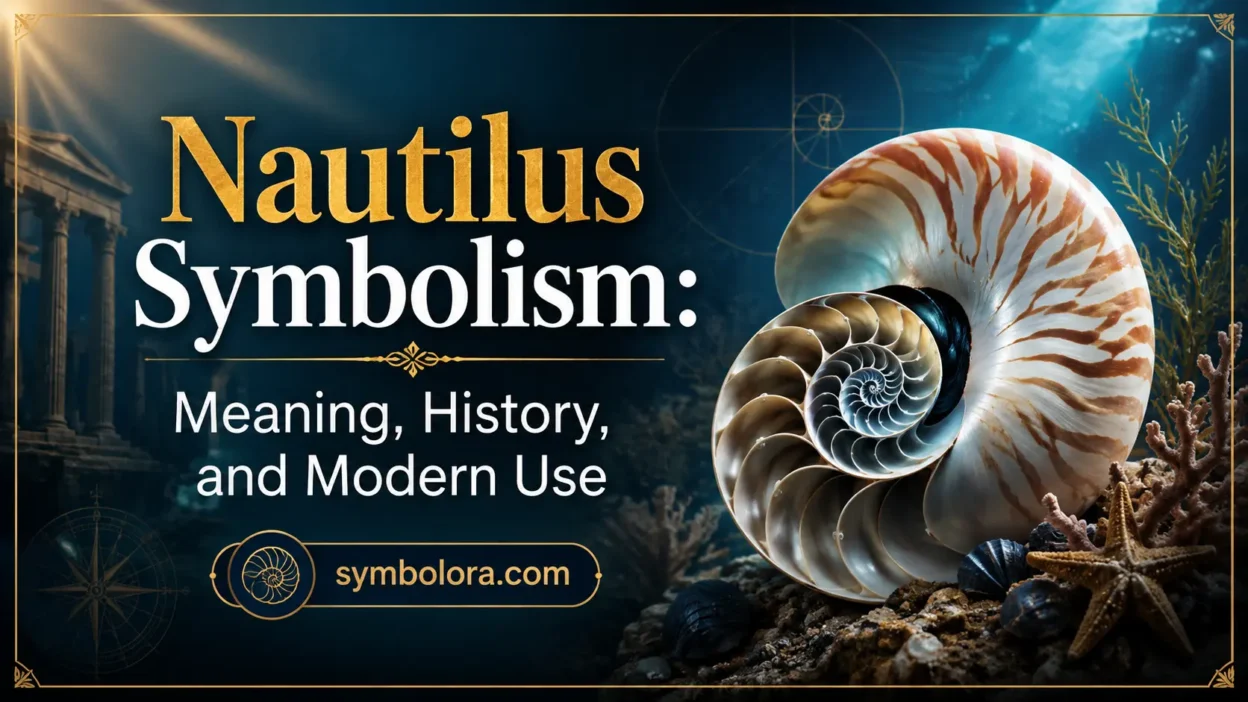
A nautilus is a marine cephalopod best known for its smooth, coiled shell and internal chambers. In modern American culture, nautilus symbolism is most often connected with personal growth, resilience, balance, exploration, and moving forward without erasing the past.
That meaning comes partly from the animal itself. As a nautilus grows, it forms larger chambers while remaining inside the same shell — the result is a visible record of development, where each stage makes room for the next while earlier stages remain part of the structure. Americans also encounter the nautilus through poetry, museum art, marine science, jewelry, and tattoos, so its meaning isn’t one fixed ancient doctrine. It’s a layered symbol shaped by biology, literature, art history, and personal interpretation.
Quick Answer
Nautilus symbolism commonly represents growth, resilience, balance, and forward movement in modern American culture, especially in tattoos, jewelry, art, and personal-development imagery. Historically, the shell has also been associated with natural wonder, maritime exploration, luxury collecting, and expanding into new stages of life.
At a glance:
- The chambered shell makes growth its strongest modern meaning
- Older chambers suggest memory, continuity, and lessons carried forward
- American literature strengthened its link with self-development and inner expansion
- Nautilus imagery also conveys exploration, ocean identity, and scientific curiosity
- Golden-ratio claims are popular but often mathematically overstated
- Ethical modern use should consider conservation and wildlife trade
What a Nautilus Is and Why Its Shape Matters
The chambered nautilus is a cephalopod, related to squid, cuttlefish, and octopuses, though unlike most living cephalopods, it retains a large external shell. The animal occupies the newest and largest chamber, while older chambers help regulate buoyancy through gas and fluid — adults commonly develop around 30 chambers over a lifetime.
A cut shell reveals connected spaces that widen as the spiral expands, and for symbolic purposes, this looks like a record of development: earlier chambers remain present even after the animal has moved into a larger living space. That makes the nautilus especially useful for expressing a mature idea of change — progress doesn’t require pretending earlier versions of life never existed. The spiral itself adds ideas of motion, repetition, and expansion on top of that.
The Core Meanings of the Nautilus
The nautilus doesn’t have one universally agreed symbolic definition. In the United States today, several meanings recur because they arise directly from its form, biology, and literary history.
| Context | Meaning in the USA | Common Associations | Notes |
|---|---|---|---|
| Personal growth | Expanding into a new stage | Maturity, learning, progress | Strongest modern reading |
| Resilience | Continuing through change | Survival, recovery | Linked to the protective shell |
| Balance | Adjusting while staying steady | Calm, adaptability | Inspired by buoyancy control |
| Memory | Carrying earlier stages forward | Experience, reflection | Older chambers remain present |
| Exploration | Moving beyond familiar limits | Ocean, science, discovery | Reinforced by literary and naval uses |
Growth concerns development, resilience concerns surviving pressure, and balance concerns adjustment. Memory adds continuity, while exploration emphasizes curiosity and movement into the unknown.
Growth Without Erasing the Past
Growth is the clearest contemporary interpretation of the nautilus shell. As the animal becomes larger, it forms a new chamber and occupies the expanded space while older chambers stay connected behind it — a structure that supports a familiar metaphor: life may require leaving an old stage without discarding everything learned there. Childhood, previous relationships, and former identities can remain part of a person’s history without becoming the place where that person still lives.
Unlike symbols of total rebirth, the nautilus suggests continuity instead. The new stage grows from the earlier structure, which makes it well suited to graduations, career changes, and quieter forms of personal development.
Resilience, Protection, and Adaptation
The shell also makes the nautilus an intuitive symbol of resilience. A soft-bodied animal survives within a hard structure that’s part of its life-support system, not merely decoration — and symbolically, that can translate into emotional protection, boundaries, and endurance under pressure. Someone recovering from grief or instability may see the shell as a reminder that vulnerability and protection can coexist.
There’s an important difference between protection and isolation worth keeping in mind, though. The nautilus moves, feeds, and adjusts constantly — its healthier symbolic reading is flexible protection: boundaries that support life rather than walls that prevent it.
Balance, Buoyancy, and Self-Regulation
Nautiluses use the chambers of their shells to help regulate buoyancy, adjusting fluid and gas as they move through different depths. That biology gives the shell a grounded basis for symbolism related to balance and self-regulation — the nautilus doesn’t remain stable by refusing to change; stability comes through constant adjustment instead.
This fits modern psychological language well. A balanced life isn’t free of stress or uncertainty — it’s a life in which a person keeps recalibrating while maintaining a coherent sense of self throughout.
American Literary Roots in “The Chambered Nautilus”
The nautilus has a strong connection to American literature through Oliver Wendell Holmes Sr.’s 1858 poem “The Chambered Nautilus.” Holmes turned the expanding shell into a metaphor for human development, using its chambers to imagine continual intellectual and spiritual enlargement. That poem helped establish a distinctly American philosophical reading of the shell, where its chambers became stages of thought, character, and inner capacity.
Holmes’s own bookplate later paired a chambered nautilus with a Latin phrase expressing movement through wider things toward higher things, further showing how closely he linked the shell with self-expansion. Modern readers can interpret the same image in secular terms just as easily: education, self-examination, or the willingness to outgrow old limitations.
Exploration and Scientific Curiosity in U.S. Culture
The word “Nautilus” also carries a strong exploration theme. Popular culture associates it with Captain Nemo’s submarine in Jules Verne’s Twenty Thousand Leagues Under the Seas, and in the United States, USS Nautilus became the world’s first nuclear-powered submarine, completing the first submerged crossing of the North Pole in 1958. These associations reinforce meanings already suggested by the shell: movement into unfamiliar territory and discovery.
A nautilus emblem can therefore communicate more than personal growth alone. In science, education, or marine settings, it can signal inquiry and a willingness to explore beyond familiar limits instead.
Cross-Cultural Art, Trade, and Natural Wonder
The nautilus shell has a global history, but that shouldn’t be turned into a false claim that every culture assigned it the same spiritual meaning. In early modern Europe, shells arriving from the Indo-West Pacific became elaborate luxury objects — goldsmiths mounted them in silver or silver-gilt as standing cups and table ornaments, often adding dragons, sea monsters, and other marine imagery.
In that setting, the shell could signal rarity, maritime reach, and wonder at unfamiliar natural forms. Its movement through trade networks also connects it to the unequal commercial and colonial systems that brought distant natural objects into European collections — history worth naming honestly. This gives the shell a more complicated meaning than simple beauty; it can represent curiosity about nature while also raising questions about extraction and luxury consumption.
Spiritual and Philosophical Interpretations
The nautilus is often described today as a symbol of spiritual awakening or sacred geometry. Such readings can be personally meaningful, but they shouldn’t be presented as one ancient, universal religious tradition. Its strongest spiritual association in American culture is metaphorical instead — the expanding chambers can suggest an enlarging inner life or the need to outgrow beliefs that have become too restrictive, an interpretation Holmes’s poem helped strengthen considerably.
The spiral can also represent cyclical growth: similar challenges may return at different stages, but the person encountering them has changed in the meantime. There’s no standard biblical meaning for the nautilus, nor is it a central traditional symbol of Christianity, Judaism, Islam, Hinduism, or Buddhism — claims assigning it a fixed ancient religious message should be treated cautiously.
Emotional and Psychological Meaning
Emotionally, nautilus imagery often communicates quiet development rather than dramatic transformation. Its visual language is orderly and reflective. For someone in transition, it may express readiness to enter a larger stage of life; for someone healing, it can suggest rebuilding capacity without denying the past; for someone establishing boundaries, the shell can represent protection while remaining open to the world.
The spiral also lends itself to introspection and self-examination. Its possible shadow meaning is withdrawal, though — protection becomes unhealthy when it turns into fear-based isolation rather than genuine boundary-setting.
Nautilus Tattoos and Personal Identity
Nautilus tattoos are especially suited to people who want a symbol combining change with continuity, since the chambered shell suggests earlier stages remain structurally connected to the present. A tattoo may mark graduation, recovery, parenthood, or a career shift — the exact meaning comes from the wearer rather than from any fixed tattoo code.
A realistic shell can emphasize nature and marine identity, while a cutaway showing chambers makes growth and memory more explicit. Waves may add adaptability and motion, and a minimalist spiral can emphasize balance or personal evolution instead. Some designs add geometric grids or Fibonacci diagrams, creating a modern sacred-geometry aesthetic — though that visual choice shouldn’t be confused with mathematical fact, as the next section explains.
Jewelry, Decor, Fashion, and Digital Design
In jewelry, the nautilus often communicates elegance and ocean connection — spiral pendants work naturally as milestone gifts because their shape suggests expansion without losing continuity. In home decor, nautilus forms create a coastal or natural-history mood without relying on obvious beach imagery, and in fashion and graphic design, the shell is useful because a few curved lines can still suggest movement and the sea.
Digital culture has broadened these uses further. A nautilus can function as a personal-development icon, a science or ocean-related logo, or visual shorthand for curiosity and continuous learning. Real nautilus shell products require more caution than printed or sculpted representations, though, since commercial demand has contributed to real conservation concerns.
The Golden Ratio Misconception
One of the most repeated claims about the nautilus is that its shell forms a perfect golden spiral based on the golden ratio or Fibonacci sequence. That claim is overstated. The shell grows in a broadly logarithmic spiral, allowing it to expand while maintaining a similar overall form, but a golden spiral is a specific kind of logarithmic spiral with a particular mathematical growth rate — and measurements of real nautilus shells don’t consistently match it.
This correction doesn’t weaken the symbolism at all. The nautilus still represents organic order and growth without needing to be a perfect mathematical diagram. Golden-ratio overlays can remain a fine artistic choice in tattoos and design — the problem begins only when they’re presented as exact biological fact instead.
Conservation, Trade, and Ethical Use
Real nautilus shells have long been sold as souvenirs, jewelry material, and collectors’ specimens, and heavy demand created real concern about overharvesting, since chambered nautiluses grow slowly, mature late, and produce relatively few offspring. International trade in nautiluses is regulated under CITES Appendix II, and the chambered nautilus has been listed as threatened under the U.S. Endangered Species Act since 2018.
For modern consumers, a resin sculpture, photograph, or other reproduction can preserve the visual meaning without increasing demand for newly harvested wild shells. Conservation changes the symbolism itself, too — the nautilus can represent not only admiration for natural form but responsibility toward the living animal behind that form.
How the Meaning Has Evolved
Different periods have emphasized different qualities of the nautilus. Early European collectors focused on rarity, maritime trade, and natural wonder. Nineteenth-century American literature turned the chambered shell into an image of moral and intellectual expansion instead. Modern science clarified how its chambers actually function, while tattoos and jewelry personalized the form around resilience and identity. Conservation has added a newer concern on top of all this: whether admiration for the shell respects the survival of the animal itself.
This evolution shows how symbolism actually develops. Meanings aren’t frozen inside objects — they emerge when physical characteristics, stories, and modern values meet.
Frequently Asked Questions
What does a nautilus shell symbolize?
A nautilus shell most often symbolizes growth, resilience, balance, and moving into new stages while retaining past experience. Its chambered structure makes it especially suitable for milestones, recovery, and personal-development themes.
What does a nautilus tattoo mean?
A nautilus tattoo commonly represents personal evolution, emotional resilience, or a major life transition. Visible chambers may emphasize stages of growth, while waves or marine elements can add adaptability and exploration.
Is the nautilus a spiritual symbol?
It can be used as a spiritual symbol for inner growth, expanding awareness, or reflection. However, it has no single universal ancient religious meaning, so modern spiritual readings are better understood as personal or philosophical.
Does the nautilus symbolize the golden ratio?
The nautilus is frequently associated with the golden ratio in popular art and design, but real shells do not consistently form an exact golden spiral. Their growth is better described as broadly logarithmic.
Is nautilus symbolism positive or negative?
Most modern interpretations are positive, focusing on growth, balance, endurance, and curiosity. A less common negative reading is excessive withdrawal, where the protective shell becomes a metaphor for emotional isolation or fear of change.
What does the nautilus mean in American culture?
In American culture, the shell is strongly associated with self-development through Oliver Wendell Holmes Sr.’s “The Chambered Nautilus.” It also carries associations with marine science, exploration, education, and technological discovery.
Is it ethical to buy a real nautilus shell?
Buyers should be cautious because international trade in nautiluses is regulated and the chambered nautilus is protected as a threatened species in the United States. Reproductions and other non-wildlife alternatives can preserve the symbolism without adding demand for newly harvested shells.
Conclusion
The nautilus works as a symbol because its structure already tells a coherent story. It grows by creating more room, keeps earlier chambers as part of the same shell, and maintains balance through adjustment. Those features support modern meanings of development, resilience, memory, and adaptability without requiring invented mythology.
In American culture, nautilus symbolism also carries a distinctive literary connection to personal expansion, along with later associations with science and exploration. Today, tattoos, jewelry, and design continue to adapt those meanings while conservation reminds us that the symbol comes from a living and vulnerable marine animal.
The most grounded lesson of the nautilus is simple: growth can be cumulative. A new stage doesn’t have to erase the structure that came before it.


