
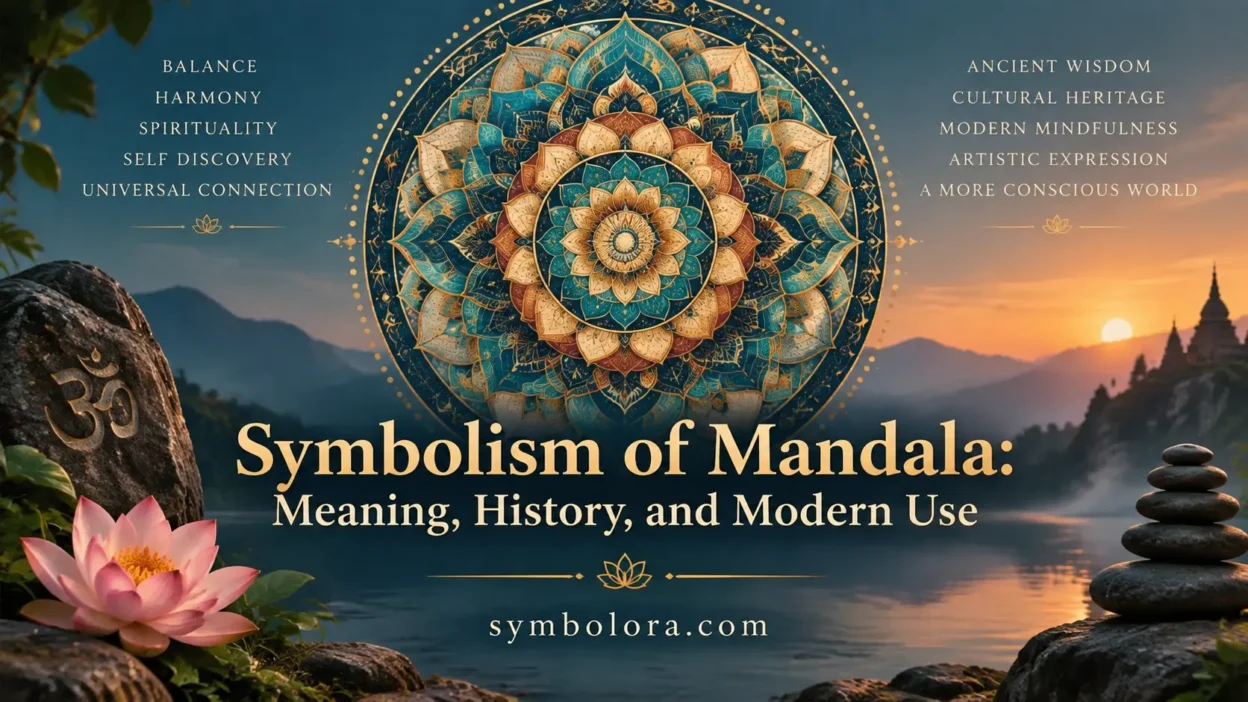
A mandala is a circular design made with balanced patterns, shapes, and repeating elements that often represent harmony, connection, and the structure of life. The symbolism of mandala has roots in ancient spiritual traditions, but today it is also recognized in the United States through art, meditation practices, tattoos, home décor, and personal expression.
The word “mandala” comes from an ancient Sanskrit term meaning “circle.” Although many people associate mandalas with Buddhism and Hindu traditions, similar circular patterns appear in different cultures as representations of wholeness, order, nature, and human creativity. Modern artists and designers often use mandalas because their symmetrical forms create a sense of balance and visual calm.
In American culture, mandalas are commonly viewed as symbols of mindfulness, self-reflection, creativity, and personal growth. They appear in wellness spaces, artwork, jewelry, coloring books, and digital designs, often separated from their original religious settings and used as broader symbols of balance and intentional living.
Quick Answer
Symbolism of mandala commonly represents balance, harmony, and self-reflection in modern American culture, especially in art, meditation, and personal design. Historically, mandalas have been sacred geometric forms connected with spiritual practices in Hinduism and Buddhism.
TL;DR
- Mandalas symbolize balance, unity, and inner reflection.
- Ancient traditions used mandalas for spiritual practice.
- Americans often connect mandalas with mindfulness and creativity.
- Circular patterns represent order and connection.
- Modern designs use mandalas in art and tattoos.
What a Mandala Looks Like and Where People See It
A mandala is usually built around a central point with patterns expanding outward in circular layers. Common elements include geometric shapes, flowers, lines, symbols, and repeated designs arranged with careful symmetry.
Traditional mandalas may contain detailed structures with specific meanings, while modern versions can be highly creative and decorative. Some are simple black-and-white patterns, while others include bright colors, natural images, or complex geometric arrangements.
People encounter mandalas in many places today, including:
- Meditation spaces
- Religious artwork
- Yoga studios
- Tattoos
- Jewelry
- Wall decorations
- Adult coloring books
- Digital artwork
- Fashion patterns
The circular structure is one reason mandalas are visually appealing. The eye naturally follows the movement from the center outward, creating a feeling of organization and completeness.
What Mandalas Commonly Mean in the United States
In the United States, mandalas are often interpreted as symbols of balance, mindfulness, and personal transformation. Their meaning depends on the context in which they appear.
For many Americans, mandalas represent taking time for reflection in a fast-paced world. A person may use a mandala design as a reminder to slow down, focus, or create emotional balance.
Common modern interpretations include:
| Context | Meaning in the USA | Common Associations | Notes |
|---|---|---|---|
| Meditation | Focus and awareness | Calm, reflection, mindfulness | Used during relaxation practices |
| Tattoos | Personal growth | Identity, transformation | Often customized with personal symbols |
| Home décor | Visual harmony | Peaceful spaces, creativity | Popular in modern interiors |
| Art | Expression and design | Pattern, imagination | Used by professional and amateur artists |
| Wellness culture | Emotional balance | Self-care, intention | Often linked with yoga practices |
Although these meanings are widespread, not every mandala carries the same message. Some people appreciate mandalas mainly for their artistic beauty rather than their spiritual background.
Ancient Roots and Early Symbolism
Mandalas developed within ancient Indian religious traditions, especially within Hinduism and later Buddhism. They were created as sacred diagrams used to represent spiritual ideas, cosmic order, and relationships between different aspects of existence.
In Hindu traditions, mandalas appear in religious texts, temple designs, and ritual practices. They often represent the universe as an organized structure with a central point connected to surrounding elements.
Buddhist traditions developed highly detailed mandalas used for meditation and visualization practices. Practitioners focused on the patterns as a way to train attention and explore spiritual concepts.
Traditional mandalas were not simply decorative artwork. Their designs followed specific rules, and each shape, color, and placement could carry symbolic meaning.
The Spiritual Meaning of Mandalas in Hindu and Buddhist Traditions
In Hinduism and Buddhism, mandalas often represent the relationship between the individual and the larger universe.
The center of a mandala commonly symbolizes a point of origin, awareness, or spiritual focus. The surrounding patterns may represent different stages, qualities, or aspects of existence.
In Tibetan Buddhism, some mandalas are created as temporary artworks using colored sand. After completion, they are intentionally destroyed as a reminder that all things change. This practice emphasizes impermanence rather than attachment.
Different traditions interpret mandalas in their own ways, but many share ideas connected with:
- Order within complexity
- Connection between parts and the whole
- Spiritual concentration
- Transformation
- Awareness
Understanding these traditions helps separate authentic cultural meanings from simplified modern interpretations.
How Mandala Symbolism Entered Western Culture
Mandalas became more familiar in Western countries during the 20th century through studies of Eastern philosophy, psychology, and art.
Psychologist Carl Jung studied circular images and viewed mandala-like patterns as representations of psychological wholeness and the process of organizing the self.
Jung’s work influenced how many Western audiences understood mandalas. Instead of seeing them only as religious objects, some people began viewing circular patterns as symbols of inner balance and personal development.
Over time, mandalas entered popular culture through art movements, spiritual communities, wellness practices, and creative hobbies.
Emotional and Psychological Meaning of Mandalas
Many people find mandalas calming because their patterns encourage attention and repetition. Creating or coloring a mandala can provide a structured creative activity that helps some people relax and concentrate.
The psychological associations often connected with mandalas include:
- Focus
- Organization
- Creativity
- Self-expression
- Reflection
The circular form may also influence how people emotionally experience the design. Circles are often associated with completeness and continuity because they have no clear beginning or end.
However, emotional responses vary. A person may view a mandala as spiritual, artistic, decorative, or simply visually pleasing depending on their background.
Mandalas in American Art and Design
Mandalas have become common in American visual culture. Artists use circular patterns in paintings, digital illustrations, murals, and graphic design because the structure allows endless creative variations.
Interior designers often include mandala-inspired artwork in spaces intended to feel peaceful or artistic. Their symmetrical appearance works well in:
- Bedrooms
- Meditation areas
- Creative studios
- Wellness centers
- Modern homes
In fashion, mandala patterns appear on clothing, accessories, and textiles. Designers often adapt the circular structure without directly using traditional religious meanings.
Why Mandalas Are Popular in Tattoos and Personal Style
Mandalas are widely used in tattoo culture in the United States because their circular structure allows artists to create designs that feel personal and meaningful. A person may choose a mandala tattoo to represent balance, personal change, a life milestone, or a connection to creativity.
Unlike traditional religious mandalas, many modern tattoo designs combine mandala patterns with other imagery, such as:
- Flowers
- Animals
- Geometric shapes
- Names or dates
- Natural elements
- Spiritual symbols
A floral mandala tattoo may suggest growth and beauty, while a geometric mandala may emphasize order and structure. Some people choose these designs simply because they appreciate symmetry and detailed artwork.
The meaning of a mandala tattoo is personal rather than universal. Two people may have similar designs but completely different reasons for choosing them.
Color Symbolism in Mandala Designs
Colors play an important role in many mandala designs. Traditional systems may assign specific meanings to colors, while modern artists often use color based on personal preference, mood, or visual style.
Common color associations include:
| Color | Common Symbolic Meaning | Modern Use |
|---|---|---|
| Blue | Calmness and wisdom | Meditation artwork and peaceful designs |
| Red | Energy and passion | Bold tattoos and expressive art |
| Green | Growth and renewal | Nature-inspired mandalas |
| White | Purity and clarity | Minimalist designs |
| Purple | Creativity and spirituality | Artistic and decorative patterns |
Color meanings are not fixed across all cultures. A color that represents one idea in a spiritual tradition may have a different meaning in another cultural setting.
Mandalas in Meditation and Mindfulness Practices
In the United States, mandalas are strongly connected with meditation and mindfulness communities. Many wellness programs use mandala drawing or coloring as a creative exercise for attention and relaxation.
The process of creating a mandala encourages people to focus on patterns, repetition, and careful movement. Some individuals use the activity as a way to disconnect from distractions and spend time in quiet reflection.
Mandalas appear in:
- Meditation classes
- Yoga studios
- Wellness retreats
- Personal journals
- Coloring books
Modern mindfulness practices often use mandalas as creative tools rather than as direct replacements for their original religious purposes.
Mandala Symbolism in Home Décor and Everyday Life
Many Americans use mandala designs in homes because the patterns create a sense of visual balance. Wall art, rugs, blankets, and decorative objects often feature mandala-inspired patterns.
In interior design, mandalas are commonly associated with:
- Peaceful environments
- Artistic expression
- Organized spaces
- Personal style
A homeowner may choose a mandala decoration because it matches a room’s appearance rather than because of its historical symbolism.
This distinction matters because modern decorative use is often separate from traditional spiritual meanings. A mandala on a wall can function as artwork while still carrying personal significance for the owner.
Cross-Cultural Meanings of Circular Symbols
Although the term “mandala” comes from Sanskrit and has strong connections with South Asian traditions, circular symbolic designs appear in many cultures.
Examples of circular symbolism include:
- Native American medicine wheels, which can represent relationships between different parts of life
- Celtic circular patterns connected with continuity and interconnectedness
- Labyrinth designs used in some Christian traditions for reflection and prayer
- Circular patterns in Islamic geometric art representing mathematical order and beauty
These symbols are not identical to mandalas, and each tradition has its own history. However, they show that circles have often been used worldwide to express ideas about connection, structure, and completeness.
Common Misunderstandings About Mandala Symbolism
As mandalas became popular globally, some meanings were simplified or separated from their original context.
One common misunderstanding is that every mandala has a universal meaning. In reality, traditional mandalas can have specific religious meanings, while modern designs may represent something entirely personal.
Another misconception is that mandalas are only spiritual objects. Today, they also exist as:
- Decorative artwork
- Design patterns
- Creative exercises
- Fashion elements
- Personal symbols
Some people also use the word “mandala” for any circular pattern. While this is common in everyday conversation, traditional mandalas usually involve deeper cultural and symbolic systems.
Cultural Respect and Modern Use
The popularity of mandalas in Western countries has created conversations about cultural appreciation and cultural borrowing.
Many artists and users approach mandalas respectfully by learning about their origins and recognizing their connection to Hindu and Buddhist traditions. Others use mandala-inspired designs mainly for artistic purposes without intending a religious meaning.
A balanced understanding recognizes both sides:
- Mandalas have important historical and spiritual roots.
- Modern people may also use them in creative and personal ways.
- Context determines how a mandala is understood.
Learning the background of a symbol allows people to appreciate its beauty while respecting the traditions that shaped it.
How Mandala Meaning Has Changed Over Time
The meaning of mandalas has expanded as they moved from traditional religious settings into global art and popular culture.
Historically, many mandalas served specific spiritual purposes. They were carefully designed tools for meditation, teaching, and religious practice.
In modern America, mandalas often represent broader ideas such as:
- Personal balance
- Creativity
- Self-discovery
- Emotional wellness
- Artistic identity
This change does not erase their original meanings. Instead, it shows how symbols evolve when they enter new cultural environments.
A symbol can maintain historical importance while gaining new interpretations through art, technology, and personal experience.
Modern Digital Culture and Mandala Designs
Digital platforms have increased the visibility of mandala artwork. Artists now create and share detailed mandala illustrations through online galleries, social media, and digital design communities.
Modern digital mandalas appear in:
- Phone wallpapers
- Graphic illustrations
- Brand artwork
- Online meditation content
- Printable designs
Technology has also allowed artists to create extremely complex patterns using digital tools. These modern versions may look different from traditional mandalas but continue using the central ideas of symmetry and circular organization.
FAQ About Mandala Symbolism
What does a mandala symbolize spiritually?
A mandala can symbolize balance, connection, and the relationship between the individual and the larger universe. In Hindu and Buddhist traditions, mandalas often serve as tools for meditation and spiritual understanding.
What does a mandala tattoo mean?
A mandala tattoo often represents personal growth, balance, creativity, or self-reflection. The meaning depends on the person’s experiences and the additional elements included in the design.
Are mandalas religious symbols?
Traditional mandalas are connected with religious practices, especially Hinduism and Buddhism. However, modern mandala designs are also used as decorative art and personal symbols without religious intent.
Why are mandalas used in meditation?
Mandalas are used in meditation because their structured patterns encourage concentration and careful observation. Some practices use them as visual tools for focusing attention.
Do different mandala colors have different meanings?
Many traditions associate colors with specific ideas, but meanings vary between cultures. Modern artists often choose colors based on personal expression and design preferences.
Are mandalas positive or negative symbols?
Mandalas are generally associated with positive ideas such as balance, creativity, and reflection. However, their meaning depends on cultural context and how the symbol is used.
Why are mandalas popular in modern American culture?
Mandalas are popular because they combine artistic beauty with meanings related to mindfulness, identity, and creativity. They appear in wellness spaces, tattoos, home design, and digital artwork.
Conclusion
Mandalas represent balance, organization, and reflection across many traditions and modern creative spaces. While their earliest meanings developed within Hindu and Buddhist practices, they have also become widely recognized in the United States as symbols of mindfulness, artistic expression, and personal identity.
The symbolism of mandala continues to evolve as people use these circular designs in tattoos, artwork, meditation, and everyday design. Understanding both their historical roots and modern interpretations allows people to appreciate mandalas as more than attractive patterns—they are symbols shaped by culture, creativity, and human experience.


