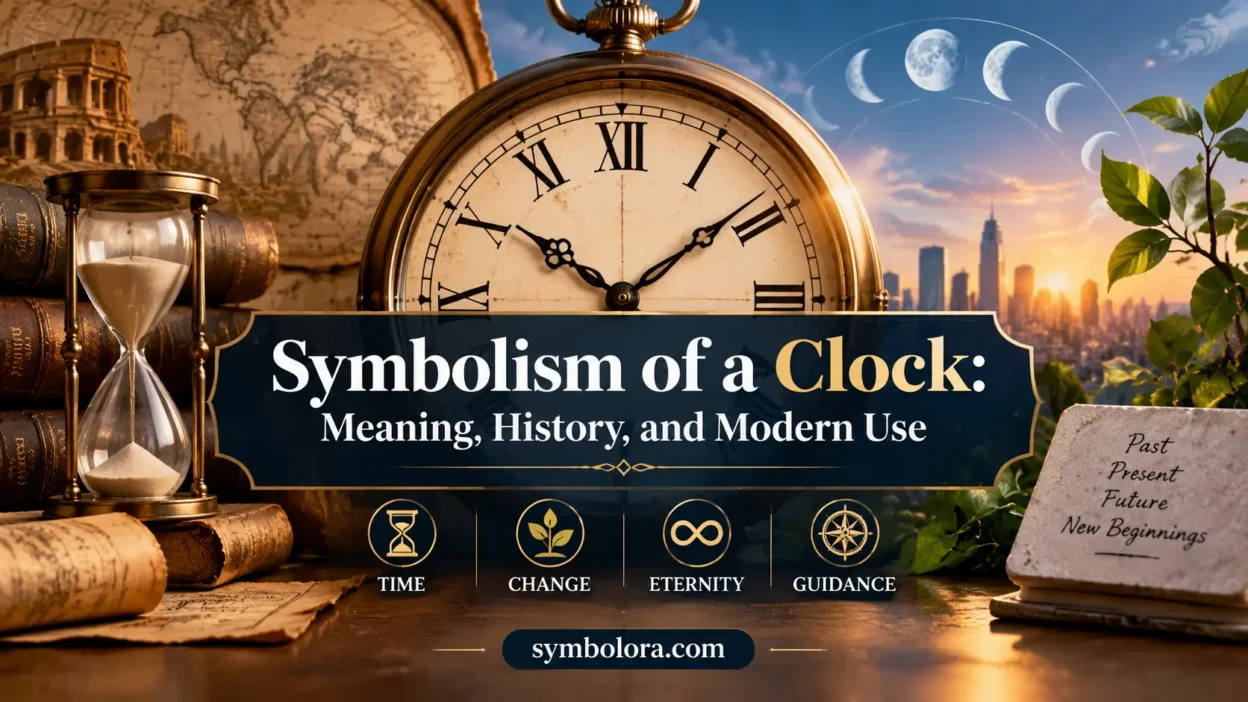
A clock is more than a tool for measuring hours and minutes. Across cultures, the symbolism of a clock has represented ideas about time, change, memory, responsibility, and the limited nature of human life. From antique grandfather clocks in American homes to watches worn as personal statements, clocks often carry meanings connected to personal experiences and social values.
People notice clocks during important moments: a wedding ceremony, a graduation, a retirement, a memorial service, or a major life transition. The simple image of a clock face can suggest that time is moving forward, opportunities are changing, and every moment has importance.
Quick Answer
The symbolism of a clock commonly represents time, life changes, responsibility, and the value of each moment in modern American culture. Historically, clocks have also symbolized human progress, mortality, discipline, and the relationship between people and the passing of time.
TL;DR
- Clocks symbolize time, change, and life transitions.
- Ancient traditions connected clocks with mortality and destiny.
- Americans often view clocks as symbols of productivity and memories.
- Watches and clocks can express identity and personal milestones.
- Broken clocks may represent endings, change, or lost moments.
What a Clock Represents in Everyday Life
A clock is one of the most familiar objects in modern society. Its circular face, moving hands, and repeating numbers create a visual reminder that time continues regardless of circumstances.
In everyday American life, clocks often represent:
- Organization: A clock helps people manage schedules, work, school, and personal commitments.
- Progress: Moving hands can represent moving forward toward goals.
- Responsibility: Being aware of time is often connected with reliability and respect.
- Life stages: Specific times can become connected with important memories.
Unlike many symbols that require cultural knowledge, clocks communicate their meaning almost immediately. A person does not need an explanation to understand that a clock represents the passage of time.
However, the meaning changes depending on the situation. A clock in an office may represent efficiency and deadlines, while a family heirloom clock may represent tradition and memories.
Ancient Roots and Early Symbolism of Clocks
The symbolic meaning of clocks developed from humanity’s long relationship with measuring time. Before mechanical clocks existed, civilizations used natural cycles such as the movement of the sun, moon phases, and changing seasons to understand time.
Early timekeeping devices, including sundials and water clocks, were connected with ideas of order and the structure of the universe. People observed that nature followed patterns, and time became associated with balance and predictability.
When mechanical clocks appeared in medieval Europe, they changed how societies viewed time. Public clocks placed on churches and town buildings made time visible to entire communities. These clocks were not only practical tools; they became symbols of social organization and shared responsibility.
The growing importance of clocks reflected a major cultural shift. Time became something people could measure, schedule, and manage rather than simply experience through natural rhythms.
How Clocks Became Symbols of Mortality and Human Life
One of the oldest meanings connected with clocks is the awareness that human life is limited.
A clock’s constant movement can remind people that moments cannot be recovered once they pass. This connection appears in art, literature, and memorial traditions where clocks represent aging, change, and the temporary nature of human experiences.
The phrase “time waits for no one” reflects this common interpretation. A clock does not stop because someone is unprepared, which makes it a symbol of both opportunity and limitation.
In some artworks, a stopped or broken clock represents the end of a particular period. It may suggest loss, memory, or a moment frozen forever.
This meaning does not always carry sadness. Many people also interpret clocks positively, seeing them as reminders to appreciate relationships, pursue goals, and make meaningful choices.
The Meaning of Clocks in United States Culture
In the United States, clocks are strongly connected with ideas of planning, achievement, and personal history.
American culture often places importance on punctuality and time management. Because of this, clocks commonly appear in workplaces, schools, businesses, and public spaces as symbols of structure and productivity.
At the same time, clocks also have emotional meanings. A family clock passed from one generation to another may represent:
- Family heritage
- Shared memories
- Connection between generations
- Respect for the past
Watches also carry personal symbolism in American culture. A graduation watch, retirement watch, or inherited pocket watch can represent achievement and important life milestones.
The meaning depends on how the object is experienced. A digital clock on a phone may represent convenience and daily routines, while an antique clock may represent craftsmanship and history.
Clock Symbolism in Art, Literature, and Popular Culture
Artists and writers have used clocks as symbols because they visually express ideas that are difficult to explain.
A clock can represent:
- The passing of youth
- A turning point in life
- Waiting for an important event
- Memories from the past
- Fear of running out of time
In literature and film, clocks often create tension. A countdown clock can represent urgency, while a stopped clock can represent a moment that changed someone’s life.
The image of a clock also appears frequently in surreal art, where unusual clocks challenge normal ideas about time. These artworks often explore how people experience time emotionally rather than scientifically.
Religious and Spiritual Interpretations of Clock Symbolism
Many religious traditions discuss time as part of a larger understanding of existence, although specific clock symbolism varies.
In Christian traditions, time is often connected with ideas of creation, human responsibility, and preparation for important spiritual events. Clocks in churches historically served both practical and symbolic purposes by organizing community life around worship.
In other spiritual traditions, time may be viewed as cyclical rather than purely linear. The movement of a clock can represent cycles, renewal, and the relationship between human life and larger natural patterns.
However, a clock itself is not a universal religious symbol. Its meaning usually comes from the cultural or spiritual context where it appears.
Emotional and Psychological Meaning of Clocks
People often develop personal relationships with clocks because time is closely connected with memory and emotion.
A clock may remind someone of:
- A childhood home
- A loved one
- A major achievement
- A difficult period that has passed
- A future goal they are working toward
Psychologically, clocks can create awareness of limited time. This awareness may encourage planning and motivation, but it can also create stress when people feel overwhelmed by deadlines.
The same clock can produce different emotions. A wedding clock display may feel joyful, while a hospital room clock may become associated with uncertainty or worry.
Common Clock Meanings in Modern Symbolism
| Context | Meaning in the USA | Common Associations | Notes |
|---|---|---|---|
| Home decor | Tradition and memories | Family, comfort, history | Often linked with antique designs |
| Watches | Achievement and identity | Success, milestones, style | Frequently given as gifts |
| Tattoos | Personal experiences | Time, change, important moments | Meaning depends on design |
| Broken clocks | Endings or transformation | Loss, change, new beginnings | Often used artistically |
| Public clocks | Community structure | Order, shared schedules | Historic town clocks are examples |
Why Clocks Appear in Tattoos and Personal Style
Clock tattoos are among the most recognizable designs connected with time and personal meaning. People often choose them to represent a specific memory, turning point, or belief about life.
Common clock tattoo meanings include:
- Remembering someone: A clock combined with a date, name, or portrait may honor a loved one or important event.
- Personal growth: A moving clock can represent change and moving into a new stage of life.
- Appreciating time: Some people use clock imagery as a reminder to value their experiences.
- Overcoming challenges: A clock may symbolize surviving a difficult period and continuing forward.
The design elements surrounding a clock often influence its meaning. A clock with flowers may suggest beauty and growth, while a clock with an hourglass may emphasize the temporary nature of life.
In modern American tattoo culture, clock designs are usually personal rather than based on one fixed meaning. The story behind the design matters more than the image alone.
Clock Symbolism in Home Decor and Interior Design
Clocks remain common decorative objects in American homes because they combine function with visual appeal.
A large wall clock can create a feeling of order in a room, while antique clocks can add a sense of history and craftsmanship. Many people display inherited clocks because they connect present generations with family memories.
Different clock styles can communicate different ideas:
- Grandfather clocks: Often associated with tradition, patience, and family heritage.
- Vintage clocks: May suggest nostalgia and appreciation for the past.
- Modern minimalist clocks: Often represent simplicity, organization, and contemporary design.
- Decorative clocks: Can serve as artistic statements rather than practical tools.
In interior design, clocks are not only objects that tell time. They can influence how people feel about a space by adding character and emotional connection.
The Symbolism of Broken and Stopped Clocks
A broken or stopped clock carries a different meaning from a functioning clock. Because a clock normally represents movement and continuation, stopping it creates a visual contrast.
Common interpretations include:
- A moment frozen in memory
- The end of a chapter
- A major life change
- A reminder of the past
A stopped clock may appear in memorial artwork to represent someone’s life ending or a meaningful moment that remains remembered.
In creative settings, a broken clock can also symbolize freedom from schedules or expectations. Some artists use it to question society’s focus on productivity and constant activity.
The meaning is not automatically negative. For many people, a stopped clock represents acceptance, reflection, and transformation.
Clock Symbolism Compared With Other Time Symbols
Clocks are only one way humans represent time. Other symbols communicate similar ideas but with different emotional meanings.
| Symbol | Main Meaning | Common Interpretation |
|---|---|---|
| Clock | Measured time | Schedules, life stages, responsibility |
| Hourglass | Limited time | Patience, mortality, waiting |
| Calendar | Organized time | Plans, goals, important dates |
| Sunrise | New beginnings | Hope, renewal, fresh starts |
| Sunset | Completion | Reflection, endings, transition |
A clock usually emphasizes measurable time, while symbols like sunrise or seasons often focus more on natural cycles and emotional change.
Cross-Cultural Meanings of Clock Symbolism
Although clocks are common worldwide today, their symbolic meanings can differ between cultures.
In many Western societies, clocks are strongly connected with schedules, productivity, and individual achievement. Time is often viewed as something that can be managed and planned.
Some cultures place greater emphasis on cyclical ideas of time, where life is understood through repeating patterns such as seasons, generations, and natural cycles. In these contexts, time may represent continuity rather than a straight path toward the future.
Traditional Chinese culture, for example, has historically connected time with balance, cycles, and harmony between natural forces. In Japanese culture, seasonal change and awareness of passing moments have often played an important role in artistic expression.
These differences show that clocks do not have one universal meaning. Their symbolism depends on how a society understands time itself.
Modern Uses of Clock Symbolism in Digital Culture
Although many people now check time on smartphones and smart devices, clock imagery remains common in digital culture.
Clock symbols appear in:
- App interfaces
- Social media graphics
- Business branding
- Productivity tools
- Online reminders
- Personal artwork
Digital clocks often represent speed and efficiency because they are connected with instant access and modern technology.
At the same time, traditional clock images continue to appear online because they carry emotional associations that digital displays often lack. A classic clock face can communicate ideas of history, memory, and human experience.
The continued popularity of clock imagery shows that people connect with the meaning behind the object, not only its practical purpose.
Common Misunderstandings About Clock Symbolism
Clock symbolism is sometimes presented in overly dramatic ways, especially online. While clocks can represent serious ideas such as mortality and change, their meanings are not limited to negative themes.
A clock does not always symbolize:
- Fear of aging
- Loss
- A warning about the future
- A fixed spiritual message
For many people, clocks represent positive ideas such as:
- Making meaningful choices
- Celebrating achievements
- Respecting memories
- Valuing relationships
The meaning of a clock depends on its setting, design, and personal connection. A family heirloom, a workplace clock, and a tattoo may all use the same image but communicate very different messages.
How Clock Symbolism Has Changed Over Time
The meaning of clocks has evolved alongside human society.
Early clocks represented order and scientific progress because they allowed communities to measure time more accurately. Later, clocks became associated with industrial schedules, work routines, and modern organization.
Today, clocks carry both practical and emotional meanings. People use them to manage busy lives, but they also use clock imagery to express personal stories and memories.
Technology has changed how people interact with time, yet the symbolic value of clocks remains. Even when a person checks time on a phone, the traditional clock image still represents ideas that go beyond numbers.
Frequently Asked Questions About Clock Symbolism
What does a clock symbolize spiritually?
A clock may symbolize awareness of life’s limited nature, personal growth, and the importance of using time wisely. Spiritual interpretations vary depending on cultural and religious beliefs.
What does a clock tattoo usually mean?
A clock tattoo often represents a meaningful moment, personal transformation, remembrance, or the importance of time. The surrounding images and chosen design usually determine the specific meaning.
Are broken clocks considered negative symbols?
Broken clocks are not always negative. They may represent endings, change, memories, freedom from pressure, or a significant moment that shaped someone’s life.
Why are clocks important in American culture?
In the United States, clocks are commonly connected with punctuality, organization, achievement, and personal milestones. They also appear in homes as symbols of family history and tradition.
What does a stopped clock symbolize?
A stopped clock can represent a moment preserved in memory, a completed life chapter, or a transition between different stages. Its meaning depends on the context.
Do clocks have different meanings in other cultures?
Yes. Some cultures view time mainly as linear progress, while others emphasize cycles, seasons, and renewal. Clock symbolism reflects these different views of time.
Conclusion
Clocks represent much more than hours and minutes. They reflect how people understand change, memory, responsibility, and the limited moments that shape human experiences.
The symbolism of a clock in modern culture connects practical ideas of organization with emotional themes such as personal history, growth, and remembrance. Whether displayed in a home, worn as a watch, or used as a tattoo design, a clock often carries a meaning shaped by the person who chooses it.
A clock reminds people that time is constantly moving, but it also highlights the moments that make life meaningful.


