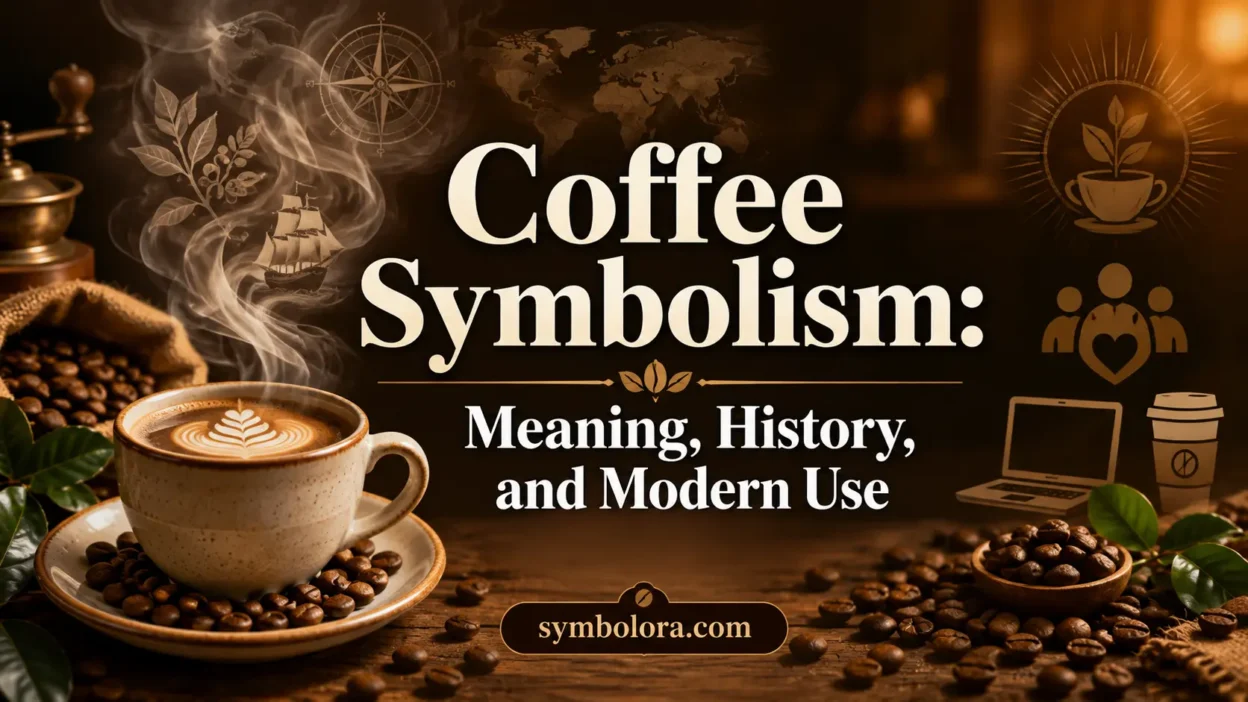
Coffee is so ordinary in American life that its symbolic side can be easy to miss. Yet coffee symbolism appears whenever a cup represents more than a drink: the start of a workday, an invitation to talk, a familiar morning routine, a first date, a quiet break, or a sign of personal taste.
Those meanings did not develop from one myth or religious tradition. They grew from the way people have used coffee for centuries—as a stimulating drink, a gesture of hospitality, a reason to gather, and a companion to conversation and work.
Today, a steaming mug can suggest productivity in an office, warmth at home, friendship in a café, or independence in someone’s personal routine. Context determines which meaning comes forward.
Quick Answer
Coffee symbolism commonly represents energy, productivity, comfort, conversation, hospitality, and social connection in modern American culture. Historically, coffee also became associated with communal gathering, intellectual exchange, friendship, and ceremonial hospitality as coffee-drinking traditions developed from the Middle East into Europe and the Americas.
TL;DR
- Coffee commonly symbolizes energy, alertness, and getting started.
- Sharing coffee can represent friendship, hospitality, and conversation.
- Morning coffee often suggests comfort, routine, and personal stability.
- Historic coffeehouses became gathering places for news and public discussion.
- Modern coffee choices can communicate taste, lifestyle, and cultural identity.
- Coffee can also symbolize stress, overwork, dependence, or consumer culture.
What Coffee Commonly Symbolizes
There is no universal symbolic definition of coffee. Its meanings come largely from the situations in which people prepare, offer, and drink it.
In the United States, several associations appear especially often.
| Context | Common Meaning in the USA | Typical Association | Notes |
|---|---|---|---|
| Morning coffee | Energy and renewal | Starting the day | Often linked with routine |
| Coffee with someone | Connection | Friendship, dating, conversation | Usually informal and low-pressure |
| Office coffee | Productivity | Work, focus, deadlines | Can also suggest workplace stress |
| Coffee at home | Comfort | Warmth, familiarity, rest | Often tied to personal rituals |
| Specialty coffee | Identity and taste | Craft, quality, lifestyle | May signal knowledge or status |
| Café setting | Community | Meetings, study, social life | Functions as a semi-public gathering space |
These meanings overlap. A single cup can represent comfort to one person and work to another.
That flexibility is exactly why coffee works so well as a cultural symbol.
Why Coffee Represents Energy and Productivity
The strongest modern association is probably energy.
Coffee contains caffeine, which contributes to its reputation as a drink for wakefulness and alertness. Over time, that physical effect became a cultural shorthand. A coffee cup now visually communicates ideas such as morning, focus, effort, deadlines, studying, and getting things done.
American workplace culture reinforces the connection. Offices have coffee machines, commuters carry travel mugs, students meet over coffee before classes, and advertising frequently places coffee beside laptops, planners, notebooks, or early-morning scenes.
As a result, coffee can symbolize readiness before any work actually begins.
Saying, “I need coffee first,” is often partly humorous. It suggests a transition from sleep or mental fog into a state where the speaker feels prepared to deal with the day.
The symbolism has a negative side too. An overflowing desk surrounded by empty cups can represent exhaustion, pressure, or an unhealthy work pace rather than healthy motivation.
Coffee as a Symbol of Hospitality and Friendship
Offering coffee is one of the simplest ways to make someone feel welcome.
In American homes and workplaces, “Would you like some coffee?” often serves a social purpose beyond thirst. It gives the host something to offer and gives both people a comfortable activity around which conversation can develop.
The association is even stronger in several coffee traditions outside the United States. Turkish coffee culture has long connected coffee with hospitality, friendship, refinement, and social occasions, while Arabic coffee traditions explicitly emphasize generosity toward guests.
This helps explain why coffee can symbolize openness and goodwill.
“Let’s get coffee” usually feels less formal than a dinner invitation. It may mean catching up with a friend, discussing business, meeting a romantic interest, welcoming a neighbor, or simply making time for another person.
The cup creates a reason to sit down and stay for a while.
Comfort, Routine, and the Feeling of Home
Coffee can also represent emotional stability.
For many people, preparing it follows a predictable sequence: filling the machine, grinding beans, heating water, choosing a mug, smelling the brew, and sitting in a familiar place.
Because the routine repeats, the drink can become associated with normalcy, privacy, and control over one’s time.
This helps explain the popularity of coffee imagery in cozy interior design. A ceramic mug beside a blanket, book, rainy window, or fireplace rarely symbolizes caffeine alone. It suggests slowing down and occupying a familiar personal space.
The meaning can be especially noticeable during change. Someone traveling, moving into a new apartment, starting a new job, or recovering from a difficult period may value a normal cup of coffee because it preserves one recognizable part of the day.
In that sense, the symbolism comes from repetition rather than ceremony.
Conversation and Community Around a Cup
Coffee has a long relationship with conversation.
Unlike drinks mainly associated with meals, coffee can create an occasion by itself. People can meet for coffee without needing a larger event.
That makes it useful as a symbol of social availability.
A coffee date says, in effect, “Let’s spend some time together.” A neighborhood café can become a place where regular customers recognize one another. Coworkers may exchange information during coffee breaks that would never come up during scheduled meetings.
Coffee shops also occupy an unusual position between private and public space. Customers can be alone without being isolated. They can work independently while remaining around other people, or meet someone without inviting that person into their home.
This social flexibility is one reason coffee remains closely connected with modern community life.
Early Roots in Ethiopia and Yemen
The historical story of coffee requires some caution because legend and documentation are often mixed together.
Wild Arabica coffee is associated with Ethiopia, while the familiar story of Kaldi—the goat herder whose animals supposedly became energetic after eating coffee cherries—is considered a legend rather than established history. Even modern coffee historians acknowledge that the exact discovery of coffee as a beverage cannot be documented with certainty.
The clearer historical development of coffee drinking emerged across the Red Sea in Yemen. By the fifteenth century, coffee cultivation and consumption were established there, and historical accounts connect the drink with Sufi communities that valued wakefulness during extended devotional activity.
These beginnings helped create two lasting associations: alertness and communal ritual.
It is therefore misleading to treat coffee’s earliest meaning as a single symbolic doctrine. Its cultural significance developed through use—religious, social, agricultural, commercial, and domestic.
Ottoman, Turkish, and Arabic Coffee Traditions
As coffee spread through the Ottoman world, it became deeply connected with social life.
Coffeehouses gave people places to converse, hear news, play games, exchange stories, and spend time outside the home. Although these spaces were shaped by the social restrictions and hierarchies of their periods, they helped establish coffee as a drink connected with public interaction.
Turkish coffee later developed ceremonial associations with hospitality and important social occasions. Its cultural tradition was added to UNESCO’s Representative List of the Intangible Cultural Heritage of Humanity in 2013.
Arabic coffee traditions similarly connect serving coffee with generosity and respectful treatment of guests.
These traditions matter when interpreting coffee imagery today. A small cup offered carefully to a guest may communicate something very different from an oversized takeout cup associated with commuting.
Both are coffee, but the social meanings are not interchangeable.
Coffeehouses as Symbols of Ideas and Public Discussion
Coffeehouses eventually became associated with information as well as refreshment.
In Ottoman cities and later in parts of Europe, customers used coffeehouses for discussion, storytelling, news, business, and political conversation. Authorities sometimes regarded such gatherings with suspicion because people could exchange opinions outside more tightly controlled institutions.
That history helped coffee acquire associations with debate, intellectual life, and civic participation.
The connection also reached colonial North America. Coffeehouses were among the public places where colonists exchanged political information and discussed events during the period leading toward the American Revolution.
It would be an exaggeration to say that coffee itself caused political change. The important symbolic point is narrower: coffeehouses provided meeting environments where information and arguments could circulate.
That distinction keeps the history grounded.
What Coffee Means in American Culture Today
Modern American coffee culture combines several older meanings with distinctly contemporary habits.
Coffee still represents wakefulness and socializing, but it now also belongs to commuting, remote work, drive-through culture, restaurant breakfasts, college life, dating, independent cafés, and home brewing.
Its everyday importance is substantial. In 2025, the National Coffee Association reported that about two-thirds of American adults drank coffee on a given day, while specialty coffee continued expanding as a major part of the market.
Current café culture is also becoming more culturally varied. Yemeni-style coffeehouses, for example, have expanded in U.S. cities, offering gathering spaces built around distinct drinks, late-night socializing, hospitality, and Arab and Yemeni cultural traditions.
So there is no single “American coffee ritual.” A diner refill, homemade pour-over, gas-station cup, iced latte, office pot, and traditional Yemeni coffee service can coexist within the same national culture while carrying different social messages.
Personal Identity, Taste, and Social Status
A coffee order can function like a small statement of identity.
Some people emphasize simplicity: black coffee, no additions. Others enjoy elaborate seasonal drinks. Enthusiasts may discuss processing methods, origins, roast levels, grinders, or brewing ratios.
None of these preferences has a fixed personality meaning. Still, consumers sometimes use them to present themselves as practical, sophisticated, health-conscious, adventurous, minimalist, traditional, or knowledgeable.
Specialty coffee has strengthened this symbolic layer by emphasizing craftsmanship and origin. Coffee can become something to study and collect rather than merely consume.
That can produce social status signals as well. Expensive machines, rare beans, carefully designed cafés, and specialized vocabulary may communicate expertise or disposable income.
Such signals are cultural rather than inherent. A costly espresso does not automatically mean sophistication, just as instant coffee does not mean a lack of taste.
Emotional and Psychological Meaning
Emotionally, coffee often represents a transition between states.
Morning coffee marks the movement from sleep to activity. An afternoon cup creates a pause inside the workday. Coffee after dinner can extend conversation. A solitary café visit can create distance from home or work without requiring total isolation.
That makes the cup a kind of boundary marker.
People may also attach memory to smell and preparation. The scent of a particular roast might recall a grandparent’s kitchen, college years, a former workplace, a trip, or a relationship.
In those cases, the symbolism is autobiographical.
Coffee itself does not universally mean nostalgia. It becomes nostalgic when repeated sensory experiences are tied to remembered people, places, or periods of life.
Coffee in Tattoos, Art, Decor, and Digital Culture
Coffee imagery appears frequently in personal and commercial design.
A coffee tattoo may represent a love of cafés, work in the coffee industry, morning routines, friendship, or simply enjoyment of the drink. Baristas and roasters may use coffee cherries, plants, portafilters, mugs, or brewing equipment to represent professional identity and craftsmanship.
In home decor, steaming cups often communicate warmth and welcome. Coffee signs in kitchens may emphasize humor, morning habits, or hospitality rather than serious symbolic belief.
Online, the imagery is even broader. Coffee appears beside books to signal quiet study, beside laptops to signal work, and in lifestyle photography to create a relaxed café aesthetic.
Even the familiar coffee-cup emoji can mean several things depending on context: taking a break, waking up, meeting someone, working late, or inviting conversation.
The image is useful precisely because most viewers understand these everyday associations quickly.
Does Coffee Have a Spiritual or Religious Meaning?
Coffee does not have one universal spiritual meaning.
Its history does include religious settings. Early coffee use in Yemen is associated with Muslim devotional communities, while coffee ceremonies in Ethiopia can accompany important social and religious occasions. Turkish and Arabic traditions also give coffee strong ceremonial and hospitality roles.
That history should not be converted into a claim that coffee universally represents spiritual awakening, divine messages, or supernatural energy.
Modern spiritual interpretations found in personal blogs, divination communities, or social media may assign meanings such as grounding, transformation, or abundance. Those are contemporary interpretive systems, not universal historical definitions.
One related practice is coffee-ground reading, often called tasseography, in which patterns left in a cup are interpreted as signs. That practice belongs to particular folk and divinatory traditions rather than to coffee drinking in general.
Positive and Negative Meanings of Coffee
Most coffee associations are positive or neutral, but the symbol can change depending on presentation.
A fresh cup shared between friends may suggest warmth, attention, and belonging.
A dark office surrounded by several empty cups can communicate something else entirely: stress, sleeplessness, pressure, or dependence on constant productivity.
Coffee can therefore symbolize both activity and exhaustion.
It can also represent indulgence when shown with desserts or luxurious surroundings, while a plain cup on a diner counter may suggest practicality and everyday American life.
Context matters more than the object alone.
That is why symbolic interpretation should begin with the setting, the people involved, and what they are doing with the coffee.
Controversies, Labor, and Misuse of Coffee Imagery
Romantic images of coffee can leave out the conditions behind the cup.
Coffee is largely grown in tropical regions outside the continental United States, and its global history is intertwined with colonial trade, plantation systems, unequal labor relationships, and changing environmental conditions. The United States grows only a small share of the coffee it consumes domestically.
Modern consumers increasingly encounter terms connected with sustainability, farmer livelihoods, traceability, and ethical sourcing. These concerns complicate the familiar image of coffee as effortless comfort.
Cultural representation also deserves care.
Traditional Ethiopian, Turkish, Arabic, Vietnamese, Mexican, Indonesian, Yemeni, and other coffee practices should not be reduced to interchangeable “exotic coffee” aesthetics. Preparation methods and hospitality customs belong to specific communities and histories.
There is also a tendency to invent ancient spiritual meanings for coffee without evidence. A grounded interpretation distinguishes established traditions from recent personal symbolism.
How Coffee’s Meaning Has Evolved
Coffee’s symbolic meaning changed as the drink moved between cultures.
Its early history emphasized stimulation, devotion, trade, and communal drinking. Ottoman coffeehouses strengthened its connection with public social life. European cafés linked it with urban conversation, literature, politics, and business. Colonial American coffeehouses became places for exchanging news and political ideas.
Later industrial production made coffee an ordinary household commodity. In twentieth-century America, restaurant refills, workplace coffee, instant coffee, and home brewing helped associate it with routine and convenience.
More recent specialty culture added ideas of craftsmanship, origin, sustainability, and individual taste.
Yet the older meanings never disappeared.
People still offer coffee to guests. They still meet over cups to talk. They still use cafés as informal gathering places.
What changed was the number of meanings available.
Frequently Asked Questions
What does coffee symbolize most commonly?
Coffee most commonly symbolizes energy, alertness, comfort, productivity, and social connection. The exact meaning depends on whether the cup appears in a workplace, home, café, romantic setting, or cultural ceremony.
What does a cup of coffee symbolize in a relationship?
Coffee between two people often represents openness, casual intimacy, or willingness to spend time together. Because meeting for coffee is usually less formal than dinner, it can suit new friendships, early dates, reconciliations, or simple conversations.
Is coffee a symbol of friendship?
Yes, coffee can symbolize friendship because sharing it often creates an occasion for conversation. This association also appears in established cultural traditions in which serving coffee communicates welcome, hospitality, and respect.
What does a coffee tattoo mean?
A coffee tattoo may represent love of coffee, café culture, a barista or roasting career, comforting routines, creativity, or memories associated with coffee. There is no universal tattoo meaning, so personal context matters.
Does coffee have a spiritual meaning?
Coffee has participated in religious and ceremonial traditions, but it has no single universal spiritual meaning. Claims that it inherently symbolizes awakening, abundance, or supernatural protection generally belong to modern personal interpretations rather than a shared historical doctrine.
Can coffee have a negative symbolic meaning?
Yes. Depending on the image or story, coffee can symbolize overwork, anxiety, sleeplessness, dependence, consumerism, or an inability to slow down. Several discarded cups beside unfinished work communicate a very different message from one cup shared with a friend.
Why is coffee associated with intellectual life?
The connection comes partly from the history of coffeehouses as gathering places for conversation, news, business, literature, and political debate. Coffee’s practical association with wakefulness reinforced its later image as a companion to reading, studying, and concentrated work.
Conclusion
Coffee symbolism is rooted less in one ancient doctrine than in repeated human behavior. Coffee has come to represent wakefulness because people drink it to begin the day, hospitality because they offer it to guests, connection because they meet over it, and comfort because its preparation often becomes part of familiar daily routines.
Its history adds further layers. Coffee has belonged to devotional settings, ceremonial hospitality, public coffeehouses, political discussion, workplaces, homes, diners, and contemporary specialty cafés.
That range is what makes the symbol useful. A cup of coffee can represent motion or rest, solitude or companionship, ordinary routine or cultural tradition. To understand what it means in any particular setting, look first at who is sharing the cup, where they are, and what the moment asks the coffee to represent.


