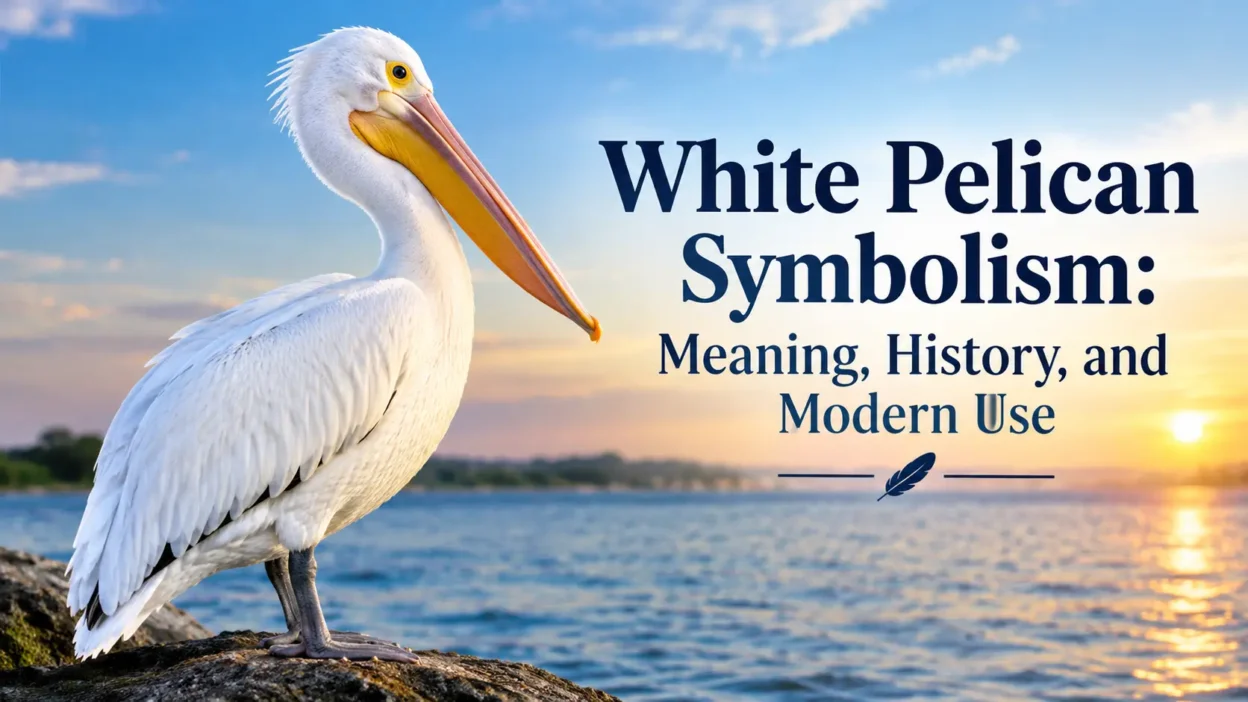
White pelican symbolism centers on care, generosity, family responsibility, and self-sacrifice. With its large white body, long bill, and expandable throat pouch, the American white pelican is a striking waterbird that can represent both individual strength and cooperation. Its appearance in art, religious imagery, wildlife photography, and personal designs gives people several ways to interpret its meaning.
In the United States, white pelicans are familiar sights in wetlands, lakes, coastal areas, and wildlife refuges. Their graceful flight and coordinated fishing behavior can suggest patience, teamwork, and a shared purpose. Their size also gives them a commanding presence, although their behavior is generally less aggressive than their appearance might suggest.
The bird’s symbolism comes from a mixture of observable behavior, older religious traditions, folklore, and modern personal interpretation. Understanding these different influences helps separate established cultural associations from meanings people create for themselves.
Quick Answer
White pelican symbolism commonly represents nurturing, generosity, family devotion, and self-sacrifice in modern American interpretations. Historically, the pelican became a Christian symbol of parental sacrifice and redemption, while its cooperative behavior also supports associations with community, patience, and shared responsibility.
TL;DR
- Care: White pelicans can represent nurturing and responsibility toward others.
- Sacrifice: Christian traditions associate the pelican with Christ’s sacrifice.
- Teamwork: Group feeding and coordinated movement suggest cooperation.
- Patience: Their fishing behavior can symbolize persistence and timing.
- Renewal: Wetland habitats and seasonal movements suggest adaptation and fresh beginnings.
- Modern meaning: Tattoos, artwork, and wildlife imagery often emphasize family and community.
1. What Does a White Pelican Look Like?
The American white pelican (Pelecanus erythrorhynchos) is a large waterbird recognized by its white plumage, black flight feathers, orange-yellow bill, and broad wings. Its most noticeable feature is a long bill with a flexible pouch underneath, which helps it scoop fish from the water.
Unlike the brown pelican, which often dives into the water to catch prey, the American white pelican generally feeds while swimming on the surface. Groups sometimes cooperate to herd fish into shallow water, where they can catch them more easily.
These visible features help explain why people associate the bird with several ideas:
- White feathers: Cleanliness, peace, and spiritual purity in some symbolic settings.
- Broad wings: Freedom, stability, and the ability to rise above difficulties.
- Large bill and pouch: Provision, nourishment, and the responsibility of caring for others.
- Group behavior: Cooperation, shared effort, and community.
These are interpretations rather than fixed meanings. The bird itself does not carry one universal message, and its symbolism depends on the cultural setting and the person interpreting it.
2. The Main Symbolic Meanings of a White Pelican
White pelicans can suggest different qualities depending on whether someone encounters them in nature, religious artwork, a dream, or a personal design.
Nurturing and family devotion are natural associations because adult pelicans feed and protect their young. Their parental behavior offers a visible example of the effort required to raise dependent offspring.
Generosity and self-sacrifice have a more specific historical background. Christian imagery developed the pelican into a figure of a parent giving its own blood to sustain its young, creating a metaphor for Christ’s sacrifice.
Cooperation and shared responsibility emerge from the way pelicans sometimes fish together. Rather than relying entirely on individual effort, a group can coordinate its movements to improve feeding success.
Patience and persistence reflect their deliberate feeding style and seasonal movements. Their ability to travel long distances and return to suitable habitats can also inspire interpretations involving endurance and commitment.
Finally, peace and renewal may come from the bird’s pale appearance, graceful flight, and association with wetlands. These meanings are especially common in personal art and contemporary spiritual interpretations, though they are not universal cultural traditions.
3. Ancient Roots and the Christian Pelican Tradition
The pelican’s most recognizable historical symbolism comes from Christian literature and art, rather than from the modern American white pelican specifically.
An early Christian text known as the Physiologus, compiled in late antiquity, helped popularize moral lessons drawn from animal stories. Medieval versions described a pelican that restored its dead young by striking its own breast and allowing its blood to revive them. The details varied among accounts, but the central theme was extraordinary parental sacrifice.
This story was not an accurate account of pelican biology. It belonged to a tradition in which animals were used to communicate religious teachings. Readers were encouraged to see a moral or spiritual lesson in an animal’s supposed behavior.
Christian interpreters connected the wounded bird with Jesus Christ, whose death was understood as an act of sacrifice that brought redemption to humanity. The pelican’s breast became an image of giving one’s life for others, while its young represented those receiving that gift.
By the late Middle Ages and early Renaissance, the motif known as the Pelican in Her Piety appeared in religious objects and decorative arts. Despite the name, the image is not necessarily a reference to the biological sex of the bird. It describes a scene of parental devotion.
The tradition influenced paintings, jewelry, book decorations, religious furnishings, and heraldic designs. Its survival across different artistic forms shows how a single animal image could communicate a complex theological idea to people who might never read a religious text.
4. What the White Pelican Means in American Culture
In the United States, the white pelican has two overlapping identities: a real North American bird and a figure that can carry older symbolic meanings.
For birdwatchers and wildlife enthusiasts, it often represents the beauty of wetlands, the seasonal movement of wildlife, and the importance of protecting natural habitats. Its large flocks can be particularly memorable when they gather on lakes or glide across the sky.
For people familiar with Christian symbolism, the pelican may suggest sacrifice, charity, and the duty to care for others. This interpretation is more likely when the bird appears in a church, religious emblem, or devotional object than in an ordinary wildlife photograph.
In personal and decorative settings, people may choose a white pelican because it represents family loyalty, a calm presence, or a connection to coastal and wetland environments. These meanings are individual interpretations rather than established national customs.
The bird is not a major, universally recognized American holiday symbol in the way that the bald eagle is associated with national identity or the turkey with Thanksgiving. Its significance is more specialized, appearing in wildlife culture, religious art, regional imagery, and personal expression.
That distinction matters: an American viewer looking at a flock of pelicans over a lake may think first of nature and freedom, while someone viewing a medieval-style pelican emblem may immediately recognize a Christian reference to sacrifice.
5. White Pelican Symbolism in Christianity
Christian symbolism gives the pelican a particularly clear interpretation: love expressed through self-giving.
In traditional depictions, the bird bends its head toward its breast, appearing to wound itself so its young can live. The scene functions as a visual comparison with Christ’s crucifixion and the belief that his sacrifice brought spiritual life to others.
The pelican can therefore represent several connected ideas:
- Redemption: The belief that sacrifice can restore a broken relationship between humanity and God.
- Charity: Giving to others out of love rather than personal gain.
- Parental love: Protecting and sustaining children, even at significant personal cost.
- Communion: In some Christian settings, the image can evoke Christ’s life-giving presence in the Eucharist.
- Service: Placing the needs of others alongside or ahead of one’s own interests.
The symbol has appeared in Christian jewelry and other devotional objects, including historical pieces in European museum collections. Its presence in a modern religious design can communicate continuity with this tradition.
However, the pelican is not interpreted identically by every Christian denomination or believer. Its meaning depends on the artwork, theological background, and setting. A bird shown feeding its young in a contemporary illustration may express family care without making a specifically religious statement.
6. White Pelicans, Family, and Parental Responsibility
One of the easiest meanings to understand comes from the bird’s actual family behavior.
American white pelicans nest in colonies, and adults share responsibilities associated with incubation and feeding their chicks. Parents bring food back to their young, and the birds’ breeding cycle requires repeated attention and coordination.
This makes the pelican a useful symbol for people thinking about the less visible work of caring for a family. Raising children involves more than affection: it requires time, practical support, protection, and repeated acts of responsibility.
A white pelican in family artwork might therefore represent:
- A parent’s commitment to raising children.
- The connection between generations.
- The work involved in supporting a household.
- The importance of dependable care.
- The balance between individual needs and family responsibilities.
The symbol can also apply to adoptive parents, guardians, grandparents, and other caregivers. Its central idea is not limited to biological parenthood.
Still, parental devotion should not be confused with unlimited self-denial. The older religious image emphasizes sacrifice, but a modern interpretation can also recognize that healthy caregiving requires sustainable boundaries and support.
7. Cooperation, Community, and Shared Effort
White pelicans often gather in large groups, and some use coordinated movements to concentrate fish in shallow water. Their feeding behavior provides a clear basis for interpreting them as symbols of teamwork.
This meaning is especially relevant in settings where success depends on people working toward a shared goal. A pelican image might appear in a conservation campaign, a community project, an educational setting, or artwork celebrating collective achievement.
The bird can represent a form of cooperation that does not erase individual contributions. Each pelican participates in the group’s movements, but the group benefits because those actions work together.
In personal terms, this symbolism may appeal to someone who values collaboration over competition. It can also serve as a reminder that asking for help is not necessarily a weakness and that practical problems sometimes require shared effort.
Unlike the Christian association with sacrifice, this interpretation does not require anyone to give up their well-being for others. It focuses instead on coordination, mutual support, and the benefits of working together.
8. The Symbolic Meaning of White Feathers and Broad Wings
The color and shape of the white pelican influence how people interpret it, although these associations should not be mistaken for universal rules.
White is commonly associated with cleanliness, peace, simplicity, and spiritual purity in many contemporary American settings. In some religious contexts, it can also suggest holiness or renewal. In other cultural settings, white has associations with mourning or funerary practices, demonstrating that color meanings are not universal.
The pelican’s broad wings add another layer. When the bird is airborne, its steady flight may suggest freedom, perspective, and the ability to move beyond immediate difficulties. Its impressive wingspan can also create an impression of strength without requiring an aggressive posture.
Together, white plumage and expansive wings can support an interpretation of calm strength: a presence that appears composed while remaining capable of long journeys and demanding physical work.
This is one reason a white pelican may appeal to people who prefer understated symbolism. The bird can represent strength through steadiness, care, and endurance rather than dominance.
9. White Pelican Symbolism in Dreams
Dream interpretations of white pelicans are personal and cannot be established as predictions or universal messages. Nevertheless, the bird’s recognizable characteristics provide useful starting points for reflection.
A pelican feeding its young might bring attention to caregiving, family responsibilities, or the question of whether support is being shared fairly. A group of pelicans working together could prompt reflection on collaboration or the people a dreamer relies on.
A pelican flying over water might be associated with gaining perspective, moving through a transition, or considering a new direction. A lone pelican could invite thoughts about independence, solitude, or feeling separate from a group.
The emotional tone of the dream matters. A calm encounter may feel reassuring, while a frightened or injured bird may connect with concerns about vulnerability or responsibility.
None of these interpretations establishes what a dream must mean. A useful approach is to consider what the bird was doing, how the scene felt, and whether any current life experience makes the image personally relevant.
10. White Pelican Symbolism in Tattoos and Personal Art
White pelicans can make distinctive tattoo subjects because their silhouettes are recognizable and their meanings can be expressed without elaborate decoration.
A person may choose a pelican tattoo to honor a parent, represent devotion to children, or mark a commitment to community service. Someone with a strong connection to wetlands, birdwatching, or a coastal region may choose the bird for its ecological and personal associations instead.
Different design choices can change the impression:
- A single pelican in flight: Independence, freedom, or a new direction.
- An adult with its young: Family devotion and caregiving.
- A group of pelicans: Cooperation and belonging.
- A traditional pelican-and-blood motif: Christian sacrifice and redemption.
- A pelican beside water or marsh plants: Nature, conservation, and attachment to a particular landscape.
White ink can be used in tattoo designs, but it may appear differently across skin tones and can change as the tattoo heals and ages. Many artists use dark outlines or contrasting colors to preserve the bird’s shape.
The meaning ultimately comes from the wearer’s intention. A pelican tattoo does not automatically indicate religious belief, parenthood, or any particular personal history.
11. White Pelicans in Jewelry, Home Decor, and Design
In decorative design, the white pelican can communicate different ideas depending on its presentation.
A traditional religious pendant may use the pelican’s self-sacrificing pose to express faith, charity, or devotion. A naturalistic sculpture, by contrast, may celebrate wildlife and the character of a particular landscape.
In home decor, pelican figures and prints can fit coastal, nautical, or wetland-inspired interiors. Their long bills and distinctive bodies create recognizable shapes, while their white plumage works well in restrained natural color palettes.
In gifts, the bird can be chosen to mark family relationships, express gratitude to a caregiver, or celebrate someone’s connection to nature. These uses are modern creative choices rather than evidence of a universal gift-giving tradition.
The design itself often provides the clearest clue to its intended meaning. A medieval-style bird with its beak against its chest has a different visual history from a flock soaring over a marsh at sunset.
12. How White Pelicans Differ From Brown Pelicans Symbolically
Although both species belong to the pelican family, their different appearances can shape the associations people make with them.


6
The American white pelican is especially associated with inland lakes, shallow wetlands, large flocks, and coordinated surface feeding. Brown pelicans are more closely associated with marine environments and their characteristic plunge-diving behavior.
These differences can affect visual interpretation. White pelicans may be used to evoke open wetlands, stillness, group movement, or pale, expansive forms. Brown pelicans may more readily evoke ocean life, shorelines, and dramatic action above the water.
| Context | White pelican associations | Brown pelican associations |
|---|---|---|
| Natural setting | Inland lakes and wetlands | Coastal and marine environments |
| Feeding behavior | Cooperative surface feeding | Characteristic plunge-diving |
| Visual impression | Broad white body and expansive wings | Streamlined coastal bird in flight |
| Personal artwork | Family, cooperation, calm strength | Coastal identity, resilience, ocean connection |
| Religious imagery | Can carry the traditional pelican symbolism | Can also represent the traditional pelican motif |
The final two rows describe possible artistic interpretations, not fixed meanings attached to each species. The historical Christian pelican motif developed around the pelican as a symbolic figure, not exclusively the American white pelican.
13. White Pelican Symbolism in Other Cultures and Traditions
The pelican’s meaning is not limited to Christianity, but its symbolism should not be treated as identical across cultures.
In European medieval traditions, the pelican became a recognizable emblem of charity and sacrifice. This meaning was reinforced through religious manuscripts, decorative objects, and Christian art.
In North America, Indigenous relationships with birds vary among individual Tribal Nations and communities. Historical records document the white pelican in some Indigenous contexts, but they do not establish one shared meaning for all Native American peoples. It would be inaccurate to assign the bird a universal Indigenous meaning without identifying a particular nation, story, or cultural source.
In contemporary nature-centered spirituality, some people interpret pelicans as reminders to care for others, respect natural cycles, or maintain balance between personal needs and collective responsibilities. These are modern personal interpretations and should not automatically be attributed to ancient traditions.
The most reliable approach is to ask where a particular interpretation comes from. A meaning documented in a medieval Christian object is different from a personal interpretation inspired by watching pelicans in a modern American wetland.
14. Emotional and Psychological Meaning of the White Pelican
People often respond to animals through the qualities they notice in their appearance and behavior. White pelicans can create an impression of calmness because they glide steadily, gather on open water, and move in coordinated groups.
Their size may suggest confidence, while their feeding behavior can remind viewers of practical care rather than dramatic displays of affection. These associations can make the bird appealing to people who value reliability, patience, and cooperation.
The pelican’s traditional religious story introduces a more complicated emotional dimension. Sacrifice can represent love and commitment, but it can also raise questions about the limits of personal responsibility. A modern viewer might interpret the image as an invitation to help others while recognizing that care should not require the destruction of one’s own well-being.
For someone remembering a loved one, the bird might symbolize a caregiver’s influence or the continuing importance of family bonds. For someone entering a new phase of life, its flight and migration may suggest movement, adaptation, or a change in perspective.
Psychologically, these interpretations are best understood as personal associations rather than universal rules. An individual’s memories, beliefs, and experiences determine which aspects of the bird feel meaningful.
15. Common Misunderstandings About White Pelican Symbolism
Several common assumptions can blur the distinction between the bird’s actual behavior and its cultural meaning.
The pelican really feeds its young with blood. This is the central misconception behind the traditional Christian image. Real pelicans feed their chicks by bringing up food, not by deliberately wounding themselves to provide blood.
Every white pelican represents Christianity. The religious motif is historically important, but a wildlife photograph or nature illustration may have no religious intention at all.
White always means purity. White can suggest purity in some American and Christian contexts, but its associations vary across cultures and situations.
Seeing a pelican predicts a particular event. There is no reliable evidence that an ordinary pelican sighting predicts good fortune, a warning, a reunion, or another specific outcome. People may still use such encounters as personal prompts for reflection.
All pelican species carry exactly the same cultural associations. The traditional religious symbol can depict a generic pelican, while contemporary designs may emphasize the distinct appearance or habitat of a particular species.
Separating observation from interpretation does not make symbolism less meaningful. It helps explain why a symbol can remain useful without requiring every claim about it to be literally true.
16. White Pelican Symbolism in Modern Life
Today, white pelican imagery can bring together older religious associations and contemporary interests in nature, family, and environmental responsibility.
In conservation settings, the bird can draw attention to the health of wetlands and the wildlife that depends on them. American white pelicans rely on suitable feeding areas, nesting sites, and seasonal habitats, so protecting these environments has practical importance beyond their visual appeal.
In art and personal expression, the bird can represent a commitment to caring for others or a preference for cooperation over competition. Its traditional Christian imagery remains relevant for people who recognize the connection between parental sacrifice and redemption.
Digital illustrations and social media posts may also use pelicans to communicate calmness, family affection, or an appreciation of wildlife. These modern meanings can spread without any direct connection to the medieval tradition.
The bird’s meaning has therefore broadened in contemporary use. Its older association with self-sacrifice remains recognizable, but many people now approach it through direct experiences of nature, personal values, and a desire to protect the environments in which it lives.
Frequently Asked Questions
What does a white pelican symbolize spiritually?
A white pelican may symbolize care, generosity, patience, and responsibility in modern spiritual interpretations. In Christian tradition, the pelican has a more specific association with Christ’s sacrifice and redemption.
Is a white pelican a symbol of good luck?
There is no widely established American tradition that makes seeing a white pelican a universal sign of good luck. Some people may interpret an encounter positively because it reminds them of hope, peace, or a meaningful personal experience.
What does a white pelican tattoo mean?
A white pelican tattoo can represent family devotion, caregiving, cooperation, or a connection to wetlands and wildlife. A design showing the bird wounding its breast has a more specific historical association with Christian sacrifice.
Why is the pelican associated with Jesus Christ?
Medieval Christian traditions described a pelican reviving its young with its own blood. Religious artists used this story as an analogy for Christ’s death and the redemption Christians associate with his sacrifice.
Does a white pelican symbolize family?
Yes, family devotion is a common modern interpretation because adult pelicans care for and feed their young. The bird can represent parenting, guardianship, and the everyday responsibilities involved in supporting loved ones.
What does it mean to see a white pelican flying overhead?
A person may interpret a white pelican in flight as a reminder of freedom, perspective, or a period of transition. There is no established evidence that the sighting predicts a particular future event.
Is white pelican symbolism different from brown pelican symbolism?
The traditional Christian pelican motif is not restricted to one species. However, a white pelican may evoke inland wetlands, coordinated group behavior, and broad white wings, while a brown pelican more readily suggests coastal environments and plunge-diving.
Conclusion
White pelican symbolism brings together several distinct ideas: family care, generosity, cooperation, patience, and sacrifice. Its best-known historical association comes from Christian art, where the pelican became an image of Christ’s self-giving love. In contemporary American culture, the bird also inspires interpretations connected with wildlife, community, personal identity, and environmental protection.
The meaning depends on the context. A religious pendant may communicate redemption, while a flock crossing a lake may suggest cooperation or freedom. A family illustration may emphasize parental devotion without making any religious claim.
Ultimately, white pelican symbolism is most useful when its historical roots are understood alongside the bird’s real behavior and the viewer’s own experience. Its lasting appeal lies in the connection between caring for others, working together, and protecting the natural world that sustains life.