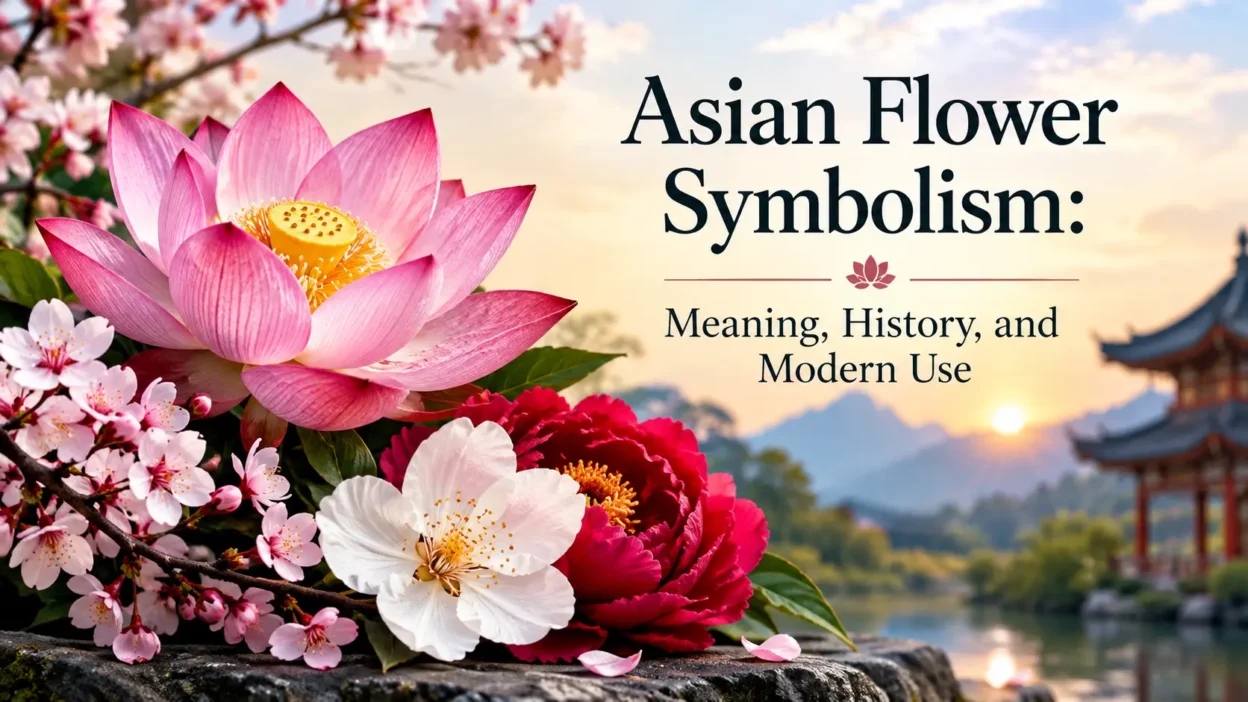
Asian flower symbolism explores the meanings people attach to flowers in the art, religions, literature, festivals, and everyday traditions of Asian cultures. From the lotus rising above muddy water to cherry blossoms opening for a brief spring season, flowers often express ideas that are difficult to communicate through words alone. They can represent purity, prosperity, endurance, love, renewal, and the passing of time.
In the United States, Asian flowers appear in botanical gardens, wedding arrangements, home decor, tattoos, paintings, fashion, and celebrations of Asian heritage. Cherry blossom festivals attract visitors each spring, while lotus designs frequently appear in spiritual art and meditation spaces. These flowers can carry cultural meaning even when someone chooses them simply for their beauty.
However, Asia includes many countries, languages, religions, and communities. A flower associated with good fortune in one setting may carry a different meaning in another. Understanding the history and cultural context behind each bloom helps explain what it represents without treating all Asian traditions as identical.
Quick Answer
Asian flower symbolism commonly represents purity, prosperity, renewal, love, and the beauty of life in modern American culture. Historically, flowers such as the lotus, peony, chrysanthemum, plum blossom, and cherry blossom developed distinct meanings in Asian religious traditions, literature, seasonal customs, and visual art.
TL;DR
- Lotus flowers often represent purity, spiritual awakening, and renewal.
- Peonies commonly symbolize prosperity, honor, and good fortune in Chinese traditions.
- Cherry blossoms express beauty, seasonal renewal, and life’s temporary nature.
- Chrysanthemums can represent longevity, refinement, and national identity in Japan.
- Plum blossoms often symbolize resilience because they bloom in late winter.
- In America, Asian flowers appear in festivals, tattoos, weddings, and decorative art.
What Asian Flower Symbolism Means
Asian flower symbolism refers to the cultural meanings associated with particular flowers across Asian societies. These meanings developed through religious teachings, seasonal observations, poetry, folklore, royal traditions, and artistic practices.
Unlike a universal dictionary, flower symbolism depends on context. A lotus in Buddhist art may communicate spiritual awakening, while a peony in Chinese decorative art may suggest wealth and honor. A cherry blossom can express the joy of spring while also reminding viewers that beauty does not last forever.
Flowers also communicate personal feelings. Someone might choose a plum blossom to represent perseverance through hardship or a lotus to mark a period of personal growth. Another person may select the same flower because of a family connection or an appreciation for its appearance.
The most useful way to interpret an Asian flower is to consider three things: the specific flower, the cultural tradition associated with it, and the setting in which it appears.
Historical Origins of Flower Symbolism in Asia
Flower symbolism developed over long periods rather than emerging from a single shared Asian tradition. In China, flowers became important subjects in painting, poetry, gardens, textiles, ceramics, and courtly life. Artists used plants to communicate ideas about character, social status, seasonal change, and moral qualities.
In India, the lotus acquired major religious significance in Hindu and Buddhist traditions. As Buddhism spread into Central and East Asia, lotus imagery became an important part of religious sculpture, paintings, ritual objects, and temple decoration. Local artists adapted floral designs to their own materials and artistic styles.
Japan developed distinctive traditions around seasonal flowers, especially plum blossoms and cherry blossoms. Flower viewing became a social and artistic practice, while flowers also appeared in poetry, imperial imagery, and decorative arts. Chrysanthemums gained particular importance through court culture and later became closely associated with the Japanese imperial institution.
These traditions influenced one another through trade, religious exchange, migration, and artistic contact. Yet shared influences did not erase local differences. The meaning of a flower remained shaped by the community that cultivated, depicted, and celebrated it.
Lotus Symbolism: Purity, Rebirth, and Spiritual Growth
The lotus is among the most recognizable flowers in Asian religious art. Its roots grow in mud, its stem rises through water, and its blossom opens above the surface. This natural process helps explain its association with purity, spiritual development, and the ability to rise above difficult circumstances.
In Buddhism, the lotus is closely connected with awakening and freedom from ignorance. Buddhist figures may be shown sitting or standing on lotus-shaped seats, while lotus patterns decorate religious objects and temple art. The flower’s appearance above muddy water provides a visual image of spiritual clarity emerging from ordinary worldly conditions.
In Hindu traditions, the lotus is associated with several deities and with ideas of beauty, creation, and auspiciousness. Its specific meaning depends on the deity, story, and ritual in which it appears.
In the United States, lotus imagery frequently appears in meditation spaces, yoga-related design, jewelry, and tattoos. People may choose it to represent a fresh start, personal resilience, or spiritual growth.
However, the lotus is not simply a generic symbol of positive thinking. Its religious meanings remain important to many practitioners, and its interpretation is more precise when connected to the tradition in which it is used.
Peony Symbolism: Prosperity, Honor, and Good Fortune
Peonies are admired for their large, layered petals and rich colors. In Chinese culture, they are strongly associated with prosperity, honor, beauty, and good fortune. Their full blossoms make them natural subjects for paintings, embroidery, decorative screens, ceramics, and other forms of traditional art.
The peony’s association with wealth developed partly through its historical connection with elite gardens and cultivated beauty. It became an important flower in Chinese artistic traditions and is sometimes described as the king of flowers. In decorative settings, peony motifs can communicate hopes for abundance, success, and an honorable life.
Peonies are also associated with romance and feminine beauty in some artistic and literary contexts. Their meaning is not limited to money or material success; they may express admiration, elegance, and a wish for a flourishing household.
American audiences often encounter peonies in wedding bouquets, garden design, fabric patterns, and Chinese-inspired decorative objects. A peony arrangement may suggest prosperity and celebration, particularly when used in a culturally informed setting.
Color, placement, and accompanying motifs can change the interpretation. A peony appearing with other auspicious symbols in Chinese art may communicate a more specific wish than a single flower used in an ordinary bouquet.
Cherry Blossom Symbolism: Beauty, Renewal, and Impermanence
Cherry blossoms, known as sakura in Japanese, are closely associated with spring, beauty, renewal, and the brief nature of life. Their blossoms often appear in great numbers, transform the landscape for a short period, and then fall quickly.
In Japan, cherry blossom viewing is an established seasonal tradition. Friends, families, and colleagues gather beneath flowering trees to appreciate the blossoms. The practice connects natural beauty with social life and the changing seasons.
Cherry blossoms also appear in Japanese poetry, paintings, and historical imagery. Their short blooming period has made them a symbol of impermanence: a reminder that beautiful experiences can be meaningful precisely because they do not last.
The flower’s historical associations are complex. Cherry blossoms have represented peaceful seasonal celebration, but they were also used in Japanese nationalist and military imagery, particularly during the early twentieth century and World War II. Those political uses are part of the flower’s history, not its only meaning.
In the United States, cherry blossoms are especially visible in Washington, D.C., where the annual spring display is associated with Japanese-American friendship. The blossoms are also popular in photography, clothing, tattoos, and garden design. For many Americans, they suggest fresh beginnings, romance, and the arrival of spring.
Chrysanthemum Symbolism: Longevity, Refinement, and National Identity
Chrysanthemums hold important places in Chinese and Japanese traditions, although their associations differ by context. In Chinese culture, the flower is often linked with longevity, refinement, and the qualities of a person who remains composed despite life’s difficulties. Its autumn blooming season contributes to its association with endurance and maturity.
In Japan, chrysanthemums became important in court culture and decorative art. The flower is closely associated with the Japanese imperial institution, whose emblematic chrysanthemum design is widely recognized. Traditional Japanese horticulture also developed many distinctive chrysanthemum varieties, demonstrating how cultivation itself became an art.
Chrysanthemums do not always communicate the same message. In some East Asian settings, they are associated with longevity or celebration; in other contexts, particularly certain funeral customs, they are connected with mourning and remembrance.
American flower customs add another layer. Chrysanthemums are common fall garden plants and seasonal decorations, while white chrysanthemums may appear in funeral arrangements depending on the cultural and family context.
When interpreting this flower, it is useful to distinguish the symbolic meaning of a chrysanthemum in Asian art from its practical role in a particular ceremony.
Plum Blossom Symbolism: Resilience and Hope
Plum blossoms are especially significant in Chinese artistic traditions and have an important place in Japanese culture as well. Because plum trees can bloom in cold weather, their flowers are often associated with resilience, perseverance, and hope before spring fully arrives.
In Chinese art, the plum blossom is one of the traditional subjects associated with cultivated character and integrity. Its ability to flower despite harsh conditions makes it an image of endurance rather than comfort. The blossom suggests that difficult circumstances do not necessarily prevent growth.
In Japan, plum blossoms are connected with early spring and the pleasure of appreciating seasonal change. Historically, plum blossom viewing held an important place in Japanese court culture before cherry blossoms became the dominant focus of the familiar springtime flower-viewing tradition.
In contemporary America, plum blossom designs may appeal to people who want to represent perseverance, independence, or a new beginning. The flower can also be chosen for its graceful branches and delicate petals.
A plum blossom is therefore particularly suitable when the intended message concerns strength under pressure, quiet determination, or hope during a difficult period.
Orchid Symbolism: Elegance, Integrity, and Refinement
Orchids have a long association with elegance and refinement in Chinese cultural traditions. In classical Chinese painting and literature, they can express modesty, integrity, and cultivated character rather than simply physical beauty.
The orchid’s graceful form and often subtle fragrance have made it an image of restrained elegance. In some traditional contexts, an orchid can suggest a person of good character whose worth does not depend on public recognition.
Modern meanings vary with the species and setting. Orchids are popular gifts, wedding flowers, home decorations, and symbols of appreciation. In American floral culture, they can communicate sophistication, affection, luxury, or admiration.
An orchid in a traditional Chinese painting may carry a different message from an orchid in a contemporary gift arrangement. Both uses are valid, but the cultural background determines whether the emphasis falls on moral character, beauty, romance, or status.
Asian Flower Symbolism Across Different Cultures
Although some floral motifs traveled across borders, Asian flower symbolism is not one unified system. The same flower can have related meanings in neighboring cultures while retaining distinct religious, historical, and social associations.
| Flower | Common cultural association | Symbolic idea | Context to consider |
|---|---|---|---|
| Lotus | Buddhist and Hindu traditions | Purity, spiritual awakening, auspiciousness | Religious imagery and ritual |
| Peony | Chinese art and tradition | Prosperity, honor, beauty | Decorative art and celebrations |
| Cherry blossom | Japanese culture | Renewal, impermanence, seasonal beauty | Spring festivals and historical imagery |
| Chrysanthemum | Chinese and Japanese traditions | Longevity, refinement, national identity | Art, court traditions, and funerals |
| Plum blossom | Chinese and Japanese traditions | Resilience, hope, integrity | Poetry, painting, and early spring |
| Orchid | Chinese artistic traditions | Elegance, modesty, cultivated character | Classical painting and literature |
These associations are common starting points, not universal rules. A particular family, religious community, artist, or region may understand a flower differently.
Korean floral traditions, for example, have their own histories and visual conventions. South Asian traditions also encompass many regional and religious interpretations that cannot be reduced to a single flower dictionary. Context is essential when moving from a broad cultural association to a specific interpretation.
Rose of Sharon Symbolism in Korean Culture
The rose of Sharon, known in Korean as mugunghwa, is South Korea’s national flower. It symbolizes endurance, national identity, and the ability to continue flourishing through hardship.
The flower’s name is associated with the idea of an enduring or unfading blossom. Its repeated flowering during the growing season has helped make it an emblem of persistence and continuity. The mugunghwa appears in Korean national imagery and official emblems, giving it a civic meaning beyond its appearance as a garden flower.
For Korean Americans and people exploring Korean heritage, the flower may represent cultural pride, family connections, or respect for Korean history. It can also communicate perseverance without requiring a religious interpretation.
This example is an important reminder that Asian flower symbolism includes national and historical identity, not just spiritual beliefs or decorative traditions.
What Asian Flowers Mean in Modern American Culture
Asian flowers have become familiar in the United States through immigration, international travel, museums, gardening, popular entertainment, and cultural festivals. Their meanings often move between cultural contexts as people encounter them in new settings.
Cherry blossoms are a particularly visible example. Washington, D.C.’s spring blossoms connect seasonal beauty with the history of Japanese-American friendship. Lotus flowers appear in yoga studios and meditation spaces, where they may suggest personal development or calm. Peonies are common in wedding arrangements and celebratory designs, while chrysanthemums are widely planted in American autumn gardens.
For Asian American communities, these flowers can carry additional personal meanings. A floral pattern might recall a grandparent’s garden, a childhood celebration, a family tradition, or an artistic style associated with a particular heritage. Such connections cannot always be captured by a simple list of symbolic definitions.
American interpretations are also influenced by commercial design. A flower may appear on packaging, clothing, stationery, or home accessories because its shape and color are attractive. In these situations, the cultural meaning may be reduced or absent.
The same design can therefore communicate different things to different viewers. One person may recognize a religious symbol, while another sees a beautiful flower. Neither interpretation automatically tells the whole story.
Emotional and Psychological Meanings of Asian Flowers
Flowers communicate through more than established cultural traditions. Their colors, shapes, scents, and seasonal patterns can also influence personal associations.
A lotus may remind someone of recovering from a difficult period because its growth offers a visible image of emerging from muddy water. Plum blossoms may suggest persistence because they bloom in cold weather. Cherry blossoms can prompt appreciation for the present because their flowering period is short.
These responses are personal rather than universal psychological rules. A flower does not automatically produce a particular emotion, and its cultural meaning cannot be determined by appearance alone.
Color can also influence interpretation. Red may suggest celebration, good fortune, or happiness in some Chinese contexts, while white can be associated with mourning in particular East Asian funeral traditions. Pink flowers may be chosen for romance, tenderness, or springtime beauty in contemporary American settings.
The surrounding situation matters just as much as the flower. A white chrysanthemum in a memorial arrangement may express respect and grief, while a chrysanthemum in a garden may simply reflect a preference for autumn color.
Why Asian Flowers Appear in Tattoos, Jewelry, and Decor
Asian floral designs are popular in tattoos and personal accessories because they combine recognizable shapes with meanings that can be adapted to individual experiences.
A lotus tattoo may mark spiritual development, a new beginning, or a personal commitment. Cherry blossom tattoos can express appreciation for life’s changing seasons, while plum blossoms may represent determination. Peonies are frequently chosen for their visual richness and associations with prosperity, beauty, or celebration.
In jewelry, small floral motifs can serve as reminders of family heritage, a relationship, a personal milestone, or a cultural tradition. Home decor may use chrysanthemums, orchids, lotus patterns, or cherry blossoms to create a particular atmosphere or reference a specific artistic style.
Before choosing a design, consider whether it has a religious or national meaning beyond its general symbolism. A lotus used in Buddhist imagery, for example, has a more specific context than a generic floral ornament. Likewise, a national flower may communicate cultural identity to people familiar with its history.
Researching the actual flower and its artistic tradition helps create a design that is both personally meaningful and respectful of its cultural background.
Common Misunderstandings About Asian Flower Symbolism
One frequent misunderstanding is that all Asian cultures share the same flower meanings. China, Japan, Korea, India, and other Asian societies have different languages, religious histories, artistic traditions, and social customs. Similar-looking symbols do not necessarily carry identical meanings.
Another mistake is treating every flower as a spiritual symbol. Many flowers appear in religious art, but they also have roles in gardening, courtly decoration, seasonal celebrations, literature, and ordinary gift-giving.
It is also misleading to assume that one color always has one meaning. White flowers can represent purity in some settings and mourning in others. Red flowers may be appropriate for celebrations but less suitable for certain memorial occasions.
Finally, popular interpretations sometimes turn cultural symbols into simplistic claims about luck, destiny, or personal energy. A peony is commonly associated with prosperity in Chinese art, but owning a peony image does not guarantee wealth. A lotus may represent awakening in a religious context, but it does not have a single mandatory meaning for every person who chooses it.
The most accurate interpretation begins with evidence about the flower’s use and leaves room for individual experience.
How to Choose an Asian Flower for a Meaningful Gift
Selecting a flower as a gift requires more than matching a symbolic meaning to an occasion. The recipient’s preferences, cultural background, and circumstances should guide the decision.
For a celebration, peonies may be a suitable choice when prosperity and good wishes are appropriate. Cherry blossoms can work well for springtime celebrations or gifts that acknowledge change and new beginnings. Orchids may express admiration, while plum blossoms can represent perseverance during a challenging period.
For sympathy gifts, take extra care. Funeral customs differ across Chinese, Korean, Japanese, and other communities, and expectations can vary between families. White flowers and chrysanthemums may be appropriate in some circumstances, but the safest choice is to ask someone familiar with the family’s customs or follow the funeral home’s guidance.
When the gift is intended to honor someone’s heritage, a specific flower with a meaningful cultural connection is often more thoughtful than a generic design labeled simply as Asian.
A brief personal message can also explain why you selected the flower. That makes the gesture more meaningful without assuming the recipient interprets the symbol exactly as you do.
How Asian Flower Symbolism Has Changed Over Time
Flower meanings have never remained completely fixed. Religious teachings, political developments, artistic exchange, gardening practices, and popular culture have all influenced how people interpret flowers.
The lotus moved through religious and artistic networks, appearing in Buddhist imagery and decorative objects across different parts of Asia. As floral designs entered secular art, some viewers continued to recognize their religious associations, while others appreciated them primarily as ornamental patterns.
Cherry blossoms illustrate another kind of change. Their associations with springtime enjoyment and impermanence existed alongside later nationalist and military uses. In contemporary American settings, the flower often appears as a symbol of friendship, travel, seasonal beauty, or Japanese cultural heritage.
Flowers also acquire new personal meanings through migration and family history. An Asian American family may use a flower in a holiday gathering or wedding because it connects generations, even if the younger generation interprets the tradition differently from its elders.
During 2025 and 2026, Asian-inspired floral imagery remains relevant in contemporary art, fashion, gardening, and personal design. Yet modern use does not erase older meanings. A flower can retain historical significance while becoming part of a new cultural experience.
Frequently Asked Questions
What is the most meaningful flower in Asian symbolism?
There is no single flower that represents all Asian cultures. The lotus is especially significant in Buddhist and Hindu traditions, while peonies, cherry blossoms, chrysanthemums, and plum blossoms have distinctive associations in Chinese, Japanese, and other cultural settings.
What Asian flower symbolizes strength and resilience?
Plum blossoms commonly symbolize resilience because they bloom in cold conditions, while Korea’s mugunghwa represents endurance and national continuity. The lotus can also represent overcoming adversity and developing spiritually.
What does a lotus flower symbolize spiritually?
In Buddhist traditions, the lotus is closely associated with spiritual awakening, purity, and freedom from ignorance. In Hindu traditions, it can represent auspiciousness, beauty, and divine association, depending on the deity and context.
What Asian flower symbolizes love and romance?
Peonies may represent beauty, romance, and prosperity in Chinese-inspired artistic and wedding contexts. Cherry blossoms can also suggest romantic beauty and the preciousness of shared experiences, particularly in modern decorative use.
Are Asian flowers appropriate for tattoos?
Yes, Asian floral designs can be meaningful tattoo choices when the flower and its cultural context are understood. Before choosing a religious or national motif, learn what it represents and consider whether the design’s traditional significance aligns with your intention.
Why are white flowers associated with mourning in some Asian cultures?
In several East Asian funeral traditions, white is associated with mourning, remembrance, or respect for the deceased. Customs differ by country, family, religion, and occasion, so white flowers should not be assumed to have the same meaning everywhere.
Do Asian flowers have the same meanings in every country?
No. A flower may share some associations across countries while having different religious, political, or social meanings in each place. The specific culture, historical period, color, and occasion all affect how it is interpreted.
Conclusion
Asian flower symbolism offers a way to understand how nature becomes part of cultural memory, religious expression, artistic tradition, and personal identity. Lotus flowers can represent spiritual awakening, peonies can express prosperity, cherry blossoms can remind people of life’s impermanence, and plum blossoms can suggest perseverance. Other flowers, including chrysanthemums, orchids, and Korea’s mugunghwa, carry their own distinct histories.
In modern American culture, these meanings appear in gardens, festivals, gifts, tattoos, weddings, and home decor. Their significance is often personal as well as cultural, shaped by family connections, individual experiences, and the setting in which each flower appears.
The most respectful way to appreciate Asian flowers is to look beyond their appearance and understand the traditions connected to them. A flower becomes more meaningful when its beauty is considered alongside the people, histories, and beliefs that have given it significance.


