Swallow bird symbolism is closely tied to homecoming, hope, freedom, loyalty, and the arrival of a new season. These meanings grew from the bird’s visible habits: swallows travel great distances, return during warmer months, build nests near people, and move through the air with remarkable speed.
In the United States, the swallow is especially familiar through barnyard wildlife, traditional sailor tattoos, vintage illustrations, jewelry, and American traditional tattoo art. Its meaning often brings together two ideas that seem opposite at first: the freedom to travel and the desire to return home.
The swallow isn’t one single species. Barn Swallows, Tree Swallows, Cliff Swallows, Bank Swallows, and other members of the swallow family differ in appearance and behavior. Still, their seasonal movement, aerial flight, and nesting habits have shaped a shared symbolic identity.
Quick Answer
Swallow bird symbolism most commonly represents safe return, renewed hope, loyalty to home, and freedom in modern American culture. Historically, the bird has also been associated with spring, long-distance travel, spiritual refuge, family life, and the experience of sailors.
TL;DR
- Swallows commonly represent homecoming, hope, freedom, and loyalty.
- Their seasonal migration made them natural signs of spring.
- Sailor tattoos traditionally recorded distance traveled at sea.
- American imagery connects swallows with movement and faithful return.
- Religious traditions emphasize refuge, belonging, and protection.
- Modern meanings depend on personal and cultural context.
What a Swallow Looks Like and Why Its Form Matters
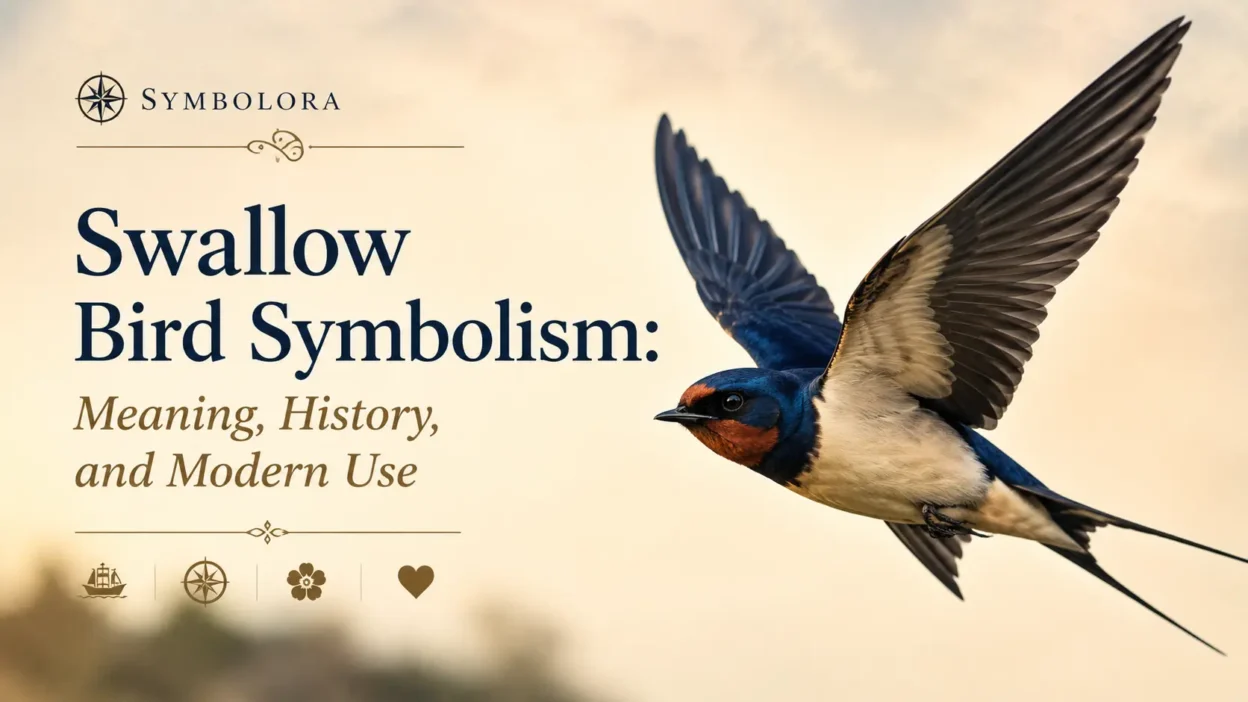
A typical swallow has a compact body, narrow pointed wings, a short bill, and an agile style of flight. The Barn Swallow, one of the most recognizable species in the United States, has a steel-blue back, a reddish or chestnut throat, and a long, deeply forked tail.
That silhouette matters symbolically. Long wings suggest movement, while the divided tail creates a sense of balance and direction. In art, the bird often appears with its wings spread, making it look energetic rather than passive.
Swallows also feed while flying, sweeping low over fields, ponds, farms, and open water as they catch insects in the air. Their continual turning and diving have encouraged associations with adaptability, quick thinking, and confidence during change.
Many Barn Swallows now build mud nests on bridges, barns, sheds, porches, and other human structures. Their willingness to live near people has strengthened their connection with domestic life and familiar places.
The Main Meanings at a Glance
| Context | Meaning in the United States | Common Associations | Important Note |
|---|---|---|---|
| Seasonal imagery | Renewal and optimism | Spring, warmth, fresh beginnings | Based on migration and return |
| Home and family | Loyalty and belonging | Nests, partners, children, reunion | Not a universal marriage symbol |
| Maritime tradition | Experience and safe return | Sailors, voyages, nautical miles | Historically tied to earned travel |
| Personal identity | Freedom with purpose | Independence, resilience, movement | Meaning varies by wearer |
| Religious imagery | Refuge and nearness to God | Home, sanctuary, protection | Not primarily a resurrection symbol |
| Memorial art | Remembrance and peaceful passage | Loss, return, continuing bonds | Mostly a modern personal use |
These interpretations overlap because they begin with the same observable pattern: the swallow leaves, travels, and returns. The bird represents movement without permanent separation.
Why Swallows Became Symbols of Return
Migration is the foundation of the swallow’s best-known meaning. Barn Swallows that breed in North America travel to wintering areas in Central and South America. Depending on location, they may return to U.S. breeding grounds from late winter through spring.
To earlier observers, a swallow’s reappearance was more than a change in wildlife — it meant that cold weather was ending, insects were returning, and another productive season could begin. The bird became a visible announcement that familiar cycles were continuing.
This seasonal pattern explains why swallows symbolize homecoming rather than simple travel. Many animals move, but the swallow became memorable because people could watch it disappear and later return to the same farms, villages, and nesting places near their homes.
In personal symbolism, that pattern can represent a traveler coming back, a military family awaiting reunion, or someone returning emotionally after a difficult period. The bird doesn’t suggest that departure was wrong — instead, it expresses the belief that movement and belonging can exist together.
Spring, Renewal, and the Return of Hope
Swallows are traditional signs of spring because their arrival often coincides with warmer weather, especially in places where the birds leave during winter and become visible again as daylight and insect activity increase.
As a result, the swallow may represent renewal after hardship — the end of grief, illness, uncertainty, isolation, or a demanding stage of life. Unlike a phoenix, though, the swallow doesn’t usually symbolize destruction followed by supernatural rebirth. Its message is quieter: difficult seasons pass, life resumes, and familiar possibilities return.
The bird can also represent good news. Seeing the first swallow once created practical excitement because it suggested that planting, outdoor work, and travel conditions were changing. Modern art preserves that optimistic emotional response even when viewers no longer depend on the bird for seasonal information.
Still, the swallow isn’t a promise that every problem has ended. The ancient warning that one swallow does not make a summer uses the bird to teach caution: one favorable sign is not enough to prove a lasting change.
Home, Loyalty, and Family Bonds
Swallows often nest close to human activity. Barn Swallows attach mud nests to beams and sheltered walls, while Tree Swallows use natural cavities and nesting boxes. These domestic settings make the birds easy to associate with households, parenting, and the protection of young.
Symbolically, a swallow may communicate loyalty to a person, family, hometown, or community. Someone can leave for education, work, military service, or personal growth while remaining emotionally connected to where they began.
A pair of swallows is sometimes used to represent partners who reunite or remain connected across distance. Parents may also choose the image to represent devotion to their children or the responsibility of creating a safe home.
These meanings shouldn’t be treated as strict biological rules. Swallow behavior varies by species and population, and human ideas about lifelong romance are often projected onto animals. The family interpretation is most convincing when understood as a cultural response to nesting, feeding, and returning — not as proof that every swallow follows one idealized relationship pattern.
Freedom Without Rootlessness
Most bird symbols are associated with freedom because birds can rise above fences, roads, and other human boundaries. The swallow adds a particular qualification to that idea: freedom doesn’t require abandoning one’s roots.
Its symbolism fits people who value independence but still want connection. A swallow can represent leaving a restrictive situation, exploring unfamiliar places, or creating a self-directed life while maintaining meaningful relationships.
The bird’s fast, controlled flight also suggests competence. It doesn’t simply drift — it changes direction rapidly, feeds in motion, and responds to conditions around it. For that reason, the swallow can symbolize flexible independence rather than impulsive escape.
That distinction makes it appropriate for graduations, relocations, career changes, recovery milestones, and other transitions. The symbol acknowledges that moving forward may involve distance, but distance doesn’t automatically erase loyalty.
Maritime Tradition and Sailor Tattoos
The swallow has one of the strongest connections between animal symbolism and maritime identity. In traditional naval tattoo culture, a swallow could mark 5,000 nautical miles traveled, with additional birds indicating greater experience at sea.
Distance wasn’t the only message. Swallows were land birds that sailors might notice when approaching shore, so their image became associated with the possibility of landfall and return. Their seasonal travels also supported the hope that a sailor, like the bird, would eventually make it home.
By the twentieth century, swallow tattoos were firmly established in the visual language of sailors and military personnel. The design was commonly rendered with a blue body, red breast, bold black outlines, and spread wings, often combined with banners, ships, anchors, hearts, flags, or the names of loved ones.
In this tradition, the swallow was never merely decorative — it communicated distance earned, professional experience, loyalty to those waiting at home, and confidence in surviving another voyage.
What the Swallow Means in the United States
Modern Americans usually encounter the swallow in three overlapping settings: nature, traditional tattoo art, and nostalgic design. Each setting emphasizes a different aspect of the bird.
In nature, it’s a familiar farm, field, wetland, bridge, and backyard bird. Barn Swallows once nested mainly in caves in North America, but most now use human-made structures — an adaptation that makes them symbols of coexistence between wildlife and built environments.
In tattoo culture, the swallow remains part of the American traditional style. People no longer need to be sailors to wear it; today, it may represent travel, military service, recovery, personal independence, or commitment to family.
The swallow also has a place in American conservation history. During the nineteenth century, birds were killed in large numbers for decorative feathers used in fashion, and concern over the effect of the millinery trade on Barn Swallows helped motivate early organized bird protection in the United States. This history gives the bird an additional modern association with wildlife stewardship.
Biblical and Christian Associations
The swallow appears in Psalm 84 beside the sparrow. The passage describes the bird finding a nest near the altar, within a poem centered on longing for God’s dwelling place.
Within Christian interpretation, this image can suggest refuge, welcome, belonging, and the desire to remain close to the sacred — particularly appropriate in art concerning sanctuary, church community, family worship, or spiritual homesickness.
The passage doesn’t establish one universal Christian definition for the bird, nor does it make the swallow a primary biblical emblem of resurrection in the way some modern symbolism pages claim. Renewal can be a reasonable personal interpretation, but it comes more directly from migration and spring than from a specific biblical teaching.
A swallow in Christian jewelry or memorial art may therefore represent finding rest, being welcomed into a protected place, or trusting that one hasn’t been forgotten.
Ancient Mediterranean Meanings
In the ancient Mediterranean world, swallows were strongly associated with the change of seasons. Their return became familiar enough to appear in philosophy, proverbs, poetry, and stories.
Aristotle used the observation that one swallow does not make a summer to explain that a single good day cannot establish a complete and happy life — a saying that survives because the bird was already understood as an early sign of warmer weather.
The swallow also appears in the tragic myth of Procne, Philomela, and Tereus. Different Greek and Roman versions disagree over which woman becomes a swallow and which becomes a nightingale. Because the story involves violence, silencing, grief, and transformation, later writers sometimes associated the swallow with sorrow, survival, or a voice altered by trauma.
These darker meanings never replaced the seasonal symbolism. Instead, they show that the bird could represent both welcome return and painful transformation, depending on the story surrounding it.
Meaning in Chinese and Other Asian Traditions
In Chinese cultural traditions, the swallow is widely connected with spring, happiness, good fortune, and family prosperity. A swallow nesting near a house could be welcomed as a favorable sign rather than treated as an intrusion.
The bird’s return to human dwellings strengthened its association with household continuity. In some older traditions, it also appeared in stories concerning ancestry, marriage, fertility, and the beginnings of important family lines.
Decorative swallows can therefore appear in paintings, ceramics, textiles, architecture, and seasonal art, communicating that warmth has returned or that a household is peaceful and fortunate.
These ideas shouldn’t be generalized across every Asian culture — meanings differ by region, period, language, and artistic tradition. Still, spring and favorable return are recurring themes because people across wide geographic areas observed similar migratory behavior.
Emotional and Psychological Interpretation
The swallow often appeals to people who have experienced separation. Its image recognizes the emotional weight of leaving while keeping attention on the possibility of return.
For someone rebuilding life after a crisis, the bird may represent resilience without denying the difficulty of the past. It doesn’t imply that recovery happens instantly — migration is long, physically demanding, and dependent on changing conditions, which makes it a useful metaphor for gradual progress.
The swallow can also express homesickness. A person may choose it while living abroad, serving in the military, traveling for work, or feeling separated from family — in that context, it becomes a portable reminder of where the person feels known.
Others identify with its constant movement. For them, the symbol is less about returning to a physical house and more about carrying an internal sense of home through changing places.
Why Swallows Appear in Tattoos, Jewelry, and Decor
Swallows work well in visual design because their outline remains recognizable at many sizes. Their pointed wings and forked tail create a natural sense of motion, whether the image is realistic, traditional, minimalist, or geometric.
In tattoos, the bird may mark a major journey, relocation, military deployment, recovery milestone, or commitment to loved ones. Traditional designs preserve nautical associations, while fine-line and watercolor versions usually place more emphasis on freedom, change, or personal memory.
Swallow jewelry is often given for graduations, departures, anniversaries, and reunions — a necklace or ring that can quietly communicate “come home safely” without using words.
In interior decor, the bird frequently appears in groups across a wall, creating the effect of a flock moving through a room and emphasizing direction and transition rather than the older maritime meaning.
On social media, swallow graphics may accompany posts about travel, healing, migration, or beginning again. In these settings, the meaning is highly personal and often explained by the caption rather than the bird alone.
How Color, Pairing, and Direction Affect Interpretation
A swallow image doesn’t have one fixed meaning — its composition can shift the message considerably.
A blue-and-red swallow with heavy black outlines usually points toward traditional nautical or American tattoo art. A black silhouette may emphasize distance, memory, or freedom. Softer colors can make the bird suitable for wedding imagery, family gifts, or spring decor.
Two swallows facing each other are commonly interpreted as reunion, partnership, or mutual loyalty. Birds flying in the same direction can suggest a shared journey, while a scattered flock often communicates independence within a community.
An upward-moving bird may suggest ambition, release, or recovery. One moving toward a heart, house, name, or date can imply return to a specific person or place.
These choices are artistic conventions rather than a universal code — the wearer or designer determines the final meaning, especially when names, flowers, banners, or dates are added.
Memorial and Mourning Meanings
Swallows sometimes appear in memorial tattoos and remembrance jewelry. Their connection with return can express the hope that emotional bonds continue even after physical separation.
A memorial design may also use the bird to represent safe passage. This meaning draws partly from maritime traditions, where surviving a voyage and reaching home were never guaranteed. In modern mourning art, the journey is often understood spiritually rather than geographically.
The swallow is especially suitable when the person being remembered loved travel, the ocean, aviation, nature, or traditional tattoos, or when their work required long absences from home.
It isn’t a universal symbol of death, though. Without a name, date, halo, flower, or other memorial element, most American viewers are more likely to read it as a sign of freedom, travel, or homecoming.
Common Misunderstandings and Misuse
One frequent mistake is confusing a swallow with a sparrow. Swallows have long pointed wings and usually a forked or notched tail, while sparrows are stockier seed-eating birds with shorter wings. Their symbolic traditions overlap in places, but they aren’t interchangeable.
A swallow-tailed kite is also not a swallow — it’s a much larger bird of prey named for the shape of its tail. Artwork featuring the kite may symbolize grace or aerial control, but it doesn’t automatically carry the sailor tradition.
Claims that every swallow tattoo has a prison, gang, or criminal meaning should be treated cautiously. Symbols can acquire local meanings within particular groups, yet there’s no single standardized criminal interpretation that overrides the bird’s established maritime and personal uses.
Another misunderstanding is that seeing a swallow guarantees good luck. Traditional symbolism reflects human interpretation, not a prediction of future events.
Finally, active nests shouldn’t be damaged simply because birds become inconvenient. North American swallows fall under federal migratory-bird protection, and nest-related rules may apply depending on whether a nest is active. Symbolic appreciation is more credible when it includes respect for the living animal.
How the Meaning Has Evolved
The earliest meanings of the swallow came from direct observation. People watched the birds return with warmer weather, build nests near homes, and disappear again before winter. Spring, family life, and return were practical associations before they became artistic ones.
Maritime culture transformed those observations into a professional emblem. The swallow came to record distance, experience, and the sailor’s hope of reaching home.
American traditional tattooing then carried the symbol beyond ships and naval service. By the late twentieth and early twenty-first centuries, people were using swallows to represent recovery, immigration, independence, grief, relationships, and personal transformation.
The central pattern has stayed stable even as the applications expanded. A swallow leaves familiar ground, survives movement, and keeps a connection with home — flexible enough to speak to sailors, migrants, families, travelers, and anyone entering a new stage of life.
Frequently Asked Questions
Is a swallow a positive symbol?
Almost always. The swallow represents hope, spring, safe return, and lasting connection more consistently than most animal symbols manage. It can carry sadder meanings in memorial art or ancient mythology, but even there it tends to point toward survival or continuing bonds rather than loss for its own sake.
What does a swallow tattoo mean?
Historically, nautical distance, sailing experience, and the hope of returning home safely — a mark that had to be earned at sea before it could be worn. Modern wearers have kept the emotional core (endurance, homecoming) while widening what it marks: travel, freedom, resilience, military service, family loyalty, or recovery from something difficult.
What do two swallows symbolize?
Partnership, reunion, or two people remaining connected across distance — and, read a little differently, two separate journeys that happen to share the same destination. The direction the birds face changes which reading fits: facing each other suggests reunion, flying together suggests a shared path.
What does a swallow mean in Christianity?
In Psalm 84, the swallow builds a nest near the altar, turning the bird into an image of refuge and nearness to God — not a grand miracle, just a small creature finding safety in the right place. Christian art borrows that quieter image for sanctuary, belonging, spiritual longing, or a protected home.
Does the swallow symbolize freedom or home?
Both, and that’s precisely what makes it distinctive. Where most freedom symbols imply total detachment, the swallow insists the two aren’t opposites — it represents the ability to travel far while keeping an emotional or physical thread back to where you started.
Are swallow and sparrow symbols the same?
No, and confusing them flattens both. Sparrows carry humility, community, ordinary life, and divine care — the everyday and overlooked. Swallows carry migration, spring, maritime experience, and return — movement and homecoming. They appear side by side in Psalm 84, but they’re saying different things.
Conclusion
Most freedom symbols ask you to choose between staying and going. The swallow refuses the choice. It is one of the only widely used animal symbols built entirely around leaving and coming back — not survival despite the departure, but return as the whole point of it. That’s a rarer message than it sounds: most of what we admire about travel, ambition, or independence gets framed as an escape from home. The swallow frames it as a route back to one.
That’s also why the symbol has survived so many different uses without losing its shape. A sailor earning a tattoo for 5,000 nautical miles, a farmer watching for the first bird of spring, a psalmist imagining a nest by the altar, a veteran choosing the design for a recovery milestone — none of them needed to know the others existed, because they were all responding to the same fact: the swallow leaves, and the swallow comes back.
Worn or watched, the swallow makes one quiet claim: distance is not the same as loss, and a life spent moving can still be a life spent belonging somewhere. That is the whole of what it has to say, and it says it every spring, the moment the first swallow reappears over a familiar field.


