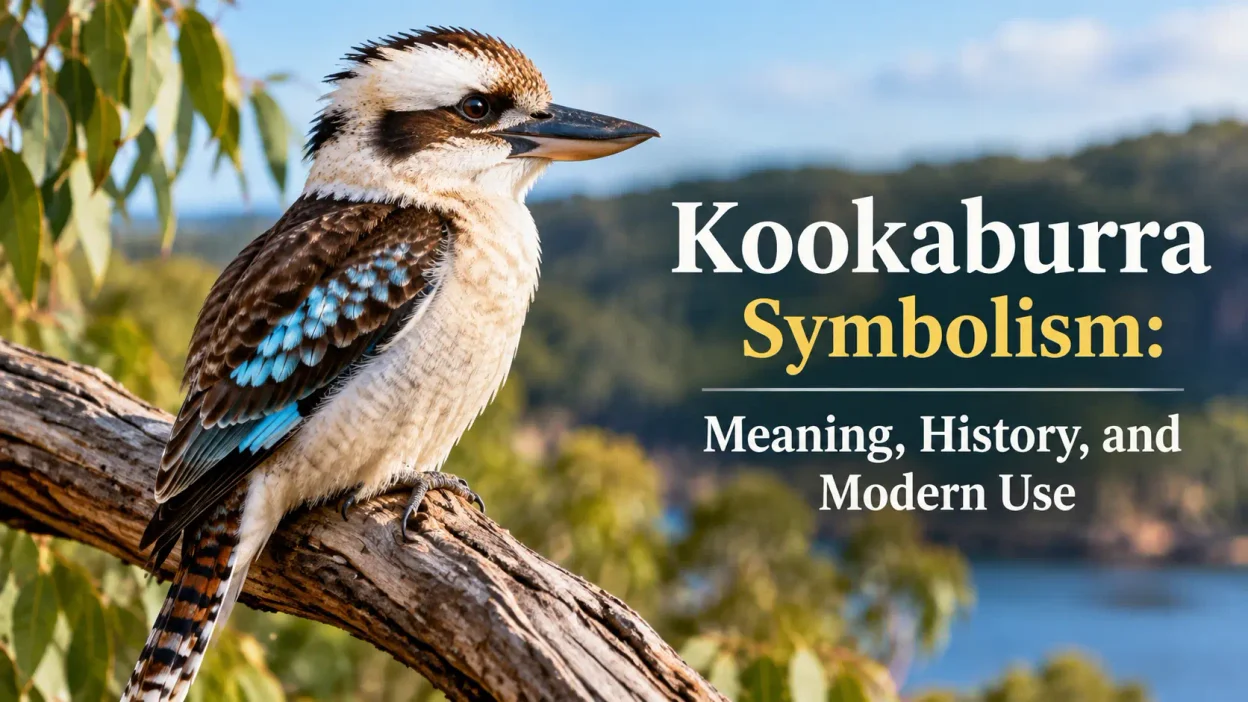
Kookaburra symbolism often centers on laughter, communication, family connections, and the ability to find joy in everyday life. Famous for its distinctive call, the kookaburra is an Australian bird that has become a recognizable symbol of the country’s wildlife and natural identity. For American readers, its unusual sound and expressive appearance can make it a memorable symbol of happiness, humor, and connection with nature.
The best-known species, the laughing kookaburra, is a large member of the kingfisher family. Its loud, cackling call can sound like a group of people laughing together, especially when several birds call in chorus. Although the sound resembles human laughter, it serves important biological purposes, including territorial communication.
The bird also carries cultural significance in Australia, including within particular Aboriginal communities whose traditions connect birds with family, identity, land, and storytelling. Understanding these traditions requires care because Indigenous Australian cultures are diverse, and no single interpretation applies to every community.
Exploring kookaburra symbolism means looking beyond the bird’s cheerful reputation. Its behavior, place in Australian culture, and use in modern art all contribute to the different meanings people associate with it today.
Quick Answer
Kookaburra symbolism commonly represents laughter, joy, communication, and family connection in modern popular culture, especially through the bird’s distinctive call. In Australian cultural contexts, the kookaburra can also carry connections to Country, community, storytelling, and Indigenous identity, although these meanings vary between traditions.
TL;DR
- Kookaburras commonly symbolize laughter, humor, and the enjoyment of life.
- Their calls communicate territory and connect members of family groups.
- In Australia, kookaburras represent recognizable native wildlife and national identity.
- Some Aboriginal communities connect kookaburras with totems, kinship, and cultural stories.
- Modern tattoos and artwork use the bird to express joy and belonging.
- Spiritual interpretations are personal unless supported by a specific cultural tradition.
What a Kookaburra Looks Like and Why It Stands Out
The kookaburra is a stout bird with a large head, strong bill, brown-and-white plumage, and a distinctive dark stripe across its face. The laughing kookaburra also has barred wings and tail feathers, with blue markings visible in parts of its plumage. Its appearance is recognizable, but its voice is what most often captures people’s attention.
Native to eastern Australia, the laughing kookaburra lives in forests, open woodlands, parks, gardens, and other places with suitable trees. It often perches quietly on a branch or fence before swooping down to catch prey. Its diet includes insects, reptiles, and small animals, making it an active predator rather than simply a cheerful woodland bird.
The name “laughing kookaburra” comes from its familiar vocalization. When several birds join the call, the resulting sound can resemble a noisy conversation or burst of laughter.
That combination of a distinctive face and an apparently joyful voice helps explain why the bird has become such an effective symbol. It is easy to recognize, easy to remember, and closely associated with the sounds of the Australian landscape.
The Main Symbolic Meanings of the Kookaburra
The kookaburra does not have one universal symbolic meaning. Instead, its best-known associations arise from its behavior, appearance, cultural setting, and the stories people tell about it.
Laughter and joy are its most familiar associations. Its cackling call sounds playful to many listeners, making it a natural image for humor, optimism, and a lighter approach to life’s difficulties.
Communication and expression form another important theme. Kookaburras use vocal calls to communicate with other birds and establish territory. Symbolically, their voices can represent speaking clearly, expressing emotions, or making oneself heard.
Family and belonging also fit the bird’s behavior. Laughing kookaburras commonly live in family groups, and younger birds may help their parents raise later broods. This cooperative behavior offers a concrete basis for interpreting the bird as a symbol of mutual support.
Connection with nature is especially relevant in Australian settings. Hearing a kookaburra can immediately evoke bushland, trees, and familiar outdoor environments.
These associations are useful starting points, but they should not be treated as a fixed spiritual code. A kookaburra may represent humor to one person, family loyalty to another, and a cherished memory of Australia to someone living overseas.
Why the Kookaburra’s Laugh Is Symbolically Important
The kookaburra’s call is the main reason people associate it with happiness and laughter. Its vocalization rises and falls in a way that resembles human amusement, and neighboring birds may join in until the sound becomes a chorus.
In nature, however, the call is not simply an expression of happiness. Laughing kookaburras use it to advertise territorial boundaries and communicate with other members of their group. Understanding this difference makes the symbolism more interesting: an action that sounds joyful to humans has a practical purpose for the bird.
This contrast can inspire several modern interpretations. The kookaburra can represent the difference between appearances and reality, the importance of communication, or the way one person’s expression can influence a larger group.
Its call may also remind listeners that joy does not always need to be deliberate or carefully planned. Sometimes an ordinary sound, a shared joke, or a familiar voice can change the atmosphere of a place.
For someone who encounters a kookaburra during a walk or hears its call in a recording, the experience may become associated with a particular memory. The symbolism grows from that personal connection rather than from a guaranteed supernatural message.
Kookaburra Symbolism in Aboriginal Australian Cultures
Kookaburras are native Australian birds, and their cultural significance predates modern tourism, national branding, and popular children’s songs. For some Aboriginal communities, birds form part of cultural systems involving kinship, totems, stories, knowledge, and relationships with Country.
Country, in many Aboriginal Australian contexts, means more than a physical landscape. It can encompass connections among land, waters, living beings, ancestors, community, responsibility, and cultural knowledge.
Some Aboriginal people identify particular birds as totems or kin. In these contexts, a bird’s significance may involve personal or family relationships and obligations, rather than merely serving as a decorative symbol.
The details differ between communities. A story, name, or ceremonial relationship belonging to one language group should not automatically be attributed to another.
It is also important to recognize that Indigenous knowledge is not simply a collection of public myths available for general interpretation. Some stories are specific to particular communities, families, or cultural circumstances. Respectful discussion should follow the context in which that knowledge has been shared.
For American readers, the key distinction is that Aboriginal Australian kookaburra traditions are living cultural practices, not just historical curiosities. Their meaning cannot be reduced to the bird’s familiar reputation for laughter.
Kookaburras, Totems, and Family Connections
The relationship between kookaburras and family is particularly visible in both their behavior and some Aboriginal cultural traditions.
Laughing kookaburras often form family groups in which older offspring help parents care for younger birds. This cooperative breeding behavior provides a real-world basis for associations with responsibility, support, and belonging.
In certain Aboriginal communities, a kookaburra may also be recognized as a totem connected with an individual or family. Such a relationship can carry cultural responsibilities and a sense of connection with other living beings.
These two ideas should remain distinct. Cooperative bird behavior can inspire a general interpretation of family loyalty, but a specific Indigenous totemic relationship has its own cultural meaning and cannot be explained solely through animal behavior.
For modern audiences, the family theme can make the kookaburra meaningful in artwork celebrating parents, siblings, children, or close friends. It can represent the idea that belonging involves more than simply living together: members of a group may also help protect and support one another.
The Kookaburra as a Symbol of Australia
In Australia, the laughing kookaburra is one of the country’s most recognizable birds. Its call is closely associated with the sounds of Australian bushland, and its image appears in educational materials, souvenirs, children’s entertainment, and wildlife photography.
Unlike an animal that represents a single region or historical event, the kookaburra is familiar to many Australians through everyday encounters. It may be heard from a garden tree, seen on a fence, or noticed during a visit to a national park.
This familiarity gives the bird a cultural role beyond its biological identity. It can evoke home, outdoor life, childhood memories, and the distinctive character of the Australian landscape.
The kookaburra is not an official national emblem in the same way as Australia’s national coat of arms, but it remains a widely recognizable part of Australian wildlife imagery.
For Americans, the bird can function much like a familiar native bird associated with a particular landscape. Its meaning may come from national identity, but it can also evoke memories of travel, wildlife documentaries, zoos, or Australian literature.
What Kookaburra Symbolism Means in the United States
The kookaburra is not native to the United States, so most Americans encounter it through media, educational settings, wildlife collections, or travel. Its symbolism in the U.S. is therefore shaped largely by its reputation and appearance rather than by everyday contact with wild populations.
The most common American interpretation is likely to center on laughter and cheerfulness. Children’s songs, animated characters, and educational illustrations often present the bird as playful or amusing.
A kookaburra image can also signal an interest in Australia, especially when paired with eucalyptus trees, Australian landscapes, or other native animals. In this context, the bird serves as a visual reminder of a place and its distinctive wildlife.
For people interested in birdwatching or conservation, it may represent curiosity about species from other parts of the world. For someone with Australian family ties, it could carry a more personal connection to home or heritage.
There is no established American tradition assigning the kookaburra a universal spiritual meaning. Interpretations such as good luck, new beginnings, or emotional healing are better understood as contemporary personal associations unless a specific tradition provides evidence for them.
Kookaburra Symbolism Across Different Contexts
| Context | Common symbolic association | Why it fits |
|---|---|---|
| Laughter and humor | Joy and lightheartedness | The bird’s call resembles human laughter |
| Family life | Loyalty and mutual support | Family members may help raise young birds |
| Australian identity | Home and native wildlife | The kookaburra is a recognizable Australian species |
| Aboriginal cultural contexts | Kinship, totems, and connection with Country | Meanings depend on particular community traditions |
| Modern artwork | Expression and connection with nature | Artists draw on the bird’s appearance and behavior |
| Personal spiritual interpretation | Awareness or a reminder to find joy | These meanings depend on individual beliefs |
The table summarizes common interpretations, not a universal set of meanings shared by every culture or individual.
Emotional and Psychological Meaning of the Kookaburra
The kookaburra’s sound can influence how people feel about an environment. A call that resembles laughter may seem welcoming, amusing, or surprising, particularly to someone hearing it for the first time.
Its symbolism often involves the relationship between mood and perception. A person who associates the bird with childhood memories may experience its call as comforting, while someone encountering it in a wildlife documentary may mainly feel curiosity.
The bird can also serve as a reminder of social connection. Because its calls are often heard in groups, people may associate it with conversation, shared humor, and the feeling of being part of a community.
These interpretations are possibilities, not psychological rules. Seeing a kookaburra does not prove that a person needs more happiness or that a particular emotional change is coming.
A more grounded understanding recognizes that symbols can help people describe their experiences. The kookaburra offers a familiar image through which someone might express a desire for more laughter, stronger relationships, or a closer connection with nature.
Kookaburra Symbolism in Tattoos, Jewelry, and Home Decor
Modern kookaburra designs often emphasize the bird’s recognizable face, strong bill, and expressive pose. Some feature a bird with its beak open, suggesting the famous call, while others show it perched quietly on a branch.
A kookaburra tattoo may represent humor, optimism, Australian heritage, or a meaningful memory of a particular place. Someone who grew up in Australia might choose it as a reminder of home, while a bird enthusiast might use it to celebrate wildlife.
Jewelry and decorative artwork often focus on the bird’s distinctive silhouette. A small pendant can express a personal interest in Australian wildlife without making a specific spiritual claim.
In home decor, kookaburra images can suit nature-inspired rooms, travel collections, children’s spaces, and Australian-themed designs. Their visual character makes them recognizable even when viewers do not know much about their cultural background.
When the bird is used in a design inspired by Aboriginal Australian art, cultural context matters. Traditional visual styles and community-specific motifs should not be copied casually or presented as generic decoration. A contemporary wildlife illustration can celebrate the kookaburra without claiming to represent Indigenous cultural knowledge.
Is Seeing a Kookaburra Considered a Sign or Omen?
Some people interpret encounters with birds as personally meaningful events. Seeing a kookaburra at a memorable moment might feel like a reminder to laugh, reconnect with family, or pay attention to the natural world.
These experiences can be meaningful without proving that the bird predicts an event. There is no universal, historically established rule that seeing a kookaburra guarantees good luck, financial success, a new relationship, or protection from harm.
The circumstances of an encounter often shape its personal significance. Someone grieving a loved one might associate the bird with a happy memory, while another person may see it as an invitation to spend more time outdoors.
It is also important not to assume that every Indigenous Australian tradition treats a kookaburra encounter as an omen. Specific beliefs about birds, messages, and spiritual relationships vary among communities and should be understood within their proper cultural settings.
A balanced interpretation allows room for personal reflection while distinguishing an individual’s belief from a documented cultural teaching or a verifiable prediction.
Common Misunderstandings About Kookaburra Symbolism
One common misunderstanding is that kookaburras literally laugh because they are happy. Their familiar call serves communication and territorial functions, even though it sounds humorous to human listeners.
Another mistake is to assume that all kookaburra symbolism comes from Aboriginal Australian traditions. Some associations do arise within particular Indigenous cultural contexts, but many popular meanings, including lightheartedness and national identity, have developed through everyday observation and modern media.
It is equally inaccurate to treat every Aboriginal community as having the same kookaburra stories or beliefs. Australia contains many distinct Aboriginal nations, language groups, and cultural traditions. A claim about one community should not automatically be generalized to all others.
Modern spiritual content may also describe kookaburras as universal messengers of good luck, healing, or transformation. Such meanings can be personally meaningful, but they should not be presented as established historical facts without specific supporting evidence.
Finally, a kookaburra’s reputation for cheerfulness does not mean the bird represents happiness in every context. Its symbolism depends on the setting, the person’s experience, and the cultural tradition being discussed.
How Kookaburra Symbolism Has Changed Over Time
The kookaburra’s significance has developed through relationships between people, wildlife, storytelling, and modern media.
For Aboriginal communities, cultural relationships with birds belong to living traditions that long predate European settlement. Their meanings cannot be understood simply as an earlier stage of the modern popular image.
During the development of modern Australian national identity, the kookaburra became increasingly familiar through public imagery, children’s entertainment, and representations of native wildlife. Its distinctive call made it particularly effective in songs and stories designed to evoke the Australian landscape.
Outside Australia, the bird became recognizable through recordings, wildlife programs, zoos, books, and international popular culture. For many Americans, the call itself is the main source of recognition.
Today, social media and personal artwork add further layers of meaning. A kookaburra may be used to express humor, appreciation for biodiversity, cultural identity, or a private memory.
This evolution shows how an animal can acquire new interpretations without losing its original biological and cultural context. Understanding those layers makes the symbol more meaningful and prevents modern assumptions from being mistaken for ancient beliefs.
Frequently Asked Questions
What does a kookaburra symbolize spiritually?
A kookaburra may symbolize joy, communication, family connection, or awareness of nature in contemporary spiritual interpretations. These meanings are personal or tradition-specific rather than universal spiritual rules.
Is the kookaburra a symbol of good luck?
Some people may associate a kookaburra encounter with a positive moment or a welcome reminder to enjoy life. However, there is no universal historical basis for claiming that seeing one guarantees good luck.
What does it mean when a kookaburra laughs?
Its familiar call is primarily a form of communication used to establish territory and interact with other birds. People often interpret the sound as a symbol of happiness because it resembles human laughter.
What does a kookaburra tattoo represent?
A kookaburra tattoo can represent humor, Australian identity, family bonds, or a love of wildlife. Its meaning depends on the wearer’s personal connection and the other elements included in the design.
What is the kookaburra’s significance in Aboriginal Australian culture?
In some Aboriginal communities, kookaburras are connected with totems, kinship, storytelling, and relationships with Country. The precise meaning varies between communities, so it is important not to treat all Aboriginal traditions as interchangeable.
Does the kookaburra symbolize family?
Family is a reasonable association because laughing kookaburras live in social groups and older offspring may help parents raise younger birds. People may use the bird to represent cooperation, responsibility, and belonging.
Is the kookaburra a symbol of Australia?
Yes, the kookaburra is a widely recognized symbol of Australian wildlife and the sounds of the bush. Although it is not an official national emblem, it appears frequently in popular culture, education, and wildlife imagery.
Conclusion
Kookaburra symbolism brings together laughter, communication, family relationships, and connection with the natural world. The bird’s distinctive call explains its cheerful reputation, while its cooperative family behavior offers a practical basis for associations with belonging and mutual support. In particular Aboriginal Australian traditions, kookaburras may carry additional cultural meanings that deserve to be understood within their specific community contexts.
For modern American readers, the kookaburra can represent humor, Australian heritage, wildlife appreciation, or a personal reminder to value everyday moments. Its meaning is most useful when personal interpretation is balanced with accurate knowledge of the bird and respect for the cultures connected to it. Sometimes, the best place to begin understanding a symbol is simply by listening carefully to the living creature behind it.